


Every options trader learns delta first, and most stop there. Delta tells you how much an option moves when the underlying moves a dollar. But delta is a snapshot, not a constant. The moment price moves, your delta is already wrong. The gamma option greek is the number that governs how fast that happens, and it is the single most underestimated risk on any short-dated book. Ignore it and a position you thought was neutral can turn sharply directional in minutes, often at the worst possible time.
This guide breaks down what gamma actually measures, how it interacts with delta, where it concentrates, and how it should change the way you size and manage trades, especially on same-day expirations.
What the Gamma Option Greek Actually Measures
Gamma measures the rate of change of delta. If delta is speed, gamma is acceleration. A call with a delta of 0.50 and a gamma of 0.05 will have a delta of roughly 0.55 after the underlying rises one point, and 0.45 after it falls one point. Delta moved; gamma told you how much.
That makes gamma a second-order greek. Delta, its sibling greek, answers “what is my exposure right now?” Gamma answers “how violently will that exposure change as price moves?” On a position you intend to hold for hours rather than seconds, the second question matters more than the first.
Gamma is always positive for long options, whether calls or puts. When you own an option, every move in your favor speeds up; every move against you slows down. That convexity is the entire reason long premium feels good when it works. The catch is that you pay for it through time decay every day you hold it.

The Relationship Between Delta and Gamma
Delta and gamma are inseparable. You cannot manage one without watching the other. A long at-the-money straddle, for example, opens with near-zero net delta. It looks directionless. But it carries enormous gamma, which means the first real move in either direction hands you a fast-growing directional position whether you wanted one or not.
This is why “delta-neutral” is a description of a single instant, not a stable state. High gamma erodes neutrality the moment the tape moves. A market maker running a delta-neutral book has to re-hedge constantly precisely because gamma keeps pushing their delta away from zero. The higher the gamma, the more often they trade to stay flat.
For a retail trader, the practical takeaway is simple: a small delta with large gamma is not a small position. It is a large position waiting for a catalyst. If you size off delta alone, you will be repeatedly surprised by how quickly a “balanced” trade becomes a one-sided bet.
Where Gamma Peaks: Strike, Time, and Volatility
Gamma is not distributed evenly. Three forces concentrate it:
- Moneyness. Gamma is highest at the money and falls off as you move toward deep in- or out-of-the-money strikes. Far OTM options barely respond to small moves, so their delta changes slowly and their gamma is tiny.
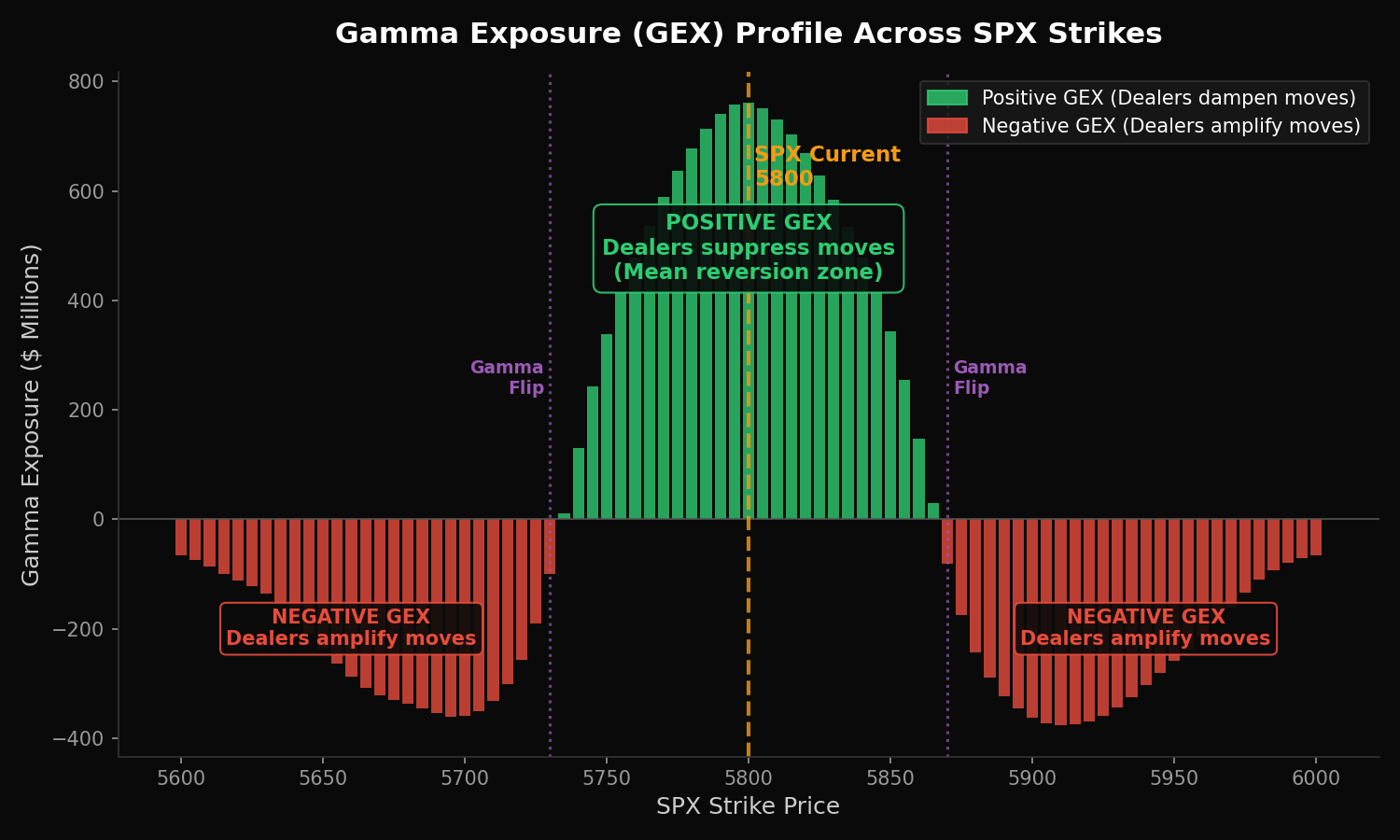
- Time to expiration. Gamma rises sharply as expiration approaches for at-the-money options. A 30-day option has its gamma spread across a wide price range; a same-day option crams it into a razor-thin band around the strike.
- Implied volatility. Lower implied volatility concentrates gamma near the money, because the market is pricing a narrow expected range. Higher implied volatility spreads gamma across more strikes.
The Options Clearing Corporation’s education arm publishes free greek calculators that let you see this curve shift in real time as you change inputs — worth running a few scenarios on optionseducation.org before you trade a short-dated strike.
Why Gamma Explodes on 0DTE
Same-day expiration is where gamma stops being an abstraction. With hours left on the clock, an at-the-money SPX option has almost all of its remaining value tied to whether it finishes a few points in or out of the money. Delta can swing from 0.30 to 0.70 on a handful of points. That is enormous gamma compressed into a tiny window.
This is the structural reason same-day expiration trades feel so different from monthly positions. A 0DTE butterfly or short spread can sit quietly all morning and then move its entire P&L in the final hour as gamma peaks. The position did not change. The clock did.
It also explains why so many 0DTE traders get hurt selling “cheap” options near the money. The premium is small because there is little time left, but the gamma is violent. A two-point move against a short at-the-money strike late in the day can multiply the loss far faster than the collected credit suggests. The contract specifications published by Cboe for SPX index options matter here too: cash settlement and the 100x multiplier mean that gamma-driven swings translate directly into large dollar moves per contract.
Long Gamma vs Short Gamma: Two Opposite Worlds
Whether you are long or short gamma decides how the market treats you on a volatile day.
Long gamma (you own options) means moves help you. Your winners accelerate and your losers decelerate. The cost is theta: you bleed premium every day the market sits still. Long gamma wants movement, the bigger and faster the better.
Short gamma (you sold options) means moves hurt you. Your delta gets worse in the direction of the move — you get longer as the market falls and shorter as it rallies, exactly the wrong way around. The reward is that you collect theta while nothing happens. Short gamma wants stillness and punishes surprise.
Most income strategies — credit spreads, iron condors, naked premium selling — are short gamma trades. They win slowly and lose quickly. Understanding that asymmetry is the difference between a sustainable selling program and an account that gives back months of gains in a single session. The same dynamic at the dealer level is what drives market-wide negative gamma conditions, which we cover next.
Trading the Gamma Option Greek Without Getting Run Over
Knowing the theory is useless if it does not change your behavior at the order entry screen. A few rules that follow directly from the gamma option greek:
- Size short-dated positions smaller. The same notional exposure carries far more gamma at one day to expiration than at thirty. If your monthly size feels safe, your 0DTE size at the same contract count is not.
- Respect the at-the-money zone. Selling strikes right at the money maximizes the credit and the gamma risk simultaneously. Moving even a little OTM dramatically reduces how fast the trade can turn against you.
- Plan exits before gamma peaks. If you are short premium into the final hour, decide your stop in advance. Gamma will not give you time to think once price approaches your strike.
- Use defined-risk structures. A spread caps the gamma damage in a way a naked short never can. The wing is not just a margin saver; it is a brake on accelerating losses.
None of this means avoiding gamma. Long-gamma trades are precisely how you profit from explosive moves. The point is to know which side of gamma you are on, and to size for the acceleration rather than the snapshot.
Gamma at the Dealer Level: Why It Moves the Whole Market
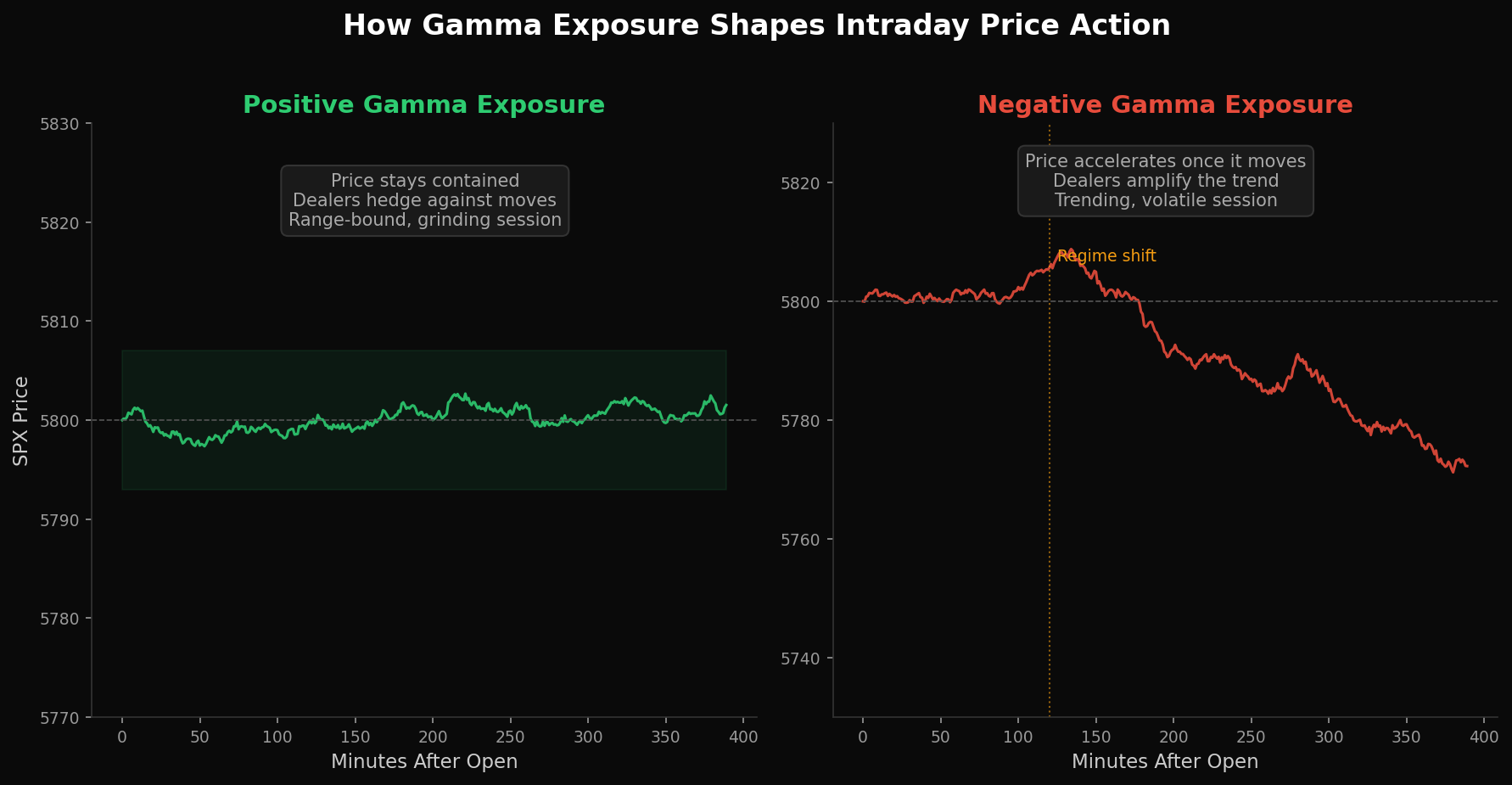
Gamma is not just a position-level greek. Aggregated across all dealers who have sold options to the public, it shapes how the entire index behaves intraday. When dealers are net long gamma, they hedge by selling rallies and buying dips, which dampens volatility and pins price. When they are net short gamma, they must buy rallies and sell dips, which amplifies moves and can turn an ordinary pullback into an air pocket.
This is the mechanism behind aggregate gamma exposure as a market signal, and it is also why professional desks practice gamma scalping — harvesting the re-hedging flow that gamma forces. You do not need to run a dealer book to use the insight: knowing whether the market is in a positive- or negative-gamma regime tells you whether to expect mean reversion or momentum on any given day.
Common Mistakes With Gamma
Three errors show up over and over:
First, sizing off delta and ignoring gamma. A position can look small and behave large. Always ask how fast the delta can change, not just where it sits now.
Second, selling near-the-money options late in the day for the credit. The premium is small because the option is about to expire, but the gamma is at its maximum. The risk-reward is far worse than the credit implies.
Third, treating “delta-neutral” as a finished trade. Neutrality with high gamma lasts exactly until the next tick. If you opened it neutral, you have to keep managing it, or accept that the market will pick a direction for you.
Frequently Asked Questions
What does the gamma option greek measure?
Gamma measures the rate of change of delta. If the underlying moves one point, gamma tells you how much your delta will increase or decrease. It is a second-order greek — delta is speed, gamma is acceleration.
Is gamma always positive?
Gamma is positive for any long option, call or put. It becomes negative from the perspective of a seller: if you are short options, you are short gamma, which means moves work against you in both directions.
Why is gamma so high on 0DTE options?
As expiration approaches, an at-the-money option’s value depends almost entirely on whether it finishes a few points in or out of the money. That compresses a large delta change into a tiny price range, producing very high gamma in the final hours of trading.
How is gamma different from delta?
Delta tells you your directional exposure right now. Gamma tells you how quickly that exposure will change as the underlying moves. A small delta paired with large gamma is a position that can become strongly directional very fast.
Should I be long or short gamma?
It depends on your view. Long gamma profits from large, fast moves but pays time decay. Short gamma collects time decay but loses quickly when the market moves. Income strategies are typically short gamma; volatility strategies are typically long gamma.
The Bottom Line
Delta tells you where you stand. The gamma option greek tells you how fast the ground is moving under you. On longer-dated trades it is a manageable background force; on same-day expirations it is the dominant risk, capable of turning a quiet position into a violent one in a single move. Size for the acceleration, respect the at-the-money zone, and always know which side of gamma you are trading. To put gamma in context with the other greeks, start with the complete greeks framework and build from there.
Want to see how professional traders read gamma and the rest of the SPX options chain in real time? FatTail teaches the structural approach to 0DTE trading through live sessions and a community of serious options traders.
FATTAIL BRIEFINGS
Get FatTail briefings in your inbox
Pick the lists you want. FOMC Alerts is selected by default.