


Most traders learn how to put on an iron condor. They learn the structure — sell a call spread above the market, sell a put spread below, collect credit on both sides. What they do not learn is what to do when it stops working. And it will stop working. Every iron condor faces a moment where price moves toward one of the short strikes and the trade turns from comfortable to painful — and that is where iron condor adjustments become the entire game.
Iron condor adjustments are the difference between a managed position and a blowup. The entry is the easy part. The adjustment is where the strategy lives or dies. Most iron condor education skips this entirely — they teach you the setup and show you the profit zone, then leave you on your own when price leaves that zone. This guide covers when to adjust, how to adjust, when to close, and when to walk away.
Why Iron Condor Adjustments Matter More Than Entry
An iron condor wins when price stays between your short strikes. After all, the profit zone is defined before entry. The problem is that price does not care about your profit zone. Markets trend. Catalysts hit. Volatility expands. And when price approaches your short strike, the comfortable trade becomes a decision point.
Without a plan for iron condor adjustments, here is what happens: the trader watches the position go from profitable to break-even to losing. They hope price reverses. It does not. The loss exceeds the original credit collected. They close at maximum loss or close to it — then vow to never trade iron condors again. The strategy was not the problem. The absence of an adjustment framework was.
The math is simple. A typical iron condor collects $100-$200 in credit on a $500-wide structure. Maximum loss is $300-$400. You need to win three to four trades for every one you lose at maximum loss just to break even. If you can reduce your losses on the bad trades through adjustments — cutting a $400 loss to $150 — the math shifts in your favor. Iron condor adjustments are not optional. They are the strategy.
When to Adjust: The Decision Framework
Not every iron condor needs adjusting. In fact, some expire safely within the profit zone. The adjustment decision depends on three variables: how close price is to your short strike, how much time remains, and what the structural environment is doing.
Delta on the tested short strike. When your short option’s delta reaches 0.30-0.35, the market is pricing a 30-35% probability of that strike being breached. This is the standard adjustment trigger. Below 0.25, the position is comfortable. Above 0.40, you are already late.
Time remaining. With 21+ days to expiration, price has room to reverse. An iron condor with 30 DTE and a tested short strike at 0.30 delta is uncomfortable but manageable. The same position with 5 DTE is an emergency — gamma is accelerating and small moves in the underlying create large changes in the option price. Iron condor adjustments are cheaper and more effective with more time remaining.
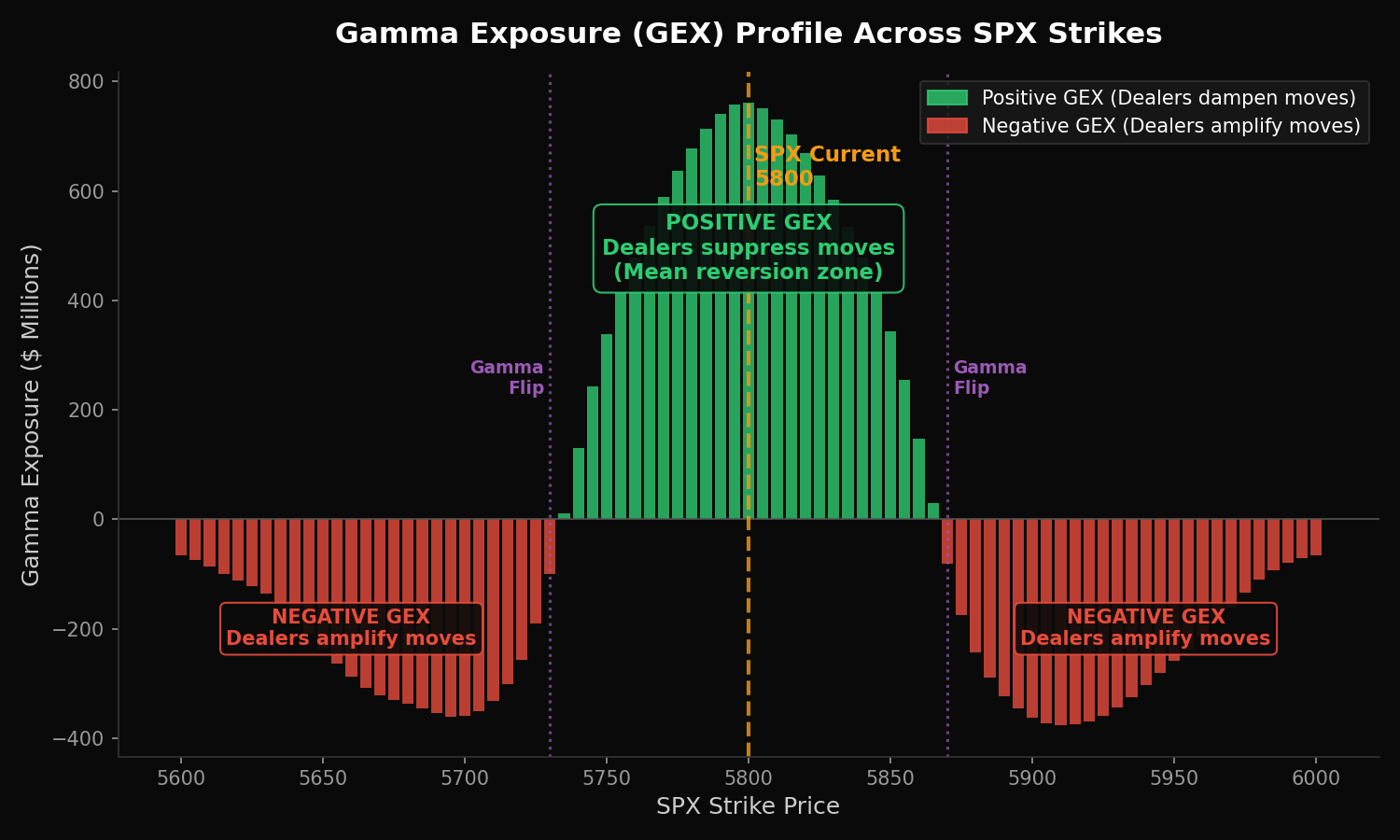
Structural context. This is what separates systematic adjustment from panic. If GEX is positive, dealer hedging is dampening moves and the session favors mean reversion — your tested strike may hold. If GEX is negative, dealers are amplifying moves and a test of your strike is more likely to become a breach. The expected move tells you whether price has room to reach your short strike within the session. Without this context, every adjustment decision is a guess.
The Four Core Iron Condor Adjustments
There are four primary ways to manage a tested iron condor. Each has tradeoffs. None is universally correct. The right adjustment depends on the specific situation.
1. Rolling the Untested Side
When one side is tested, the other side has decayed significantly. You can buy back the untested spread for a small debit and re-sell it closer to the current price — collecting additional credit. This widens your profit zone in the direction of the move while adding credit that offsets potential losses.
The risk is that price reverses after you roll. Now your rolled side is closer to the money and the original tested side is safe. In other words, you have shifted your exposure, not eliminated it. Rolling works best when the move is gradual and implied volatility is stable. In a sharp trending move, rolling the untested side just chases price.
2. Closing the Tested Side Early
Sometimes the simplest adjustment is to buy back the tested spread before it reaches maximum loss. If you collected $150 in total credit and can close the tested side for a $200 loss, your net loss is $50 — far better than the $350 maximum. You keep the untested side open to collect the remaining premium.
Of course, this requires accepting a loss on half the position while the overall trade is still recoverable. Most traders resist this because it feels like admitting defeat. However, the math is clear: a $50 net loss versus a potential $350 maximum loss is not a difficult decision. It only feels difficult because of ego.
3. Converting to a Different Structure
A tested iron condor can be converted into a butterfly spread by adjusting the strikes. If your call side is tested, you can close the put spread and reposition the call strikes to create a butterfly centered near the current price. This changes the trade from a range-bound bet to a convergence bet with defined risk.
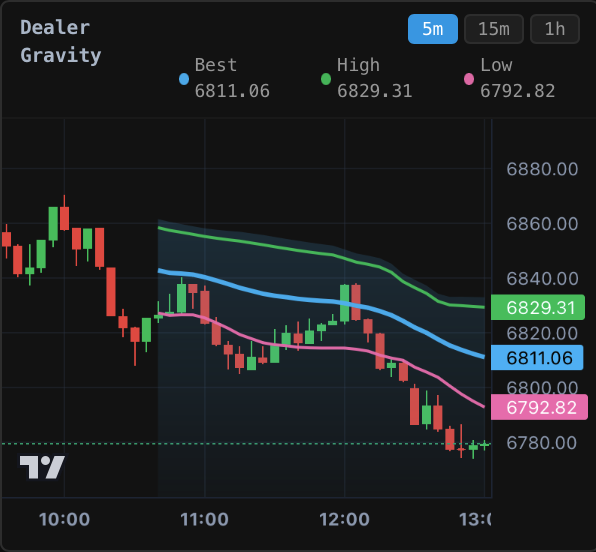
This adjustment works best when you have structural reason to believe price will consolidate — for example, when dealer positioning shows a gravity level near the current price. Converting to a butterfly is not a defensive move. It is a strategic repositioning based on what the market structure is telling you.
4. Closing the Entire Position
Sometimes the best adjustment is no adjustment — just close the trade. If the structural environment has changed, if a catalyst has created a sustained directional move, if the VIX regime has shifted from compression to expansion — the original thesis is invalidated. Ultimately, no amount of rolling or restructuring fixes a thesis that no longer applies.
Closing at a loss is not failure. It is risk management. The iron condor is a defined-risk structure, but defined risk only works if you honor the exit. Traders who hold through maximum loss because they refuse to close are not managing risk. They are avoiding reality.
What Most Traders Get Wrong With Adjustments
Adjusting too late. Waiting until the short strike is in the money before acting. At that point, the adjustment is expensive and the damage is done. In practice, iron condor adjustments work best when the short strike delta reaches 0.30-0.35 — before the position is in crisis, not after.
Adjusting without structural context. Rolling the untested side because price moved 1% is reactive, not informed. The question is not whether price moved — it is whether the structural environment supports further movement in that direction. A 1% move into positive GEX is different from a 1% move into negative GEX. The adjustment should match the structural read.
Turning a loss into a bigger loss. Some traders adjust by adding more risk — widening spreads, selling more premium, doubling down on the tested side. This is not an adjustment. It is averaging into a loser. Every legitimate iron condor adjustment either reduces risk, repositions exposure, or exits the trade. None increases risk.
Never adjusting at all. The opposite extreme. Some traders set the iron condor and refuse to touch it — treating it as a passive income structure that manages itself. An iron condor is not passive income. It is an active position that requires monitoring and management. The traders who treat it as set-and-forget are the ones who take maximum losses repeatedly.
The daily pre-market analysis in Observer ($17/week) gives you the structural context to make informed adjustment decisions — GEX profile, expected move, and VIX regime before every session. Activator ($97/month) adds real-time tools and weekly coaching for active position management. Navigator ($267/month) provides daily direct coaching with Ernie. Compare all plans here.
The Structural Alternative to Iron Condor Adjustments
Here is the question nobody asks: why are you adjusting an iron condor instead of placing a structure that does not need adjusting?
The iron condor requires adjustments because it is a range-bound bet on an uncertain range. You are guessing that price stays between two strikes. When it does not, you scramble to fix the position. The entire adjustment framework exists because the original trade has a structural flaw — it profits from the absence of movement, but markets move.
A butterfly spread approaches the problem differently. Instead of betting on a range and adjusting when it fails, the butterfly targets a specific level informed by dealer positioning data. The risk is defined at entry — $30-$100. The target is $500-$2,500. There is no adjustment needed because the trade either works or it does not, and the cost of being wrong is small.
The iron condor: risk $300-$400 to collect $100-$200. Adjust when tested. Roll. Restructure. Manage. Monitor. Hope.
The butterfly: risk $30-$100 to target $500-$2,500. Place it at the structural target. It works or it does not. Move on.
Same market. Same SPX options. One requires a complex adjustment framework. The other requires reading the GEX landscape and placing the trade at the level the data identifies. That is the structural approach — and it is what Observer ($17/week), Activator ($97/month), and Navigator ($267/month) deliver. Compare all plans here.
Frequently Asked Questions
When should you adjust an iron condor?
Adjust when the delta on your tested short strike reaches 0.30-0.35, which indicates the market is pricing a meaningful probability of that strike being breached. Also consider the structural context — if GEX is negative and the expected move supports further directional movement, adjust earlier. With less than 7 days to expiration, gamma acceleration makes adjustments less effective and closing may be the better choice.
What is the best iron condor adjustment?
There is no single best adjustment. Rolling the untested side works in gradual moves with stable volatility. Closing the tested side early works when the loss is still manageable. Converting to a butterfly works when structural data supports price consolidation at a specific level. Closing the entire position works when the original thesis is invalidated. The right adjustment depends on time remaining, structural context, and how much of the original credit remains.
How do you avoid losing money on iron condors?
You do not avoid losses — you manage them. The key is deploying iron condors only when the structural environment favors range-bound behavior — positive GEX, compressed expected move, low VIX regime. Then have a predetermined adjustment plan before entry: at what delta do you act, what adjustment do you use, and at what point do you close. This framework limits losses on the trades that go wrong.
Should you let an iron condor expire or close early?
Close early in most cases. Holding through expiration exposes you to gamma risk — small price moves create large P&L swings in the final days. If the iron condor has captured 50-70% of maximum profit with more than a week remaining, closing locks in the gain and frees capital for the next opportunity. The remaining 30-50% of potential profit is rarely worth the tail risk of holding.
Are iron condors better than butterfly spreads?
Iron condors and butterflies serve different purposes. Iron condors profit from range-bound behavior with negative asymmetry — small wins, large potential losses. Butterflies profit from convergence to a specific price level with positive asymmetry — small risk, large potential reward. Structural traders prefer butterflies because the target is informed by dealer positioning data, while iron condors require guessing the range and adjusting when the guess is wrong.
FATTAIL BRIEFINGS
Get FatTail briefings in your inbox
Pick the lists you want. FOMC Alerts is selected by default.