


Last updated: April 2026
What Is an Iron Condor Options Strategy?
An iron condor is a four-leg options strategy that collects premium by selling an out-of-the-money call spread and an out-of-the-money put spread simultaneously. You are betting that price stays inside a range between your two short strikes until expiration. The structure:- Sell an OTM put — collect premium on the downside
- Buy a further OTM put — cap your downside risk
- Sell an OTM call — collect premium on the upside
- Buy a further OTM call — cap your upside risk
The Iron Condor Options Strategy Risk-to-Reward Problem
Here is a typical iron condor on SPX 0DTE:- Sell the 5750 put / Buy the 5740 put (10-wide put spread)
- Sell the 5850 call / Buy the 5860 call (10-wide call spread)
- Net credit received: $1.00 ($100 per contract)
- Maximum loss on either side: $9.00 ($900 per contract)
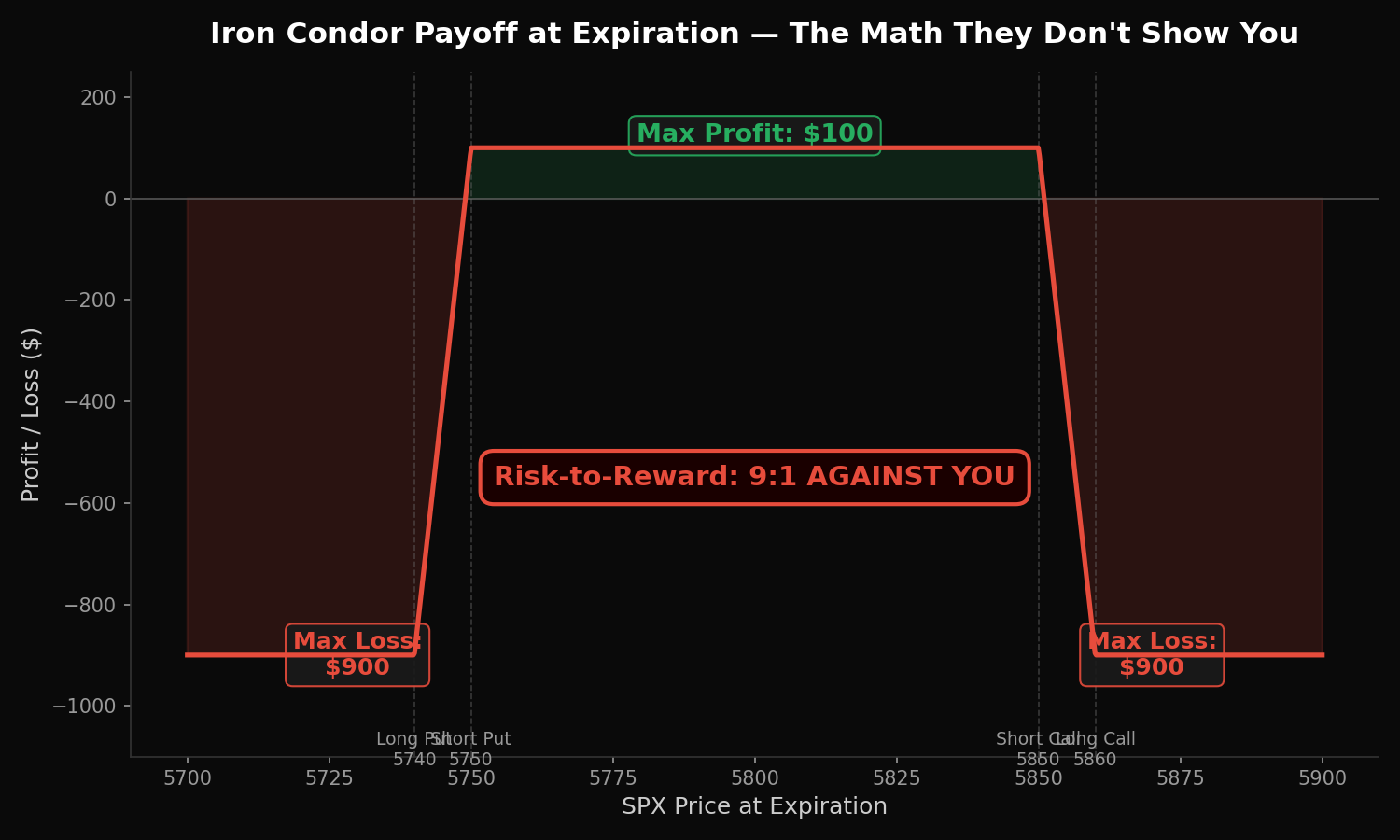 To break even over time with this iron condor options strategy, you need to win approximately 90% of your trades. Not 70%. Not 80%. Ninety percent. One loss wipes out nine winners. Two consecutive losses wipe out eighteen winners.
This is not a risk management problem you can solve with better entries. It is a structural deficiency built into the strategy itself. The iron condor options strategy rewards you with a small, frequent profit while exposing you to an infrequent but catastrophic loss. That is the textbook definition of negative skew — and negative skew compounds against you over time.
Why the Iron Condor Options Strategy Fails on 0DTE
The iron condor options strategy requires one thing above all else: a range-bound market. Price must stay between your short strikes for the entire session. On longer-dated options, this is plausible — you have weeks for the market to oscillate within a range and for theta to decay your short options. On same-day expiration contracts, three things work against the iron condor: Gamma is at its peak. On the final day of an option’s life, gamma — the rate at which delta changes — is at its maximum. Small price moves create large swings in option value. A 15-point SPX move that barely registers on a 30-day option can blow through an iron condor’s short strike in minutes on a 0DTE contract. The iron condor options strategy was designed for low-gamma environments. Same-day expiration is the highest-gamma environment that exists. Intraday regime shifts are common. Markets do not stay in one mode all day. A session that opens in a grinding, range-bound mode can shift to a trending mode after an economic release, a VIX spike, or a dealer gamma flip. The iron condor has no mechanism to adapt to this. Once price breaches a short strike, the loss accelerates toward maximum. There is no time to recover. On a 45-day iron condor, if price moves against you early, there are weeks remaining for it to come back. On a 0DTE iron condor, if price breaches your short strike at 11:00 AM, you have five hours of accelerating gamma working against you. The position does not recover. It deteriorates.Iron Condor vs Iron Butterfly — What Actually Changes
Some traders hear that iron condors are problematic and switch to iron butterflies, assuming the centered structure fixes the issue. It does not solve the core problem. An iron butterfly sells both the put and the call at the same strike (at the money) and buys wings on either side. Because the at-the-money options carry more premium, the credit collected is larger — but so is the risk if price moves away from the center. The key differences:- Iron butterfly — larger credit, narrower profit zone, maximum profit only if SPX settles exactly at the short strike. Higher probability of partial loss.
- Iron condor — smaller credit, wider profit zone, maximum profit if SPX settles anywhere between the short strikes. Lower win amount per trade.
The Butterfly Alternative — Inverted Risk-to-Reward
A standard butterfly spread inverts everything about the iron condor’s risk profile. Instead of collecting a small credit and risking a large loss, you pay a small debit and position for a large gain. A typical SPX 0DTE butterfly costs $0.40-$1.50 per contract ($40-$150) with a maximum return of $9.00-$10.00 per contract ($900-$1,000). That is a 9:1 favorable risk-to-reward ratio. The exact inverse of the iron condor.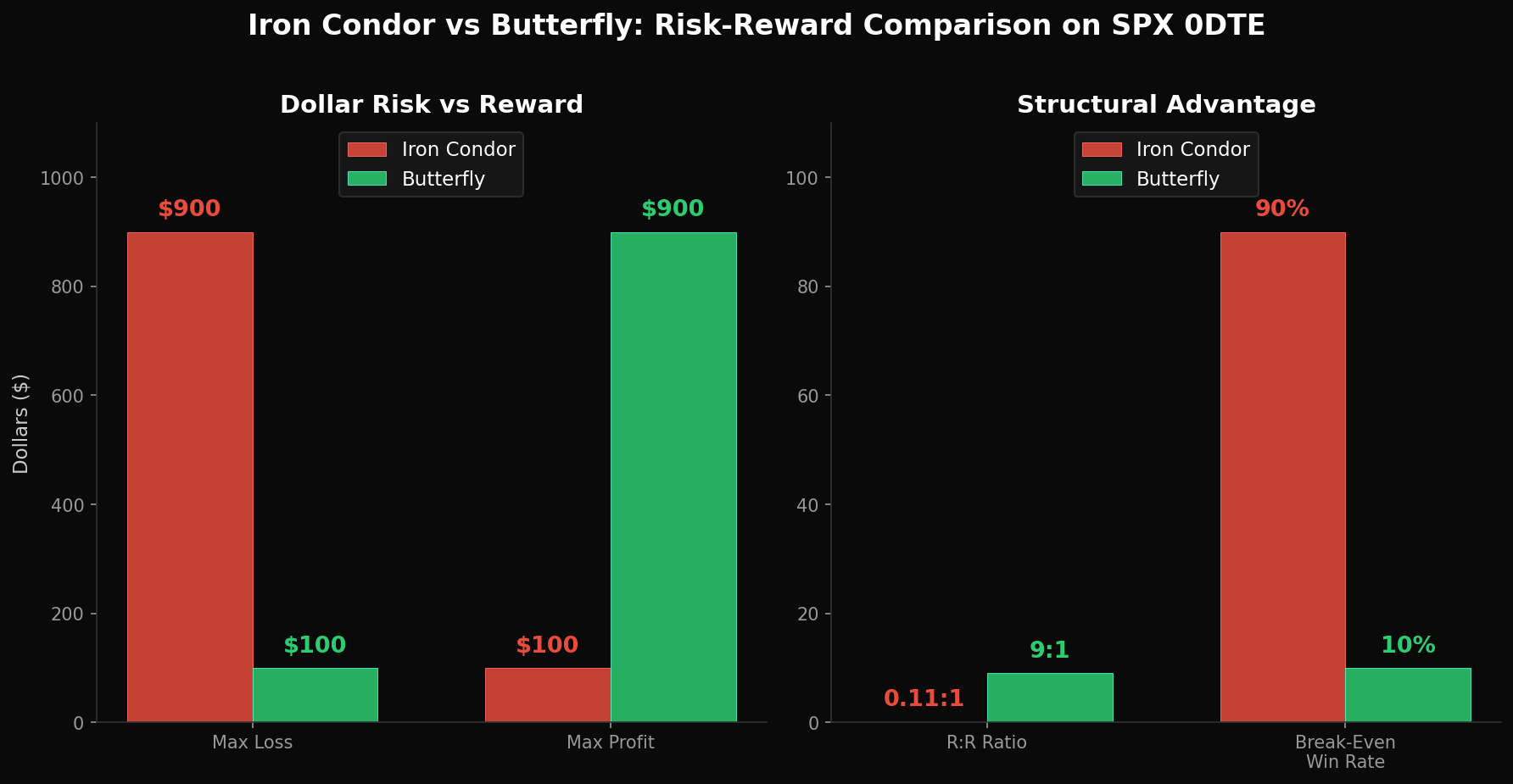 To break even with butterflies, you need to win roughly 10-15% of your trades — not 90%. In practice, a well-structured butterfly strategy using regime-aware width selection wins 45-65% of the time. That margin between the required win rate and the actual win rate is where the edge lives.
The butterfly thrives in the same environment that kills the iron condor:
- Amplified gamma — small price moves toward the body of the butterfly produce outsized gains. The same gamma that destroys iron condors accelerates butterfly profits.
- Accelerated theta — the butterfly benefits from time decay on its short legs. On 0DTE, this decay happens in hours, not weeks, concentrating the profit potential into a single session.
- Defined risk — your maximum loss is the debit paid. No margin expansion. No assignment risk on SPX (European-style exercise). No overnight exposure.
What the Performance Data Actually Shows
These are not hypothetical comparisons. This is what the structural data shows across live 0DTE trading sessions: Iron condor typical performance:- Win rate: 75-85% (high, but not high enough)
- Average win: $80-$120 (credit collected minus commissions)
- Average loss: $700-$900 (near max loss when breached)
- Break-even win rate required: ~90%
- Result: slow bleed punctuated by catastrophic drawdowns
- Win rate: 45-65% depending on VIX regime
- Average win: $180-$500+ (asymmetric payoffs on runners)
- Average loss: $40-$150 (the debit paid)
- Break-even win rate required: ~10-15%
- Result: consistent small losses offset by occasional large wins — positive skew that compounds
The Reverse Iron Condor — A Better Premium Structure
If you are committed to trading a condor-shaped structure, the reverse iron condor deserves attention. Instead of selling the inner strikes and buying the outer strikes, you flip it — buy the inner strikes and sell the outer strikes. This creates a debit structure that profits from a large move in either direction. You pay a premium upfront (defined risk) and profit if SPX moves beyond either wing by expiration. The reverse iron condor shares the butterfly’s structural advantage: small risk, large potential reward. It is essentially a strangle with defined risk — you are long volatility instead of short volatility. On a 0DTE session where a regime shift or trend day occurs, the reverse iron condor captures the move that would have destroyed a standard iron condor. The trade-off is that you lose on range-bound days. But when the debit is $100-$200 and the potential return is $800-$900, the math works in your favor over time — the opposite of the standard iron condor options strategy.When an Iron Condor Can Work: Regime, Skew and Strike Placement
The math above is why we do not default to iron condors on 0DTE. On longer-dated options, a condor can still earn its keep, but only when the market structure supports the range you sold. These are the conditions to check before you sell one.
The GEX regime decides whether the range holds
Gamma exposure is the single most important variable for the iron condor strategy. It determines whether the market microstructure supports range containment or actively works to breach it.
In a positive GEX regime, dealers are long gamma. They buy dips and sell rips, creating mean reversion that pins the underlying within a range. This is the ideal environment for iron condors. The structural floor and ceiling created by dealer hedging actively protect your short strikes. Moves that threaten your range get dampened by the same market mechanics that drive daily price action.
In a negative GEX regime, dealers are short gamma. They sell into declines and buy into rallies, amplifying directional moves. This is the worst environment for the iron condor strategy. The range you sold has no structural protection. A 1% move can cascade into a 3% move because dealer hedging fuels the momentum rather than containing it.
The practical rule is straightforward: deploy iron condors when GEX is positive above and below the market. Avoid them when the GEX profile shows negative gamma at nearby strikes. The GEX flip level — where dealer positioning shifts from supportive to destructive — should sit well outside your short strikes. If it sits between them, your iron condor is structurally compromised from entry.
VIX regime: premium vs containment
The VIX level determines the premium available and the probability of range containment. Both matter for the iron condor strategy, and they pull in opposite directions.
Low VIX (below 15). Premiums are thin. An iron condor that collects $0.80 on 5-wide spreads has a maximum loss of $4.20 per side — a 5:1 risk-reward against you. The probability of staying in the range is high, but the reward for being right is too small to compensate for the occasional breach. Furthermore, low VIX environments are fragile. Volatility mean-reverts, and a spike from 12 to 20 can blow through your strikes before you can adjust.
Moderate VIX (15-22). This is the sweet spot. Premiums are rich enough to provide a meaningful credit, and the VIX level is sustainable — not so elevated that a regime change is imminent. A 5-wide iron condor might collect $1.50-$2.00, giving you a more balanced risk profile. The expected move is contained, and dealer positioning typically supports range-bound behavior in this regime.
High VIX (above 25). Premiums are extremely rich, but the environment is hostile to range-bound strategies. High VIX means the market is pricing in large moves. The iron condor strategy requires stability, and high VIX is the opposite of stability. Additionally, elevated VIX often coincides with negative GEX — dealers are short gamma and amplifying moves. The rich premium is compensation for genuine risk, not a free lunch.
Strike placement using structure
Mechanical strike placement — selling at a fixed delta regardless of context — is the lazy approach. Structural strike placement uses dealer positioning data to place strikes where the market microstructure supports your trade.
Short strikes. Place them at or near levels where dealer gamma is positive. These are natural support and resistance levels created by options open interest. The underlying tends to gravitate toward these levels and bounce off them — precisely the behavior a range structure needs.
Long strikes. Place them beyond the expected move for the expiration period. The expected move represents the range that the options market itself is pricing in. If your long strikes are inside the expected move, you have paid for protection that the market considers likely to be needed — a structurally unfavorable position.
Width. Wider spreads collect more credit and have better risk-reward ratios, but they also expose you to larger losses. In practice, 5-wide to 10-wide spreads on SPX offer the best balance. Narrower spreads have too little premium to justify the commission and management overhead. Wider spreads require more capital and amplify the impact of miscalculating the range.
The skew problem: the put side is more dangerous
Skew creates an asymmetry that most iron condor strategy guides ignore entirely. The put side of the condor sits on steeper skew than the call side. This means the put spread collects less credit per unit of width than the call spread, despite carrying more directional risk.
Consequently, consider what happens in a selloff. The put side faces three compounding forces: the underlying moves against it, theta evaporates as IV spikes, and the skew steepens further — making the position more expensive to close. The call side faces none of these during a selloff. It benefits from the directional move, benefits from collapsing IV, and benefits from flattening skew.
This asymmetry means the two sides of an condor position are not equally risky. The put side is structurally more dangerous. Experienced traders account for this by placing the put spread further from the money than the call spread, accepting less premium on the put side in exchange for a higher probability of survival. The unbalanced condor — wider on the put side — is structurally superior to the textbook symmetric version.
Managing an iron condor
Entry defines the trade. Management determines the outcome. The iron condor strategy requires active monitoring because the risk profile changes as the underlying moves and time passes.
Take profits at 50%. Close the entire position when you have captured 50% of the maximum credit. Holding beyond this point exposes you to gamma risk in the final days of expiration — the same theta acceleration that helps you also means delta moves become more violent near the short strikes.
Cut the losing side. If the underlying approaches one of your short strikes, close that side rather than hoping for a reversal. The delta on the threatened side accelerates as the underlying approaches, and the loss compounds quickly. Close the losing side, keep the winning side open, and reassess whether to redeploy.
Watch the Greeks. Net delta should be near zero at entry. As the underlying moves, delta shifts. If net delta exceeds 0.15-0.20, the position is no longer neutral — it is directional. Either adjust by closing the threatened side or accept the directional risk with a clear exit plan.
Respect the regime shift. If GEX flips from positive to negative while your iron condor is open, the structural support for your range has disappeared. Tighten stops or close the position entirely. Do not hold an iron condor through a regime change hoping that the range will hold anyway.
Common Iron Condor Options Strategy Mistakes
These patterns appear repeatedly in the trading records of iron condor traders who eventually quit: Widening the wings to collect more credit. This increases the credit by a small amount while increasing the maximum loss substantially. A 20-wide iron condor on SPX does not collect twice the premium of a 10-wide — but the max loss doubles. The risk-to-reward ratio gets worse, not better. Adjusting the losing side. When price approaches a short strike, many iron condor traders roll the threatened side further out. This locks in a partial loss on the original position, opens a new risk exposure, and increases overall capital at risk. Rolling is not risk management. It is loss deferral with compounding risk. Ignoring the VIX regime. An iron condor placed when VIX is at 28 has a fundamentally different probability of success than one placed at VIX 14. High-volatility environments produce larger intraday ranges, making it far more likely that price breaches a short strike. The iron condor options strategy demands low-volatility conditions — and many traders do not check the regime before entering. Counting wins instead of measuring R-multiples. An 85% win rate sounds exceptional until you calculate the R-multiple: winning $100 eighty-five times ($8,500) and losing $900 fifteen times ($13,500). Net result: -$5,000. The win rate was never the metric that mattered. Risk-adjusted return was. Sizing by contract count instead of risk. Selling 10 iron condors because “the premium looks good” means risking $9,000 on a single session. If that session produces a trending move, the loss is not an inconvenience. It is a career event. Position sizing should always be denominated in risk units, never in contract count.Frequently Asked Questions
What is an iron condor options strategy?
An iron condor is a four-leg options strategy that sells an out-of-the-money put spread and call spread simultaneously, collecting premium. Maximum profit occurs if price stays between the short strikes at expiration. Maximum loss occurs if price moves beyond either wing. The strategy has an adverse risk-to-reward ratio — typically risking $800-$900 to collect $100-$200 in premium.What is the difference between an iron condor and an iron butterfly?
An iron condor sells strikes away from the current price on both sides, creating a wide profit zone with a smaller credit. An iron butterfly sells both options at the same strike (at the money), collecting a larger credit but with a narrower profit zone. Both are short-volatility strategies with adverse risk-to-reward ratios. The choice between them is a trade-off between probability and payoff — neither solves the structural risk problem.Why do iron condors fail on 0DTE options?
Iron condors require range-bound conditions for the entire trading session. On 0DTE contracts, gamma is at its peak, meaning small price moves cause large changes in option value. Intraday regime shifts can turn a grinding session into a trending one within minutes. When this happens, the iron condor’s short strike is breached and the loss accelerates toward maximum — with no time remaining for recovery.What is a reverse iron condor?
A reverse iron condor flips the standard structure — you buy the inner strikes and sell the outer strikes, creating a debit position that profits from large moves in either direction. Instead of collecting premium and hoping price stays still, you pay a small premium and profit from volatility. The risk-to-reward ratio is favorable: risk the debit paid, profit from movement. It is structurally aligned with 0DTE gamma dynamics rather than fighting them.Are butterfly spreads better than iron condors for 0DTE trading?
For same-day expiration on SPX, butterfly spreads offer a structurally superior risk-to-reward profile. A butterfly risks $40-$150 with potential returns of 5-25x the debit paid. An iron condor risks $800-$900 to collect $100-$200 in premium. The butterfly requires a 10-15% win rate to break even while the iron condor requires approximately 90%. Over hundreds of trades, the butterfly’s positive skew compounds favorably while the iron condor’s negative skew compounds against you.What is the best VIX level for iron condors?
The 15-22 VIX range offers the best balance for the iron condor strategy. Premiums are rich enough to provide meaningful credit, and the volatility environment is sustainable. Below 15, premiums are too thin. Above 25, the market is pricing in moves that are likely to breach your range. Moderate VIX combined with positive GEX creates the ideal conditions.
How do you adjust a losing iron condor?
Close the threatened side when the underlying approaches your short strike. Do not hold through the breach hoping for reversal. Keep the profitable side open to offset the loss. If the regime has shifted — GEX turned negative or VIX spiked — close the entire position. Adjustment means active risk reduction, not adding more risk to salvage a trade.
Choose Structures That Survive Their Worst Day
The iron condor options strategy is not a bad strategy in all contexts. On longer-dated options in low-volatility environments, it can produce consistent income. But on 0DTE SPX contracts — where gamma is amplified, regime shifts happen intraday, and there is no time for recovery — the iron condor’s structural weaknesses are exposed in real time. The question is not whether you can win with iron condors. You can. You will win most of the time. The question is whether your wins are large enough to survive the losses. With a 9:1 adverse risk-to-reward ratio, the math says no. At FatTail, structural awareness comes first. Before every session, we surface the regime context, dealer positioning, and gamma exposure that determine which strategies have a structural edge — and which ones are fighting the environment. Start with the Observer for daily structural analysis and market positioning tools. After Observer, the next step is annual Navigator for daily direct coaching with Ernie. Compare all plans here.FATTAIL BRIEFINGS
Get FatTail briefings in your inbox
Pick the lists you want. FOMC Alerts is selected by default.