


Every selling options strategy starts with the same pitch: collect premium, let time decay work for you, and profit as options expire worthless. The math sounds clean. Sell an option, pocket the premium, and keep it if the market stays within your expected range. What the pitch leaves out is the risk profile — and the risk profile is where most premium sellers eventually blow up.
Selling options is not inherently wrong. It is a legitimate approach that generates consistent income in the right conditions. But a selling options strategy deployed without understanding market structure, volatility regimes, and the asymmetric risk it carries is a strategy that works until it does not — and the failure is usually catastrophic enough to erase months of gains in a single session. This guide covers how premium selling actually works, what risks it carries, when it is appropriate, and how to structure it within a defined-risk framework.
How Selling Options Works: The Basic Mechanics
When you sell an option — as outlined in the CBOE’s strategy education resources — you receive premium upfront in exchange for an obligation. Sell a call, and you are obligated to sell the underlying at the strike price if it is above that strike at expiration. Sell a put, and you are obligated to buy the underlying at the strike price if it is below that strike at expiration. If the option expires out of the money, you keep the full premium. If it expires in the money, you absorb the loss.
The edge in selling comes from time decay. Every option loses extrinsic value as expiration approaches, and that decay accelerates in the final days and hours. When you sell an option, theta works in your favor — the premium you collected erodes whether the market moves or not. The Greeks that define your position are positive theta (you benefit from time passing) and negative gamma (sharp moves hurt you disproportionately).
This theta-gamma tradeoff is the defining characteristic of every selling options strategy. You earn small, consistent returns when the market cooperates, and you absorb large, concentrated losses when it does not. Understanding this tradeoff — not just intellectually, but as a lived reality in your trading account — is the prerequisite for selling options responsibly.
Why High Win Rates Are Misleading
The most common argument for selling options is the win rate. Sell far out-of-the-money options, and they expire worthless 80-90% of the time. That sounds like a business with a 90% success rate. It is not.
A selling options strategy with a 90% win rate and a 10:1 loss-to-win ratio has zero edge. If you collect $100 nine times ($900 total) and lose $1,000 once, you are down $100 after ten trades. The win rate is irrelevant without the corresponding loss magnitude. This is the negative skew problem that every premium seller must confront: the wins are small and frequent, and the losses are large and rare.
The psychological trap is that the frequent wins create the illusion of a working strategy. You collect premium for weeks, watching your account grow steadily, and conclude that selling options is easy money. Then the market delivers a 3-standard-deviation move — not a once-in-a-decade event, but something that happens several times per year in SPX — and the accumulated premium vanishes in hours.
This is not a theoretical risk. It is the lived experience of the majority of retail premium sellers who trade without defined risk. The strategy works until the tail event arrives, and the tail event always arrives eventually.
Naked Selling vs Defined-Risk Structures
The critical distinction in any option selling strategy is whether the risk is naked (unlimited or very large) or defined (capped at a specific maximum loss).
Naked puts and calls carry theoretically unlimited risk on calls and substantial risk on puts (the underlying can go to zero). Selling a naked SPX put at 5500 when the index is at 5600 means your maximum loss is $550,000 per contract if SPX goes to zero. The probability is near zero, but the payoff structure is wildly asymmetric. Margin requirements partially address this, but margin calls during sharp moves force liquidations at the worst possible prices.
Defined-risk structures cap your maximum loss by pairing the sold option with a bought option further out. A credit spread — selling a put at 5550 and buying a put at 5530, for example — limits your maximum loss to the width of the spread minus the credit received. If you collect $3 on a 20-point spread, your maximum loss is $17 per share ($1,700 per contract). The tradeoff is that you collect less premium, but you can quantify your worst-case scenario before entering the trade.
Iron condors extend this concept by selling both a put spread and a call spread, collecting premium from both sides. Iron butterflies concentrate the sold strikes at the money for maximum premium collection. Both are defined-risk premium-selling structures that cap the downside while still benefiting from theta.
The structural argument is clear: never sell naked options. The incremental premium from naked selling does not compensate for the tail risk. Defined-risk structures sacrifice some premium in exchange for survivability — and survivability is the only thing that matters over a long enough timeframe.
When Selling Options Works — And When It Does Not
A selling options strategy is not universally good or bad. It is conditionally appropriate — and the conditions are defined by market structure, not by your personal preference.
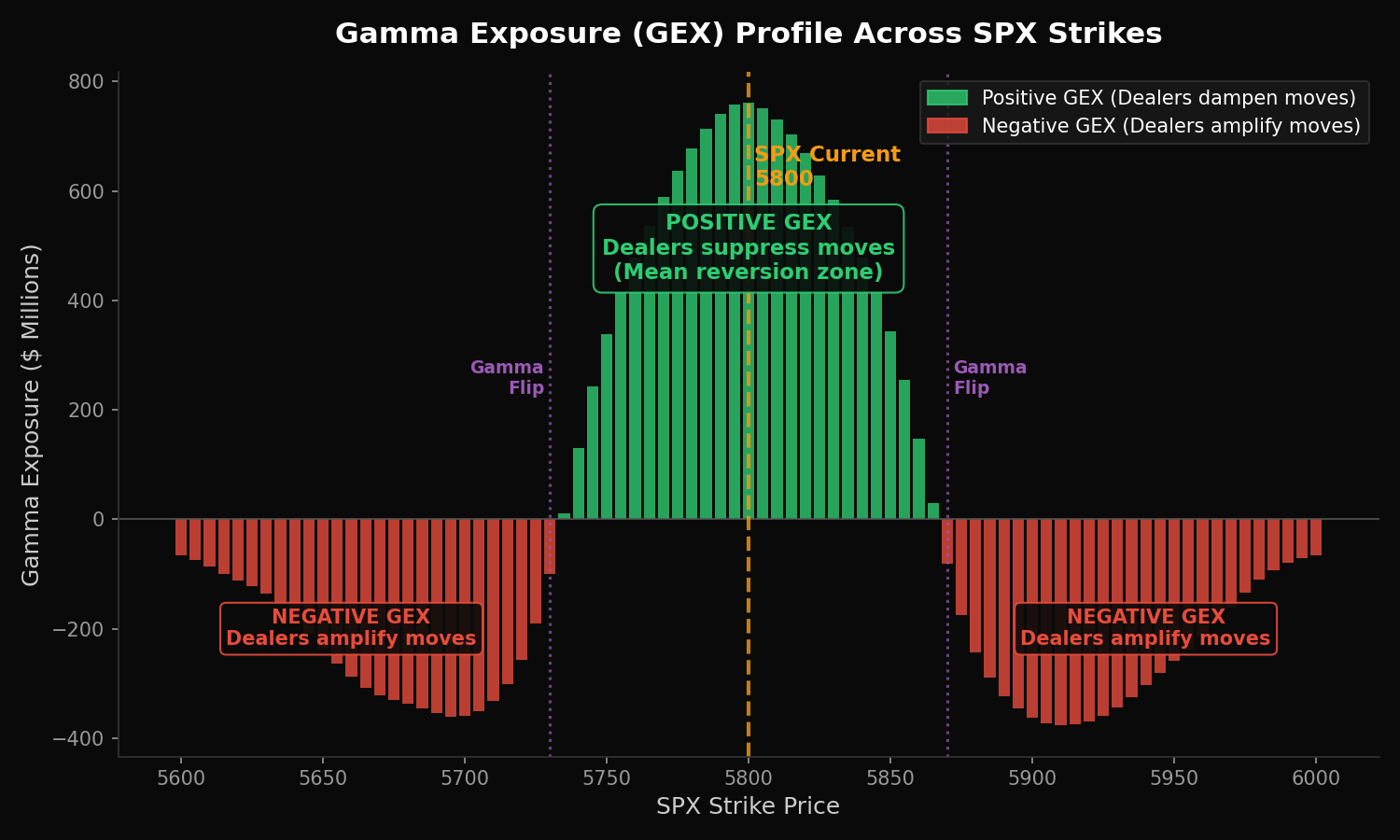
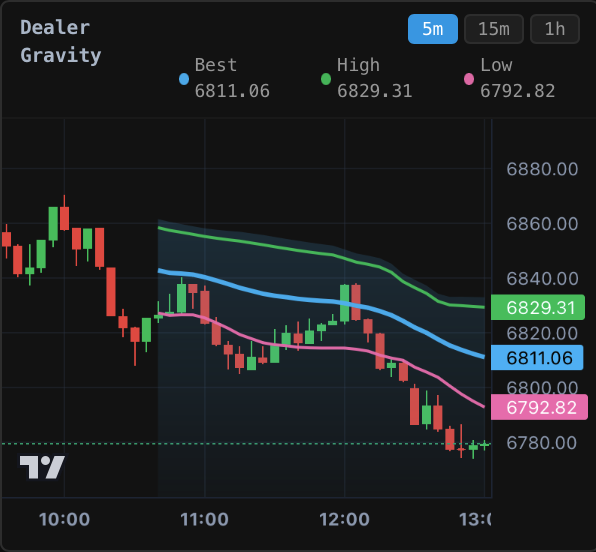
Selling works in compressed, range-bound environments. When gamma exposure (GEX) is positive and the expected move is narrow, dealer hedging creates a suppressive effect on volatility. Price tends to mean-revert toward dealer gravity levels rather than trending. In these conditions, selling premium — via credit spreads, iron condors, or short strangles with defined risk — has a structural tailwind. The market is working against directional moves, which means sold options are more likely to expire worthless.
Selling is dangerous in trending, expanded-range environments. When GEX is negative and the expected move is wide, dealer hedging amplifies directional moves rather than suppressing them. The market can trend aggressively through strike levels, and sold options that looked safe at the open can be deep in the money by noon. These are the sessions where premium sellers absorb their largest losses — and they happen often enough to matter.
The VIX regime adds another layer. High VIX means implied volatility is elevated, which makes premium expensive. Selling expensive premium has a mathematical edge because you are collecting more than the market is statistically likely to realize. Low VIX means premium is cheap, and selling cheap premium offers thin margins with the same tail risk. The best conditions for selling combine positive GEX (range-bound behavior) with elevated VIX (expensive premium).
This is the structural framework that the daily pre-market analysis in Observer ($17/week) covers every session — GEX positioning, expected move, VIX regime, and dealer gravity levels. Activator ($97/month) adds real-time GEX tools and weekly coaching, while Navigator ($267/month) provides daily direct coaching with Ernie. Compare all plans here.
Selling Put Options: The Most Common Entry Point
Selling put options is the most popular option selling strategy among retail traders — often framed as getting paid to buy a stock at a discount. You sell a put at a strike below the current price, collect the premium, and if the stock stays above the strike, you keep the premium. If it drops below, you are assigned the shares at the strike price minus the premium collected.
For SPX options, which settle in cash rather than shares, selling puts means you absorb the cash difference if the index closes below your strike. There is no stock assignment — just a cash settlement that can be substantial on a large move.
The sell put option strategy works well when you have a genuine directional bias supported by structural analysis. If GEX is positive above 5600 and you believe the market will hold that level, selling a 5580/5560 put spread collects premium while defining your risk at $2,000 per contract minus the credit. The structural read provides the thesis, and the defined-risk spread provides the execution.
Where this strategy fails is when traders sell puts mechanically — every week, same delta, same width — without reading the positioning landscape first. Mechanical selling works until the regime changes, and regime changes are exactly what market structure analysis is designed to detect.
Risk Management for Premium Sellers
Risk management for a selling options strategy requires a different framework than for buying strategies. The risk is not that you lose your premium — it is that a single loss can exceed many months of collected premium.
Position sizing is the first defense. No single credit spread or iron condor should risk more than 1-2% of your total account. If your account is $50,000, your maximum loss on any single position should be $500-$1,000. This means the width of your spread and the number of contracts must be calibrated to stay within this limit. Premium sellers who size positions based on the credit received rather than the maximum loss are setting up for a catastrophic drawdown.
Daily and weekly loss limits are essential. Set a maximum daily loss (typically 3-5% of account) and stop trading when you hit it. Premium selling creates a false sense of security because the small, steady wins mask the risk of the large loss. A hard stop prevents the large loss from compounding into an account-ending event.
Close losers before they reach maximum loss. A credit spread does not need to reach its maximum loss to be a bad trade. If the market moves against you and the spread reaches 50-70% of its maximum loss, closing it and accepting the partial loss is usually better than holding to expiration and hoping for a reversal. The math favors cutting losers early when you are selling premium, because the remaining premium you might save is small relative to the additional loss you might absorb.
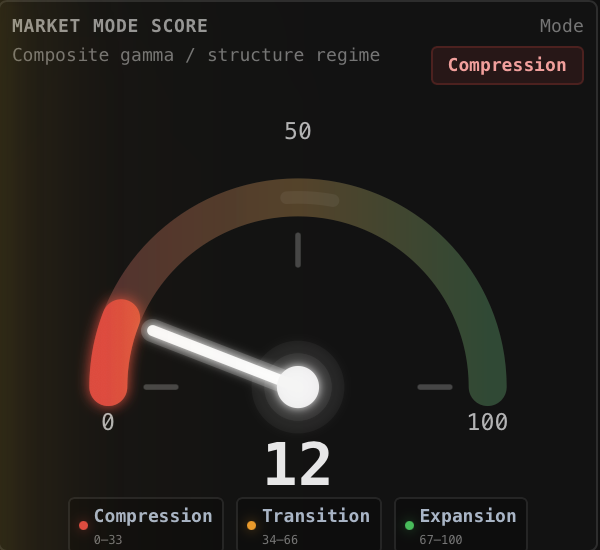
Adjust or exit when the regime changes. If you entered a selling options strategy based on positive GEX and compressed expected moves, and the GEX flips negative mid-session, the thesis for your trade has changed. Sticking with a premium-selling position when the structural environment no longer supports it is not discipline — it is stubbornness.
The Buy-Side Alternative: Defined-Risk Buying Structures
The opposite side of the selling options strategy coin is buying defined-risk structures — particularly butterfly spreads. Where selling collects small premium with large tail risk, butterflies pay small premium with large potential reward.
A butterfly centered at a dealer gravity level costs $30-$100 in premium and can return $500-$2,500 if price converges on the target at expiration. The risk-reward is 5:1 to 25:1 — the mirror image of selling’s 1:5 to 1:25 payoff. The win rate is lower (20-30% versus 70-80%), but the asymmetry runs in your favor rather than against you.
This does not mean buying is always better than selling. It means the choice between buying and selling should be driven by the structural environment — not by a permanent preference. In positive GEX with compressed ranges, selling premium has the structural edge. In negative GEX with expanded ranges, buying directional butterflies targeted at order flow levels has the structural edge. The framework reads the market and selects the appropriate structure — buying or selling — for that session’s conditions.
This is the core of the FatTail approach: structural analysis determines the trade, not a fixed premium-selling approach or buying approach applied regardless of conditions. Learning to read GEX, expected move, and VIX regimes — covered in the options trading education pathway — is what transforms a one-dimensional seller into a complete trader.
Frequently Asked Questions
Is selling options a good strategy?
Selling options can be profitable in the right market conditions — specifically in compressed, range-bound environments where dealer positioning suppresses volatility. However, selling carries negative skew risk: small, frequent wins and large, rare losses. Without defined-risk structures and strict position sizing, a single adverse move can erase months of collected premium. Selling is conditionally appropriate, not universally good.
What is the safest way to sell options?
The safest approach uses defined-risk structures like credit spreads and iron condors rather than naked options. Cap maximum loss per position at 1-2% of your account, set daily loss limits, and close losing positions before they reach maximum loss. Most importantly, only sell premium when the market structure supports it — positive GEX environments with compressed expected moves favor selling strategies.
What is the most profitable selling options strategy?
No single selling strategy is universally most profitable. Credit spreads, iron condors, and iron butterflies each perform best in different conditions. The most profitable approach reads the structural environment first and selects the structure that matches the current regime. Selling in the right conditions and sitting out the wrong ones generates better long-term returns than any fixed strategy applied mechanically.
Can you make a living selling options?
Some traders generate consistent income from selling options, but it requires substantial capital, strict risk management, and the discipline to stop selling when conditions are unfavorable. A $100,000 account selling premium at 1-2% risk per position might generate $2,000-$5,000 per month in favorable conditions — but will have losing months that offset multiple winning months. Realistic expectations and adequate capitalization are essential.
What is a sell put option strategy?
Selling a put option means collecting premium in exchange for the obligation to buy the underlying at the strike price if it drops below that level. For cash-settled instruments like SPX, it means absorbing the cash difference. The sell put option strategy is most commonly deployed as a put credit spread — selling a put at one strike and buying a lower-strike put to cap the risk — when structural analysis indicates the market is likely to hold above the sold strike.
FATTAIL BRIEFINGS
Get FatTail briefings in your inbox
Pick the lists you want. FOMC Alerts is selected by default.