


Theta decay options strategies are the most misunderstood category in retail trading. The pitch sounds compelling — sell premium, collect time value, let the clock do the work. Every day that passes, the option loses value. You keep the difference. It sounds like a paycheck. In reality, theta decay is a variable that changes magnitude depending on where you sit relative to the strike, how much time remains, and what the volatility environment is doing. Most traders who build strategies around it misread all three.
Time decay is not a constant force. It accelerates. It shifts. It interacts with every other Greek in the chain. Consequently, treating theta as a simple “time = money” equation is the fastest way to blow up an account that looked profitable for months. This guide explains how theta decay actually works in practice, when it helps, when it kills, and how structural traders use it as context rather than strategy.
How Theta Decay Options Pricing Works
Every option loses extrinsic value as expiration approaches. This is theta decay — the daily erosion of the time premium embedded in the option’s price. An option worth $5.00 with 30 days to expiration might lose $0.05 per day at first. However, with 5 days left, that same option might lose $0.25 per day. With 1 day left, it could lose $1.00 in a single session.
This is the theta decay curve. It is not linear. It is exponential — specifically, it accelerates as expiration approaches. The relationship follows the square root of time. Halving the time to expiration does not halve the remaining premium. It reduces it by roughly 30%. As a result, the final week of an option’s life produces more theta decay than the previous three weeks combined.
At-the-money options experience the highest theta. They carry the most extrinsic value because the probability of finishing in or out of the money is closest to 50/50. Deep in-the-money and deep out-of-the-money options have less extrinsic value to lose, so their theta is lower.
This basic structure is where most theta decay options education stops. Here is what they leave out.
The Theta Decay Options Trap
The standard retail approach to theta decay is simple: sell options, collect premium, wait. If the underlying stays in range, you profit from the daily erosion. Credit spreads, iron condors, and covered calls are all built on this logic. The win rate is high — typically 65-80%. The account grows slowly and steadily. Then a single move wipes out months of gains.
This is the trap. Theta decay is real, but it is not free. The premium you collect for selling an option is the market’s estimate of the risk you are absorbing. When you sell a put at the 0.20 delta strike and collect $1.50 in premium, the market is telling you that the expected cost of that risk — including the occasional blowout — is approximately $1.50. In other words, there is no structural edge in selling premium at fair value.
Traders who build theta decay options portfolios believing they are “harvesting theta” are actually harvesting a fair premium for tail risk. The math works until the tail arrives. Furthermore, when it arrives — and it always arrives — the loss is multiples of the gains. A 75% win rate with 3:1 risk-to-reward against you produces breakeven at best and negative expectancy after fees and slippage.
When Theta Decay Options Strategies Work
Theta is not inherently an enemy or an ally. In theta decay options trading, everything depends on which side of the trade you sit and what the environment is doing.
Selling premium in elevated IV. When implied volatility is significantly above realized volatility, the premium you collect exceeds the statistical cost of the risk. This is the only scenario where selling theta has a mathematical edge. The IV crush that follows elevated vol accelerates the decay beyond what the Greeks alone predict.
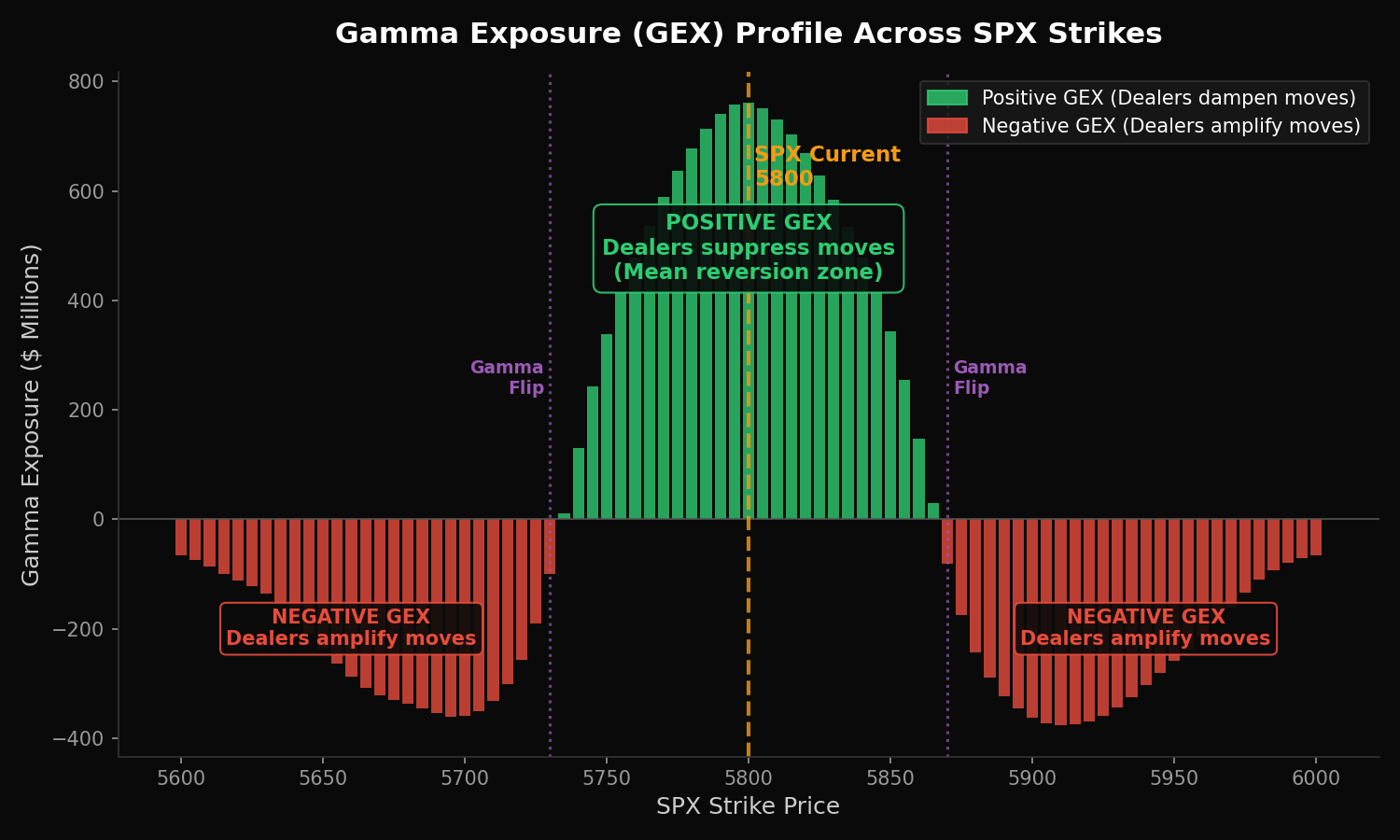
Positive GEX environments. When dealer gamma exposure is positive, market makers dampen directional moves. Ranges compress. Mean reversion dominates. In these conditions, the underlying is less likely to breach your short strikes, which means the theta you are collecting has structural support underneath it — not just a probability estimate but an active mechanical force keeping price in range.
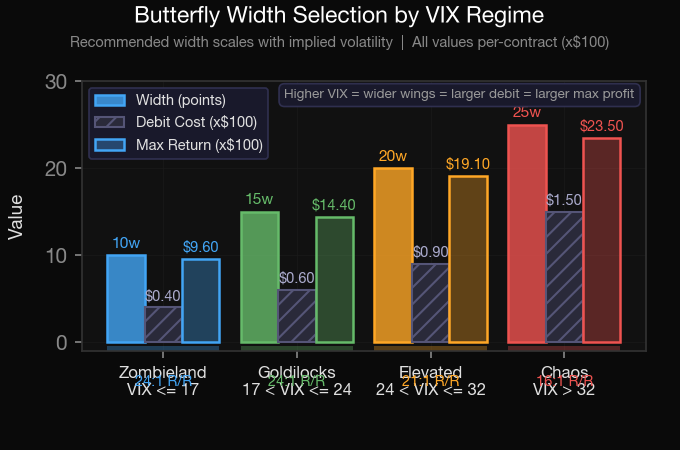
Short-dated butterflies at convergence targets. The butterfly spread uses theta decay differently. Instead of selling premium and hoping price stays away from your strike, you buy a structure that profits when price converges on your target. In this case, theta works for you near the center strike as expiration approaches. The key difference is that you paid a small debit rather than absorbing tail risk.
21-45 DTE sweet spot. For premium sellers, the optimal window is 21-45 days to expiration. Theta acceleration is meaningful but gamma risk has not yet spiked. Closer to expiration, the daily theta number looks large — but so does the gamma, which means small price moves create outsized P&L swings. In practice, the last 7 days are the most dangerous period for premium sellers despite having the highest daily theta.
When Theta Works Against You
Understanding when theta decay options positions get destroyed is more important than understanding when they profit.
Buying options with no catalyst. Buying calls or puts without a specific catalyst is a pure theta bleed trade. Every day the underlying does not move in your direction, the option loses value. A $3.00 call with 14 days left can decay to $1.50 in a week even if the underlying barely moves. The directional thesis may be correct, but the timing must also be precise — and timing is the hardest variable in trading.
Low IV environments. When implied volatility is low, the premium available for selling is thin. A $0.50 credit on a $500-wide credit spread means you are risking $450 to collect $50. The theta is technically positive, but the risk-reward is catastrophic. The math requires a 90% win rate just to break even.
Negative GEX regimes. When gamma exposure is negative, dealer hedging amplifies moves. The range expansion that negative gamma produces is exactly the condition that breaches short strikes and turns theta income into realized losses. Selling premium in a negative gamma environment is like collecting pennies in front of a steamroller that is accelerating.
Earnings and events. IV crush after earnings looks like theta decay but it is actually vega collapse. Traders who conflate the two often sell premium before events thinking they are “selling theta” when they are actually taking on event risk. The distinction matters because event risk is binary — the outcome is either within range or far beyond it — while theta decay is continuous.
The daily pre-market analysis in Observer ($17/week) delivers the context that determines whether theta is working for or against you — GEX profile, VIX regime, expected move, and dealer gravity levels. Activator ($97/month) adds real-time tools and weekly coaching. Navigator ($267/month) provides daily direct coaching with Ernie. Compare all plans here.
The Structural Approach to Theta
Structural traders do not build strategies around theta. They read the environment first and select structures where theta happens to work in their favor as a secondary benefit — not the primary edge.
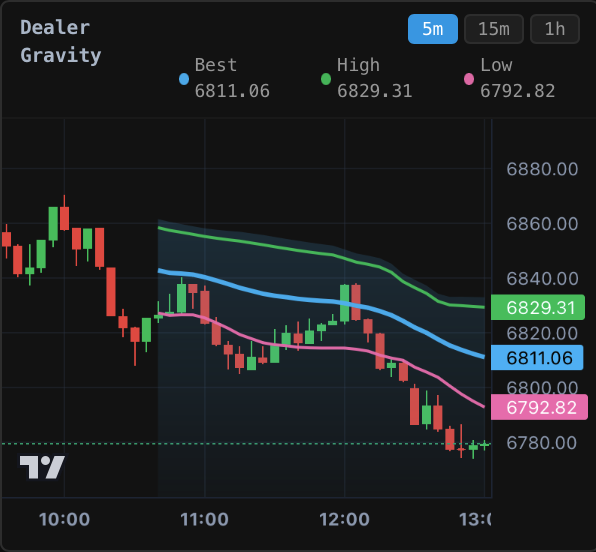
In positive GEX environments with elevated IV, a butterfly placed at the dealer gravity level benefits from theta acceleration near expiration while the positive gamma environment keeps price converging toward the target. Theta is not the thesis — convergence is. Theta simply accelerates the payoff.
In negative GEX environments, theta is irrelevant. The structural play is directional, aligned with order flow. The time decay on a directional spread matters far less than the delta exposure. Trying to “sell theta” in this environment is the most common mistake premium sellers make.
This regime-based approach is the difference between consistent results and the boom-and-bust cycle that defines most theta decay options accounts. The strategy does not change because of a preference for income. It changes because the environment changed — and theta only helps when the environment supports range-bound behavior.
The Bottom Line
Theta decay options strategies work exactly when the environment supports them and fail exactly when it does not. The time decay component of an option’s price is real. It is measurable. It is predictable in magnitude. What is not predictable is whether the underlying will stay in the range that allows you to collect it.
That is the fundamental problem with building a strategy around theta alone. You are betting on range. You are collecting a fair premium for that bet. Ultimately, the only edge comes from reading the structural environment — GEX, VIX regime, expected move — and only deploying theta-positive structures when the data supports the range assumption. Everything else is a coin flip with asymmetric downside.
That structural read starts with Observer ($17/week): daily GEX profiles, gravity levels, expected move, and VIX context. Activator ($97/month) adds real-time tools and weekly coaching. Navigator ($267/month) provides daily direct coaching with Ernie. Compare all plans here.
Frequently Asked Questions
What is theta decay in options?
Theta decay is the daily erosion of an option’s extrinsic value as expiration approaches. It accelerates over time — the final week produces more decay than the previous three weeks combined. At-the-money options experience the highest theta because they carry the most time premium relative to their strike.
Can you make money from theta decay?
You can collect premium by selling options and profiting from theta decay, but only when the underlying stays within your profitable range. The premium collected is the market’s fair estimate of the risk absorbed. Without a structural edge — such as elevated IV or positive GEX — selling theta produces breakeven results at best after accounting for tail losses.
What is the best strategy for theta decay?
No single strategy works in all conditions. Credit spreads and iron condors benefit from theta in range-bound, positive GEX environments with elevated IV. Butterfly spreads use theta differently — profiting from convergence rather than range. The environment determines which structure is appropriate, not a preference for income.
Does theta decay happen overnight or during market hours?
Theta decay is continuous but not uniform. Most pricing models distribute decay across calendar days, meaning weekends and holidays contribute to decay. In practice, the market reprices options at the open to reflect overnight decay. Short-dated options lose the most value overnight because the proportional reduction in remaining time is largest.
How does theta interact with implied volatility?
When implied volatility rises, extrinsic value increases — temporarily offsetting theta decay. When IV falls, the vega loss compounds the theta loss. For premium sellers, declining IV is the best environment because both theta and vega work in the same direction. Rising IV is the worst because vega expansion overwhelms the theta you are collecting.
FATTAIL BRIEFINGS
Get FatTail briefings in your inbox
Pick the lists you want. FOMC Alerts is selected by default.