


Most traders do not blow up because they failed to find one more market indicator. They blow up because a normal losing trade was large enough to damage the account, their confidence, or both. This guide to capital allocation trading is about solving that problem before the opening bell – by deciding what any one trade is allowed to cost you. It is the core risk management case.
For an SPX 0DTE trader, allocation is not a bookkeeping exercise. It is the operating system. Expiration-day options can move from manageable to urgent quickly, especially when positioning shifts, volatility expands, or price breaks a key area. A defined-risk structure helps contain the loss. Proper allocation makes sure that contained loss is small enough to be survivable and repeatable.
Capital allocation trading starts with survival
Capital allocation means assigning a predetermined portion of your account’s usable risk capital to a trade, a session, or a strategy. It is not the same as buying power. And it is not the same as asking your broker, “How many contracts can I place?”
Buying power tells you what the platform may permit. Allocation tells you what your process permits.
That distinction matters because a trader can have enough buying power to place a position that is wildly inappropriate for the account. Defined-risk spreads can create a false sense of safety here. Yes, the maximum loss is known. But if that maximum loss represents too much of the account, the trade is still oversized. Defined risk is a structure. Appropriate size is a decision.
The first job of allocation is to eliminate the risk of ruin. That does not mean eliminating losses. Losses are planned reps in any real trading process. It means constructing your exposure so a sequence of ordinary losses does not force you into emotional decisions, revenge trades, or a long recovery period. The OCC’s options education is a steady reference for the mechanics.
Start with a risk unit, not a contract count
A contract count is the wrong starting point. One SPX spread may have a very different maximum loss than another, depending on width, credit received, and the structure used. Two contracts are not automatically twice the risk of another two contracts. The Cboe SPX specifications define the contract you are sizing.
Start instead with a risk unit: the maximum amount you are willing to lose on one fully defined position. That amount should be based on the portion of capital you have deliberately designated for this strategy, not on a recent winning streak, a strong market opinion, or the desire to make back a loss.
Once the risk unit is set, contract quantity becomes math:
Position risk = maximum loss per contract x number of contracts
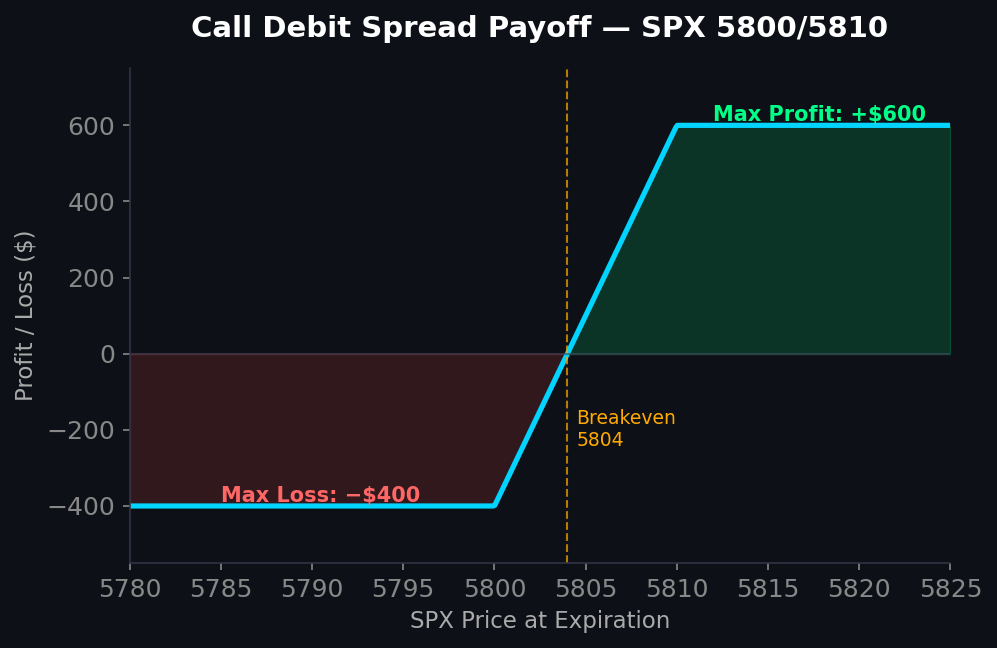
The result must stay inside your risk unit. If it does not, reduce size, choose a narrower defined-risk structure if it fits the plan, or do not take the trade. Skipping a setup because it does not fit your allocation is discipline, not missed opportunity. Here is a worked risk sizing example.
This is where many self-directed traders go wrong. They size from conviction. They feel more certain after watching a trend extend, seeing a level hold twice, or hearing a persuasive market narrative. But conviction does not reduce the actual risk of the position. It often increases it, because certainty invites size.
Positioning and structure deserve attention. Prediction does not deserve the authority to override your risk budget.
Use your worst normal day as the reference point
Do not build size around your average day or your best month. Build it around a bad but realistic stretch of execution: several stopped or fully challenged positions, difficult price action, and the temptation to deviate from the plan.
Ask a hard question: if that stretch happens, can you still trade your next valid setup exactly as designed?
If the answer is no, your allocation is too aggressive. The number may look reasonable in a spreadsheet. It is not reasonable if it changes your behavior under pressure.
This is why smaller size is often a professional decision. It creates room to gather data, follow the rules, and let expectancy play out across enough repetitions. A trader who survives a rough week with discipline has preserved something more valuable than a single trade’s potential payout: their ability to keep executing.
Allocate across the day, not just the first trade
A common mistake is treating every setup as if it exists in isolation. In 0DTE trading, the first position changes the context for every decision that follows. It uses risk capacity. It may create correlated exposure. It can affect the quality of your judgment after a win or loss.
Set a session-level loss limit before trading begins. This is the point at which the day is over, regardless of how appealing the next setup appears. The purpose is not punishment. It is to prevent a controlled trading day from turning into an uncontrolled one.
Also decide in advance whether your framework allows more than one position, and under what conditions. A second trade is not automatically diversification. That overlap is a common risk allocation error. If both positions depend on the same directional assumption or are exposed to the same sharp move, you may simply be stacking risk.
Think in terms of total exposure. If your first trade has used much of the day’s risk budget, the next trade must either be smaller, materially different in exposure, or skipped. More activity is not better process. A clean no-trade decision is often the correct allocation decision.
Keep allocation separate from trade quality
A well-formed setup can lose. A poorly formed setup can win. That is not a contradiction. It is the reality that makes process necessary.
When traders increase size only because a setup appears especially attractive, they quietly turn their framework into a prediction contest. They may call it discretion, but often it is just unmeasured confidence. Discretion can have a place, but only when it is defined, documented, and tested over a meaningful sample.
Until then, keep sizing consistent. Let the trade structure, entry criteria, adjustment rules if your plan includes them, and exit rules do the work. Consistent allocation makes your trade log readable. You can identify whether an outcome came from the market, execution, or a flaw in the rules. Variable emotional sizing muddies all three.
There are exceptions. An account can grow or shrink, and allocation should be reviewed periodically. A trader may also have separate risk buckets for separate strategies. But these changes should happen on a schedule, based on data, not in the middle of a live session because today feels different.

Build a capital allocation trading routine
The best allocation rules are simple enough to follow when the market is moving. Before the session, define the maximum risk per position, the maximum total loss for the day, and the maximum number of positions your plan permits. Then confirm that the planned structure fits those limits before entering.
After the session, review allocation separately from P&L. Did the trade fit the risk unit? Did combined positions create more exposure than intended? Did you add size after a loss, reduce size after a win, or make any decision that was not in the plan? Those questions reveal more than whether the day finished green.
A useful trade log records maximum defined loss, contracts, total session exposure, entry rationale, exit rationale, and whether sizing complied with the rules. Over time, this turns allocation from an idea into evidence. You stop relying on memory, which is usually kind to your best decisions and vague about your worst ones.
At FatTail.ai, this is part of learning to operate a defined-risk SPX framework rather than following a stream of calls. The goal is not dependence on someone else’s confidence. The goal is knowing your own limits, reading your own data, and executing a process you can defend.
Your allocation should make losses boring
If a planned loss ruins your day, changes your next trade, or creates an urgent need to recover, the position was too large. That is not a character flaw. It is feedback from the system.
Reduce the size until a loss becomes information rather than an event. Then give yourself enough repetitions to evaluate the framework honestly. Capital allocation will not make every trade work. It does something more useful: it keeps one trade, one session, or one difficult week from deciding your future as a trader.
Frequently Asked Questions
What is capital allocation in trading?
Capital allocation means assigning a predetermined portion of your usable risk capital to a trade, session, or strategy. It is the operating system, not a bookkeeping exercise. Its first job is to eliminate risk of ruin so a sequence of ordinary losses does not force emotional decisions or a long recovery.
How is capital allocation different from buying power?
Buying power is what the platform may permit; allocation is what your process permits. A trader can have enough buying power to place a position that is wildly inappropriate for the account. Defined-risk spreads can create false safety: the max loss is known, but if it is too large a share of the account, the trade is still oversized.
How do you set a position size from a risk unit?
Start with a risk unit, the maximum you will lose on one fully defined position, based on capital designated for the strategy. Then position risk equals maximum loss per contract times contracts, and the result must stay inside the risk unit. If it does not, reduce size, choose a narrower structure, or skip the trade.
Should you allocate all your risk to the first trade?
No. In 0DTE the first position changes the context for every later decision and uses risk capacity. Set a session-level loss limit before trading, decide whether your framework allows more than one position, and think in total exposure. A second trade on the same assumption is stacking risk, not diversification.
Should you increase size when a setup looks especially good?
Usually no. Sizing up because a setup looks attractive quietly turns a framework into a prediction contest; conviction does not reduce actual risk and often increases it. Keep sizing consistent so your trade log stays readable, and change allocation only on a schedule, based on data.
FATTAIL BRIEFINGS
Get FatTail briefings in your inbox
Pick the lists you want. FOMC Alerts is selected by default.