


The fastest way to blow up trading SPX 0DTE is to treat it like a prediction game.
That is usually where traders go wrong when they ask how to trade SPX 0DTE. They start with direction. Bullish or bearish. Breakout or reversal. Then they oversize, chase a move, and turn a one-day product into a permanent account problem. SPX 0DTE can be traded professionally, but only if you stop trying to be right and start building around defined risk, position structure, and repeatable execution. This SPX-specific approach builds on our broader 0DTE options guide and the structural approach to intraday index trading.
How to trade SPX 0DTE starts with the right objective
Most retail traders come to 0DTE looking for speed. That is exactly backward. The real objective is control.
SPX 0DTE gives you tight feedback, frequent opportunity, and clear intraday windows. The Cboe SPX contract specifications detail the cash settlement and expiration timing that define the product. It also gives you extreme gamma, fast premium decay, and very little room for emotional mistakes. The OCC’s options education is a good grounding in how these forces behave. So the question is not whether the market will move. It always moves. The question is whether your framework can survive normal variance without forcing you into oversized losses.
A good 0DTE process is built on three ideas. First, every trade has defined risk before entry. Second, sizing is small enough that a planned loser is just another rep. Third, the setup is based on structure and positioning, not on the fantasy that you can predict every turn in the index.
If that sounds less exciting than social media screenshots, good. Excitement is expensive.
Stop trading SPX 0DTE like a one-leg opinion
A lot of traders begin with long calls and long puts because the logic feels simple. If SPX goes up, buy a call. If it drops, buy a put. The problem is that 0DTE options are not simple directional instruments. They are rapidly changing exposure packages. Delta changes fast. Theta matters fast. Implied volatility shifts matter fast. A move in price alone does not guarantee a good result.
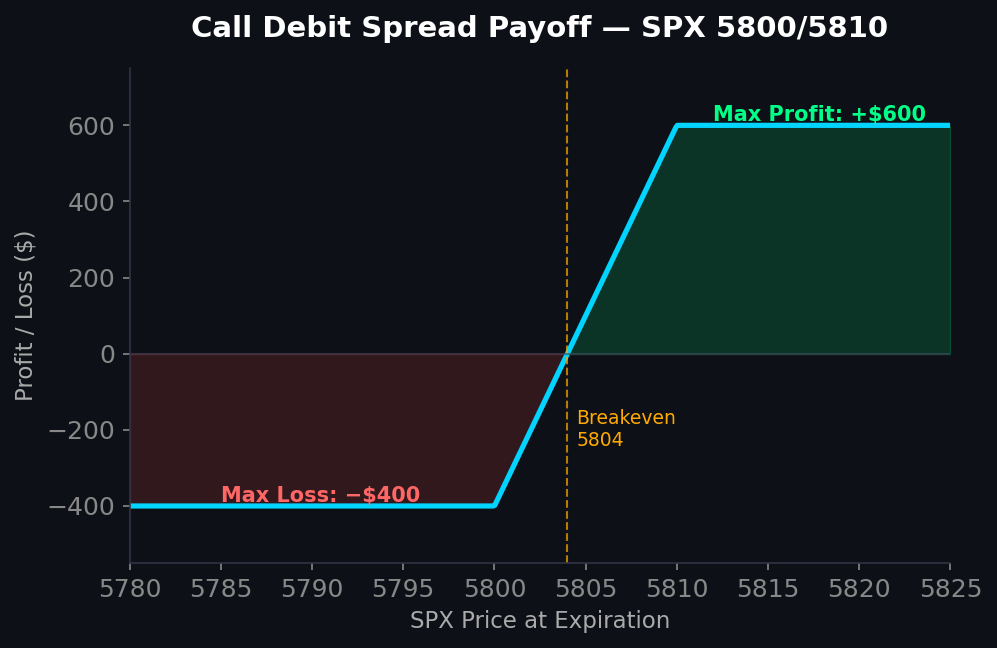
That is why defined-risk structures matter. Instead of paying for raw lottery-ticket convexity or selling naked premium and pretending that stops will save you, a professional approach uses structures with known max loss and a planned response to time and price behavior. Vertical spreads are the obvious starting point because they cap risk, shape the payoff, and force discipline.
This is not about finding the perfect structure for every session. It is about removing catastrophic outcomes from the game. Once the risk of ruin is off the table, you can actually learn.
Why defined risk matters more than being right
Traders often obsess over accuracy because it feels measurable. But accuracy by itself is a weak compass. You can be right often and still lose if your losers are too large, your entries are late, or your structure is fragile.
Defined-risk trading changes the scoring system. A loss is no longer proof you were bad. It is the cost of running a system through variance. That mental shift matters. It keeps you from revenge trading after one red rep or doubling size just to recover a morning mistake.
The goal is not to eliminate losses. The goal is to make losses survivable, intentional, and small enough that process stays intact.
Build your day around market structure, not noise
If you want a repeatable answer to how to trade SPX 0DTE, start with a daily routine. Not alerts. Not random entries because a candle looks dramatic.
Before the open, define the zones and conditions that matter. Where are the major areas of dealer pressure, likely pinning, or acceleration? Where has the market recently accepted or rejected price? Where might volatility expansion change the character of the session? You are not trying to forecast the entire day. You are building a map so you can recognize when price is behaving normally and when it is breaking the expected structure.
That map gives context to your trade location. Location matters more than urgency. Entering a spread in the middle of nowhere because you feel late is not a plan. Entering around a level where structure, positioning, and intraday behavior align gives you something to evaluate beyond gut feel.
This is where many self-directed traders improve fast once they stop consuming random signals and start studying positioning. Tools can help, but tools do not replace thinking. A heatmap, exposure overlay, or risk graph is useful only if it helps you answer a practical question: what is the market likely to defend, where can it move cleanly, and what structure fits that path?
There is no single “best” session type
Some days are clean trend days. Some are rotational and hostile to chasing. Some look quiet until they suddenly are not. Your process has to account for that.
On a trend day, you may want a structure that participates in continuation without requiring a perfect entry. On a rotational day, you may prefer setups that benefit from containment around a zone. On a chaotic news-driven day, the best trade may be no trade at all.
That last part is where discipline shows up. If your framework only works when you force action every day, it is not a framework. It is dependency wearing a spreadsheet.

Sizing is the real edge most traders ignore
Oversizing is the silent killer of 0DTE traders. Not because one trade always ends the account, but because bad sizing makes normal variance feel unbearable. Then psychology takes over, and the process disappears.
Your size should be set by the maximum planned loss of the structure and by what a string of losses would feel like, not by how confident you are in today’s setup. Confidence is not a risk model.
This is where experienced traders often need the most correction. They know enough to identify decent setups, but they still size as if each trade should work now. That creates emotional fragility. A proper size lets you execute the same playbook tomorrow, and next week, and after a rough patch. If you cannot withstand a losing streak without changing your personality, your size is too big.
Small size is not timid. Small size is what allows consistency.
Execution should be boring
Professional 0DTE trading is repetitive by design. You know what conditions qualify a setup. You know the structure you are willing to use. You know the max risk before clicking. You know what invalidates the trade. You know how you will manage it if price moves, stalls, or tags your zone and fails.
That sounds obvious, but many traders still improvise in the live market. They enter first, then invent reasons. They adjust risk mid-trade because they suddenly feel conviction. They widen the plan because SPX is “just shaking out weak hands.” That language usually means the trader is now negotiating with risk instead of managing it.
Clean execution is mechanical. Not because you are a robot, but because discretion should live in the preparation, not in panic.
What to review after every trade
If you want progress, review the decision, not just the P and L.
Did the trade match your setup criteria? Was the location valid? Was size appropriate? Did the structure fit the session type? Did you follow the planned management rules? If the trade lost, was it still a good trade? If it won, did you actually execute well, or did you just get lucky with direction?
That distinction matters. Traders who only review outcomes train themselves to chase randomness. Traders who review process build repeatability.
A trade log helps, but only if it captures useful information. Not just entry and exit. Record the context, the structure, the intended path, the actual path, and whether the execution matched the plan. Over time, patterns emerge. You will find where you force trades, where you enter too late, where you size inconsistently, and where your best setups actually come from.
That is how independence is built. Not from copying someone else’s entries, but from seeing your own behavior clearly.
The right mindset for trading SPX 0DTE
The best traders in this space are not the ones who need to be right every day. They are the ones who can take a planned loss without losing their process.
That is a hard shift for traders raised on alerts and hero trades. But it is the shift that matters. SPX 0DTE is not a place for ego. It is a place for preparation, risk control, and honest review.
If you are serious about learning how to trade SPX 0DTE, stop asking what the market will do next. Ask better questions. What structure fits this session? Where is the risk clearly defined? Is the size survivable? Does this trade belong in my process, or am I just bored?
That is the difference between gambling and operating.
FatTail.ai teaches traders to build that kind of repeatable framework because independence comes from process, not from signals.
You do not need more opinions. You need a plan you can still trust after a loss.
Frequently Asked Questions
How do you trade SPX 0DTE without guessing?
Stop starting with direction. Build around defined risk, position structure, and repeatable execution instead. Every trade has a known maximum loss before entry, size is small enough that a planned loser is just a rep, and setups are based on market structure and positioning rather than predicting every turn in the index.
What structures work best for SPX 0DTE?
Defined-risk structures with a known max loss, such as vertical spreads, are the obvious starting point because they cap risk, shape the payoff, and force discipline. Long single options expose you to fast delta, theta, and volatility shifts, while naked premium relies on stops that may not save you.
Is SPX 0DTE trading profitable?
It can be, but the edge comes from process, not prediction. Profitability depends on removing catastrophic outcomes through defined risk, sizing so variance is survivable, and executing the same playbook consistently. Accuracy alone is a weak compass if losers are large or entries are late.
How much should you risk on an SPX 0DTE trade?
Size by the maximum planned loss of the structure and by what a string of losses would feel like, not by how confident you are today. Confidence is not a risk model. If you cannot withstand a losing streak without changing your personality, your size is too big.
How is trading SPX 0DTE different from general 0DTE options?
The principles carry over, but SPX is cash-settled with no early-assignment risk, deeply liquid, and offers clean index exposure, so the focus shifts to structure location around dealer positioning and intraday levels rather than single-stock idiosyncrasies. It is the index-specific application of the broader 0DTE framework.
FATTAIL BRIEFINGS
Get FatTail briefings in your inbox
Pick the lists you want. FOMC Alerts is selected by default.