


A 0DTE SPX trade can expire in a few hours, but the lesson can compound for years. That only happens if you know how to use trade review correctly. A review is not a replay of whether the market did what you expected. It is a way to measure whether you followed a defined-risk process when price, volatility, and time pressure were moving fast.
Most traders review trades backward. They see a loss, then search for the thing they “missed.” They see a winner, then assume the decision was sound. Both reactions are dangerous. A good trade can lose. A poor trade can win. If outcome is your only scorecard, you will train yourself to chase luck and abandon the process that protects you.
What Trade Review Is Actually For
Trade review exists to separate execution from outcome. Its job is to tell you whether your position, size, entry, adjustment decisions, and exit matched your plan.
That distinction matters most in 0DTE. Gamma is high. Time decay is fast. A small move in SPX can change the risk profile of a position quickly. The Cboe SPX specifications define the product behind that risk. Traders who act from memory tend to remember the pain of a loss or the excitement of a win. They do not remember the exact context in which they made the decision.
A useful review creates a record. You can see what the market was pricing, where key positioning levels were, how much risk you accepted, and whether you had a valid reason to put capital at risk. Over a meaningful sample, patterns become visible.
Maybe your losses cluster on days when you trade before the market establishes itself. Maybe your best executions come from waiting for price to interact with a structural level rather than predicting direction at the open. Maybe your position sizes quietly expand after a winning streak. Those are not personality flaws. They are operating problems. Trade review gives you a way to find and correct them.
How to Use Trade Review Without Grading Yourself on P&L
Start by reviewing each trade in two passes. The first pass is objective. Capture the facts before your memory rewrites them. The second pass is diagnostic. Ask whether those facts show disciplined execution.
Your trade log should record the structure used, entry time, SPX level at entry, strikes, credit or debit, defined maximum risk, number of contracts, and planned exit or adjustment conditions. Capture the market context too: volatility conditions, major economic events, important gamma exposure levels, and whether price was trending, rotating, or reacting around a known area.
Do not turn this into a diary full of vague commentary. “Felt bearish” is not a review note. “Entered a defined-risk call spread above a resistance area after price rejected that level twice” is useful because it can be tested against future trades.
Then ask a short set of hard questions:
- Was the trade permitted by my setup rules?
- Did the position have clearly defined maximum risk before entry?
- Was the size appropriate for that risk?
- Did I manage the position according to the plan rather than reacting to fear or greed?
- Would I take the same trade again in the same conditions?
The fifth question is the one that cuts through outcome bias. If the answer is yes after a loss, the loss may have been a planned rep. If the answer is no after a gain, you did not prove that your process works. You got paid for breaking it. Review your exits too, like structuring butterfly exits.
Review the Decision Point, Not Just the Exit
The exit gets attention because it produces the final P&L. But the entry decision often carries the more valuable lesson. Review the chart and positioning context as it existed at the moment you entered, not as it looked after the market moved.
This is where screenshots matter. Take one at entry and another at exit. Mark your expected risk, relevant structural levels, and the reason for the trade. A screenshot freezes the evidence. It prevents you from claiming a level was obvious when it only became obvious later.
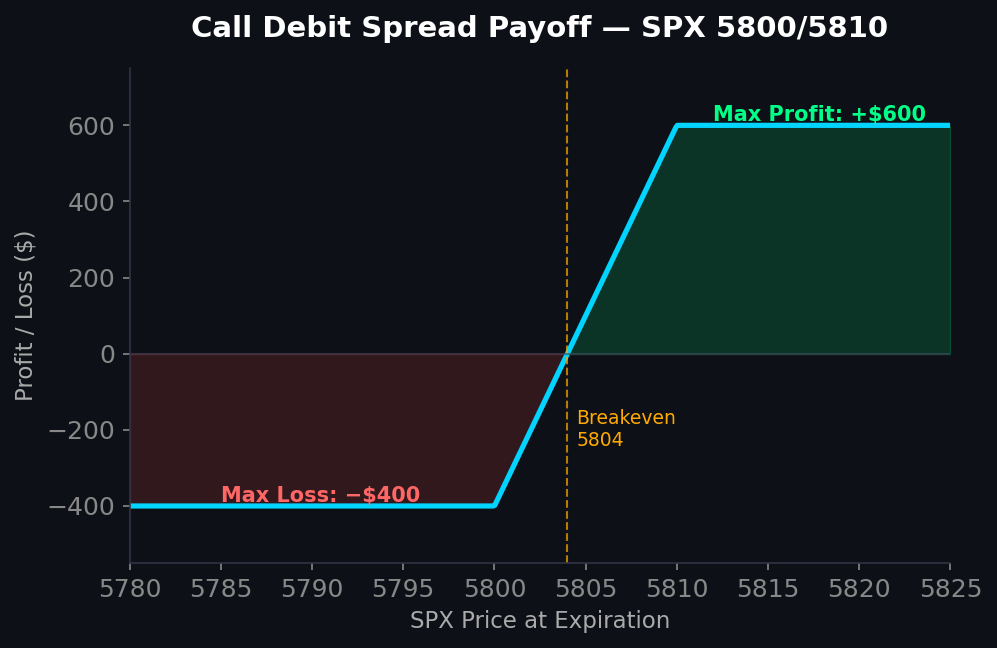
For 0DTE SPX traders, also review how the position’s risk changed as price moved. A payoff graph can show whether the trade remained within your intended exposure or whether an adjustment introduced more complexity than the original plan justified. Defined risk does not mean a trade cannot become uncomfortable. It means the discomfort has boundaries you understood before clicking the order button.

Review at Three Different Speeds
A single end-of-day review is not enough. The best process uses three time horizons: immediate, daily, and weekly.
The immediate review takes two minutes after the trade closes. Record the facts while they are fresh. Did you follow the plan? What triggered the exit? Was there anything unusual about execution, liquidity, or your own behavior?
The daily review happens after the session, when the clock is no longer forcing decisions. This is the time to compare your trade to the market structure and identify one lesson. Not ten. One. You might find that you entered too close to a key level, waited too long to reduce risk, or passed on a valid setup because of a prior loss.
The weekly review is where you look for repetition. One trade is a story. Ten or twenty trades can be data. Group trades by setup, time of day, market condition, and execution quality. You are not searching for a magic signal. You are looking for evidence that your rules are clear enough to repeat and your risk is small enough to survive normal variance.
The Metrics That Matter More Than Being Right
Win rate is easy to understand and easy to misuse. It tells you how often trades closed favorably. It does not tell you whether your position sizing was sound, whether losses were controlled, or whether one outsized mistake erased a month of disciplined work.
Instead, measure adherence. What percentage of trades met every entry rule? How often did you size within your limits? How often did you hold or adjust exactly as planned? How many losses came from valid trades versus rule violations?
Also track loss size relative to your predefined maximum risk. If a defined-risk strategy regularly creates losses larger than expected, investigate the mechanics. Start from a clean risk sizing example. Was the position truly defined risk? Did you close at a different price because of spreads or liquidity? Did you add contracts? Did you combine positions in a way that changed the total exposure?
The goal is not to eliminate losses. That is fantasy. The goal is to eliminate the risk of ruin by making losses survivable, expected, and contained. The OCC’s options education is a steady reference for the mechanics.
Tag Your Mistakes So They Stop Repeating
Use consistent tags for errors. Four or more categories justify a simple list:
- Oversized position
- Early entry
- Late exit
- Rule-breaking adjustment
- Trading outside approved conditions
- Emotional re-entry
Tags turn vague frustration into something measurable. If “early entry” appears repeatedly, the solution may be a rule requiring confirmation before entry. If “emotional re-entry” appears after losses, the solution may be a mandatory pause after a stopped trade. Do not try to fix everything at once. Pick the highest-frequency error or the error with the greatest risk impact.
Use Live Trade Review as Training, Not Signal Delivery
A live trade review can accelerate learning, but only if you use it as a laboratory. The point is not to copy another trader’s position. The point is to compare your reasoning with a professional process and identify the gap.
Bring a specific question. Why was this structure inappropriate for the market context? Was my size too large relative to the risk graph? Did I confuse a directional opinion with a structural setup? Specific questions create specific improvements.
At FatTail.ai, trade review is designed around this kind of independence. The useful takeaway is not “what did someone else trade?” It is “what evidence supported the decision, what risk was accepted, and could I apply that framework myself next time?” Not signals. Not alerts. A repeatable way to think.
Turn the Review Into One Change
A review that never changes behavior is just recordkeeping. Honest review is one of the best habits for consistent traders. At the end of each week, write one operating rule for the next week. Keep it narrow and observable.
For example: “I will not enter a new 0DTE position during the first part of the session unless my approved setup conditions are present.” Or: “I will reduce planned contract size until I complete ten trades with full rule adherence.” These are process commitments, not predictions.
Then review the rule itself at week’s end. Did it reduce errors? Did it create an unintended problem? Keep, refine, or discard it based on evidence. This is how a trading framework becomes personal without becoming random.
Your next trade review does not need to be perfect. It needs to be honest. Record what happened, separate the decision from the result, and make one correction you can execute under pressure. That is how you stop depending on being right and start building a process that can hold up when the market does not cooperate.
Frequently Asked Questions
What is trade review for?
To separate execution from outcome. It tells you whether your position, size, entry, adjustments, and exit matched your plan, rather than whether the market happened to cooperate. A good trade can lose and a poor trade can win, so outcome alone trains you to chase luck.
How do you review trades without grading on P&L?
Review in two passes: an objective pass capturing the facts (structure, entry time, SPX level, strikes, risk, size, planned exits, context) before memory rewrites them, then a diagnostic pass asking whether those facts show disciplined execution. The key question is whether you would take the same trade again in the same conditions.
How often should you review trades?
At three speeds. An immediate two-minute review after the trade to capture facts, a daily review after the session to draw one lesson, and a weekly review to find repetition across ten or twenty trades grouped by setup, time of day, condition, and execution quality.
What metrics matter more than win rate?
Adherence: what percentage of trades met every entry rule, how often you sized within limits, and how often you held or adjusted as planned. Also track loss size relative to your defined maximum risk. The goal is not to eliminate losses but to keep them survivable and contained.
How do you stop repeating the same trading mistakes?
Tag errors consistently (oversized position, early entry, late exit, rule-breaking adjustment, trading outside approved conditions, emotional re-entry), then fix the highest-frequency or highest-impact one with a specific rule. End each week by writing one narrow, observable operating rule for the next.
FATTAIL BRIEFINGS
Get FatTail briefings in your inbox
Pick the lists you want. FOMC Alerts is selected by default.