

title: “The Time Warp Trade Guide (FIRST DRAFT for Coach’s markup)”
status: “DRAFT v0.1 · 2026-10-25 · NOT PUBLISHED · do not post”
Editor’s block (remove before publishing)
| Field | Proposal |
|---|---|
| SEO title | The Time Warp Trade: A 1DTE SPX Batman Butterfly Strategy | FatTail |
| Meta description | Coach Ernie’s Time Warp: two far-OTM SPX butterflies (a “Batman”) placed right before the close for the next session. Width by regime, the 5% pricing rule, and patient management. |
| Slug | /time-warp-trade/ (checked: 404 today, so it’s free) |
| H1 | The Time Warp Trade: Buy Tonight, Get Paid by Tomorrow’s Gap |
| Primary keyword | time warp trade |
| Secondary keywords | batman options strategy, batman butterfly, 1dte spx strategy, 1dte butterfly, overnight options trade, spx butterfly strategy, out of the money butterfly |
| Schema | Article + FAQPage |
| Visuals | 10 charts in visuals/time-warp-guide/ (all hypothetical, captioned) |
| Sources | Coach’s description 2026-10-25; Final Hour transcripts E022 and E032 (/workspace/timewarp/tx/) |
The Time Warp Trade: Buy Tonight, Get Paid by Tomorrow’s Gap
The complete, step-by-step guide: prerequisites, afternoon prep, building the Batman, order entry, overnight, the open, exits, settlement and your journal.
By Coach Ernie, FatTail. Updated October 25, 2026.
Risk first. Options can lose all the money you put into a trade. Every number in this guide is a hypothetical example, not a result or a promise. This is education, not financial advice.
What is the Time Warp?
It’s super simple. The Time Warp is a 1DTE trade: you place it the day before, right before the market closes, for the next session. You buy two butterflies, well out of the money: a put fly below the market and a call fly above it.
We call it a Batman because the risk graph looks like Batman’s ears.
We’ve been playing the Time Warp on The Final Hour with great success. It’s part of our VIX playbook, and it fits the way we trade: risk a little, wait patiently, and let the occasional big move pay for everything.
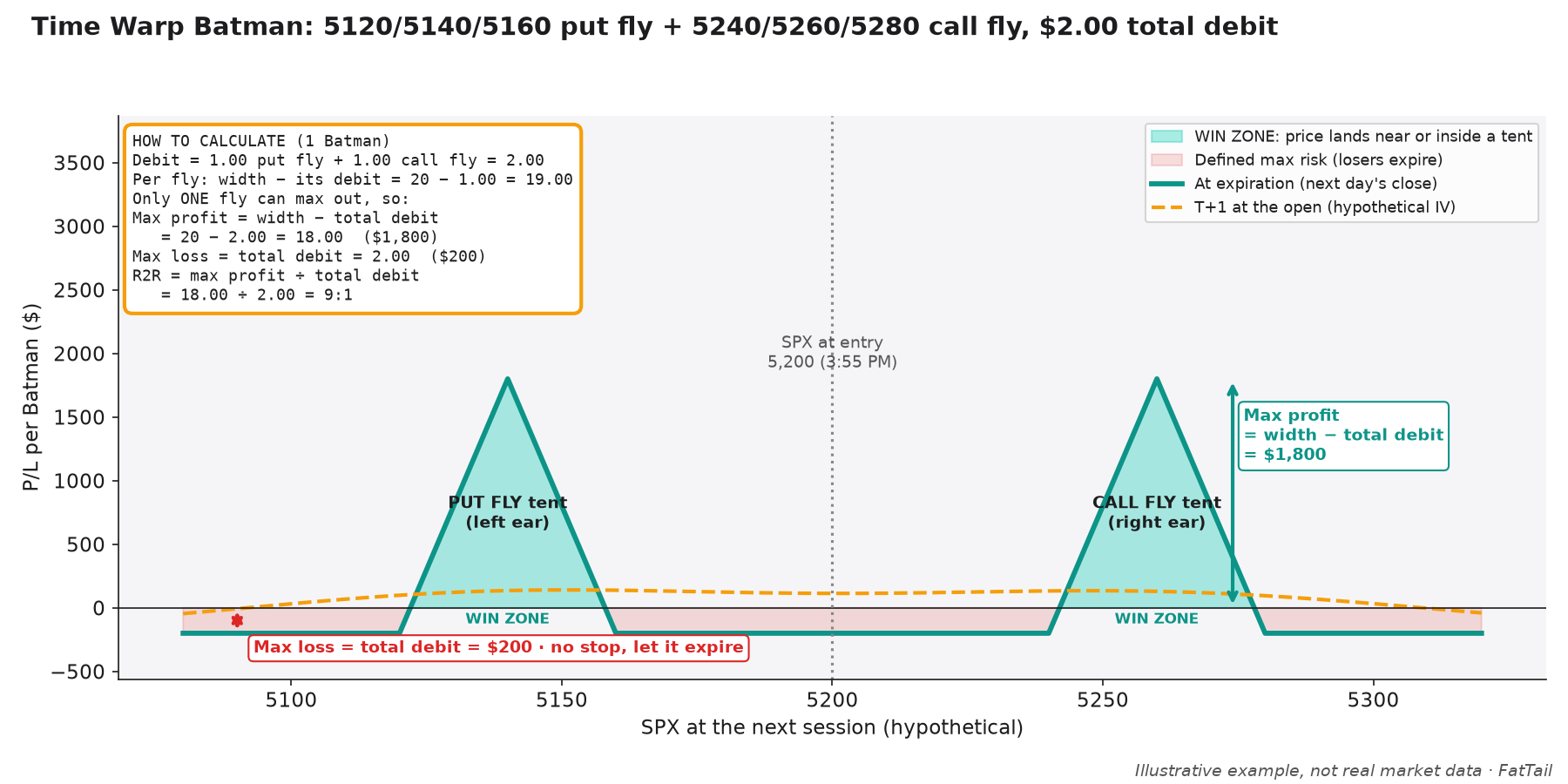
Illustrative example, not real market data. Hypothetical strikes and prices. The T+1 curve is a model estimate at the next open.
The one principle: manage the winners, not the losers
You don’t manage the losses. You stay patient and take big wins when price lands near or inside one of the butterfly tents.
- The small debit is your defined max risk. You know it at entry.
- There’s no stop-loss. A losing Batman is simply allowed to expire.
- All of your management goes into the winners: be patient, and take the big win when price lands near or inside a tent (the win zone on the chart).
That’s the whole trade. Everything below is detail.
Why it works: you’re paying for the overnight
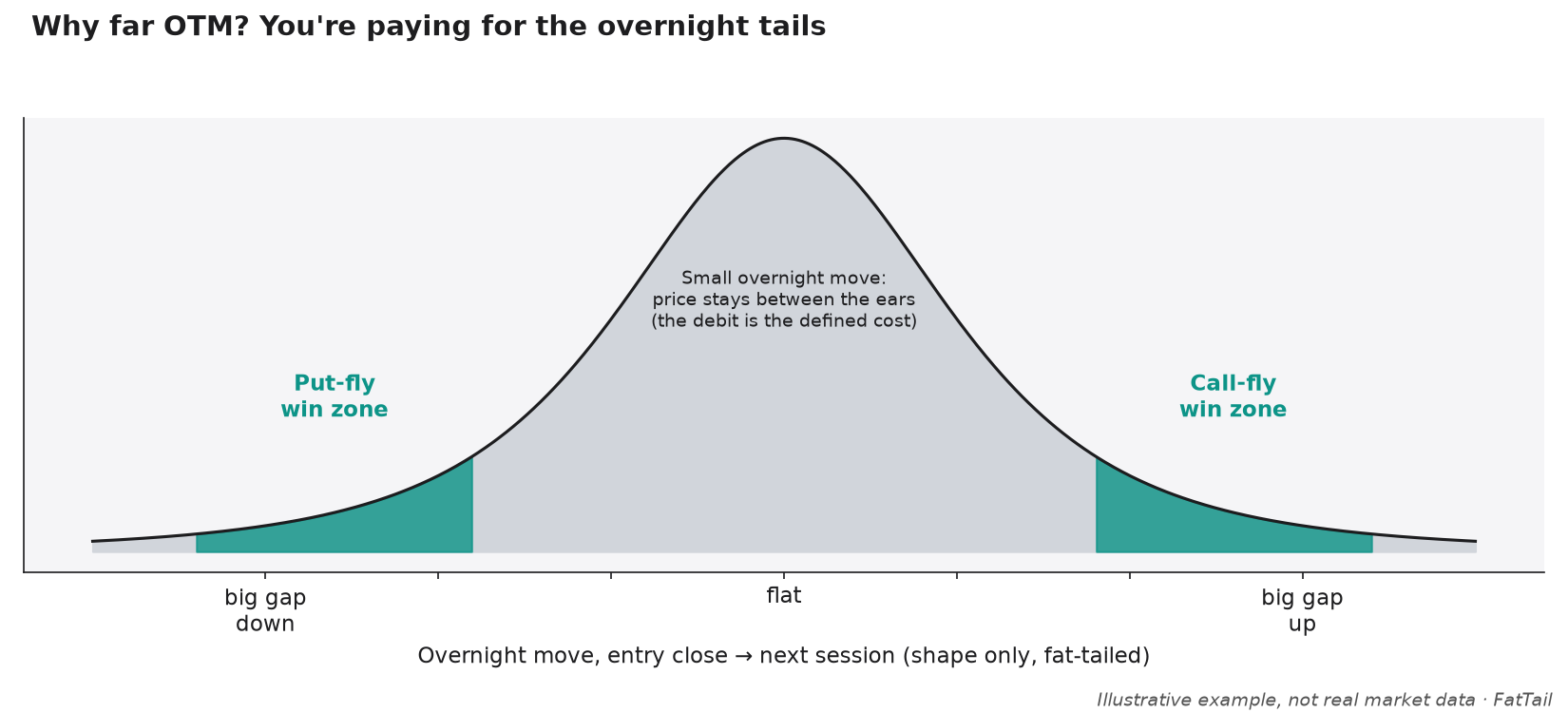
Illustrative example, not real market data. Shape only.
Placing flies this far out of the money looks like a mistake at first. It isn’t. You’re counting on overnight movement or gaps. Between the close and the next open, news, futures and global markets can move SPX more than a calm afternoon ever would. Because the flies are so far out, they’re cheap, so a small, known cost buys you exposure to the move.
Why not put it on earlier in the day? In Coach’s words from the show: it would be a lot more expensive, and you’re not going to get those kinds of moves.
The routine: analysis, execution, reflection
The Time Warp lives inside the same daily routine as everything we teach (see the 0DTE Strategy Guide [VERIFY: that URL goes live when the guide publishes]). And the same Shu Ha Ri applies: follow the setup exactly as written first, then adapt it, then make it your own.
The whole cycle at a glance
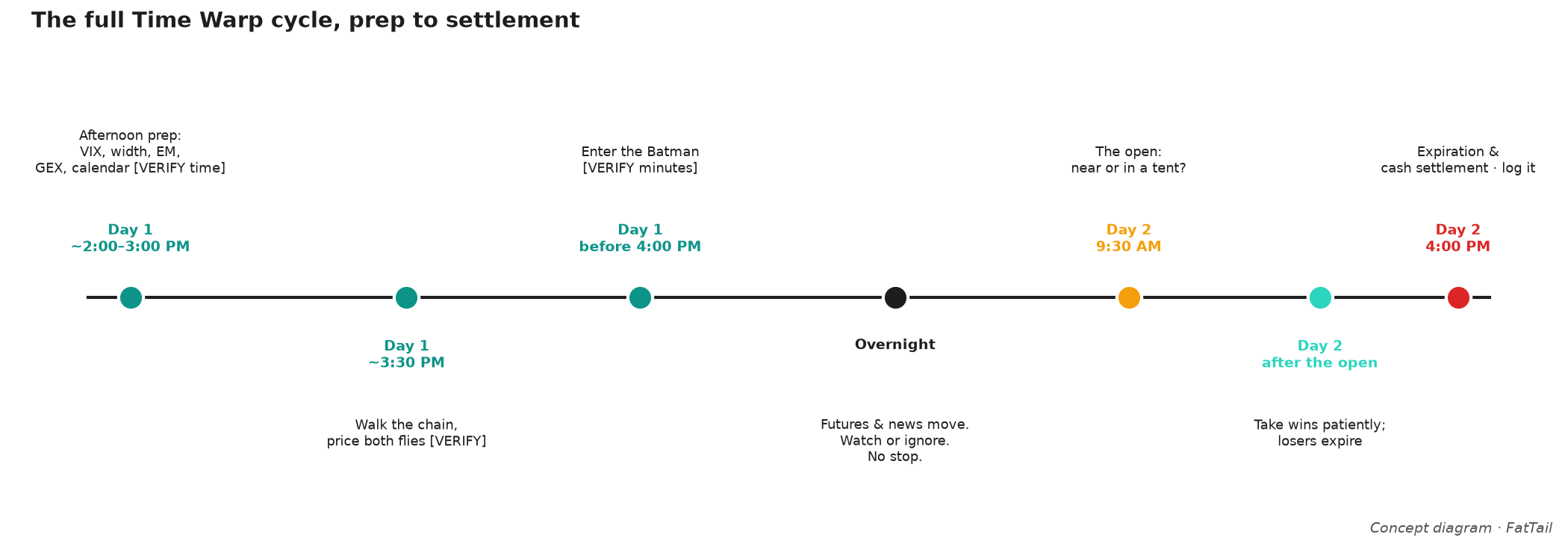
Concept diagram. Times marked [VERIFY] are placeholders until Coach confirms them.
0. Prerequisites (before your first Time Warp)
What you’re trading. The Time Warp uses SPX index options, specifically the SPXW weekly/daily series, which list an expiration every trading day (SPX expiration schedule). That’s what makes a 1DTE trade possible every session.
Key facts, and why they matter here:
| Feature | SPX / SPXW | Why it matters for the Time Warp |
|---|---|---|
| Settlement | Cash-settled. No shares change hands | You can’t be assigned stock overnight or at expiration |
| Exercise style | European. Exercisable only at expiration | No early assignment on your short options while you hold |
| Settlement time | SPXW dailies are PM-settled off the closing value (the standard monthly SPX is AM-settled) | Your 1DTE fly settles on the next day’s close |
| Multiplier | $100 per point | A $1.00 fly debit = $100; an 18-point max profit = $1,800 |
| Taxes (US) | Index options are generally Section 1256 contracts | Not tax advice. Ask your tax professional |
Your account needs:
– [ ] A margin or options account at a broker that offers SPX/SPXW index options (not every broker does).
– [ ] Options approval for multi-leg spreads (butterflies). Brokers name their approval levels differently. Ask for the level that allows debit spreads and butterflies. [VERIFY: which brokers Coach recommends, if any]
– [ ] A platform that can enter a butterfly as one order (buy 1 / sell 2 / buy 1) and show next-day expirations.
– [ ] A risk-graph or analysis tool so you can see the Batman’s ears before you click.
– [ ] Your position-size rule written down. [VERIFY: Coach’s sizing rule]
Practice first. Shu means following the form exactly. Paper-trade the full cycle (prep → entry → open → log) for [VERIFY: number of sessions] before you put real money on it.
Daily prep routine (afternoon)
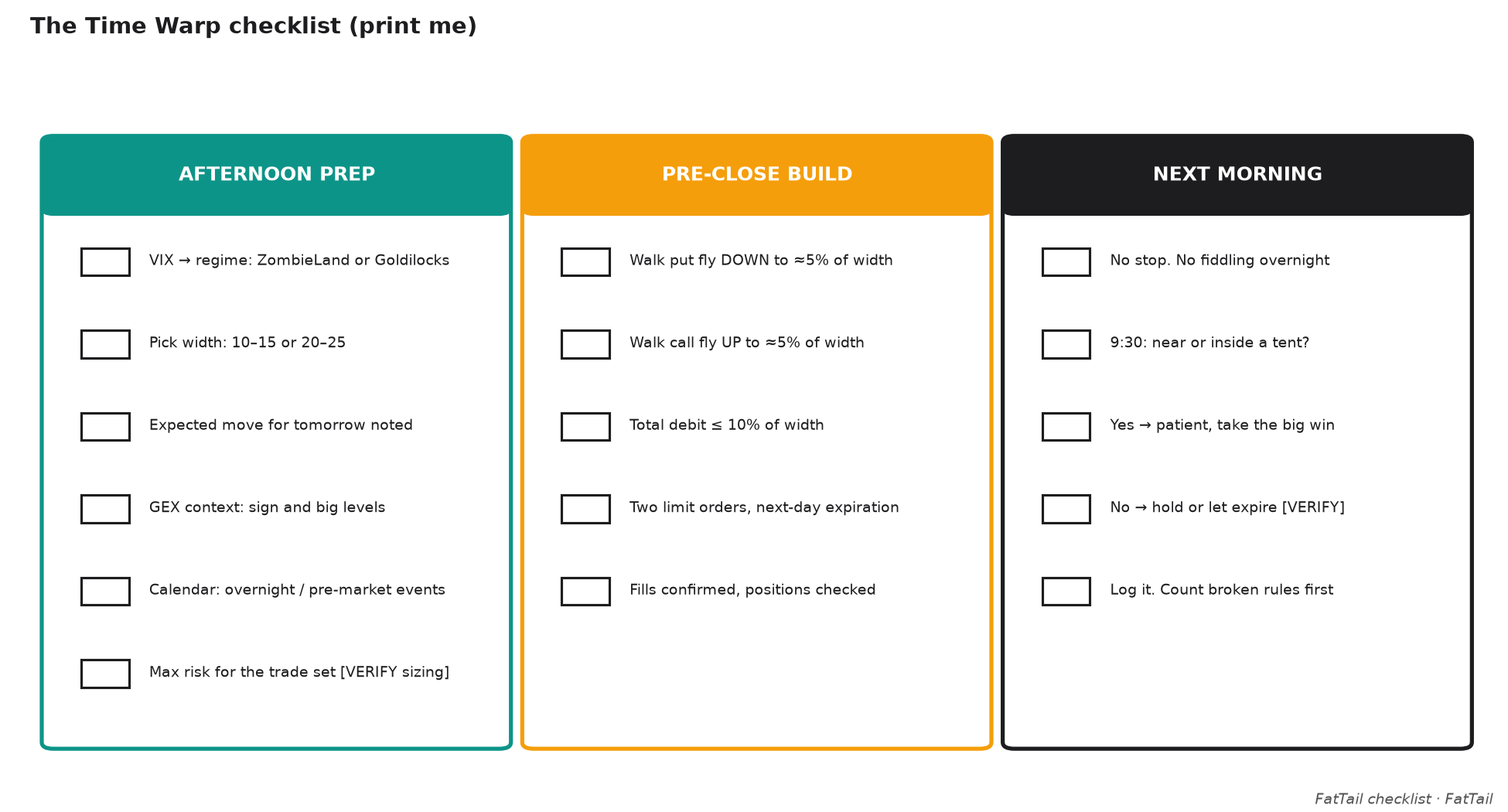
FatTail checklist. Print it.
Do this every afternoon before you decide whether to place a Time Warp. [VERIFY: the time Coach starts prep, e.g. during the Final Hour]
- Read the regime from the VIX. ZombieLand (low volatility) or Goldilocks (higher volatility)? See the regime table in step 1 below. [VERIFY: boundaries]
- Choose the width. ZombieLand → 10–15 wide. Goldilocks → 20–25 wide.
- Check the expected move for the next session (Expected Move explained). It tells you how far a “normal” overnight-plus-day move might travel, and how far out your 5%-priced flies are landing compared with it.
- Check GEX context (GEX explained): positive or negative overall, and the big call and put walls. Note them in your log. [VERIFY: does Coach use GEX for Time Warp strike placement or only as context?]
- Check the calendar for overnight event risk: scheduled economic releases before the next open (jobs, CPI, Fed), big earnings after the close, holidays and early closes. Events are part of why overnight gaps happen. [VERIFY: does Coach skip, size down, or prefer the Time Warp on event nights?]
- Decide: trade or no trade. If the regime isn’t one where the Time Warp is viable, skip it and log “no trade” with the reason.
1. Analysis
Read the volatility regime. The regime sets the wing width.
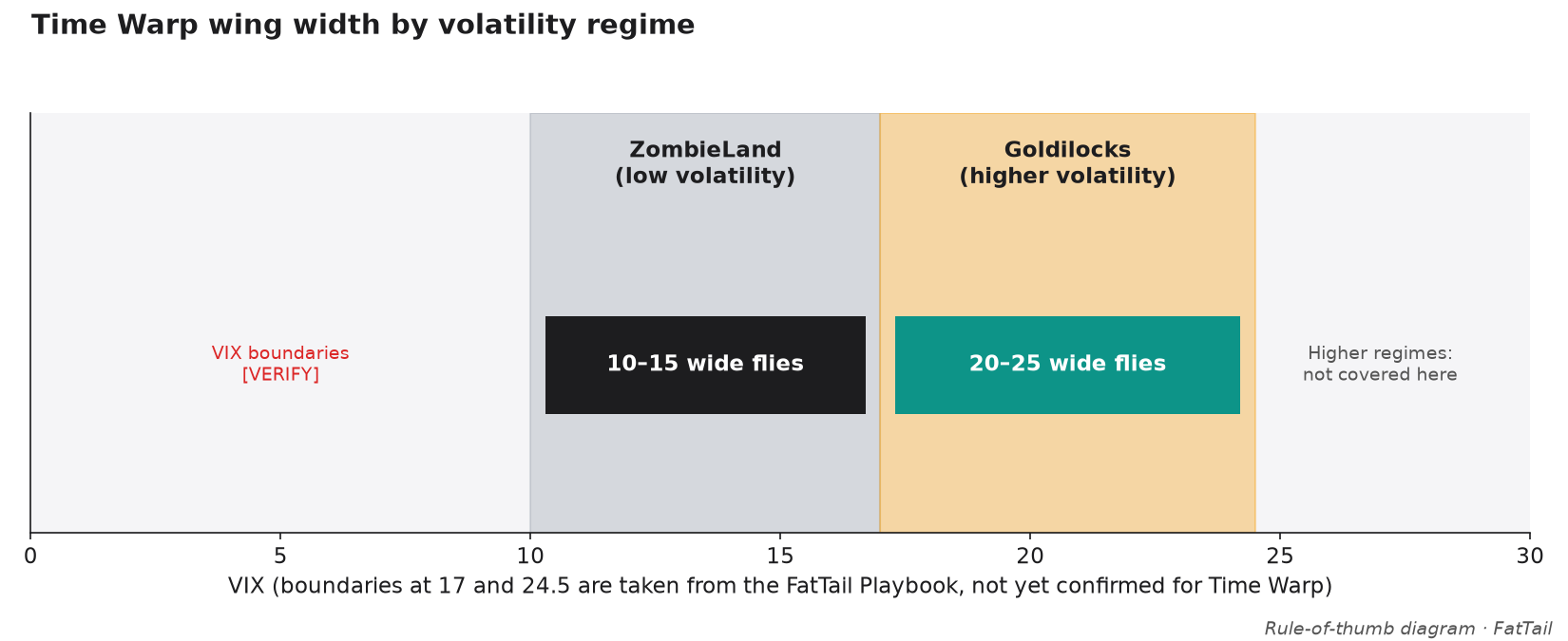
Rule-of-thumb diagram.
| Regime | What it feels like | Fly width |
|---|---|---|
| ZombieLand (low volatility) | “Like being chased by zombies and running through mud” | 10–15 wide |
| Goldilocks (higher volatility) | Volatility in a workable range | 20–25 wide |
On the show Coach has also said a Batman on a 0DTE day belongs to higher volatility, while in lower volatility you consider the Batman as a 1DTE trade, which is the Time Warp.
2. Setup
- Structure: one OTM put butterfly below the market and one OTM call butterfly above it. Same expiration: the next session.
- Width: by regime (above).
- Pricing: the 5% rule. Price each fly so its debit averages about 5% of its width. A 20-wide costs about a $1.00 debit. Coach’s ceiling on the show: never pay more than 10% of the max profit potential for the whole Batman, so two 20-wides are limited to $2.00 total.
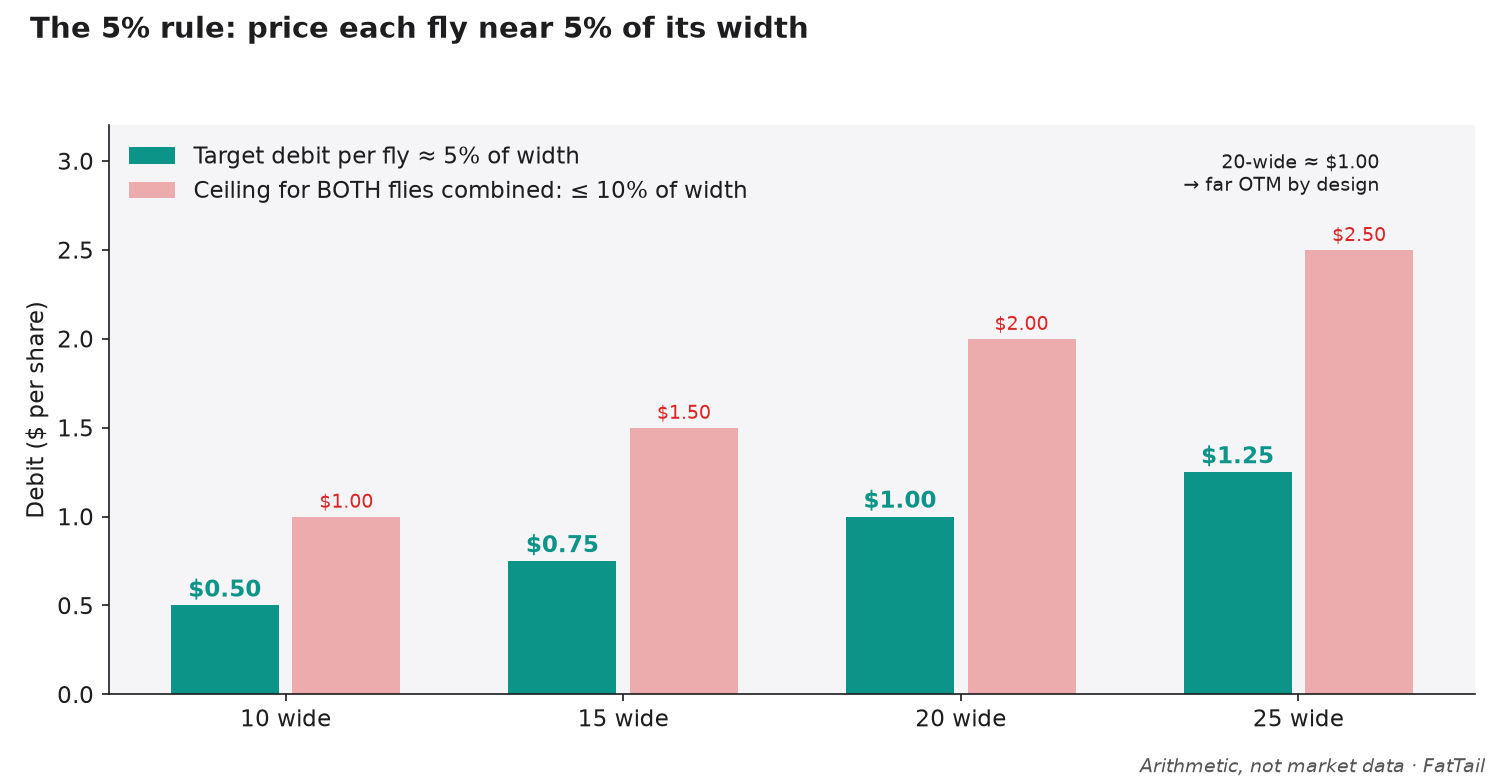
Arithmetic, not market data.
The price sets the strikes, not the other way around: you walk each fly out until it costs about 5% of its width. That’s what puts them so far out of the money. [VERIFY: Coach’s strike-selection detail. Do you start from the expected move, GEX levels, or just walk out to the price? Must both flies sit about the same distance from the market? On the show (E022) Coach “reeled in” the call fly a bit at all-time highs.]
Building each fly: a worked walkthrough
Hypothetical: SPX is at 5,200, the regime is Goldilocks, so you pick 20-wide flies. Your target is about 5% of 20 = $1.00 per fly.
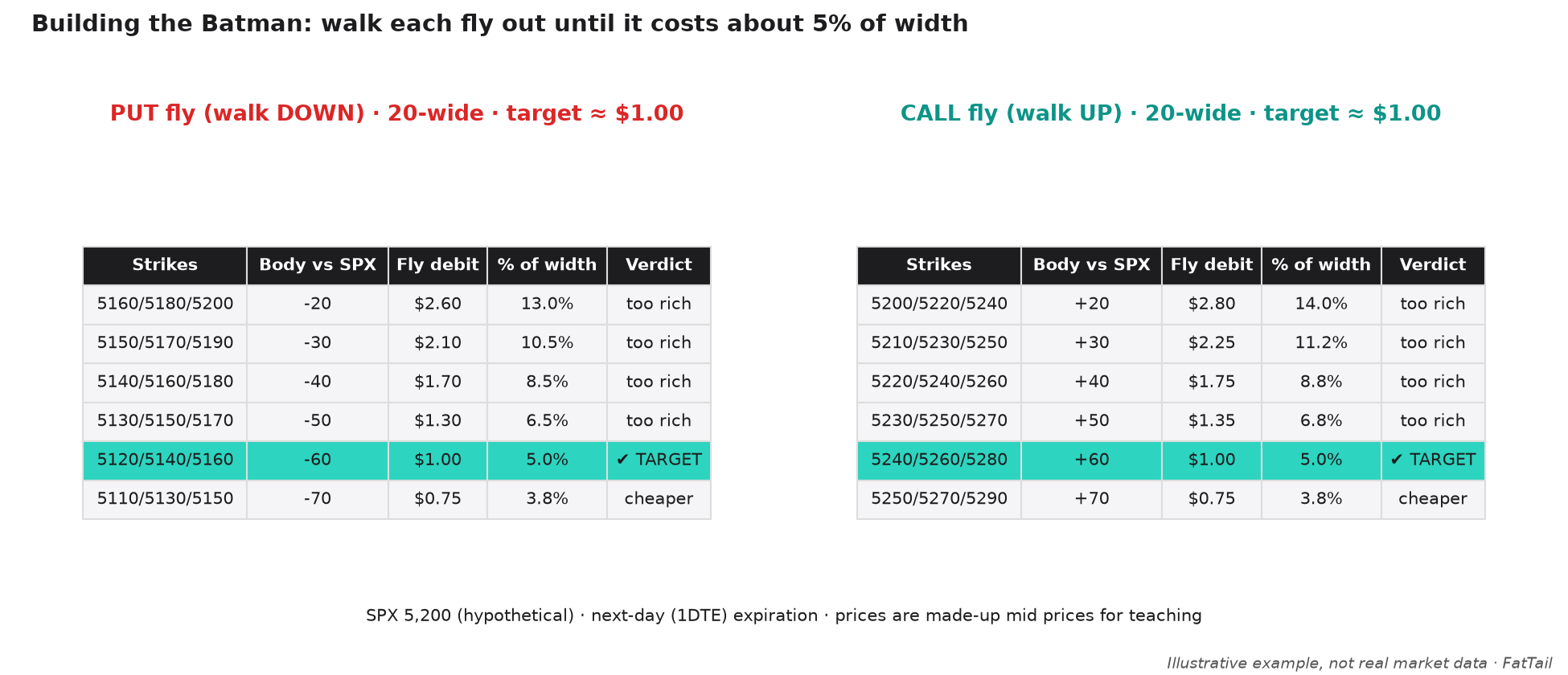
Illustrative example, not real market data. Made-up mid prices for teaching.
Put fly (walk DOWN):
1. Start with the body near the market, e.g. 5160/5180/5200. Too rich (13% of width).
2. Move the whole fly down 10 points at a time. Keep the wings 20 away from the body on each side.
3. Stop when the mid price is about $1.00: here 5120/5140/5160, body 60 points below SPX.
Call fly (walk UP): the same thing in the other direction, landing at 5240/5260/5280, body 60 points above SPX.
Sanity checks before you send:
– [ ] Each fly ≈ 5% of width; the whole Batman ≤ 10% of width (here $2.00).
– [ ] Wings symmetric (20 / 20) on each fly.
– [ ] Both flies on the next-day expiration.
– [ ] The risk graph shows two ears with a valley around today’s price.
Skew means the two sides won’t always land the same distance from the market; put prices are usually richer. That’s normal: you price to the 5% rule, not to a distance. [VERIFY: Coach’s strike-selection detail, as noted above]
How to calculate it (hypothetical 20-wide Batman)
- Total debit = $1.00 put fly + $1.00 call fly = $2.00 ($200)
- Max profit per fly = width − that fly’s debit = 20 − 1.00 = 19.00
- But only ONE fly can max out. SPX can’t close at both bodies. The other fly’s debit is lost, so for the whole Batman:
- Max profit = width − total debit = 20 − 2.00 = 18.00 ($1,800)
- Max loss = total debit = $200
- R2R = max profit ÷ total debit = 18.00 ÷ 2.00 = 9:1
That matches Coach’s own walk-through on the show: “We take $200 of risk going after $1,800 of profit potential.” Paying less than 10% pushes the ratio further. Coach mentioned ratios from 1:9 out to around 1:20 when the debit is lower.
3. Execution
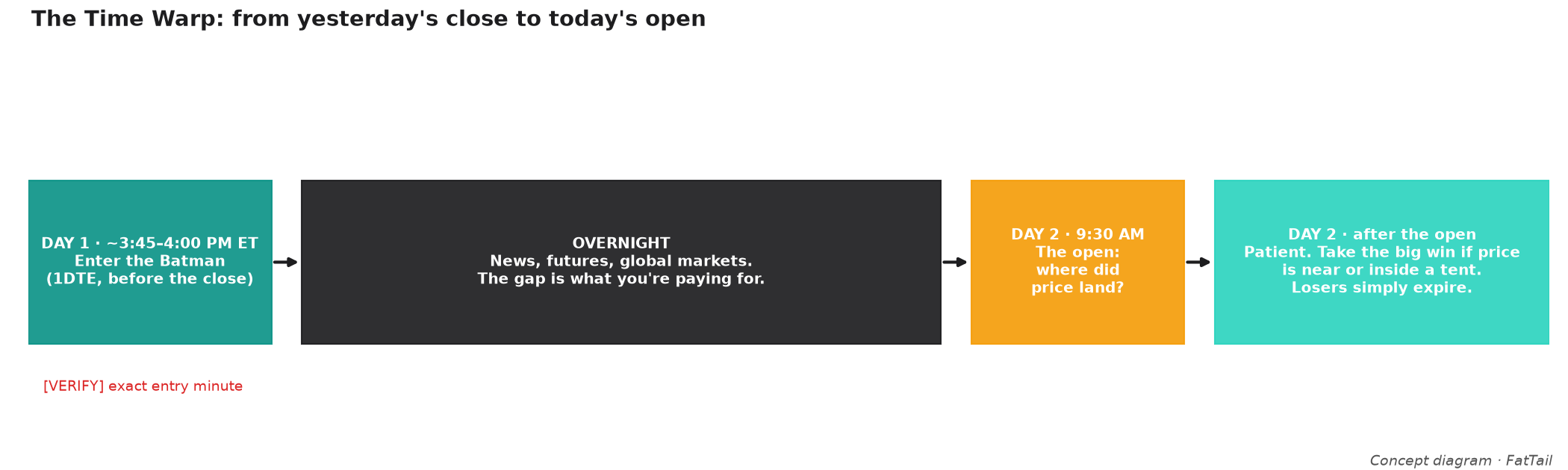
Concept diagram.
Pre-close setup: minute-by-minute
[VERIFY: all times are placeholders until Coach confirms the entry window.]| Time (ET) | Do this |
|---|---|
| ~3:30 PM | Prep done: regime, width, expected move, GEX, calendar logged. Decide trade or no trade |
| ~3:35 PM | Open the next-day chain. Walk the put fly down and the call fly up to ≈5% of width |
| ~3:40 PM | Check the risk graph: two ears, total debit ≤ 10% of width |
| ~3:45 PM | Stage both orders (limit, debit, DAY) |
| [VERIFY] entry window, e.g. ~3:45–3:55 PM | Send. Work the price if needed (below) |
| Before 4:00 PM | Confirm fills, positions and the expiration date. Log entry time, strikes, debits, SPX |
Entry
- When: right before the market closes, the day before. [VERIFY: the exact entry window, e.g. the last 10–15 minutes.]
- What: the put fly and the call fly, next-day expiration, each priced near 5% of its width. Limit orders.
- Size: [VERIFY: Coach’s position-sizing rule. On the show he put on “two positions as always” in one example; confirm whether that’s a rule.]
Order entry: the butterfly ticket
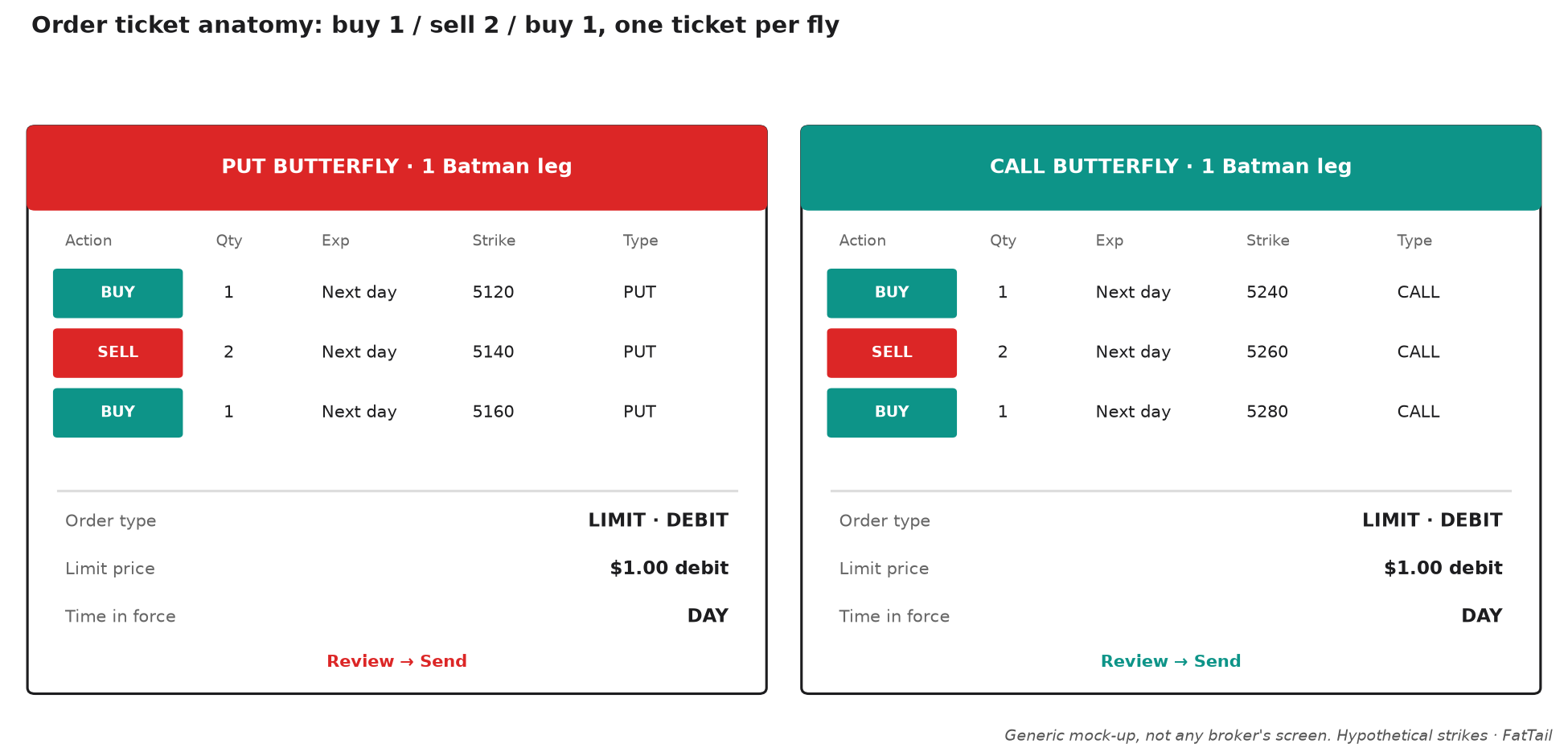
Generic mock-up, not any broker’s screen. Hypothetical strikes.
Anatomy of one fly:
– BUY 1 lower strike · SELL 2 middle strike (the body) · BUY 1 upper strike. All puts (put fly) or all calls (call fly). Same expiration.
– Order type: LIMIT, as a net debit. Never a market order on a multi-leg spread.
– Limit price: your 5% target (e.g. $1.00 on a 20-wide).
– Time in force: DAY.
Two orders or one? Enter each fly as its own butterfly order (two tickets). It’s simple, each fly fills at its own price, and you can close them separately tomorrow, which is exactly what you’ll want when only one ear pays. [VERIFY: does Coach ever send the Batman as one 6-leg order?]
Working the order:
1. Start at or a little below the mid.
2. If it doesn’t fill, step the price by a nickel at a time. Don’t chase past the 5% target per fly or the 10% ceiling total.
3. If one fly fills and the other doesn’t, keep working the other one; don’t overpay to finish the pair. [VERIFY: Coach’s rule if only one side fills before the close]
4. Confirm the fill price and log it.
Don’t leg in. Always enter the fly as a single butterfly order, never leg by leg. Legging can leave you with a naked short option if the market moves between clicks.
Overnight: watch or ignore, but don’t touch
- What moves overnight: S&P futures trade nearly around the clock, and news (economic data, earnings, global markets) can push the next open well away from today’s close. That gap is what you paid for.
- Watch if you like; it changes nothing. There’s no stop to set and nothing to adjust. Your max loss is already known: the debit.
- Stay patient. The trade isn’t decided at 2 AM. It’s decided at and after the open.
[VERIFY: does Coach ever close a Time Warp in the overnight session if a fly gets rich?]
At the open: the decision tree
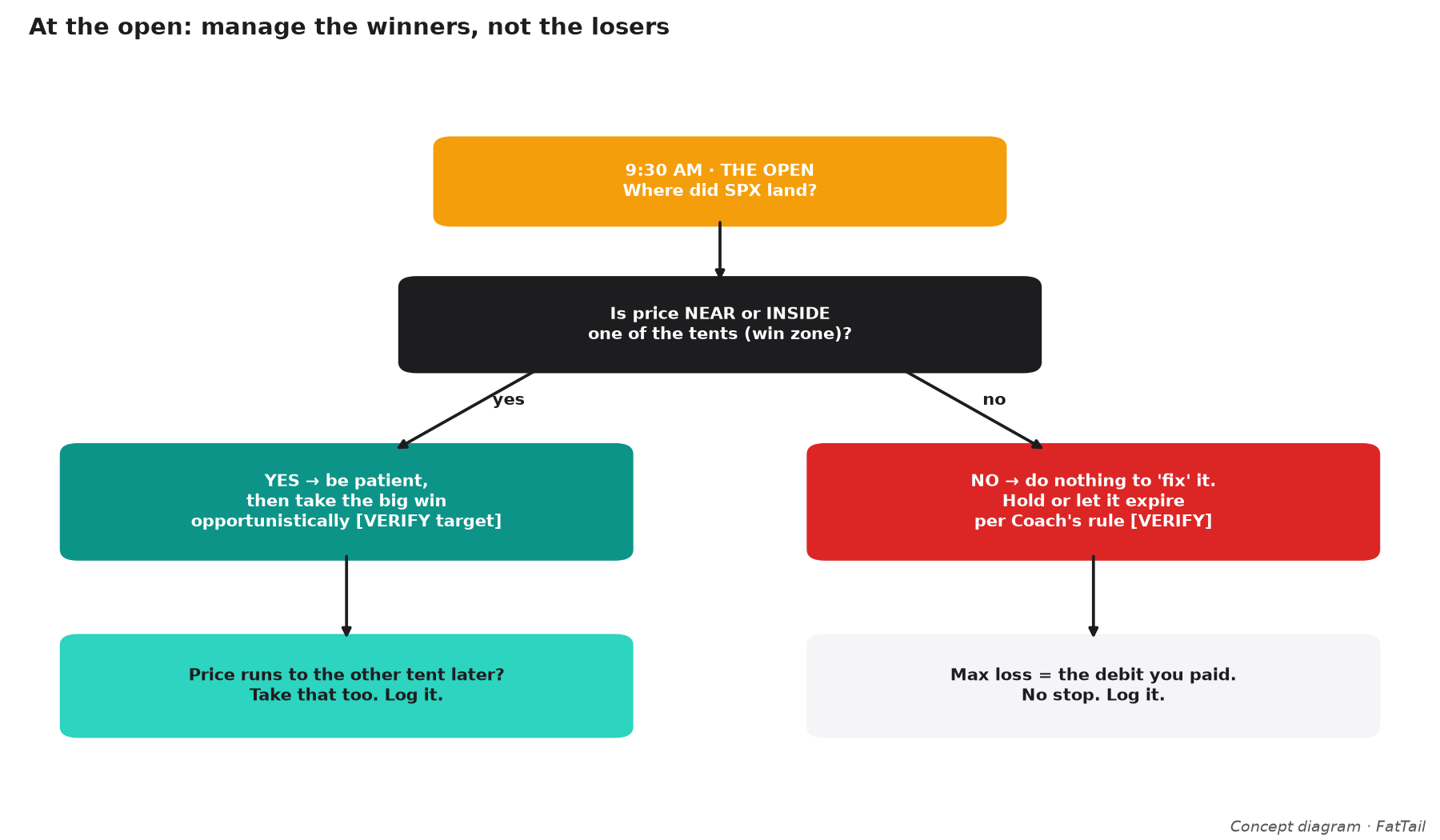
Concept diagram.
Exit: patience with the winners
- Wait until the open. Don’t touch it overnight.
- At the open, look where price landed. If it’s near or inside a tent, that fly is in the win zone.
- Be opportunistic about taking profits. A little patience can land a huge winner relative to the cost of the trade.
- Losers expire. There’s no stop to hit and nothing to fix. The debit was the cost of the ticket.
Exit mechanics
- Closing a winner: send a SELL order on that butterfly as one ticket (sell 1 / buy 2 / sell 1), LIMIT, net credit. Price it at or near the mid, then step it if needed.
- Close each fly on its own ticket. Usually only one ear is worth anything.
- Don’t leg out of the winner. Closing one leg at a time can leave you with unbalanced risk while the market moves.
- Losing fly: nothing to do. You don’t sell a worthless fly to “manage” it; it expires. [VERIFY: does Coach ever sell a near-zero fly to free up capital?]
- If you hold to expiration: SPXW dailies settle in cash on the closing value. A fly that finishes inside its tent pays its intrinsic value automatically; one outside it expires worthless. [VERIFY: confirm Coach’s guidance on holding a winner into settlement versus selling before the close]
Sometimes price runs to one side, pays well, then “leaves the stadium” and comes back toward the other side for a small profit there too. Big profits on both sides are rare.
4. Risk management
The debit is the risk management. You don’t manage the losses.
- Defined risk: max loss = total debit, known before you click.
- No stop-loss, no adjusting, no adding. You let losers expire.
- Cheap by rule: the 5% target and the 10% ceiling keep each ticket small.
- Win rate: Coach says you should average about 60% of your trades being winners. That’s Coach’s figure from running the trade, not a guarantee. [VERIFY: confirm the wording and the period it’s based on before publishing.]
- Size small enough that a run of expiring losers doesn’t change your behavior. [VERIFY: sizing rule, as above.]
5. Reflection
Log every Time Warp, winners and losers alike. At the end of the week, count broken rules first.
Trade log template
| Date | Regime / VIX | SPX at entry | Entry time | Put fly (strikes) | Put debit | Call fly (strikes) | Call debit | Total debit (% of width) | SPX at open | Gap (pts) | Near or in a tent? | Exit time | Exit price | P/L $ | R multiple | Rules followed? | Lesson |
|---|---|---|---|---|---|---|---|---|---|---|---|---|---|---|---|---|---|
Filled example (hypothetical, not a real trade):
| Field | Example |
|---|---|
| Date | Day 1 → Day 2 (hypothetical) |
| Regime / VIX | Goldilocks / [hypothetical] |
| SPX at entry | 5,200 at 3:50 PM |
| Put fly | 5120/5140/5160 for $1.00 |
| Call fly | 5240/5260/5280 for $1.00 |
| Total debit | $2.00 (10% of width) = $200 max risk |
| SPX at the open | 5,235 (gapped up 35) |
| Near or in a tent? | Call tent, near the lower wing |
| Action | Patient. SPX drifts to 5,255; call fly sold for a hypothetical $12.00 |
| Put fly | Let it expire |
| P/L | $1,200 − $200 = $1,000 (hypothetical) |
| R multiple | +5R on $200 risk |
| Rules followed? | Yes |
| Lesson | Waiting past the open paid; didn’t touch the put fly |
Weekly review (Sunday Retrospective)
- Count broken rules first: overpaid? Entered early? Touched a loser? Took a winner too soon or too late?
- Then look at the trades: wins vs expirations; which ear paid; gap size vs the expected move; regime.
- Change one thing at a time and write it down. That’s how Shu becomes Ha.
Reflection questions
– Did I pay more than 5% per fly, or more than 10% in total?
– Did I enter right before the close, or chase earlier in the day?
– When I won, did I take it, or did I wait past the win zone?
– When I lost, did I let it expire, or did I fiddle with it?
Common mistakes
- Overpaying. Paying 8–10% per fly instead of about 5% kills the ratio. Keep the whole Batman ≤ 10% of width.
- Pulling the flies in “so they have a chance.” Far OTM is the design. You’re paying for the gap.
- Entering too early in the day. It costs much more, and the moves you want come overnight.
- Managing the loser. No stops, no rolls, no adding. Let it expire.
- Grabbing the first green number at 9:31. A little patience can land a huge winner relative to the cost.
- Legging in or out. Always trade the fly as one order.
- Market orders on spreads. Always limit.
- Wrong expiration. It must be the next session.
- Ignoring the regime. Wrong width for the volatility you’re in.
- Not logging. No log, no reflection, no improvement.
One-page printable checklist
(Also the graphic above: “The Time Warp checklist.”)
Afternoon prep
– [ ] VIX → ZombieLand or Goldilocks
– [ ] Width: 10–15 or 20–25
– [ ] Expected move noted
– [ ] GEX sign and walls noted
– [ ] Calendar: overnight / pre-market events
– [ ] Size set [VERIFY]
Pre-close build
– [ ] Put fly walked down to ≈5% of width
– [ ] Call fly walked up to ≈5% of width
– [ ] Total ≤ 10% of width
– [ ] Two limit-debit butterfly orders, next-day expiration
– [ ] Fills confirmed and logged
Next morning
– [ ] No stop, no overnight fiddling
– [ ] 9:30: near or inside a tent?
– [ ] Yes → patient, take the big win
– [ ] No → hold or let it expire [VERIFY]
– [ ] Log it
Glossary
- 1DTE: one day to expiration. The option expires at the next session’s close.
- Batman: an OTM put butterfly below the market plus an OTM call butterfly above it. The risk graph looks like Batman’s ears.
- Body: the middle strike of a butterfly, where you sell 2. Max payoff is at the body at expiration.
- Butterfly (fly): buy 1 / sell 2 / buy 1, equal distance between strikes, all calls or all puts.
- Debit: what you pay to open. For a long fly, it’s your max loss.
- European-style: exercisable only at expiration; no early assignment.
- Cash-settled: settles in cash, not shares.
- Expected move: the market’s implied estimate of how far price may travel by expiration.
- GEX (gamma exposure): an estimate of dealer hedging pressure by strike.
- Gap: the difference between one session’s close and the next session’s open.
- Goldilocks: FatTail’s name for a higher-volatility regime (“just right”).
- R2R (reward-to-risk): max profit ÷ max loss.
- SPXW: the SPX weekly/daily options series, PM-settled.
- Tent: the triangle-shaped profit area of a butterfly on the risk graph. The tents are the win zone.
- Time Warp: Coach’s 1DTE Batman, placed right before the close for the next session.
- Width (wing width): the distance from a wing strike to the body.
- Win zone: price near or inside a tent.
- ZombieLand: FatTail’s name for a low-volatility regime (“like running through mud”).
Watch it live
See the Time Warp placed on The Final Hour. We put it on near the close, on screen, and you can watch it play out at the next open. Start your Observer trial → fattail.ai/try [VERIFY: trial terms before stating price on-page]
Free: the 0DTE Strategy Guide and its downloadable playbook. [VERIFY: add Time Warp as a Strategy Watcher option?
/tools/strategy-watcher/isn’t live yet.]
Frequently asked questions
What is the Time Warp trade?
A 1DTE SPX trade placed right before the close for the next session: two far out-of-the-money butterflies, a put fly below and a call fly above.
Why is it called a Batman?
Two tents, one on each side of the market. The risk graph looks like Batman’s ears.
How wide should the flies be?
10–15 wide in low-volatility ZombieLand; 20–25 wide in higher-volatility Goldilocks.
How much should each fly cost?
About 5% of its width, so a 20-wide costs about $1.00. Keep the whole Batman at or under 10% of the max profit potential.
What’s the max profit and max loss?
Max profit = width − total debit, because only one fly can max out. Max loss = total debit. On a hypothetical 20-wide Batman for $2.00: $1,800 vs $200, a 9:1 reward-to-risk ratio.
Do you use a stop-loss?
No. You don’t manage the losses. The small debit is the defined max risk, and losers are allowed to expire. You manage the winners: patiently take the big win when price lands near or inside a tent.
What’s the win rate?
Coach says you should average about 60% winners. That’s his figure, not a promise.
Why not place it earlier in the day?
It would cost a lot more, and the moves you’re paying for happen overnight and at the open.
Can I do a Batman on a 0DTE day?
Coach uses the 0DTE Batman in higher volatility. In lower volatility, the Batman becomes the 1DTE Time Warp.
Internal links (checked 2026-10-25)
- 0DTE Butterfly Strategy Guide (200)
- SPX Options Guide (200) · SPX Options Expiration (200)
- 0DTE Long Butterfly Strategy Explained (200)
- Expected Move (200) · VIX Explained (200) · Time Decay (200) · Gamma Exposure (GEX) (200)
- 0DTE Strategy Guide: 404 until that draft publishes
- /try/ (301 → /product/observer/)
Educational only. Not financial advice. 0DTE options carry substantial risk of loss.