


FOMC Alerts · November 24, 2026
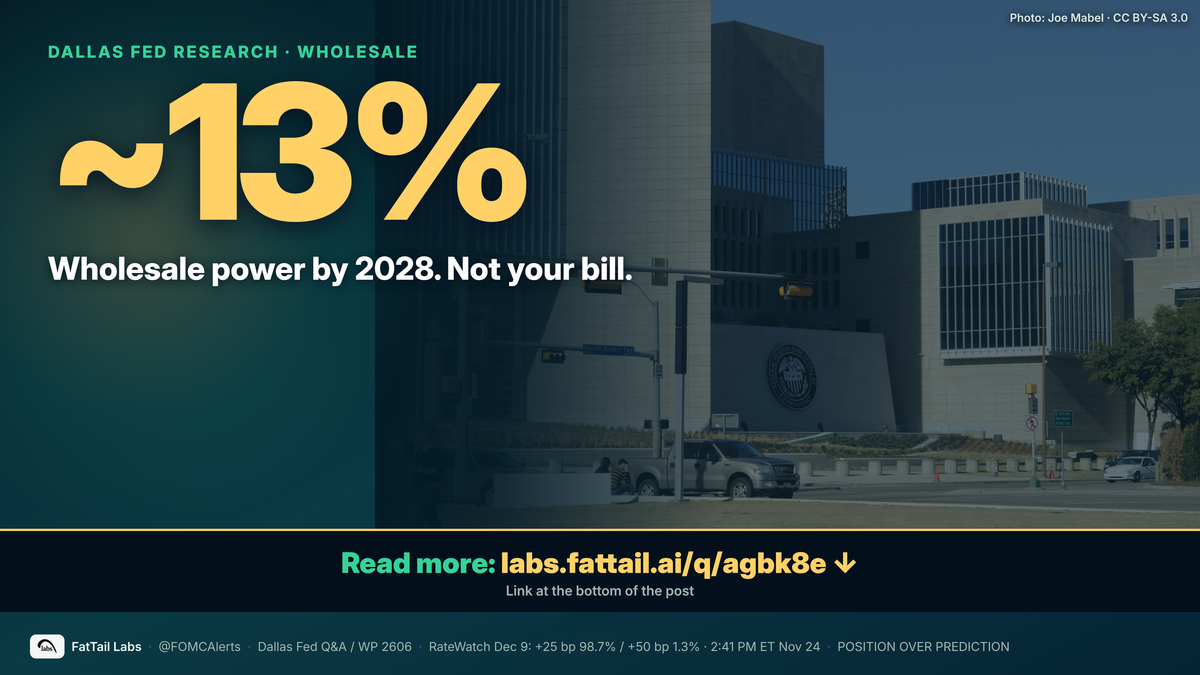
On Monday, Nov. 23, the Federal Reserve Bank of Dallas published an on-the-record Southwest Economy Q&A with research economist Reid Taylor, built on Dallas Fed Working Paper 2606 (Kay, Reaser and Taylor, revised October 2026). It puts a counterfactual number on data centers electricity prices in wholesale markets: about a 7 percent increase nationally so far, and around 13 percent by 2028, each compared with a modeled world that has no data centers. Those rounded figures are Taylor’s, from the Q&A. The paper’s preferred-scenario numbers are 6.9 percent by 2025 and 12.3 percent by 2028. This is staff research, not an FOMC policy signal, and it is not a forecast of retail bills or of the CPI.
Data centers electricity prices: what the number measures
The percentages are a gap versus a no-data-center counterfactual. They are not a change in the price level, and they are not a household bill. The paper uses an hourly, unit-level dispatch model of 23 U.S. regional markets that trade over capacity-constrained interfaces. It looks back over 2021–2025 and projects 2026–2028 under low, mid-range and high utilization scenarios. The authors frame it as a short-run, partial-equilibrium exercise.
In the preferred scenario, the national wholesale gap reaches 12.3 percent by 2028. The 2028 range across scenarios is wide: 5.2 percent on the low side and 55.2 percent on the high side. About half of the increase in generator payments, the paper finds, is a transfer to inframarginal generators. How much of any wholesale gap reaches households depends on contracts, cost-of-service regulation, and who pays for new transmission. Taylor said the cost of energy makes up, on average, around 50 percent of a retail bill. In the Q&A he also said data centers in ERCOT are potentially adding 60 gigawatts within a handful of years. That wording is “potentially,” not a cap.
Why prices spill to places with few data centers
“Just because your county or your city is not getting a data center, doesn’t mean you’re not going to be affected by higher electricity prices,” Taylor said. In his Q&A, California — a region with few data centers — sees about an 18 percent increase by 2028 through grid trade; the paper’s figure for that region is 17.2 percent. He also said Virginia would see about 43 percent higher prices in 2028. That 43 percent figure is from the Q&A only. It is not in the paper, whose mid-range figure for the northern Virginia zone is 27.6 percent, and we do not use it as a headline.
Other regional figures in the Q&A also differ slightly from the paper and should be read that way. Taylor put Virginia and North Carolina at about 16 percent so far; the paper has 15.0 percent for northern Virginia. He put ERCOT at only about 10 percent so far; the paper has 12.6 percent for 2024–25. For 2028, he put ERCOT at about 30 percent; the paper’s figures are 28.0 percent and 29.4 percent in two exhibits.
Advertisement · From FatTail Labs

Observer: train with Coach for $17/week
A six-week trial and training program built to install pro trading habits: live daily coaching, courses, a Discord trade room and the full FatTail platform.
A narrow inflation bridge, and a Williams contrast
Do not map a wholesale counterfactual onto the CPI. Electricity is 2.513 percent of CPI-U relative importance as of September 2026, with energy services at 3.245 percent and energy at 7.649 percent, per BLS CPI Table 2 in the October CPI 2026 release. Electricity rose 0.9 percent seasonally adjusted in October, after +0.2 percent in September and −0.2 percent in August. There is no official October 12-month electricity rate, because October 2025 data are unavailable after the 2025 lapse in appropriations. From the BLS not-seasonally-adjusted index (CUUR0000SEHF01), we calculate a September 12-month change of 309.852 / 296.887, or +4.4 percent. That is our calculation, not a BLS-published rate.
The Q&A was published on Nov. 23, the same day New York Fed President John C. Williams, a permanent FOMC voter, said in prepared remarks: “Although the effects of tariffs, geopolitical conflicts, and the AI surge are showing up in prices of certain categories of goods, there is little evidence of these spilling over significantly into broader and more persistent inflation.” That sentence covers tariffs, geopolitical conflicts and the AI surge together, and it is about goods. It does not mention electricity, and it is not a rebuttal of the Dallas Fed estimates. Taylor does not comment on monetary policy or on inflation persistence. The broader AI-and-inflation debate is a separate official-text question.
RateWatch, our ZQ futures method, still has the December 9 path at +25 bp 98.71 percent, +50 bp 1.29 percent and hold 0 percent, as of 2:41 PM ET Nov. 24. January 27 stands at +25 bp 66.59 percent and hold 33.41 percent; March 17 at +25 bp 59.13 percent and hold 40.87 percent. The current target range is 3.75–4.00 percent. Those odds were already in the high 90s for a December hike before this Q&A, and we do not read them as a reaction to it. As of Tuesday, December 9 is 15 days away. Wednesday’s October PCE, at 8:30 AM ET, is the next scheduled inflation print.
What it means for 0DTE
- Energy: This is staff research and commentary, not policy and not a scheduled event. The week’s scheduled event risk is Wednesday’s October PCE at 8:30 AM ET.
- Premium: Let the VIX price it. After Monday’s close the VIX was 26.62, with VIX1D near 26.69; premium is still elevated into PCE and the run-up to December 9.
- Structure: Defined risk, with max loss known before entry. Size for gaps around the PCE release, not for a research note.
- Plan, don’t predict: This paper does not reset the December path. Map two PCE scenarios for Wednesday — a firm print that keeps January hike paths in play, and a softer one that pulls them back — and prepare for both.
Related reading: FOMC Alerts · FOMC meeting schedule 2026 · Warsh on AI inflation · How oil prices affect interest rates · October CPI 2026
Sources
- Data center surge powering questions of who pays electricity bills (Q&A with Reid Taylor) (Federal Reserve Bank of Dallas, Southwest Economy, Nov 23, 2026)
- Processing Power: The Effect of Data Centers on Wholesale Electricity Markets (Working Paper 2606, revised October 2026) (Federal Reserve Bank of Dallas (Kay, Reaser and Taylor), Rev. Oct 2026)
- The Economic Mixdown (remarks as prepared for delivery) (Federal Reserve Bank of New York, John C. Williams, Nov 23, 2026)
- Consumer Price Index — October 2026, Table 2 (U.S. Bureau of Labor Statistics, Oct 2026 (relative importance as of Sept 2026))
Trade it with structure
Observer is a six-week trial and training program: train with Coach for $17/week. You get everything a full coaching member gets, every week, and the six weeks are designed to install pro trading habits: courses on strategy, process and risk management, live daily coaching, a Discord trade room with hundreds of experienced traders, and the platform (heatmap, GEX tools, risk graph, position analyzer and journal). Start Observer.
Educational content, not investment advice. Options involve risk and are not suitable for all investors.
FATTAIL BRIEFINGS
Get FatTail briefings in your inbox
Pick the lists you want. FOMC Alerts is selected by default.