


FOMC Alerts · October 21, 2026
The 2026 FOMC meeting schedule at a glance
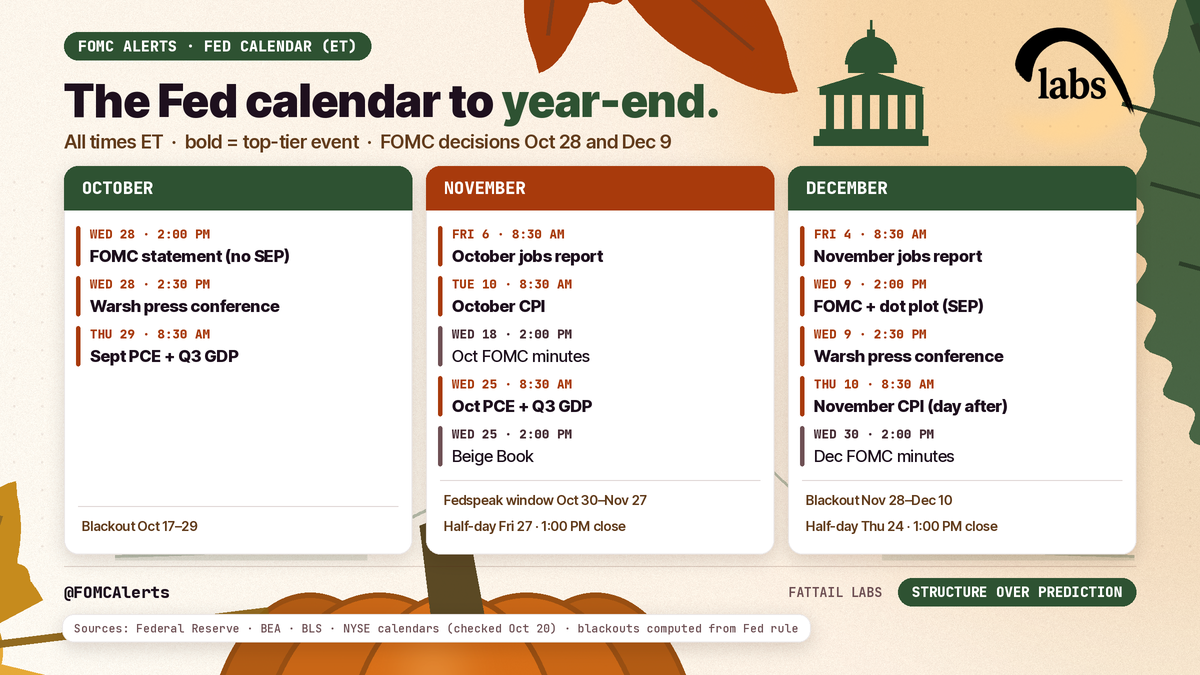
The 2026 FOMC meeting schedule has two decisions left: Wednesday, Oct 28, and Wednesday, Dec 9. Both statements are set for 2:00 PM ET, and Chair Kevin Warsh’s press conference follows at 2:30 PM ET, so both land inside the SPX and SPY 0DTE session. Only December is a Summary of Economic Projections meeting. The next dot plot comes on Dec 9, not Oct 28 (Federal Reserve meeting calendar; Fed October and December calendars). The full list of FOMC dates 2026, with SEP meetings and minutes release days, is in the table below.
When is the next FOMC meeting?
The next FOMC meeting is Dec 8–9, 2026, the last meeting of the year, with the statement at 2:00 PM ET on Wednesday, Dec 9. The Oct 27–28 meeting is over; its statement came at 2:00 PM ET on Wednesday, Oct 28.
The order of events matters more than the dates. The Fed decides on Oct 28 without September PCE, which BEA publishes at 8:30 AM ET the next morning together with the advance Q3 GDP estimate (BEA). It decides on Dec 9 without November CPI, which BLS publishes at 8:30 AM ET on Dec 10 (BLS). In both weeks, the session after the Fed opens with a top-tier inflation print stacked on top of the FOMC reaction.
This page is a reference for the rest of the year. All times are Eastern. We checked every date against the Fed, BEA, BLS and NYSE calendars on Oct 20, 2026. Where a date is our reading of a Fed rule rather than a date the Fed publishes, we say so, and anything the issuer hasn’t confirmed is marked TBC.
Is there an FOMC meeting in November 2026?
No. The Federal Reserve’s 2026 calendar lists no November meeting. The last meeting was October 27–28, and the next is December 8–9, a Summary of Economic Projections meeting. November still carries data the Fed will weigh: BEA publishes Personal Income and Outlays (PCE), October 2026, on November 25 at 8:30 AM ET (BEA).
FOMC meeting schedule 2026: all eight meetings
| Meeting | Decision day | Statement (ET) | Press conference (ET) | SEP / dot plot | Minutes |
|---|---|---|---|---|---|
| Jan 27–28 | Wed Jan 28 | Held | Yes | No | Released Feb 18 |
| Mar 17–18 | Wed Mar 18 | Held | Yes | Yes | Released Apr 8 |
| Apr 28–29 | Wed Apr 29 | Held | Yes | No | Released May 20 |
| Jun 16–17 | Wed Jun 17 | Held | Yes | Yes | Released Jul 8 |
| Jul 28–29 | Wed Jul 29 | Held | Yes | No | Released Aug 19 |
| Sep 15–16 | Wed Sep 16 | Held | Yes | Yes | Released Oct 7 |
| Oct 27–28 | Wed Oct 28 | 2:00 PM | 2:30 PM | No | Wed Nov 18, 2:00 PM |
| Dec 8–9 | Wed Dec 9 | 2:00 PM | 2:30 PM | Yes (time TBD, see note) | Wed Dec 30, 2:00 PM |
For the last meeting of the year — Dec 8–9, with an SEP — see our December Fed meeting preview.
How to read it: the Fed marks SEP meetings with an asterisk on its calendar page, and this year that’s March, June, September and December. The page lists a press conference for every 2026 meeting held so far. Each 2026 minutes release has come exactly three weeks after the decision, and the Fed’s November and December calendars list Nov 18 and Dec 30, both at 2:00 PM, for the last two.
One open item: the December calendar lists the meeting at 2:00 PM but gives no separate time for the projections. At this year’s SEP meetings the projection materials were posted with the statement, so 2:00 PM is the expected time for the dot plot, but treat it as TBC until the Fed confirms. The 2027 schedule isn’t covered here.
Fed calendar through December: the days that carry energy
These are the rows that matter for an SPX session, Oct 21 through Dec 31. The tiers are our labels. High means a Fed decision or a top-tier data release. Medium means a secondary release or a Fed document. Structure means a blackout, holiday or half-day. Weekly balance-sheet releases and minor BLS reports are left out. Sources: Fed Oct, Nov and Dec calendars, BEA, BLS Oct, Nov and Dec schedules, and NYSE holidays and hours.
| Date | Time (ET) | Event | Tier |
|---|---|---|---|
| Sat Oct 17 – Thu Oct 29 | All day | FOMC blackout for the October meeting (our dates from the Fed rule) | Structure |
| Wed Oct 28 | 2:00 PM | FOMC statement, Oct 27–28 meeting (no SEP) | High |
| Wed Oct 28 | 2:30 PM | Chair Warsh press conference | High |
| Thu Oct 29 | 8:30 AM | September PCE (Personal Income and Outlays) + Q3 GDP advance, BEA | High |
| Fri Oct 30 | 8:30 AM | Employment Cost Index, Q3, BLS | Medium |
| Tue Nov 3 | 10:00 AM | JOLTS, September, BLS | Medium |
| Fri Nov 6 | 8:30 AM | Employment Situation (jobs), October, BLS | High |
| Tue Nov 10 | 8:30 AM | CPI, October, BLS | High |
| Wed Nov 11 | — | Veterans Day: Fed holiday, Fed releases move to Thu Nov 12. NYSE is open | Structure |
| Fri Nov 13 | 8:30 AM | PPI, October, BLS | Medium |
| Wed Nov 18 | 2:00 PM | FOMC minutes, Oct 27–28 meeting | Medium |
| Wed Nov 25 | 8:30 AM | October PCE + Q3 GDP second estimate, BEA | High |
| Wed Nov 25 | 2:00 PM | Beige Book (last of 2026) | Medium |
| Thu Nov 26 | — | Thanksgiving: NYSE closed | Structure |
| Fri Nov 27 | 1:00 PM close | NYSE early close (1:15 PM for eligible options) | Structure |
| Sat Nov 28 – Thu Dec 10 | All day | FOMC blackout for the December meeting (our dates from the Fed rule) | Structure |
| Tue Dec 1 | 10:00 AM | JOLTS, October, BLS | Medium |
| Fri Dec 4 | 8:30 AM | Employment Situation, November: the last jobs report before the Dec FOMC | High |
| Wed Dec 9 | 2:00 PM | FOMC statement + Summary of Economic Projections (dot plot) | High |
| Wed Dec 9 | 2:30 PM | Chair Warsh press conference | High |
| Thu Dec 10 | 8:30 AM | CPI, November, BLS: the morning after the Fed | High |
| Tue Dec 15 | 8:30 AM | PPI, November, BLS | Medium |
| Wed Dec 23 | 8:30 AM | November PCE + Q3 GDP third estimate, BEA | High |
| Thu Dec 24 | 1:00 PM close | NYSE early close (1:15 PM for eligible options) | Structure |
| Fri Dec 25 | — | Christmas: NYSE closed | Structure |
| Wed Dec 30 | 2:00 PM | FOMC minutes, Dec 8–9 meeting | Medium |
Two things on this list can still move. BLS and BEA can revise release dates, so check them again the week of each print. The Fed also adds speeches and testimony as they’re scheduled.
Advertisement · From FatTail Labs

Observer: train with Coach for $17/week
A six-week trial and training program built to install pro trading habits: live daily coaching, courses, a Discord trade room and the full FatTail platform.
Fed blackout periods and the Fedspeak window
Under the FOMC’s policy on external communications, reaffirmed in January 2026, participants stop commenting on monetary policy and the economy from 12:00 AM ET on the second Saturday before a meeting until 11:59 PM ET on the day after it. Applied to this year’s dates, that puts the blackouts at Oct 17–29 and Nov 28–Dec 10. The Fed doesn’t post those dates on its calendar. They’re our application of its rule.
That leaves Oct 30 to Nov 27 as the window when officials can talk, and the October minutes land inside it on Nov 18. As of Oct 20, the Board’s calendar lists no speeches or testimony by Board members from Oct 21 through Dec 31. Reserve Bank presidents’ appearances aren’t on that calendar, and we haven’t checked them, so expect Fedspeak in the open window even though none is listed yet.
What the Fed sees before December, and what it doesn’t
Four mornings feed the December decision: October jobs on Nov 6, October CPI on Nov 10, October PCE on Nov 25 and November jobs on Dec 4. That’s where December pricing gets built. November CPI arrives the morning after the decision. For where October and December pricing stands now, see our October FOMC hike odds piece.
Nov 25 is the most crowded day on the list. PCE and GDP hit at 8:30 AM, and the year’s last Beige Book lands at 2:00 PM. That’s the day before Thanksgiving, which is followed by a closed Thursday and a 1:00 PM close on Friday. Holiday liquidity around a data day is its own kind of risk.
How FOMC days have traded
FatTail’s FOMC history dataset (scheduled rate decisions; SPX and VIX from Cboe, yields from FRED) gives the base rates. They describe the past. They aren’t a forecast for Oct 28 or Dec 9.
- FOMC days vs other days (Jan 2015 to Oct 16, 2026; 93 decision days, 2,869 other days): median SPX intraday range 1.11% vs 0.87%, median absolute close-to-close move 0.56% vs 0.49%, and a 1%+ close on 33.3% vs 24.2%.
- SEP meetings: median range 1.20% (n=46) vs 0.99% at non-SEP meetings (n=47). VIX closed lower on 58.7% of SEP days vs 51.1%.
- VIX overall: it closed lower on 54.8% of FOMC days, about the same as other days (54.5%). This close-to-close measure misses any intraday crush.
- The next session: median absolute SPX move of 0.58% the day after FOMC vs 0.49% on a typical day.
- December meetings, 2015–2025: median absolute move 0.81% and median range 1.43%, with n=11, a small sample. It includes Dec 19, 2018 (-1.54%, 3.78% range) and Dec 18, 2024 (-2.95%, VIX up 11.75 points).
The limits: these are daily closes and daily highs and lows, so they don’t separate the morning from the 2:00 PM window. Minutes days and Beige Book days haven’t been measured.
What it means for 0DTE
- Energy: The scheduled event risk sits in the High rows: the 8:30 AM data opens and the two 2:00 PM statements. Oct 28–29 and Dec 9–10 are two-session events. Blackout weeks are quiet on the calendar, which doesn’t mean a quiet tape.
- Premium: Let the VIX price it. FOMC days have carried more range, and a lower VIX close after the statement has been close to a coin flip, so don’t build a plan around IV crush. Check the expected move against these base rates before you sell premium into 2:00 PM.
- Structure: Use defined-risk structures and know the max loss before entry. Size for the gap into the next morning’s 8:30 print if anything is held overnight. On the Nov 27 and Dec 24 half-days the session is shorter, and NYSE lists 1:15 PM for eligible options. Confirm SPX option hours with Cboe (TBC).
- Plan, don’t predict: Mark the High rows a week ahead and decide in advance whether you trade the 2:00–3:00 PM window at all. The calendar tells you when the energy arrives, not which way it goes.
Related reading: How to Manage Expiration Day in 0DTE SPX · Expected Move in Options: The Range That Defines Every 0DTE Session · How to Plan Market Scenarios for 0DTE SPX · More FOMC Alerts
Sources
- Meeting calendars and information (Federal Reserve, Accessed Oct 20, 2026)
- Calendar: November 2026 (Federal Reserve Board, Accessed Oct 20, 2026)
- Calendar: December 2026 (Federal Reserve Board, Accessed Oct 20, 2026)
- FOMC Policy on External Communications of Committee Participants (Federal Reserve, Reaffirmed Jan 27, 2026)
- Release Schedule (U.S. Bureau of Economic Analysis, Accessed Oct 20, 2026)
- Schedule of Selected Releases for November 2026 (U.S. Bureau of Labor Statistics, Accessed Oct 20, 2026)
- Schedule of Selected Releases for December 2026 (U.S. Bureau of Labor Statistics, Accessed Oct 20, 2026)
- Holidays & Trading Hours (NYSE, Accessed Oct 20, 2026)
Trade it with structure
Observer is a six-week trial and training program: train with Coach for $17/week. You get everything a full coaching member gets, every week, and the six weeks are designed to install pro trading habits: courses on strategy, process and risk management, live daily coaching, a Discord trade room with hundreds of experienced traders, and the platform (heatmap, GEX tools, risk graph, position analyzer and journal). Start Observer.
Educational content, not investment advice. Options involve risk and are not suitable for all investors.
FATTAIL BRIEFINGS
Get FatTail briefings in your inbox
Pick the lists you want. FOMC Alerts is selected by default.