


A position can look small on the chart and still be too large for your account. That is why learning how to calculate maximum loss comes before choosing a strike, reading gamma exposure, or deciding whether today’s setup is worth taking.
For a defined-risk SPX trade, maximum loss is not a mystery and it is not a feeling. It is a number established before entry. If you cannot state that number clearly, you are not sizing a trade. You are hoping the market behaves.
Hope is not a risk plan. A planned loss is.
What maximum loss actually means
Maximum loss is the largest loss your position can produce at expiration under its stated structure, assuming you hold it through the outcome that is worst for that structure. For a properly constructed defined-risk option position, the loss is capped because the long option protection limits the exposure from the short option.
That definition matters because traders often confuse maximum loss with several other things: the premium collected, the buying-power effect shown by a platform, a stop-loss level, or the amount they expect to lose if they manage early. Those may be useful inputs. None replaces the defined risk of the position.
Your maximum loss is the amount you must be able to accept without changing your rules, doubling down, or turning the next trade into an emotional recovery attempt. It is the unit of risk that lets you survive ordinary losing streaks.
The core maximum-loss formulas
The math is simple. The discipline is not.
For a credit spread, calculate the width of the strikes, subtract the credit received, then multiply by the contract multiplier.
Maximum loss = (spread width – credit received) × contract multiplier × number of contracts
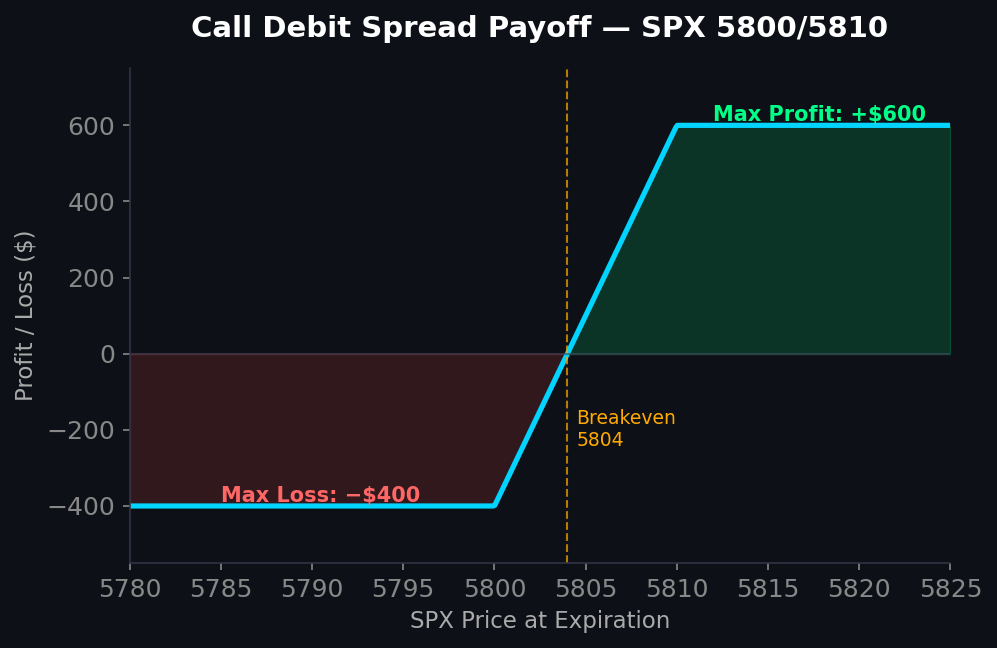
For a debit spread, your maximum loss is generally the debit paid, multiplied by the contract multiplier and the number of contracts.
Maximum loss = debit paid × contract multiplier × number of contracts
For an iron condor, calculate the defined risk on each side. If both sides have the same width, the practical expiration maximum loss is typically the wing width minus the total credit received, multiplied by the contract multiplier and contract count. Only one side can be fully threatened at expiration.
Maximum loss = (wing width – total credit received) × contract multiplier × number of condors
Broken-wing structures, asymmetric condors, and multi-leg butterflies require more care. Do not assume the widest-looking side is the risk. Read the expiration payoff graph, identify the worst settlement region, and verify the result in your trade ticket before sending the order. Learn to read them in our payoff diagrams guide.
For SPX options, use the contract multiplier shown in your platform and contract specifications. Premiums are quoted in index points, not as the final cash amount that leaves your account. The Cboe SPX contract specifications list the multiplier. That distinction is where sizing errors begin.
A simple credit-spread example
Suppose you sell a five-point-wide SPX credit spread and collect 1.20 points of credit. Your risk per spread is not 1.20 points. That is the amount received. The risk is the remaining distance between the spread width and the credit.
The calculation is:
5 – 1.20 = 3.80 points of risk
Then apply the contract multiplier to determine the cash risk per spread. If you trade multiple spreads, multiply again by the number of contracts.
Notice what the formula does not ask: whether you think the market will stay above or below a level. Directional confidence does not reduce defined risk. A better thesis may affect whether you take the trade. It should not change the math after you enter it.
Why credit received is not your risk
Retail traders are often drawn to the credit because it is visible, immediate, and easy to compare. But credit is compensation for accepting risk. It is not protection from risk.
A wider spread may bring in more premium, but it also increases the distance that can be lost if the structure fails. A larger credit can reduce maximum loss within the same width, but it may also reflect a trade placed closer to the market, during higher volatility, or against more immediate event risk.
This is the trade-off. You cannot evaluate risk from credit alone. You need the width, the credit, the number of contracts, and the account-level exposure already on.
Stop chasing a premium target. Start defining an acceptable loss. The OCC’s options education walks through the payoff math.
How to calculate maximum loss at the account level
Per-trade risk is only the first calculation. The number that protects your trading business is total open risk. That is the heart of capital allocation.
Start by deciding the portion of your account you are willing to put at risk on one idea. Then divide that risk budget by the maximum loss per contract. Round down. Always round down. Here is a worked risk sizing example.
Position size = risk budget ÷ maximum loss per contract
If the result is less than one contract, the position is too large for the risk budget. That is not a cue to force the trade. It is information. You can use a narrower defined-risk structure, wait for a different setup, or skip the trade.
Next, add the maximum loss of every open position that could be pressured by the same market move. Two trades with different strikes are not automatically diversified. If both are short downside exposure and SPX sells off sharply, they may behave like one larger position.
That is why a portfolio view matters. The question is not, “Can I afford this spread?” The question is, “What happens if every correlated position reaches its planned loss together?”
Maximum loss versus a stop-loss rule
A stop is a management rule. Maximum loss is the structural boundary of the position. They serve different jobs.
A trader may choose to exit a 0DTE position well before its expiration maximum loss if price, time, volatility, or the structure’s risk graph violates the plan. That can reduce the realized loss. It can also produce a loss larger or smaller than expected because markets move quickly, especially near expiration.
Do not use an intended stop as an excuse to oversize the structure. Stops are execution-dependent. Defined risk is built into the position.
The conservative approach is to size so the structural maximum loss is survivable, then use management rules to improve consistency. Not the other way around.
What can make realized losses differ from the calculation
The calculated maximum loss is your expiration framework, but actual trading has friction. Bid-ask spreads, commissions, fees, fills, and fast intraday repricing can affect the realized result when you close before expiration.
For 0DTE SPX trading, this matters because gamma can accelerate quickly as price approaches a short strike. A position that looked comfortably distant can become a decision point in minutes. Your risk graph changes with price and time. Your original maximum loss does not.
This is not an argument against 0DTE. It is an argument for respecting its speed. Enter with defined risk. Know where the pressure points are. Avoid adding size simply because a threatened position now looks cheap to adjust.

A pre-trade maximum-loss checklist
Before entry, confirm four things: the exact strike width, the credit or debit, the contract multiplier, and the total number of contracts. Then look at the expiration payoff graph and make sure its worst-case result matches your own calculation.
After that, place the trade in context. Ask whether it overlaps with another open position, whether a scheduled event changes the risk environment, and whether the loss still fits your daily and overall account risk limits.
If any answer is unclear, do not improvise. Smaller is a position size. Flat is a position size too.
The real purpose of calculating maximum loss
Calculating maximum loss is not about finding a trade that never loses. Losses are part of a sound options process. The goal is to make every loss planned, limited, and small enough that it does not distort the next decision.
That is the difference between trading a framework and reacting to a chart. At FatTail.ai, the focus is defined-risk structure, positioning, and review because those are the parts a self-directed trader can control.
You do not need to predict every SPX move. You need to know the cost of being wrong before you put capital at risk. Once that number is clear, you can trade the plan instead of negotiating with the market.
Frequently Asked Questions
What does maximum loss mean in options?
The largest loss a position can produce at expiration under its stated structure, assuming you hold through the worst outcome. For a defined-risk position the loss is capped because the long option limits the short option exposure. It is not the premium collected, the buying-power effect, or a stop level.
How do you calculate maximum loss on a credit spread?
Maximum loss equals the spread width minus the credit received, times the contract multiplier and number of contracts. For example, a five-point spread collecting 1.20 points leaves 3.80 points of risk per spread before applying the multiplier. Directional confidence does not change that math once you are in.
How do you calculate maximum loss on an iron condor?
With equal-width sides, the practical expiration maximum loss is the wing width minus the total credit received, times the multiplier and number of condors, because only one side can be fully threatened at expiration. Broken-wing and asymmetric structures need you to read the payoff graph for the worst region.
Is the credit received your risk?
No. Credit is compensation for accepting risk, not protection from it. A larger credit can reduce maximum loss within a width, but it may reflect a trade placed closer to the market or in higher volatility. Evaluate width, credit, contracts, and account-level exposure together.
How does maximum loss differ from a stop-loss?
Maximum loss is the structural boundary of the position, built in before entry; a stop is an execution-dependent management rule that can produce a larger or smaller realized loss because markets move fast near expiration. Size so the structural maximum loss is survivable, then use stops to improve consistency, not the reverse.
FATTAIL BRIEFINGS
Get FatTail briefings in your inbox
Pick the lists you want. FOMC Alerts is selected by default.