


FOMC Alerts · October 22, 2026
The Fed votes before the data
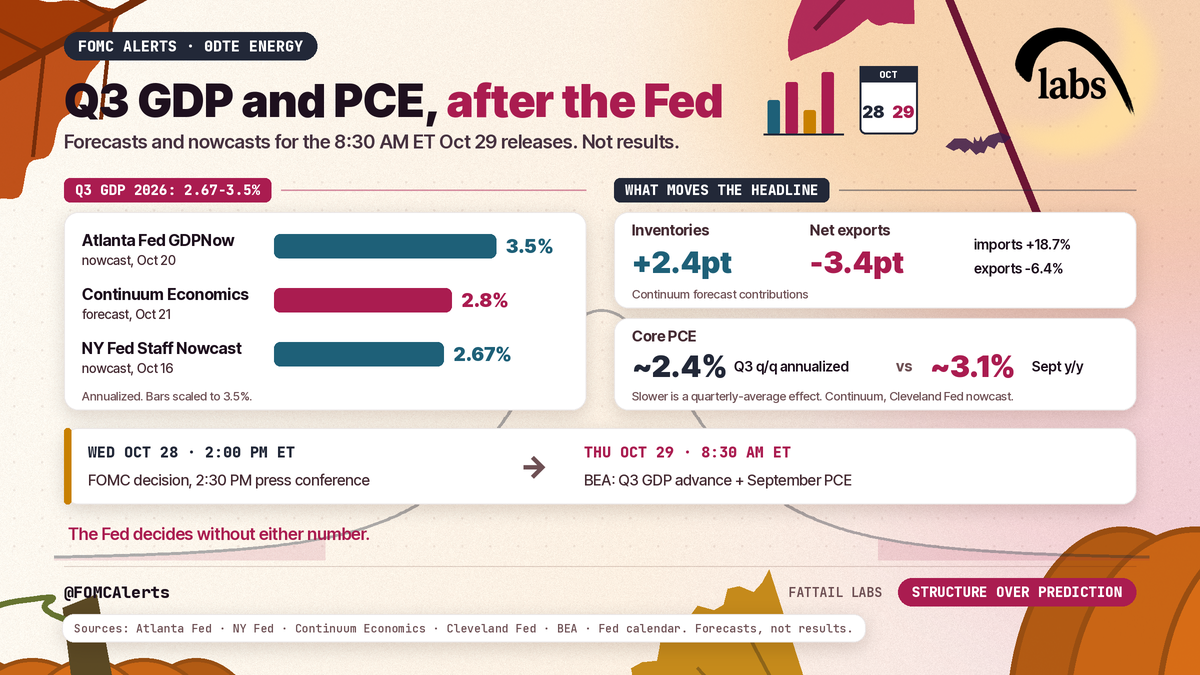
FOMC week has two acts. The Fed announces its decision on Wed Oct 28 at 2:00 PM ET, with Chair Warsh’s press conference at 2:30 PM ET and no new projections (Fed calendar). The next morning at 8:30 AM ET, the Bureau of Economic Analysis publishes both the advance estimate of Q3 GDP 2026 and September personal income and outlays, which carries the core PCE price index (BEA schedule). So the committee decides without either number. Our 2026 FOMC meeting schedule has the full calendar.
That makes Thursday morning a second event stacked on top of the FOMC reaction. The ECB also decides on Oct 29, with its deposit rate at 2.50% since Sept 16; the ECB site doesn’t post the times (ECB calendar, ECB rates). Everything below about Q3 is a forecast or a nowcast. Nothing is a result until 8:30 AM ET on the 29th.
What the forecasts say about Q3 GDP
Continuum Economics’ preview, published Oct 21, looks for Q3 real GDP growth of 2.8% annualized, which would be the strongest quarter since Q3 2025’s 3.9% (Continuum Economics). For reference, BEA’s latest estimates put Q2 at 2.2%, Q1 at 2.5% and Q4 2025 at 0.2% (BEA). The Fed’s own nowcasts bracket that forecast:
| Source | Type | Q3 GDP (ann.) | As of |
|---|---|---|---|
| Atlanta Fed GDPNow | model nowcast | 3.5% | Oct 20 (next update Oct 27) |
| Continuum Economics | forecast | 2.8% | Oct 21 |
| NY Fed Staff Nowcast | model nowcast | 2.67% | Oct 16 |
| Philadelphia Fed SPF | survey (two months old) | 2.5% | Aug 14 |
Sources: Atlanta Fed, Continuum, NY Fed, Philadelphia Fed.
On Kalshi, a prediction market, a Q3 print above 2.5% was bid at 78 cents and offered at 80, and above 3.0% at 61-64 cents, at 8:38 AM ET Oct 22 (Kalshi). One caveat: Kalshi’s contract is dated Oct 30, while BEA schedules the release for Oct 29, so the ticker date looks stale. The market settles on BEA’s advance estimate.
Why the headline will be noisy: imports and inventories
The headline number hides a tug-of-war. In Continuum’s breakdown, final sales to domestic purchasers (consumers, businesses and government, excluding inventories and trade) rise 3.8%, the same as in Q2. Inventories then add about 2.4 points, the first build since early 2025, and net exports subtract about 3.4 points. That net-export drag comes from both sides of the ledger: imports up 18.7% and exports down 6.4%. Continuum ties the import surge to AI investment, which is its view, not a BEA breakdown. Our post on Goldman’s AI and core PCE estimate covers the AI capex side.
That arithmetic produces a number that’s easy to misread. “This will leave final sales (GDP less inventories) up by only 0.4%,” Continuum writes. That 0.4% is GDP minus the inventory contribution, 2.8 minus 2.4. It is not final sales to domestic purchasers, which Continuum still sees at 3.8%. The two measures differ by the net-export drag.
GDPNow tells the same story at a smaller size: net exports at -2.86 points, inventories at +1.90 points, final sales to domestic purchasers at 4.34% and final sales to private domestic purchasers at 4.71%. There’s a recent precedent for a swing this size. In BEA’s current data, Q1 2025 had net exports at -4.04 points and inventories at +2.54 points, and GDP grew just 0.1%. Q2 2025 reversed it (+4.49 and -3.17) and GDP grew 4.0%. If Q3 lands near these forecasts, it would be the biggest import-inventory pair since then. The steadier read is final sales to private domestic purchasers (4.6% in Q2) and core PCE, not the headline.
Advertisement · From FatTail Labs

Observer: train with Coach for $17/week
A six-week trial and training program built to install pro trading habits: live daily coaching, courses, a Discord trade room and the full FatTail platform.
“Slower inflation” is a quarterly-average effect
Continuum expects Q3 core PCE prices to rise 2.4% annualized, the slowest since Q3 2024, assuming a 0.3% gain in September. The Cleveland Fed’s nowcast is close at 2.33% (Cleveland Fed). That can look odd next to Q2’s 3.3% and an August core PCE rate of 3.0% from a year earlier (BEA).
The explanation is how BEA builds a quarter: it averages the three monthly price levels. Core PCE rose only about 0.13% in both June and July, then 0.25% in August (BEA via FRED). Those soft early-summer months pull the Q3 average down. On our math, a 0.3% September gain gives about 2.36% annualized for the quarter, and the sensitivity is modest: 0.2% gives about 2.22% and 0.4% about 2.49%.
The year-over-year rate barely moves. The Cleveland Fed nowcasts September core PCE at +0.28% for the month and 3.05% from a year earlier. Our own calculation with a 0.3% month gives about 3.1%. So the quarterly number can say “slower” while the annual rate stays around 3.05-3.1%. For the Fed’s December decision, the September monthly core print is the number that matters, not the Q3 average.
Businesses in the Atlanta Fed’s survey agree that inflation is easing slowly, not ending. In October, firms’ year-ahead unit-cost expectations slipped to 2.3% from 2.4% in September, versus a 2.0% pre-pandemic average and a 3.8% peak in April 2022. Year-over-year unit-cost growth held at 2.6% (Atlanta Fed Business Inflation Expectations). The panel is about 690 firms in the Sixth District.
How the morning after FOMC has traded
Thursday’s release lands while options are already trading. SPX options trade in Cboe’s Global Trading Hours from 8:15 PM to 9:25 AM ET. Since Oct 19, select ETF and single-stock options, SPY and QQQ among them, also trade in a 7:30-9:25 AM ET pre-market session on Cboe’s C1 exchange, limit orders only (Cboe, Cboe FAQ).
FatTail’s FOMC history gives a descriptive base rate. On the session after a scheduled decision (2015-2026, n=93), the median absolute SPX move was 0.58% against 0.49% on all sessions, and the median intraday range was 1.13% against 0.88%. When that session was also an advance-GDP day (n=14, a small sample), the median range was 1.31%. Both 2026 cases, Apr 30 and Jul 30, closed up more than 1%. That history describes the past; it isn’t a forecast for Oct 29. For the Oct 28 decision itself, see the case for an October rate hike vs. what’s priced.
What it means for 0DTE
- Energy: Two scheduled events, 18.5 hours apart: the FOMC at 2:00 PM ET Wednesday, then GDP and PCE at 8:30 AM ET Thursday, with the ECB later that day. Treat Thursday’s open as its own event, not a continuation of Wednesday.
- Premium: The VIX prices both. Thursday’s 8:30 release is a fresh input after Wednesday’s press conference, so check where premium sits before Thursday’s open rather than carrying Wednesday’s read forward.
- Structure: Size for a gap at the open. Positions held through Wednesday’s close carry the 8:30 print with them, so the max loss should be known before the close, not after the open.
- Plan, don’t predict: Read the release in order: core PCE month-over-month first, then final sales to private domestic purchasers, then the headline. A big headline beat or miss driven by imports and inventories is a different scenario from a core PCE surprise.
Related reading
- FOMC Alerts hub: the Oct 28 calendar, upcoming data and all our Fed coverage.
- All FOMC Alerts posts: every alert, newest first.
- How to Plan Market Scenarios for 0DTE SPX: building the two-branch plan for a stacked event morning.
Sources
- Preview: Due October 29 – U.S. Q3 GDP – Stronger growth, slower inflation (Continuum Economics, Oct 21, 2026)
- Release Schedule (U.S. Bureau of Economic Analysis, accessed Oct 21, 2026)
- GDP (Third Estimate), 2nd Quarter 2026 and Annual Update (U.S. Bureau of Economic Analysis, Sep 30, 2026)
- Personal Income and Outlays, August 2026 (U.S. Bureau of Economic Analysis, Sep 30, 2026)
- Personal Consumption Expenditures Excluding Food and Energy (Chain-Type Price Index) (PCEPILFE) (FRED, St. Louis Fed (BEA data), Oct 20, 2026)
- GDPNow (Federal Reserve Bank of Atlanta, Oct 20, 2026)
- New York Fed Staff Nowcast (Federal Reserve Bank of New York, Oct 16, 2026)
- Inflation Nowcasting (Federal Reserve Bank of Cleveland, Oct 21, 2026 (checked 8:40 AM ET Oct 22; no newer update))
- Third Quarter 2026 Survey of Professional Forecasters (Federal Reserve Bank of Philadelphia, Aug 14, 2026)
- Business Inflation Expectations (Federal Reserve Bank of Atlanta, Oct 21, 2026)
- Q3 GDP markets (KXGDP-26OCT30) (Kalshi, 8:38 AM ET Oct 22, 2026)
- Cboe Launches Extended Trading Sessions for Select Single Stock and ETF Options (Cboe Global Markets, Oct 19, 2026)
- Equity Options Extended Trading Hours FAQ (Cboe, 2026)
- Meeting calendars and information (Federal Reserve, 2026)
- Monetary policy meetings calendar; Key ECB interest rates (European Central Bank, accessed Oct 21, 2026)
Trade it with structure
Observer is a six-week trial and training program: train with Coach for $17/week. You get everything a full coaching member gets, every week, and the six weeks are designed to install pro trading habits: courses on strategy, process and risk management, live daily coaching, a Discord trade room with hundreds of experienced traders, and the platform (heatmap, GEX tools, risk graph, position analyzer and journal). Start Observer.
Educational content, not investment advice. Options involve risk and are not suitable for all investors.
FATTAIL BRIEFINGS
Get FatTail briefings in your inbox
Pick the lists you want. FOMC Alerts is selected by default.