


A 0DTE trader can be directionally right, choose a sensible market location, and still take an unnecessary loss because the structure did not match the job. That is the real question in SPX butterflies versus iron condors. Not which trade has the prettier win rate. Not which one someone posted after a favorable day. The question is what risk shape you are buying, where that risk lives, and whether your account can carry it repeatedly.
Both structures can be defined risk. Both can be used in SPX. Both can be built around observable positioning, expected range, and time of day. But they distribute risk and reward very differently. Treating them as interchangeable income trades is how traders end up oversizing, adjusting emotionally, and turning a planned loss into a problem.
Start With the Payoff Shape
An iron condor combines a put credit spread below the market with a call credit spread above it. The position collects a credit and has a profit zone between the short strikes. Its risk is capped beyond either long wing. On the expiration graph, it resembles a flat plateau with losses on both outer edges.
A butterfly uses three strikes on one side or around a chosen center strike, with the middle strike carrying twice the contracts. Depending on construction, it can be entered for a debit or a credit. A standard long butterfly has its best outcome near the body, or center strike, and limited losses away from that area. Its graph is a tent, not a plateau.
That distinction changes the conversation. An iron condor is generally designed to benefit if SPX remains within a range. A butterfly is generally designed to express a more specific view about where price may settle or where a structural level may contain price. One gives you a broader zone. The other concentrates its opportunity near a location.
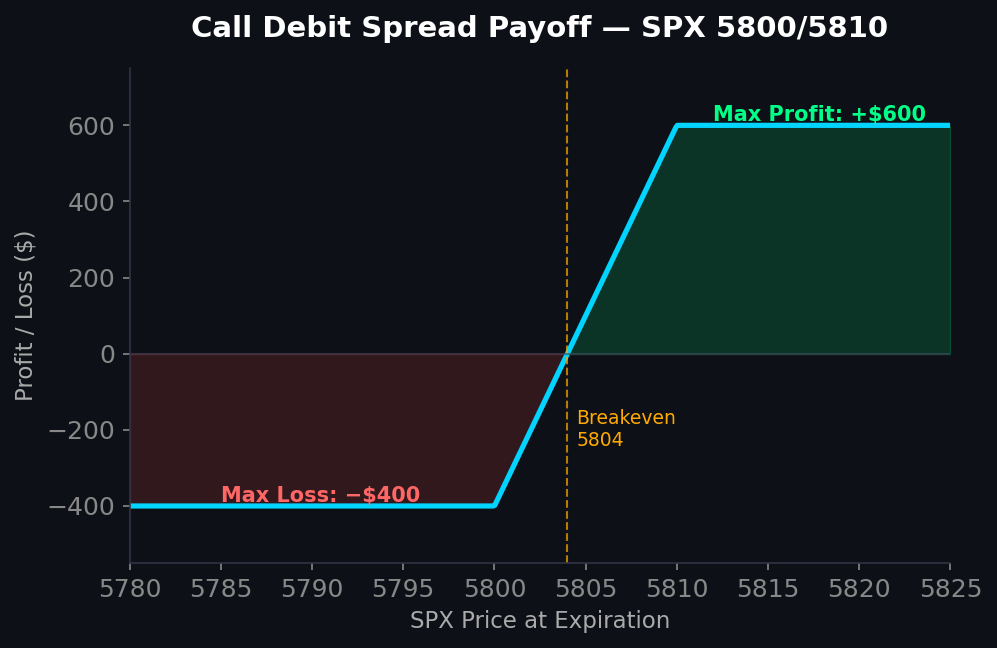
Neither is automatically conservative. A wide iron condor sold too close to the market can have a deceptively narrow margin for error. A butterfly placed at a level with no reason behind it is simply a precise bet disguised as structure. Defined risk does not mean appropriate risk.
SPX Butterflies Versus Iron Condors in 0DTE
Zero days to expiration magnifies the differences. With only hours or minutes left, delta can change quickly, extrinsic value collapses, and a small index move can redraw the position’s risk graph. The structure must fit the market condition and your operating plan. The Cboe SPX specifications detail the expirations you are trading.
An iron condor can make sense when you see a credible range thesis: meaningful support and resistance, a contained expected move, or positioning that suggests price may remain balanced. The trader is not predicting a closing print. They are defining a zone and accepting that the market can invalidate it.
The trade-off is that a condor often has risk on both sides. Price may threaten one short strike, reverse, and later challenge the other. If your response is to keep moving threatened sides or adding contracts, you have not solved the problem. You have changed the position under pressure.
A butterfly is more location-specific. It can be useful when a trader sees a level that matters, such as an area where dealer positioning, prior acceptance, or intraday structure creates a reason to expect pinning or containment. The key word is reason. A butterfly should be placed because your process identifies a meaningful location, not because the max-profit graphic looks compelling.
The trade-off is path dependency. A butterfly may look excellent if SPX closes near its body, yet spend much of the day under pressure if price moves away early. With 0DTE, waiting for the perfect expiration outcome is not a strategy. You need to know beforehand whether you will hold, close, reduce, or leave the trade alone at predefined conditions.
The Credit Is Not Your Risk Measure
Retail traders often compare these structures by asking which one brings in more premium. That is backward. Credit is not risk. It is compensation for a particular payoff shape, strike placement, time remaining, and market environment.
A condor that brings in more credit usually does so because the short strikes are closer, the wings are wider, volatility is higher, or some combination of those factors is true. The extra credit may be reasonable. It may also mean the market has priced meaningful movement into the day. Do not call it safer because the premium feels substantial.
The same problem appears with butterflies. A cheap butterfly is not automatically a smart butterfly. Low cost can reflect distance from the market, low probability of reaching the body, or a payoff that is highly sensitive to timing. The debit tells you the maximum planned loss for that unit. It does not tell you whether the trade belongs in your plan.
Start with maximum loss per contract. Then determine how many contracts fit the account-level risk budget. That order matters. If you choose quantity first and justify the risk afterward, you are gambling with a position graph. Work through a full risk sizing example.
Sizing Is Where the Strategy Becomes Real
A defined-risk position only protects you if the defined loss is small enough to take without changing your behavior. If a single full loss makes you freeze, chase, or skip the next qualified setup, the size is wrong.
For each structure, calculate the actual worst-case loss, including the intended entry cost and realistic execution assumptions. Decide the fraction of account risk assigned to one trade and to the day. Then size down until a normal losing rep feels operationally boring.
That may sound conservative. It is also how a trader stays in the sample long enough to learn whether the framework has expectancy. You do not need to avoid losses. You need losses that are pre-accepted, capped, and small enough that the next decision remains clean. The OCC’s options education explains how each spread caps risk.
Butterflies can appear easier to size because the debit is visible and limited. Condors can appear easier because they are credit trades with a broad profit region. Those impressions are not sizing rules. Compare each trade in dollars at the contract quantity you intend to use, not as an abstract graph.

Adjustments Need a Rule, Not a Reflex
0DTE options do not give traders much room for improvised repair work. A threatened condor can tempt you to roll a side, add another spread, or turn the trade into a more complicated position. A butterfly drifting away from its center can tempt you to add another butterfly and average into a thesis.
Sometimes an adjustment is part of a tested playbook. Most of the time, retail adjustments are an emotional attempt to avoid booking a planned loss.
Before entry, define what invalidates the original idea. Is it a price level, a change in intraday structure, a time threshold, or a loss limit? Define whether an adjustment is permitted and exactly what it is meant to accomplish. If you cannot describe the adjustment before the position is stressed, do not invent it afterward. Define the invalidation condition first.
A clean close is not a failure. It is often the most professional decision available. Your job is not to rescue every trade. Your job is to preserve capital and decision quality across hundreds of trades.
Choose the Structure That Expresses the Thesis
Use an iron condor when your process supports a bounded range and you want a wider area of potential profitability, while accepting exposure to both sides of that range. Use a butterfly when your process supports a meaningful target or containment level and you are willing to accept a more concentrated payoff.
There are days when neither belongs on. A trending session, a post-event repricing, a broken level, or unclear positioning can make both structures poor expressions of the market. No trade is a valid position. Cash is defined risk too.
At FatTail.ai, the focus is not on finding a structure that never loses. That does not exist. The focus is building a repeatable 0DTE SPX process: read the environment, select a structure with intent, size it so the defined loss is tolerable, and review the result without rewriting the rules.
The better choice between a butterfly and an iron condor is the one that fits your thesis, your risk budget, and your prewritten response if price disagrees. Make that decision before the order goes in. Afterward, execute the plan.
Frequently Asked Questions
What is the difference between an SPX butterfly and an iron condor?
An iron condor pairs a put credit spread below the market with a call credit spread above it, giving a wide profit plateau between the short strikes. A butterfly uses three strikes around a center, with the middle strike double, giving a tent-shaped payoff that peaks near the body. A condor benefits from a range; a butterfly expresses a more specific location.
Which is safer, a butterfly or an iron condor?
Neither is automatically conservative. A wide condor sold too close to the market can have a deceptively narrow margin for error, and a butterfly placed at a level with no reason is a precise bet disguised as structure. Defined risk does not mean appropriate risk.
Does more credit mean less risk?
No. Credit is compensation for a payoff shape, strike placement, time remaining, and volatility, not a measure of risk. A condor brings in more credit usually because the short strikes are closer or volatility is higher, meaning the market has priced in more movement. Start from maximum loss per contract instead.
When should you use an iron condor versus a butterfly in 0DTE?
Use a condor when your process supports a bounded range and you want a wider profitable area while accepting exposure on both sides. Use a butterfly when your process supports a meaningful target or containment level and you accept a more concentrated, path-dependent payoff. On some days neither belongs on; cash is defined risk too.
How should you size butterflies and iron condors?
Compare each in dollars at the contract quantity you intend to use, not as an abstract graph. Calculate the actual worst-case loss, decide the fraction of account risk for one trade and the day, then size down until a normal losing rep feels operationally boring.
FATTAIL BRIEFINGS
Get FatTail briefings in your inbox
Pick the lists you want. FOMC Alerts is selected by default.