


A 0DTE SPX trade can look simple on a chart and still be completely misunderstood. The expiration is close. The premium moves fast. A trader sees a setup, takes a position, and then lets one oversized loss decide whether the entire day feels like success or failure. That is not a strategy. It is exposure without an operating system.
SPX options education should do more than explain calls, puts, and expiration. It should teach you how to think under pressure: how to define risk before entry, size a position so a normal loss is survivable, and review the decision without rewriting the rules after the fact. The OCC’s options education is a good starting point for the mechanics.
The goal is not to become better at guessing where the S&P 500 will close. The goal is to build a repeatable process around what the options market is pricing, how positioning may affect the day, and what your account can safely absorb.
What SPX Options Education Should Actually Teach
Most retail options content begins with a strategy name. Iron condor. Credit spread. Butterfly. That is backwards. A structure is just a container. Without a framework for context, sizing, and risk, even a defined-risk structure can be used irresponsibly.
Good SPX options education starts with the mechanics, then moves quickly to decision-making. You need to understand that SPX is a cash-settled index option and that its contract characteristics, settlement conventions, and expiration timing can differ from products that look similar. Verify the current contract specifications with your broker before trading. Details matter when time to expiration is measured in hours. The Cboe SPX contract specifications cover the cash settlement and expiration timing.
But mechanics are only the entry point. The real education is learning to answer a few harder questions before each trade: What is the market pricing for today? Where is the market structurally positioned? What would invalidate this idea? How much can I lose if I am wrong? And is this trade sized so that a loss remains a planned rep rather than an account-level event?
If a course cannot help you answer those questions, it is teaching vocabulary, not trading. See what to actually learn and what to skip.

Stop Treating 0DTE as a Prediction Contest
Many traders arrive at SPX because they want action. They stay stuck because they believe action requires an opinion. Bullish or bearish. Breakout or reversal. Green day or red day.
That mindset creates a bad habit: attaching your identity to a market call. Once that happens, you begin managing the trade to protect the opinion. You hold too long. You add risk. You skip a planned exit because the market is supposed to come back.
A professional framework works differently. It begins with positioning and probabilities, not certainty. This is the essence of our SPX structural trading guide. The market may be pinned near a meaningful level, balanced between competing forces, or vulnerable to movement if a key area fails. None of those observations is a promise. They are context for selecting a defined-risk structure and deciding whether the opportunity justifies the risk.
This distinction matters. Prediction asks, “What will happen?” Positioning asks, “What is priced, what could change, and where is my risk if the market does something else?” The second question gives you something you can execute.
You do not need to be right about every move. You need a process that prevents ordinary uncertainty from becoming ruinous.
Defined Risk Is the Starting Line
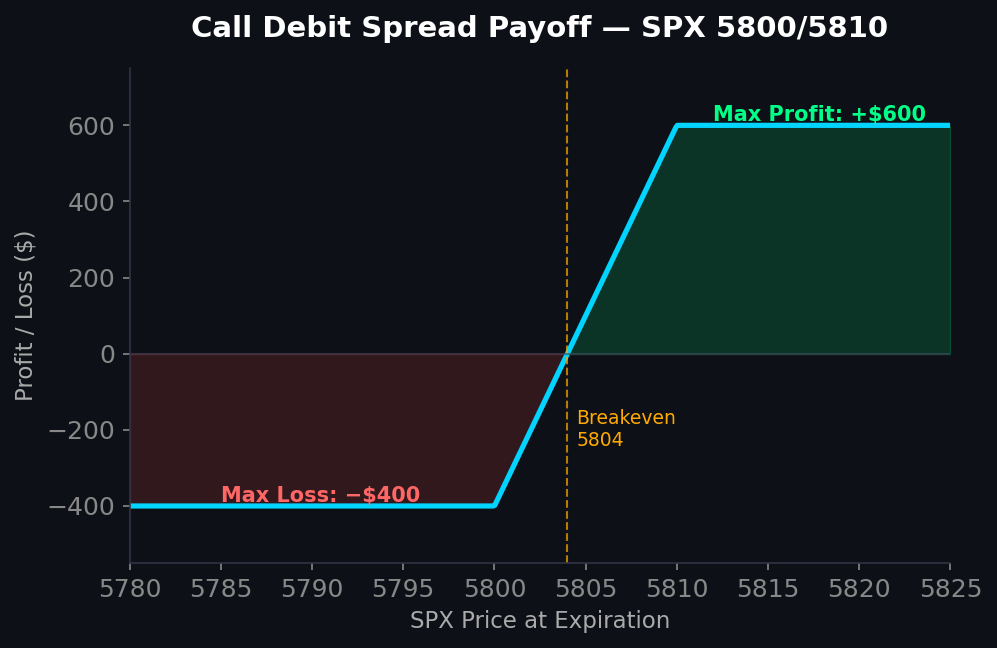
Defined risk does not mean a trade is automatically safe. A max loss only helps if the amount is appropriate for your account and if you understand the conditions that can cause the loss. A trader who repeatedly risks too much on defined-risk spreads is still taking a path toward emotional decision-making.
Start from the loss, not the credit or the potential payout. Before entry, know the maximum planned loss for one contract, then decide how many contracts your account and trading plan can support. If the full loss would cause you to abandon your rules, revenge trade, or spend the rest of the week trying to recover, the position is too large.
This is where smaller accounts often make the most expensive mistake. They try to make each trade matter. That pressure encourages concentration, premature adjustments, and the search for a perfect setup. The better approach is slower and less exciting: use size that allows you to gather clean feedback over a meaningful sample of trades.
A loss should be information about the setup, execution, and market conditions. It should not be a referendum on your ability to trade.
Learn the Market Context Before Selecting the Structure
A structure should express a market condition, not substitute for analysis. That means your daily work needs a consistent order of operations.
First, assess the opening environment. Was there a meaningful overnight move? Is volatility elevated or compressed? Is there a scheduled event that can quickly change pricing and movement? Then look at the market’s current location relative to major levels and areas of concentrated options positioning. Finally, define the conditions under which you will participate, stand aside, or reduce size.
Tools such as gamma exposure overlays, convexity heatmaps, and risk graphs can make this work more visible. They are not magic. They do not tell you what to trade. They help you see where dealer positioning, volatility, and price behavior may create different conditions than the chart alone suggests.
The key is consistency. If you use a tool only after a trade goes wrong, it becomes another way to explain the past. Use it before the trade to define your assumptions, and after the trade to test whether those assumptions held up.
Standing Aside Is Part of the Framework
Not every session offers a clean opportunity. A day can be too event-driven, too directional, too erratic, or simply outside the conditions your framework was designed to handle. Passing is not a failure of discipline. It is discipline.
Traders who depend on alerts often struggle here because they have outsourced the decision to participate. They feel they must take the trade because someone sent it. Self-directed traders work from criteria. When the criteria are absent, there is nothing to force.
That independence is a skill. It is also one of the most valuable outcomes of a serious education process.
Build a Routine You Can Repeat
The strongest SPX traders are not improvising their entire day. They use a routine that reduces preventable errors while leaving room for judgment when conditions change.
Your routine should include a premarket preparation window, a defined process for evaluating the open, entry criteria, sizing rules, and a post-trade review. Keep it simple enough that you will actually follow it when the market is moving quickly.
The review is where most traders leave progress on the table. Do not only record whether the trade made or lost money. Record the structure, time of entry, market context, size, planned risk, exit reason, and whether you followed your rules. Add a note about what you saw versus what actually developed.
Over time, the trade log becomes more useful than your memory. Memory protects the ego. Data does not. It can show that your best trades occur in a narrower set of conditions than you assumed, or that your largest losses come from a repeated sizing or adjustment error rather than bad luck.
That is why live review matters. At FatTail.ai, the purpose of reviewing real market decisions is not to hand traders a call to copy. It is to make the reasoning visible, then help traders apply it to their own process.
Measure Process Before Outcome
A single trade is noisy. A single day is noisy. Even a short losing streak can happen inside a sound framework. If you score yourself only by the latest outcome, you will keep changing a process before it has enough data to be evaluated.
Track process metrics alongside financial results. Did you trade only approved conditions? Did you follow your size cap? Did you enter where your plan called for entry? Did you respect the defined loss? Did you take a trade when you should have stood aside?
These questions are corrective because they point to actions you control. The market’s final print is not under your control. Your exposure is. Your preparation is. Your willingness to follow the plan is.
This does not mean ignoring results. Results matter. But they need context. A profitable trade taken outside your rules is not proof that the rule was wrong. It may be evidence that you were rewarded for bad behavior. A planned loss taken exactly as designed may be evidence that the risk controls worked.
Education Should Make You Need No One
The wrong kind of SPX education creates dependence. It gives you a daily level, a trade idea, or a confident opinion, then leaves you unable to operate when the message stops arriving.
The right kind builds judgment. It teaches you to read the same inputs, size from the same principles, and evaluate your own decisions with honesty. Coaching and tools can accelerate that work, but neither should replace your ability to think.
Your next step is not finding a better signal. It is writing down the risk rules you will follow before the next SPX session begins, then giving yourself enough time and enough data to become the trader who can follow them.
Frequently Asked Questions
What should SPX options education teach?
More than calls, puts, and expiration. It should teach you to think under pressure: define risk before entry, size so a normal loss is survivable, read market context and positioning, and review decisions honestly. If a course cannot help you answer those questions, it is teaching vocabulary, not trading.
Is SPX different from other options?
Yes. SPX is a cash-settled index option, and its contract characteristics, settlement conventions, and expiration timing can differ from products that look similar. Those details matter when time to expiration is measured in hours, so verify current specifications before trading.
Why is 0DTE not a prediction contest?
Attaching your identity to a market call leads you to manage the trade to protect the opinion, holding too long and adding risk. A professional framework begins with positioning and probabilities, asking what is priced, what could change, and where the risk is if the market does something else.
What is the most important thing to learn first?
Defined risk as a starting line, then sizing. A max loss only helps if the amount is appropriate for the account and you understand the conditions that can cause it. Start from the loss, not the credit, and size so a full loss does not make you abandon your rules.
How do you measure trading progress?
Track process metrics alongside results: did you trade only approved conditions, follow your size cap, enter where the plan called for it, and respect the defined loss? A single trade or day is noisy, so measure process before outcome over a meaningful sample.
FATTAIL BRIEFINGS
Get FatTail briefings in your inbox
Pick the lists you want. FOMC Alerts is selected by default.