


A 0DTE trade can be structurally defined-risk and still be dangerously oversized. That is the contradiction many traders miss. They focus on whether the spread has a capped loss, then allocate enough contracts that one ordinary loss damages the account, the week, or their ability to execute the next valid setup. Learning how to size 0DTE positions starts there: defined risk is a feature of the structure. Proper sizing is the process that makes that feature real. For the why behind keeping risk small, see why small risk per trade keeps you trading.
The goal is not to avoid losses. A real 0DTE framework has planned losing trades. The OCC’s options education is a good grounding in the defined-risk structures behind that. The goal is to make each one small enough that you can take it cleanly, document it, and be present for the next opportunity. Not signals. Not prediction. Not hoping a high-probability-looking trade somehow cannot lose.
Start With the Risk of the Trade, Not the Credit
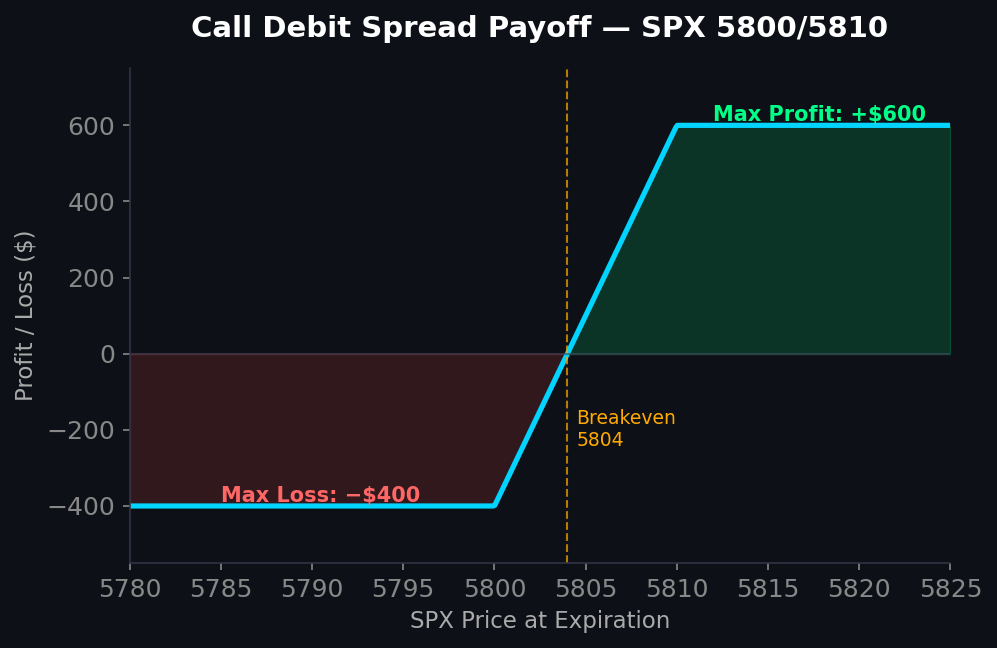
A credit received is not your position size. Neither is the margin your broker displays. The relevant number is the maximum planned loss of the defined-risk structure, including the effect of the width, credit, commissions, and any realistic execution friction.
For a vertical credit spread, the basic calculation is straightforward:
Maximum risk per contract = spread width – credit received
For an iron condor, calculate the maximum loss on the challenged side rather than treating both spreads as separate independent risks. A sharp directional move can pressure the short strikes together with changes in implied volatility and liquidity. The graph may show a capped loss, but the path to that loss can be fast on expiration day.
That is why 0DTE sizing begins with a simple question: if this trade reaches its planned maximum loss, what fraction of my account and daily risk budget disappears? If the answer creates hesitation, forces a recovery trade, or makes you alter your plan mid-session, the size is too large. This is the foundation of options risk management.
Set a Fixed Risk Unit Before the Market Opens
The cleanest way to size a position is to define a risk unit, often called 1R. One R is the amount you are willing to lose on one standard trade when the thesis fails or the position reaches its predefined exit condition.
Your R should be small enough to survive a normal sequence of losses without changing your behavior. Investor-education bodies like the SEC stress sizing to survive drawdowns for exactly this reason. That last clause matters more than it sounds. Traders often choose a number that looks tolerable in a spreadsheet, then discover it is emotionally intolerable after two losses during a volatile session.
A useful risk unit is based on three constraints: account equity, the strategy’s historical loss distribution, and your ability to execute consistently. Account size tells you the ceiling. Historical data tells you what a realistic rough patch looks like. Your behavior tells you whether the number is actually usable.
Do not choose R based on what you want to make that day. That reverses the process. Income targets encourage traders to increase size when premiums are thin, force trades when conditions are poor, and turn a planned loss into a personal problem. Risk comes first. Opportunity comes second.
How to Size 0DTE Positions With Simple Contract Math
Once you know your maximum acceptable loss for a trade, contract count becomes math rather than emotion:
Contracts = maximum risk per trade ÷ maximum loss per contract
Always round down. If the calculation produces a partial contract, that is not an invitation to stretch your risk budget. It is information. Either use fewer contracts, use a narrower defined-risk structure if it fits your rules, or pass.
Suppose your framework allows 1R of risk on a standard setup. If the maximum loss per spread means two contracts stay below 1R and three exceed it, the correct size is two. The market does not care that three feels more productive. The extra contract changes the distribution of your outcomes.
This is also why narrower spreads are not automatically safer. A narrower width may reduce maximum loss per contract, but it can change premium collected, short-strike location, sensitivity to movement, and the room available for a planned adjustment or exit. Structure selection and position size are connected, but they are not interchangeable.
A professional process chooses the structure because it fits the market condition and framework. Then it sizes the structure according to the predefined risk unit.

Separate Trade Risk From Daily Risk
One trade can be correctly sized and your day can still be oversized.
0DTE traders often make this mistake through stacking. They enter an early position, add another trade after a move, then sell a second structure that appears different but carries exposure to the same market outcome. What looks like diversification is frequently just more short convexity in the same session.
Before entering any additional position, measure total open risk, not just the new trade’s risk. Ask whether the positions share the same directional vulnerability, short-strike region, volatility exposure, or time-of-day risk. Two positions that both lose during an upside acceleration are one larger thesis, regardless of how they are labeled.
Set a daily loss limit separately from 1R. Our 0DTE risk management rules cover daily limits in depth. This is the point at which you stop initiating new risk and move into review mode. It protects the account, but it also protects decision quality. After a loss, the temptation is rarely analytical. It is usually the urge to get back to even.
Your daily limit should account for the fact that losses cluster. A choppy, event-driven, or trend day can invalidate several otherwise reasonable entries. The limit exists because no single day deserves the power to alter your long-term process.
Size Smaller When Conditions Change
Not every session deserves standard size. 0DTE premiums can look attractive precisely when the market is pricing meaningful uncertainty. Major economic releases, central bank events, unexpected headlines, and fast directional moves can all change the practical behavior of a position.
The answer is not to predict every move. The answer is to have a rule for uncertainty before it arrives. That may mean reduced size, wider distance from the underlying, one planned trade instead of several, or no trade at all. A no-trade decision is part of a defined-risk framework, not a failure to participate.
Size should also change when liquidity degrades. Wide bid-ask spreads and rapid premium changes can make the theoretical maximum loss less relevant than the real cost of exiting according to your plan. If execution quality deteriorates, reduce contracts or stand aside. Position size must reflect the market you can actually trade, not the clean version shown in a backtest.
Do Not Use Adjustments to Hide Oversizing
Adjustments are often presented as proof that a trade can be managed. Sometimes they are useful. But an adjustment is not a substitute for initial sizing.
If you cannot accept the original defined loss, you are too large. If an adjustment requires adding risk simply because the existing loss feels unacceptable, you are no longer managing a planned position. You are negotiating with a position that has already exceeded your psychological capacity.
A sound framework defines, in advance, what an adjustment is meant to accomplish. It may reduce directional exposure, harvest changing premium conditions, or reposition risk within a stated maximum daily budget. It should not be an improvised rescue mission.
This is where risk graphs and trade logs earn their place. Review whether adjustments improved the distribution of outcomes across a meaningful sample, not whether they saved one memorable trade. One dramatic recovery can teach the worst possible lesson: that size does not matter if you are clever enough under pressure.
Let Your Data Earn Larger Size
The right time to increase size is not after a winning streak. It is after you have demonstrated repeatable execution across different market conditions, documented losses, and followed your risk rules without exceptions.
Review your trades in R, not just dollars. This is also why win rate matters less than expectancy. Look for whether losses stayed within plan, whether size drifted on emotional days, and whether multiple positions created hidden concentration. Separate setup quality from execution quality. A valid setup can lose. An invalid oversized trade can win. Those are not the same thing.
At FatTail.ai, the objective is trader independence: a process you can run, measure, and improve without needing someone to tell you what to click. Position sizing is central to that independence because it removes the need to be right. When the loss is planned and survivable, you can think clearly.
The market will eventually test every size decision. Make sure the number you choose lets you treat that test as a normal rep, not an emergency.
Frequently Asked Questions
How do you size a 0DTE position?
Start from the maximum planned loss of the defined-risk structure (width minus credit, including commissions and friction), decide how much of your account and daily budget that loss can consume, and divide your allowed risk by the max loss per contract. Always round down.
What is a risk unit (1R) in 0DTE?
1R is the amount you are willing to lose on one standard trade when the thesis fails. It is set by account equity, the strategy’s historical loss distribution, and your ability to execute consistently, small enough to survive a normal sequence of losses without changing your behavior.
How many contracts should you trade?
Contracts = maximum risk per trade divided by maximum loss per contract, rounded down. If the calculation produces a partial contract, use fewer, use a narrower defined-risk structure if it fits, or pass. The extra contract changes the distribution of your outcomes.
What is the difference between trade risk and daily risk?
One trade can be correctly sized while your day is oversized through stacking, adding correlated positions that share the same directional or volatility exposure. Measure total open risk before adding, and set a daily loss limit separately from 1R that moves you into review mode.
When should you size down on 0DTE?
Around major economic releases and events, during fast directional moves, and when liquidity degrades and bid-ask spreads widen. Have a rule for uncertainty before it arrives, reduced size, more distance, one trade instead of several, or no trade, which is a valid decision.
FATTAIL BRIEFINGS
Get FatTail briefings in your inbox
Pick the lists you want. FOMC Alerts is selected by default.