


FOMC Alerts · October 22, 2026
What happened to the stock-bond correlation
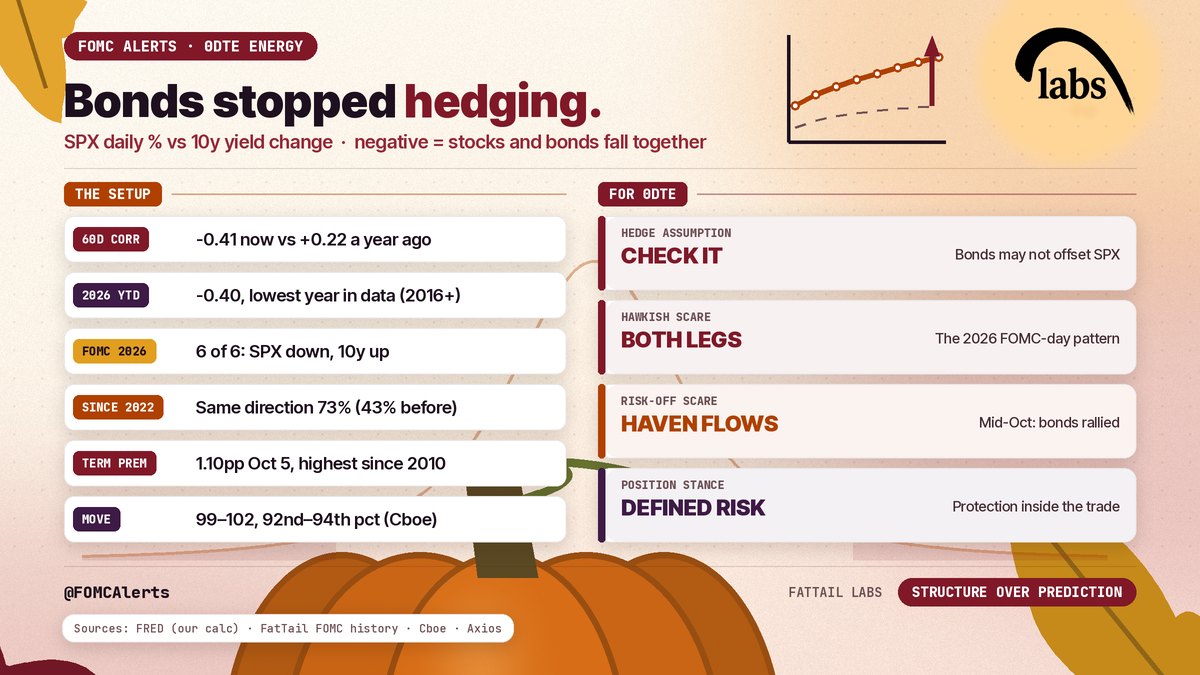
Treasuries have mostly stopped hedging stocks this year. The stock-bond correlation in 2026 has run the wrong way for anyone counting on bonds to cushion an equity hit. We measured it with FRED data as the correlation between the daily % change in the S&P 500 and the daily change in the 10-year Treasury yield (FRED SP500, FRED DGS10). On that measure, a negative number means stocks fall on days yields rise. In other words, stock prices and bond prices are moving together, and the bond leg isn’t offsetting anything.
The 60-day reading was -0.41 on Oct 19, against +0.22 a year earlier. For 2026 so far it is -0.40, the most negative calendar year in our FRED window, which starts in October 2016. From 2016 through 2021 every year came in between +0.11 and +0.51. The 60-day low this year was -0.71 on June 5. A longer check on the SPX closes in our FOMC history dataset shows the same break: +0.40 for 2008–2021 and -0.10 for 2022 through mid-October 2026.
The hedge is weaker, not gone. The 20-day reading eased from -0.66 on Oct 6–7 to -0.25 on Oct 19, after a week that looked like a classic flight to safety. Axios reports that the 10-year started last week at 5.23%, briefly topped 5.3% after a hot CPI report, and ended near 5.08%, which Deutsche Bank’s Jim Reid called the biggest weekly drop since April 2025 (Axios). The 10-year closed at 5.15% on Oct 19 (FRED).
Why bonds stopped hedging: term premium and a new buyer base
Much of the rise in long yields has been term premium, the extra yield investors demand for holding duration, rather than Fed expectations. The Federal Reserve Board’s Kim-Wright estimate of the 10-year term premium hit 1.10 percentage points on Oct 5, its highest since April 2010, and was 0.99 on Oct 16 (FRED THREEFYTP10). It was about 0.14 in September 2024 and 0.43 a year ago.
T. Rowe Price’s Tim Murray makes the same point from the yield side. In his report, as summarized by ETFdb, the 10-year rose from about 3.73% to 5.1% in the two years to Sept 23, and only about 72bp of that came from higher Fed-policy expectations. He attributes the rest to term premium, driven by geopolitical uncertainty, persistent inflation worries, heavy Treasury issuance and expected global capex. T. Rowe’s allocation committee is staying short duration (ETFdb).
Who owns the bonds has changed too. Treasury data cited by Axios show official foreign holders, such as central banks and sovereign funds, held 11.8% of Treasuries in August, down from 40% in the financial-crisis era. Hedge funds’ share rose to about 33.5% from around 10%, by Sakonnet Research founder Adam Josephson’s estimate using a financial-center proxy. “There’s ever more supply, and someone has to step in to absorb it and that someone is increasingly price sensitive, highly leveraged buyers,” Josephson told Axios. Axios also notes federal interest outlays reached $1.052 trillion in fiscal 2026 (Axios).
Advertisement · From FatTail Labs

Observer: train with Coach for $17/week
A six-week trial and training program built to install pro trading habits: live daily coaching, courses, a Discord trade room and the full FatTail platform.
FOMC days have leaned the same way
FatTail’s FOMC history dataset (scheduled rate decisions, daily closes) shows the shift on Fed days. They describe the past. They are not a forecast.
- 2008–2021: SPX and bond prices moved in the same direction on 45 of 105 FOMC days with a nonzero 10-year move (43%). Median absolute moves were 3.0bp in the 2-year and 4.0bp in the 10-year.
- 2022–September 2026: same direction on 27 of 37 (73%), with median absolute moves of 7.0bp in the 2-year and 5.5bp in the 10-year.
- Every 2026 meeting so far closed with SPX lower and the 10-year yield higher: Jan 28, Mar 18, Apr 29, Jun 17, Jul 29 and the Sept 16 hike. Three of those were SPX drops of more than 1.2%. Two were close to flat (-0.01% and -0.04%), so read six of six as a small sample, not a rule.
- On SPX-down FOMC days, the 10-year rose on 21 of 50 from 2008 to 2021, and on 13 of 23 since 2022.
- Baseline: since 2015 the median absolute 2-year move has been 4.0bp on FOMC days against 2.0bp on other days, per our patterns file.
The caveat: these are close-to-close numbers. They don’t show what happened in the minutes after 2:00 PM, only where the day ended.
The counterpoint: haven flows still show up
Bonds can still rally when stocks fall, and they did in mid-October. Bessent, in a 2Way interview reported by Bloomberg, said he doesn’t expect contagion from France’s bond turmoil and sees flight-to-safety money flowing into Treasuries (Yonhap Infomax). Finansavisen, citing Bloomberg, adds that the France–Germany 10-year spread reached 159bp this month and that the US 10-year is about 20bp below its early-October peak (Finansavisen).
The useful distinction is the type of scare. A growth or risk-off scare can still send money into Treasuries. An inflation or hawkish-Fed scare is the case where both legs have fallen together this year.
Scenarios to prepare for
The FOMC statement is due at 2:00 PM ET on Wednesday, Oct 28, with Warsh’s press conference at 2:30 PM ET (Fed October calendar). September PCE and the Q3 GDP estimate follow at 8:30 AM ET on Thursday, Oct 29 (BEA). These are setups to plan around, not calls.
- Hawkish read at 2:00 PM: dissents or firmer language about December. This is the case that matches 2026’s FOMC days, with stocks and bonds falling together.
- Risk-off without an inflation angle: a growth scare or an outside shock. This is the case where Treasuries have still acted as a haven, as in mid-October.
- Thursday’s 8:30 open: an inflation-flavored surprise in PCE would test the same both-legs-down pattern a second time in two sessions.
What it means for 0DTE
- Energy: The correlation shift is background, not an event. The scheduled event risk is Oct 28 at 2:00 PM, and Thursday’s 8:30 data.
- Premium: Rates volatility is already elevated. Cboe says the MOVE index held 99–102, the 92nd to 94th percentile, in the week of Oct 12–16, while the VIX rose 5 points to about 20 and one-month SPX skew jumped from the 15th to the 82nd percentile (Cboe). Let the VIX set the price of premium.
- Structure: Don’t count on a TLT or ZN position to offset short SPX premium into the statement. In 2026 that offset has failed on Fed days. Carry the protection inside the trade with defined-risk index structures, and know the max loss before entry.
- Plan, don’t predict: Decide in advance which scare you’re sized for. If it’s the hawkish one, assume both legs can move against you at once.
Related reading: Index Options for Defined-Risk 0DTE Trading · VIX Explained: What the Volatility Index Really Tells You About SPX Options · How to Calculate Maximum Loss in SPX Options · More FOMC Alerts
Sources
- The Treasury market has been acting weird lately (Axios, Oct 19, 2026)
- Fed Hiking Cycle May Run Longer Than Markets Expect (ETFdb (citing T. Rowe Price), Oct 20, 2026)
- Week of 10/19/2026: Scramble for Downside Hedges Fuels VIX Surge Ahead of MegaCap Earnings (Cboe Insights, Oct 19, 2026)
- Bessent Says French Bond Market Turmoil Won't Spread (Yonhap Infomax (citing Bloomberg), Oct 20, 2026)
- Bessent ser pengestrøm fra Frankrike (Finansavisen (citing Bloomberg), Oct 20, 2026)
- S&P 500 (SP500) and 10-Year Treasury Yield (DGS10) (FRED, St. Louis Fed, Oct 19, 2026)
- Term Premium on a 10 Year Zero Coupon Bond (THREEFYTP10) (FRED / Federal Reserve Board (Kim-Wright model), Oct 16, 2026)
Trade it with structure
Observer is a six-week trial and training program: train with Coach for $17/week. You get everything a full coaching member gets, every week, and the six weeks are designed to install pro trading habits: courses on strategy, process and risk management, live daily coaching, a Discord trade room with hundreds of experienced traders, and the platform (heatmap, GEX tools, risk graph, position analyzer and journal). Start Observer.
Educational content, not investment advice. Options involve risk and are not suitable for all investors.
FATTAIL BRIEFINGS
Get FatTail briefings in your inbox
Pick the lists you want. FOMC Alerts is selected by default.