


A trade alert can feel useful right up until the market moves fast, the trade goes against you, and the person who sent it is not sitting beside you to explain the next decision. That is the real issue in trade alerts versus self direction. It is not simply a question of convenience. It is a question of who owns the risk, the judgment, and the ability to repeat the work tomorrow.
For active SPX and 0DTE traders, that distinction becomes especially sharp. Expiration-day options do not leave much room for vague plans, late entries, or emotional improvisation. You need to know what you are trading, why the structure fits the current market, how much it can lose, and what would make you exit or adjust. Verify the SPX series you trade on the Cboe product page. An alert cannot build that operating system for you.
Trade Alerts Versus Self Direction: What You Are Really Choosing
An alert service sells certainty, or at least the appearance of it. A message arrives with a ticker, direction, strike selection, and sometimes an entry or exit instruction. The implied promise is simple: follow the person with the answer.
But markets do not reward borrowed certainty. The alert sender may have a different account size, risk tolerance, fill quality, position size, tax situation, or ability to monitor the position. They may be hedging another exposure. They may close early while you are still trying to get filled. Even if the trade idea is sound, your execution may be a completely different trade.
Self direction does not mean trading alone with no education, no data, and no feedback. That is just unstructured discretion. Real self direction means building the capacity to make decisions inside a defined framework. You use coaching, review, tools, and live market context to learn the process. Then you can explain your own position without pointing to someone else’s alert.
That difference matters most on losing days. A trader dependent on alerts often responds to a loss by asking whether the next signal will make it back. A self-directed trader asks whether the setup met the plan, whether the position was sized correctly, and whether the loss stayed within the amount the structure was designed to risk. One response creates dependency. The other creates evidence.
Alerts Solve a Short-Term Problem
Alerts can reduce the discomfort of making a decision. For a newer trader, that relief is real. Staring at an SPX chart with multiple expirations, strikes, implied volatility shifts, and intraday positioning can create analysis paralysis. A signal appears to remove the burden.
It also removes the learning opportunity.
If you take a trade without understanding the market structure behind it, you cannot evaluate whether the thesis was valid. You cannot know if a poor result came from a bad fill, an oversized position, a changing volatility environment, or a flawed setup. You only know that a stranger’s call made or lost money in your account.
That is not a repeatable process. It is outsourced judgment.
The weakness becomes obvious when alerts conflict, arrive late, or stop working in a different regime. A directional call that looked brilliant in a clean trend may become dangerous in a compressed, two-sided market. A high-frequency sequence of trades may be manageable for the person who designed it and impossible for a trader with a full-time job or limited screen time. The alert itself does not tell you whether it belongs in your plan.
The hidden sizing problem
Position size is where alert dependency becomes expensive. Traders often size from confidence rather than account-level risk. They see a trade described as “high conviction,” use more contracts than usual, and discover that conviction does not cap losses.
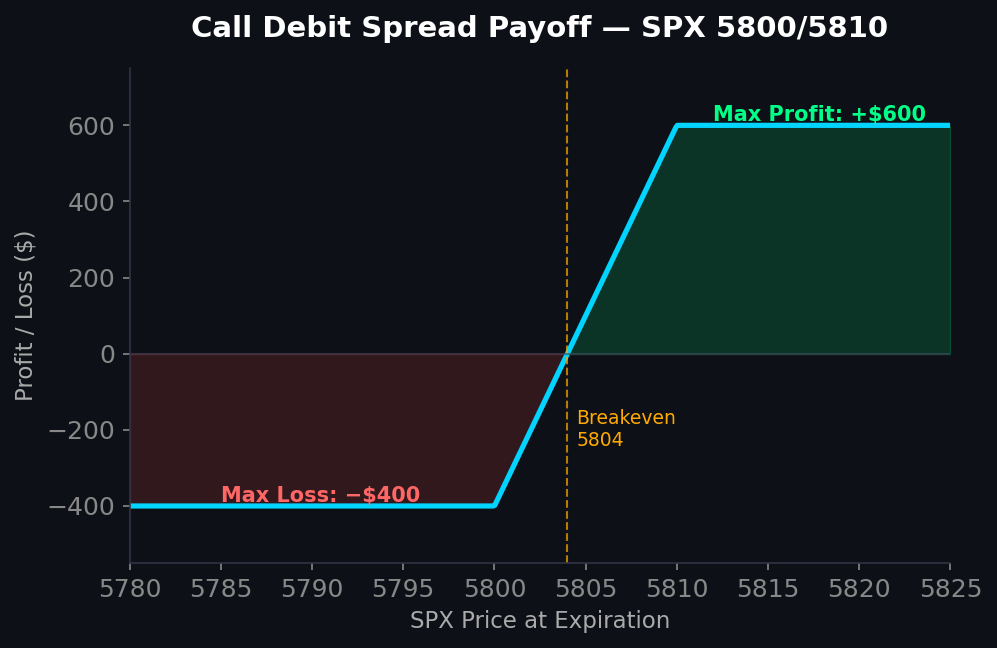
Defined-risk structures force a more professional question: if this trade loses as planned, what does that mean for the account? Before entry, you should know the maximum loss per position, the total risk already deployed, and the point at which additional trading would violate your daily or weekly process.
A trade can be a reasonable idea and still be wrong for your size. No alert can answer that without knowing your full risk picture. You have to own that decision.
Self Direction Is Not Prediction
Many traders reject alerts but make the opposite mistake. They assume self direction means becoming a better market forecaster. They spend their mornings trying to call the exact high, low, close, or next twenty-point move in SPX.
Stop guessing.
A durable 0DTE framework does not require you to be right about every move. It requires you to understand the environment well enough to select structures with defined risk, place them where the market’s positioning and price behavior support the thesis, and manage them according to rules established before emotions take over.
That is a different standard. You are not trying to win an argument with the market. You are assessing probabilities, constraints, and payoff shapes.
For example, a trader may observe that price is holding within a range while key positioning levels appear likely to influence intraday movement. That observation does not guarantee a quiet session. It provides context for deciding whether a particular defined-risk structure makes sense, how much room it needs, and whether the potential reward justifies the planned risk. If conditions change, the process should tell you what to do next.
The point is not to predict perfectly. The point is to avoid taking risks you cannot explain or survive. The OCC’s options education is a good independent grounding.

What a Self-Directed 0DTE Process Looks Like
A working process is usually less exciting than an alert feed. That is a feature, not a flaw. It begins before the opening bell with preparation: identify relevant price areas, review volatility and positioning context, define the types of setups you are prepared to trade, and decide the maximum risk available for the day.
During the session, you wait for the market to provide information. Price behavior matters. So does the relationship between price, time, volatility, and the strikes you choose. You do not need to force a trade because a chat room is active or because you have been watching screens for an hour. A daily options routine makes that easier.
When a setup qualifies, the trade has a known structure and a known worst-case outcome. You enter at a size consistent with the plan. Then you manage the position according to pre-established conditions rather than reacting to every candle.
Afterward, you review. Not just the profit or loss. Review whether the setup matched your criteria, whether sizing was appropriate, whether execution followed the rules, and whether the decision quality was sound. A planned loss can be a good trade. An impulsive gain can be a bad one. That is the core of process versus outcome trading. If you cannot separate those two ideas, you will keep training yourself to chase outcomes.
At FatTail.ai, the goal is not to hand traders another source of calls. It is to help them develop this kind of repeatable operating system through live market exposure, structured education, trade review, and tools built around index-options decision making.
When Alerts May Have a Limited Place
There is a reasonable use for external trade commentary: as information, not instruction. A skilled trader can watch how another professional frames market conditions, compare that view with their own work, and decide whether it changes anything. That is education when it is paired with independent reasoning. That is the aim of live market coaching.
The problem starts when the message becomes a substitute for a plan. If you cannot state the thesis, defined risk, invalidation point, and sizing logic in your own words, you are not using research. You are following orders.
That distinction also protects you from the social pressure surrounding trading. Alert communities can make constant action feel normal. Screenshots amplify winners. Losses disappear into silence. Your account does not care how active the room is. It only reflects the risk you actually took.
Build Independence One Repetition at a Time
Moving away from alerts does not require a dramatic declaration that you will never listen to another market opinion. It requires changing the order of operations. Start with your framework. Define the risk. Form your own view of the conditions. Then use outside input as a challenge to your thinking, not a replacement for it.
Expect the transition to feel uncomfortable. Alerts provide a false sense of protection because someone else appears responsible for the decision. Self direction makes responsibility visible. That can sting after a loss, but it is also where improvement becomes possible.
Keep the scope narrow. Trade fewer setup types. Use defined-risk structures. Size small enough that a planned loss remains a planned loss. Log each decision. Review the work when the market is closed and your nervous system is no longer negotiating with the chart.
The trader who needs no signal provider is not the trader who knows the future. It is the trader who can face uncertainty with a process, protect capital when wrong, and return tomorrow with the same discipline.
Frequently Asked Questions
What is the difference between trade alerts and self-direction?
An alert hands you a ticker, direction, and strikes and asks you to follow the sender. Self-direction is the capacity to make decisions inside a defined framework using coaching, review, tools, and market context. Alerts create dependency; self-direction creates evidence you can explain and repeat.
Are trade alerts ever useful?
As information, not instruction. A skilled trader can watch how another professional frames conditions, compare it with their own work, and decide whether it changes anything. It becomes a problem when the message replaces a plan: if you cannot state the thesis, defined risk, invalidation, and sizing in your own words, you are following orders.
Why is position sizing a problem with alerts?
Alerts are described by conviction, and traders size from confidence rather than account-level risk. Conviction does not cap losses. No alert can tell you the right size without knowing your full risk picture, so you must own the maximum loss per position and the total risk already deployed.
Does self-direction mean predicting the market?
No. It does not require calling the exact high, low, or next move. It requires understanding the environment well enough to select defined-risk structures, place them where positioning and price behavior support the thesis, and manage them by rules set before emotion takes over. The goal is to avoid risks you cannot explain or survive.
How do you transition from alerts to self-direction?
Change the order of operations: start with your framework, define the risk, form your own view, then use outside input as a challenge rather than a replacement. Keep scope narrow, trade fewer setups, use defined risk, size small, log each decision, and review when the market is closed.
FATTAIL BRIEFINGS
Get FatTail briefings in your inbox
Pick the lists you want. FOMC Alerts is selected by default.