


A trade can be defined risk and still be reckless. That is the uncomfortable distinction many active options traders miss. Why do traders oversize positions? Usually not because they cannot calculate a maximum loss. They oversize because, in the moment, that maximum loss feels unlikely, acceptable, or necessary to make the trade matter.
That thinking is not a personality flaw. It is a process flaw. If position size changes with your confidence, frustration, or need to recover, you do not have a risk framework. You have a set of emotional exceptions waiting for market volatility to expose them.
For SPX and 0DTE traders, this matters even more. Short-dated options move fast. A structurally sound idea can still produce an account-disrupting loss when too much size is attached to it. Defined risk protects you from the unlimited-loss problem. Correct sizing protects you from the risk-of-ruin problem. The OCC’s options education covers position-risk fundamentals. You need both.
Why Do Traders Oversize Positions? They Confuse Belief With Edge
The most common reason is conviction. A trader sees a level holding, a gamma structure that appears supportive, or a setup that worked several times recently. The market story feels clear. So they add contracts.
But a clear story is not the same as a favorable outcome. Positioning can inform a trade thesis. It cannot make the future certain. Even a well-researched SPX structure can fail when price moves through a key area, volatility changes, or intraday flows accelerate in a direction no chart pattern could guarantee.
Oversizing turns a normal uncertainty into a personal referendum. The trader is no longer executing an idea with a known risk. They are trying to prove they are right.
Professional risk practice starts from the opposite premise: this trade can lose. Not because the analysis was foolish, but because loss is part of the distribution. Size the trade so that outcome is survivable, routine, and reviewable. If a full loss would change your behavior on the next trade, the position was too large.
Recent Results Distort Risk Perception
A streak changes behavior quickly. After several winners, traders often feel as if they have earned the right to size up. After several losses, they may increase size to get back to even. That recovery pressure is how revenge trading starts. Both reactions place the last few outcomes in control of the next decision.
The first is overconfidence. The second is recovery pressure. Neither has anything to do with the current trade’s planned risk.
Markets do not know you are on a streak. A 0DTE session does not offer better odds because you were disciplined yesterday, nor does it owe you a reversal after a difficult week. When size responds to a recent emotional scorecard, execution becomes unstable.
This is why a fixed sizing rule matters. It prevents a winning day from turning into entitlement and a losing day from turning into a chase. You can adjust size over time, but that adjustment should follow a scheduled review of account capacity, performance data, and demonstrated process consistency. It should not happen at 11:42 a.m. because a setup looks perfect.
Defined Risk Creates a False Sense of Safety
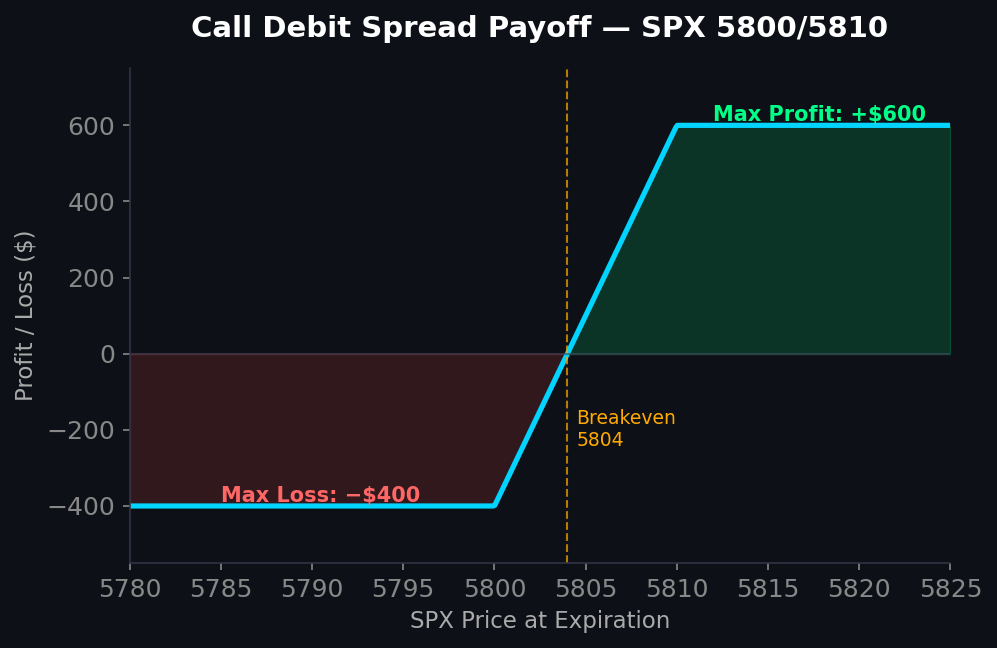
Defined-risk spreads are an essential tool. They make the maximum loss known before entry. But traders can misuse that clarity.
They see a limited loss per spread and conclude the trade is safe. Then they add enough contracts that the total defined loss becomes disproportionate to the account or to the day. The risk is still defined. It is simply too large. That is one of the top mistakes in 0DTE sizing.
That distinction matters. A seatbelt does not make it wise to drive into a wall. A defined-risk structure does not make every quantity appropriate.
Before entering, calculate the risk of the entire position, not the risk of one contract. Then ask a more useful question: if this position reaches its planned maximum loss, can I execute the next qualified trade exactly as written? Can I review the loss without changing rules, skipping setups, or trying to force a recovery?
If the answer is no, your quantity is not a position size. It is a bet size.
One Thesis Can Hide Multiple Risks
Oversizing also happens through accumulation. A trader opens one position, then adds another at a nearby strike, then takes a second setup that depends on the same market behavior. Each position may look defined risk in isolation. Together, they can create concentrated exposure to a single directional move.
This is especially relevant in SPX trading. Multiple credit spreads, butterflies, or other defined-risk structures can all be vulnerable if price breaks one area with momentum. Different strikes do not automatically mean diversification.
Assess risk at the portfolio level. What happens if the underlying moves quickly in one direction? What happens if volatility expands? What is the combined maximum planned loss across positions that share the same thesis? The answer should guide size before the trade is placed, not after the market is moving.
The Need for a Trade to Matter
Small positions can feel unsatisfying. That is another reason traders oversize. They want a good read to produce a meaningful result, and they dismiss smaller size as not worth the effort.
That is backwards. The purpose of a trade is not to generate excitement or validate analysis. The purpose is to execute a repeatable process with acceptable risk. Early in a trader’s development, a smaller position is often more valuable because it lets them see their real decision-making without the noise of panic.
If a loss at your current size feels unbearable, you will interfere with the plan. You may close too early, refuse a planned adjustment, move a stop, add to a loser, or hesitate on the next valid entry. The problem is not discipline in the abstract. The position was large enough to make discipline expensive. Oversizing is a big part of what causes intraday option losses.
Size should be boring. That is the point. Boring size lets you gather clean data on whether your structure, entries, exits, and trade management rules work over a meaningful sample.

Build a Sizing Rule Before the Session Starts
Correct position sizing is not an instinct. It is a pre-commitment. Decide your unit of risk when the market is closed and your nervous system is not negotiating.
Start with a maximum loss for one trade expressed as a small, predetermined portion of the capital allocated to trading. Then establish a separate maximum planned loss for the entire session. The exact level depends on account size, strategy design, experience, and the frequency of your setups. There is no universal contract count. Contract specs for the series you trade are on the Cboe product page.
What should be universal is the sequence: define the structure, determine its maximum loss, calculate quantity from the risk budget, and check total exposure already on the book. Quantity is the last decision, not the first.
For example, if a setup has a wider risk profile than usual, you reduce contracts. If you already have exposure to the same directional scenario, you reduce contracts or pass. If the smallest practical position is still too large for your risk budget, the correct trade is no trade.
That is not missed opportunity. It is risk control doing its job.
Treat Losses as Planned Reps
Traders who oversize often see a loss as evidence that something has gone wrong. A properly sized loss is often evidence that the system worked as designed: the trade had defined risk, the loss stayed within the plan, and capital remains available for future opportunities.
This reframing changes behavior. You stop trying to eliminate losses and start trying to eliminate unplanned damage. You stop scoring yourself on one outcome and start measuring whether you followed the process.
A useful post-trade review asks: Was the quantity correct for the setup? Did the combined exposure exceed the daily plan? Did confidence, frustration, or fear influence the contract count? Did I take a trade because it fit the framework, or because I needed something to happen?
The answers are often more valuable than another indicator or another alert. Not signals. Not prediction. A repeatable operating process.
The next time a trade feels unusually certain, pause before adding size. Certainty is often the warning sign. Your job is not to find the one trade that changes everything. Your job is to keep executing well enough that no single trade ever can.
Frequently Asked Questions
Why do traders oversize positions?
Usually not because they cannot calculate a maximum loss, but because in the moment that loss feels unlikely, acceptable, or necessary to make the trade matter. If size changes with confidence, frustration, or a need to recover, that is a process flaw: emotional exceptions instead of a risk framework.
Does defined risk mean a position is safe?
No. Defined-risk spreads make the maximum loss known before entry, but adding enough contracts can make the total defined loss disproportionate to the account. The risk is still defined; it is simply too large. Calculate the risk of the entire position, not one contract, and ask whether you could take the next trade unchanged after a full loss.
How should you size an SPX or 0DTE position?
Quantity is the last decision, not the first. Define the structure, determine its maximum loss, calculate quantity from a pre-set risk budget, then check total exposure already on the book. Set a maximum loss per trade and a separate maximum planned loss for the session while the market is closed.
Is a small position size a waste of a good setup?
No. The purpose of a trade is to execute a repeatable process with acceptable risk, not to validate analysis. Boring size lets you gather clean data on whether your entries, exits, and management work over a meaningful sample without the noise of panic.
How do you stop oversizing after a winning or losing streak?
Use a fixed sizing rule so a winning day does not become entitlement and a losing day does not become a chase. Adjust size only through a scheduled review of account capacity and performance data, never at 11:42 a.m. because a setup looks perfect.
FATTAIL BRIEFINGS
Get FatTail briefings in your inbox
Pick the lists you want. FOMC Alerts is selected by default.