


At 9:30 a.m., a 0DTE position can look calm. By 2:00 p.m., one index move, a volatility shift, or a failed level can completely change its risk profile. That is what is 0DTE trading in practical terms: trading options that expire at the end of the current session, where time is short, pricing is sensitive, and poor risk decisions get exposed fast.
0DTE trading is not inherently gambling. But it becomes gambling when the plan is to sell premium, hope price stays put, and react only after the position becomes uncomfortable. The expiration date does not create discipline. The trader does.
What Is 0DTE Trading?
0DTE means zero days to expiration (see our full breakdown of 0DTE options). A 0DTE option is an option contract that expires on the same day it is traded. In index options such as SPX, that creates a market where the remaining value of an option is almost entirely tied to what could happen before the closing bell.
Unlike a position with days or weeks remaining, there is little time for a thesis to recover. Theta, or time decay, works quickly. So do changes in delta and gamma, which describe how quickly an option’s price and directional sensitivity can change as the underlying index moves. Near expiration, those changes can become severe.
That sensitivity is why 0DTE attracts active traders. The OCC’s options education is a good grounding in the theta and gamma behavior behind it. It offers frequent opportunities to express a defined view around current market conditions. It is also why a casual approach can produce unstable results. The same mechanics that create efficient premium decay can turn a small error in sizing or structure into a large account-level problem.

Why Same-Day Expiration Changes the Game
A longer-dated option gives a trader time. A 0DTE option largely removes it. The Cboe SPX contract specs detail the same-day settlement and expiration mechanics. If price moves against a short premium position early in the day, there may be no multi-day window for the market to mean-revert. If volatility expands, the mark-to-market effect can be sharp even if price has not crossed a strike.
The central issue is not whether the market will go up or down. It is how the option market is priced relative to the range and path the market may travel before expiration.
That requires traders to pay attention to positioning, expected movement, major levels, and the changing shape of risk throughout the session. An index can finish near where it opened and still create a difficult day for a position that was poorly placed or poorly managed. Path matters.
This is where many retail traders make a category error. They treat 0DTE as a fast version of stock trading. It is not. You are trading a decaying, nonlinear instrument. Price direction matters, but so do time, implied volatility, strike selection, and the concentration of risk near expiration.
0DTE Trading Is Not About Being Right
The popular version of 0DTE trading is a prediction contest: call the high, call the low, find the next big move. That approach creates emotional dependence on every candle. It also encourages traders to oversize because conviction feels like an edge.
A professional framework starts elsewhere. It asks what risk is being accepted, where that risk is defined, how much capital is exposed, and what conditions would make the trade invalid or difficult to manage. Prediction may inform a trade, but it cannot be the whole plan.
A trader can have a reasonable directional read and still lose because the structure was too close, the entry was late, or the position was too large for the available risk budget. The reverse is also true: a trader does not need to forecast every move perfectly to execute a sound, repeatable process.
Stop guessing. Start measuring the trade before it is placed.
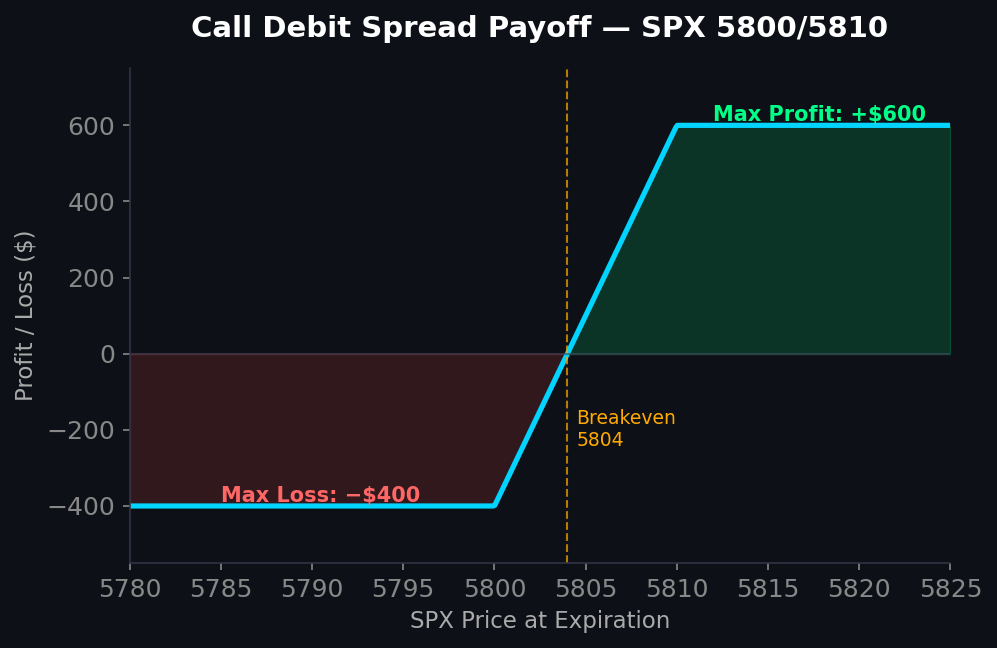
Defined Risk Is the Starting Point
In 0DTE, undefined risk is not a badge of sophistication. It is a risk-of-ruin problem. Same-day options can reprice quickly enough that a position which appears manageable can become oversized before a trader has made a clear decision.
Defined-risk structures place a known boundary around the worst-case loss at entry. That boundary does not make a trade safe or guarantee a favorable outcome. It does make the exposure measurable. Measurable risk can be sized. Sized risk can be repeated. Repetition is what allows a trader to evaluate a process without one bad day overwhelming a long series of disciplined decisions.
The right structure depends on the market environment and the trade thesis. A trader may use risk-defined spreads or other capped-risk combinations to express a directional, neutral, or range-based view. The details matter, but the principle comes first: know the maximum planned loss before the order is sent.
This also changes the meaning of a loss. A planned loss inside a predefined range is not a failure of character. It is a normal rep in a probabilistic business. An unplanned loss caused by oversized exposure, improvised adjustments, or refusal to exit is a process failure worth reviewing.
A Better 0DTE Trading Framework
A repeatable 0DTE process begins before the opening bell. The goal is not to force a trade every day. The goal is to understand the day you are entering and recognize when the available opportunity does not justify the risk.
Start With Market Structure
Identify the context: overnight movement, current volatility conditions, scheduled events, key index levels, and options positioning. A market opening inside a quiet, balanced range presents a different problem from a market repricing after a major economic release.
Positioning matters because dealer hedging flows and concentrated open interest can influence how price behaves around important strikes. These inputs are not magic levels. They are context. Use them to form scenarios, not certainties.
Define the Trade Before Entering
Before entering, define the structure, the maximum loss, the position size, and the conditions that would change your view. If those answers are vague, the trade is not ready.
Position size deserves more attention than entry precision. A good structure can still create poor decisions when it is too large. When risk is appropriately sized, a trader can observe the market, follow rules, and accept an ordinary losing trade without turning it into a rescue mission.
Manage the Position, Not the P&L Emotion
Once in a trade, monitor the risk graph and the relationship between price, time, and volatility. Do not let a temporary profit convince you that risk has disappeared. Do not let a temporary loss automatically demand an adjustment.
Management should be driven by preplanned conditions and the position’s actual exposure. Sometimes the best decision is to take risk off. Sometimes it is to hold within the original plan. Sometimes the correct action is no trade at all. It depends on the structure and the market, not on a need to be right.
Review Every Session
The edge is built in the review. Record the market context, trade rationale, size, execution, management decisions, and outcome. Then separate a good process from a good result.
A profitable trade can be poorly executed. A losing trade can be well executed. If you only score yourself by profit and loss, you will reinforce luck and punish discipline. A trade log, risk graph, and honest review turn individual sessions into usable data.
The Most Common 0DTE Mistakes
The first mistake is treating premium collected as profit already earned. Premium is compensation for risk, and on expiration day that risk can change quickly.
The second is entering without a size rule. Traders often focus on which strike to sell or buy while ignoring the more consequential question: what happens if the position reaches its planned maximum loss? If the answer would disrupt the account or force emotional decision-making, the size is wrong.
The third is outsourcing judgment to alerts and social media calls. Signals can provide an idea, but they cannot know your account size, risk tolerance, existing exposure, or plan. A trader who needs someone else to tell them when to enter and exit has not built a trading process. They have rented one.
Finally, many traders overtrade. Daily expiration does not mean daily obligation. Some sessions offer clean structure and acceptable risk. Others are too volatile, too compressed, or too unclear. Passing is a position.
The Real Opportunity in 0DTE
0DTE trading gives a disciplined trader a compact environment to practice the skills that matter most: defining risk, sizing correctly, reading structure, managing uncertainty, and reviewing decisions without excuses. Our guide to trading same-day options walks through the full process.
That is the opportunity. Not signals. Not alerts. Not a heroic market call. Build a process that can absorb normal losses, preserve your ability to trade tomorrow, and make you less dependent on anyone else’s opinion.
Frequently Asked Questions
What is 0DTE trading?
0DTE trading means trading options that expire at the end of the current session, where time is short, pricing is sensitive, and poor risk decisions get exposed fast. A 0DTE option is a contract that expires the same day it is traded, so its value is almost entirely tied to what happens before the close.
Is 0DTE trading gambling?
Not inherently. It becomes gambling when the plan is to sell premium, hope price stays put, and react only after the position is uncomfortable. The expiration date does not create discipline; the trader does, through defined risk, sizing, and a repeatable process.
Why does same-day expiration change everything?
A longer-dated option gives time for a thesis to recover; a 0DTE option removes it. Theta decays fast, and delta and gamma change fast, so a mark-to-market can move sharply even if price has not crossed a strike. Path matters, not just direction.
What is the most important rule in 0DTE trading?
Know the maximum planned loss before the order is sent. Same-day options can reprice quickly enough that an undefined-risk position becomes oversized before you decide anything. Defined risk makes exposure measurable, measurable risk can be sized, and sized risk can be repeated.
What are the most common 0DTE mistakes?
Treating collected premium as profit already earned, entering without a size rule, outsourcing judgment to alerts and social media, and overtrading. Daily expiration is not a daily obligation; passing on a poor session is itself a position.
FATTAIL BRIEFINGS
Get FatTail briefings in your inbox
Pick the lists you want. FOMC Alerts is selected by default.