


A trader wins 88% of the time, then gives back six weeks of gains in one oversized loss. Another wins just over half the time and ends the month stable, controlled, and able to take the next setup without flinching. That is why win rate doesn’t matter nearly as much as most retail traders think it does.
Win rate is a scorecard statistic. It tells you how often trades closed green. It does not tell you whether the system has positive expectancy, whether the losses were contained, whether size was appropriate, or whether one bad day can damage the account beyond repair.
For 0DTE SPX traders, this distinction is not academic. Expiration-day options move fast. Premium changes fast. The OCC’s options education is a good grounding in the mechanics behind that speed. A process that feels successful because it produces frequent small winners can be structurally dangerous if it leaves room for rare, oversized losses. The goal is not to be right often. The goal is to run a defined-risk process that can survive being wrong. That is the heart of sound risk management.
Why Win Rate Doesn’t Matter Without Expectancy
A trading system is not profitable because it wins a lot. It is profitable when the average money made on winners, combined with the frequency of winners, outweighs the average money lost on losers.
The basic framework is simple:
Expectancy = (win rate × average win) – (loss rate × average loss)
That equation is not exciting. It is also where most trading confusion gets cleared up.
Consider two simplified systems. System A wins 85% of its trades. Its average winner is $100, but its average loser is $700. System B wins 52% of its trades. Its average winner is $180 and its average loser is $150. System A can look impressive for weeks because most trades are winners. But its math may be fragile. A few losses can erase a large number of wins.
System B can feel uncomfortable because losses happen regularly. Yet it may have a healthier payoff structure and a more reliable path to positive expectancy. The trader using it is not waiting for perfection. They are executing a process whose numbers work across a meaningful sample.
This is the corrective most traders need. A loss is not proof that the trade was bad. A win is not proof that the trade was good. Outcome is one data point. Process, risk, entry quality, structure selection, and size tell you what actually happened.
High Win Rates Can Create Bad Habits
High win-rate strategies are attractive for a reason. Frequent winners produce relief. They make it easier to believe you understand the market. They can also train traders to avoid the exact behaviors that keep an account alive: taking planned losses, respecting risk limits, and accepting uncertainty.
The problem starts when a trader treats a normal losing trade as an exception that must be fixed. They widen a stop, add size, roll without a plan, or hold a defined-risk position past the point where their rules said to exit. The original trade may have had manageable risk. The response to being wrong creates the real damage.
This pattern is especially common in short-premium thinking. A trader collects relatively small credits repeatedly, sees a long string of wins, and begins to experience those wins as expected income. Then SPX moves with speed, volatility expands, or the market reprices a level they assumed would hold. The loss is no longer a planned rep. It becomes a negotiation with the market.
Markets do not negotiate.
A high win rate can be useful information. It may reveal that your entries are selective or that a particular structure behaves consistently in certain conditions. But it is never enough information on its own. If the strategy needs a near-perfect sequence of small wins to offset occasional damage, it is not stable just because the dashboard looks green.

Defined Risk Changes the Question
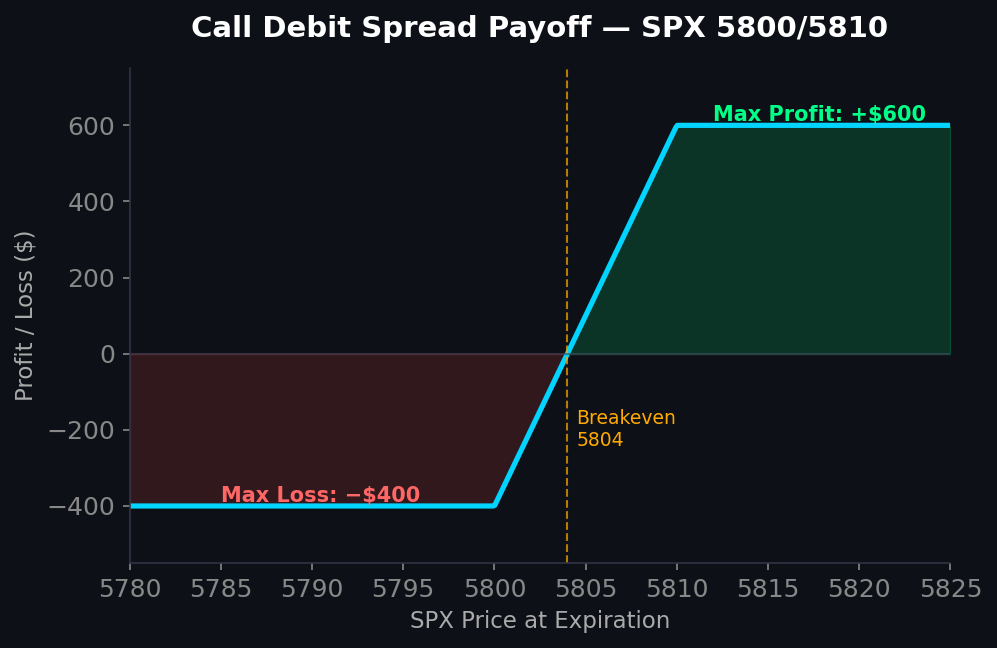
Defined-risk structures give the trader a known worst-case exposure before entering the position. That does not make every trade good. It does make risk visible, measurable, and compatible with disciplined sizing.
Instead of asking, “How likely is this to win?” ask better questions. What is the maximum planned loss? How much credit or debit is being exchanged for that risk? Where is the structure relative to key positioning and price levels? Does implied movement justify the trade? What size keeps this loss routine rather than disruptive?
Those questions move the trader away from prediction and toward construction.
In a 0DTE SPX framework, positioning matters because it provides context for how price may behave around major strikes and dealer exposure zones. It is not a crystal ball. A convexity heatmap or GEX overlay should not be used as a signal that guarantees direction. It is information for building a trade thesis, identifying where conditions may change, and deciding whether the defined risk is acceptable.
The distinction matters. Signals make traders dependent. A framework teaches them to evaluate conditions for themselves.
Defined risk also protects the psychological side of execution. When the maximum loss is sized correctly, you do not need every trade to work. You can close a loser according to plan, document it, and be ready for the next opportunity. That is what professional behavior looks like. Not emotional detachment. Preparedness.
Size Determines Whether Your Edge Survives
A positive-expectancy strategy can still fail under poor sizing. This is where traders often misunderstand the lesson and swing too far in the other direction. They hear that win rate is not everything, then assume a favorable payoff ratio gives them permission to trade large.
It does not.
Position size determines how much room you have to experience the normal distribution of outcomes. Every valid system has losing streaks. Even a process with a strong historical edge can deliver several losses in a row. If a small run of ordinary losses causes you to abandon rules, cut size in panic, or take revenge trades, the position was too large for you.
Correct sizing is not about finding the largest trade you can tolerate. It is about choosing a size that lets you execute the same process through wins, losses, quiet sessions, and volatile sessions. Your account must be able to absorb the planned risk. Your decision-making must be able to absorb it too.
This is why risk of ruin deserves more attention than win rate. Investor-education bodies like the SEC stress position sizing and defined loss limits for exactly this reason. Risk of ruin asks a more serious question: can a normal adverse sequence remove you from the game? A trader who wins often but risks too much on each position can have a beautiful short-term record and a bad long-term design.
Small enough to continue is not timid. It is structural.
Measure What Actually Improves a Trading Process
If win rate is not the main score, what should you track? Start with a trade log that captures more than entry and exit. Our guide on reviewing option trades covers how. Record the structure, maximum defined risk, position size, market context, thesis, planned management, actual management, and whether you followed the plan.
Over a meaningful sample, review your average win, average loss, expectancy, maximum drawdown, and results by setup type. Look for the behavior beneath the P&L. Are losses larger when you enter late? Do certain structures perform poorly when volatility is compressed? Are profitable trades being cut early because you are trying to protect a high win rate? Are losing trades held longer because you are reluctant to take a red result?
Those answers are actionable. “My win rate dropped” is not.
There are situations where win rate deserves attention. A sudden change can indicate that market conditions have shifted, entries have drifted, or you are forcing trades outside your framework. But it should trigger investigation, not reflexive changes. A lower win rate paired with better average wins and controlled losses may be an improvement. A higher win rate paired with growing tail risk may be a warning.
The point is not to dismiss the metric. The point is to put it in its proper place.
Stop Trying to Protect a Number
The need to maintain a high win rate turns traders into defenders of a statistic. They skip valid setups after a loss. They take profits too quickly. They move rules to avoid realizing a planned loss. They judge a day by whether it was green rather than whether the work was clean.
That is backwards.
A disciplined 0DTE SPX trader should expect losses. They should know the maximum damage before entry, use sizing that keeps that damage survivable, and review the trade without rewriting history. Some losses will be clean executions in bad outcomes. Some wins will be poor executions that happened to work. The log should teach the difference.
At FatTail.ai, the work is built around that distinction: defined risk, structural context, repeatable execution, and honest review. Not signals. Not alerts. Not the impossible job of being right all the time.
The next time you feel the urge to protect your win rate, pause and ask a better question: did I take a trade that fit my process, at a size I can carry, with risk I understood before I entered? If the answer is yes, a planned loss is not a failure. It is the cost of staying in the game long enough for your process to matter.
Frequently Asked Questions
Does win rate matter in trading?
Less than most traders think. Win rate tells you how often trades closed green, not whether the system has positive expectancy, whether losses were contained, or whether one bad day can damage the account. A high win rate with oversized losses is fragile.
What is expectancy in trading?
Expectancy = (win rate x average win) minus (loss rate x average loss). A system is profitable when the size and frequency of winners outweigh the losers, not simply because it wins often. A 52% system with a healthy payoff can beat an 85% system with tiny winners and large losers.
Why can a high win rate be dangerous?
Frequent winners produce relief and can train traders to avoid the behaviors that keep an account alive, such as taking planned losses and respecting risk limits. The damage often comes from the response to being wrong: widening stops, adding size, or refusing to exit.
What should you track instead of win rate?
Average win, average loss, expectancy, maximum drawdown, and results by setup, alongside a log of structure, defined risk, size, context, and rule adherence. “My win rate dropped” is not actionable; “losses are larger when I enter late” is.
How does position size affect a trading edge?
A positive-expectancy strategy can still fail under poor sizing. Every valid system has losing streaks; if a normal run of losses makes you abandon rules or take revenge trades, the position was too large. Risk of ruin matters more than win rate.
FATTAIL BRIEFINGS
Get FatTail briefings in your inbox
Pick the lists you want. FOMC Alerts is selected by default.