


Most traders do not fail with a 0dte butterfly strategy because the structure is flawed. They fail because they treat a defined-risk trade like a prediction contest. They pick a direction, force an entry, oversize the position, and then judge the trade by whether it won. That is backward. In 0DTE index options, the real edge comes from where you position risk, how you size it, and whether your process survives the days when the market does not cooperate.
A butterfly is not magic. For the full mechanics, see our complete 0DTE butterfly guide. It is just a way to express a very specific view on location and movement while keeping risk capped. For self-directed SPX traders, that matters. Defined risk gives you room to think clearly. It also gives you a way to stay in the game long enough to build skill instead of blowing up on one bad afternoon.
What the 0DTE butterfly strategy is really doing
At a basic level, a butterfly combines long and short options at three strikes to create a tent-shaped payoff. On expiration day, that shape becomes extremely sensitive to where SPX is trading relative to your center strike and wing width. The OCC’s options education has a free tool to plot this before you trade it. That is why the structure attracts so much attention in 0DTE. Small changes in price, time, and implied volatility can change the trade quickly.
But the important point is not the textbook payoff diagram. The important point is the bet you are actually making. A 0dte butterfly strategy says, in effect, that you believe price is likely to spend meaningful time near a certain zone before the close, and that the move beyond your wings is less likely than the market is pricing. Sometimes that means leaning into a balanced, range-bound session. Sometimes it means using the structure after an early expansion move when the market starts showing signs of compression. It depends on context.
This is where retail traders often go off track. They ask, “Where do I think SPX will finish?” That sounds reasonable, but it is the wrong first question. The better question is, “Where is the market pricing movement, where is dealer positioning likely to matter, and where can I place a structure so the risk is clean if I am wrong?” Positioning first. Prediction second.
Why traders are drawn to it – and why they misuse it
The appeal is obvious. Risk is defined at entry. The structure can offer strong convexity if price moves toward your body strike. And because the trade is built for expiration day, you get quick feedback. That combination is attractive to active traders who want repeatable setups without open-ended exposure.
The misuse comes from the same source. Fast feedback tempts people to overtrade. Defined risk tempts them to oversize because the maximum loss looks “manageable.” And the payoff tent tempts them to anchor on the perfect finish instead of the trade’s actual behavior during the session.
A butterfly is not a lottery ticket for pin risk. It is a managed structure. If you enter it with no framework for time of day, expected move, strike placement, and exit logic, you are just guessing with nicer packaging.

How to think about strike placement in a 0DTE butterfly strategy
Strike placement is the whole game. The body strike is where your peak payoff sits at expiration. The wings define your risk and shape your sensitivity. Move any of those pieces and you change the trade materially.
In practice, your placement should reflect market conditions, not your hope. On a compressed day with balanced auction behavior, a centered butterfly near a high-interest zone may make sense. On a trend day, forcing a neutral butterfly in the middle of a directional move is usually just a slow way to donate premium. In that case, a broken-wing or directional variation may fit better, or no trade may be the best trade.
That is the part many traders resist. They want one setup that works every day. There is no such setup. A structure has to match the session. If the market is expanding, your butterfly needs to respect that. If the market is rotating around a well-defined area, you can position for that. Same strategy family. Different application.
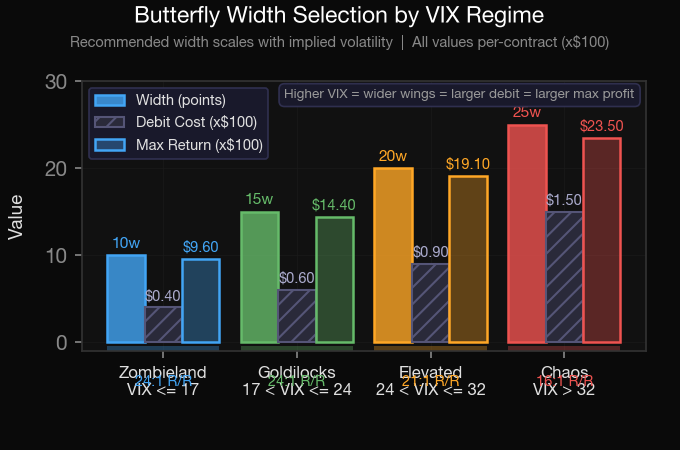
The other issue is wing width. Narrow wings create more concentrated exposure and can increase payoff near the center, but they also reduce room for error. Wider wings can be more forgiving, but they change your cost, your Greeks, and your reward profile. There is no universally correct width. There is only the width that fits your account size, your session thesis, and your risk plan.
Risk is defined, but that does not mean safe
This is the lesson traders need to hear plainly. Defined risk does not excuse bad sizing. If you put on too many butterflies, you can still damage your account quickly. Risk of ruin does not disappear because the broker shows a capped loss number.
Sizing is not a side note. It is the strategy. A trader who uses small, repeatable size can survive variance, review mistakes, and improve. A trader who sizes to make the day “worth it” usually ends up turning normal losing trades into emotional events. Once that happens, process is gone. The next trade becomes revenge, not execution.
This is also why judging the 0dte butterfly strategy by a single trade is useless. The structure will have clean losses. It should. That is the point of engineering them. A planned loss is not evidence that the strategy is broken. It is the cost of operating a defined-risk framework in a market that will not do what you want on demand.
What to watch during the session
By the time you are in the trade, your job changes. You are no longer trying to prove your forecast. You are managing location, tempo, and time.
Location means whether SPX is behaving relative to your body and wings the way the setup required. Tempo means whether price is moving in a controlled way or expanding beyond what the structure can tolerate. Time matters because a 0DTE butterfly is not static. The same price at 11:00 a.m. and 3:30 p.m. can mean very different things for risk and opportunity.
Volatility matters too, but not in the vague way most retail content talks about it. What matters is whether changing implied volatility and intraday order flow are helping your structure hold shape or causing it to flatten and lose edge. On expiration day, gamma can matter more than your opinion. The Cboe contract specs for SPX explain why cash-settled expiration behaves this way. That is why process-driven traders use tools, levels, and review instead of relying on feel.
Common mistakes that break the trade
The first mistake is forcing butterflies into trend days. If the auction is one-sided, the market is telling you something. Listen.
The second is entering too early. A trade placed before the session has shown its character is often just a guess with a timestamp. Patience is a real edge in 0DTE.
The third is waiting for max profit. That fantasy ruins more butterflies than bad entries do. Expiration-day structures can look great and then deteriorate fast. If your framework includes realistic profit-taking and disciplined exits, use them.
The fourth is skipping review. Traders love the entry and hate the homework. But your progress will come from trade logs, screenshots, risk graphs, and post-trade notes. Not from memory. Not from vibes. If you cannot explain why the trade fit the session, why you sized it the way you did, and why you exited when you did, you are not building a repeatable process.
A professional way to use the structure
The professional mindset is simple. You are not trying to be right about every session. You are trying to deploy a structure when the conditions fit, with risk sized small enough that any single outcome is ordinary.
That means your checklist matters more than your conviction. Session type. Key levels. Expected movement. Placement of the body and wings. Maximum planned loss. Adjustment or exit conditions. Review afterward. The trade should be boring before it is exciting.
This is also where coaching and purpose-built tools can shorten the learning curve. Not because someone gives you signals. Not alerts. Not trade copying. Because good guidance teaches you how to see the session, how to position risk, and how to review your own execution honestly. That is a very different thing.
FatTail.ai teaches this from the standpoint that matters most: your job is to become independent. The goal is not dependence on a guru. It is having a repeatable operating process you can run yourself.
When the 0DTE butterfly strategy makes sense
This structure makes sense when you have a clear reason to believe price is likely to interact with a defined zone and when your risk can be expressed more efficiently with a butterfly than with a simpler spread. It makes less sense when the market is disorderly, directional, or likely to keep repricing range all day.
That is the real answer most traders need. Not whether butterflies are good or bad. Whether this butterfly, in this session, at this size, with this placement, makes sense.
Stop looking for a setup that removes uncertainty. That setup does not exist. Build one that contains it. Then do the next trade the same way.
Frequently Asked Questions
What is a 0DTE butterfly strategy?
A 0DTE butterfly strategy places a butterfly spread on same-day-expiration options, most often on SPX. It combines long and short options at three strikes to create a tent-shaped, defined-risk payoff, expressing the view that price will spend time near a chosen zone before the close.
Where should you place the strikes in a 0DTE butterfly?
Placement should reflect market conditions, not hope. On a compressed, balanced day a centered butterfly near a high-interest zone can fit; on a trend day, forcing a neutral butterfly usually just donates premium, and a broken-wing or directional variation may fit better, or no trade at all.
Is the 0DTE butterfly strategy high risk?
The maximum loss is defined at entry, but defined risk does not mean safe. Oversizing turns a string of ordinary losses into a self-inflicted drawdown. Risk of ruin does not disappear because the broker shows a capped loss number, so sizing is the real strategy.
When does a 0DTE butterfly make sense?
It makes sense when you have a clear reason to believe price will interact with a defined zone and the view is expressed more efficiently with a butterfly than a simpler spread. It makes less sense when the market is disorderly, directional, or repricing range all day.
Why did my 0DTE butterfly lose even though price finished near the strike?
Expiration-day butterflies are highly sensitive to timing and gamma. A position can look great mid-session and deteriorate fast, and waiting for maximum profit ruins more butterflies than bad entries do. Realistic profit-taking and disciplined exits matter more than a perfect finish.
FATTAIL BRIEFINGS
Get FatTail briefings in your inbox
Pick the lists you want. FOMC Alerts is selected by default.