


Both the iron condor and the iron butterfly are defined-risk, neutral, credit-selling structures built from four legs. On a payoff diagram they look like cousins. But the choice between them is one of the most consequential a premium seller makes, because iron condor vs iron butterfly is really a trade-off between how much you collect and how often you win. Pick the wrong one for the market in front of you and you either leave money on the table or take a position that gets run over the moment price moves. This guide breaks down how each is built, the exact trade-off between them, and which to sell in which conditions.
Iron Condor vs Iron Butterfly: The Core Difference
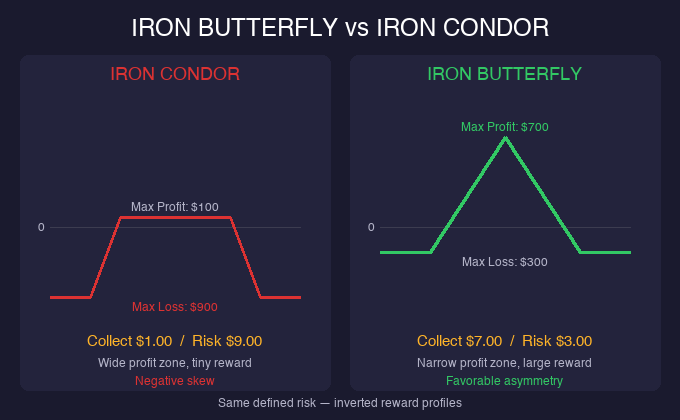
The difference comes down to strike placement. An iron condor sells an out-of-the-money put spread and an out-of-the-money call spread, leaving a wide gap between the two short strikes. An iron butterfly sells the put and the call at the same at-the-money strike, with protective wings above and below.
That single design choice drives everything else. The condor’s short strikes sit away from the current price, so it has a wide profit zone but collects less premium. The butterfly’s short strikes sit right at the money, so it collects far more premium but has a razor-thin profit zone centred on one price. Everything that follows — win rate, reward, adjustment behaviour — flows from this. For the deeper mechanics of each, the full iron condor guide and the iron butterfly breakdown cover them individually.
How Each Structure Is Built
An iron condor has four legs at four different strikes:
- Sell an out-of-the-money put (short put)
- Buy a further out-of-the-money put (long put, the wing)
- Sell an out-of-the-money call (short call)
- Buy a further out-of-the-money call (long call, the wing)
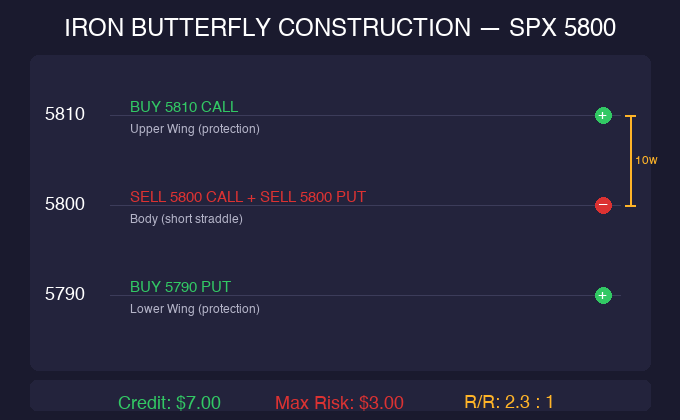
An iron butterfly has four legs at three strikes, with both short options at the middle strike:
- Sell an at-the-money put and an at-the-money call (same strike)
- Buy a protective put below and a protective call above (the wings)
Both are defined-risk: your maximum loss is the wing width minus the credit received, and both are built from two vertical credit spreads. The butterfly is simply a condor with its short strikes collapsed together to the same price.
The Trade-Off: Premium vs Probability
This is the heart of the decision. The iron butterfly collects a much larger credit because you are selling at-the-money options, where premium is richest. But that fat credit buys you a narrow break-even range — price has to finish very close to the centre strike. The iron condor collects less, but its breakevens are far apart, so price has much more room to wander and still leave you profitable.
Put simply: the butterfly is higher reward and lower probability; the condor is lower reward and higher probability. Neither is “better.” A butterfly that wins pays far more than a condor that wins, but it wins less often. Over enough trades the two can produce similar expectancy — the difference is the shape of the ride, and how much volatility you can stomach.
When the Iron Condor Wins
Reach for the iron condor when you expect the underlying to stay within a range but you are not confident about exactly where it will land. Its wide profit zone is forgiving of drift, which makes it the better choice when:
- You have a genuinely neutral view but expect some movement within a band.
- Implied volatility is moderate to high, widening your breakevens further for the same risk.
- You want a higher probability of profit and are willing to accept a smaller credit for it.
The condor is the workhorse of range-bound income selling. It trades away peak premium for breathing room, and that breathing room is what keeps you in the trade when price wobbles.
When the Iron Butterfly Wins
Reach for the iron butterfly when you have a strong conviction that price will pin near a specific level — often around a heavily traded strike or a max pain point — and when implied volatility is elevated enough to fatten the at-the-money credit. It shines when:
- You expect very little movement and can name the price it will hover around.
- Implied volatility is high, maximising the at-the-money premium you collect.
- You want maximum credit and accept a narrow profit zone to get it.
The butterfly is a precision instrument. When you are right about the pin, it pays handsomely; when the underlying drifts, it deteriorates fast. High implied volatility is close to a prerequisite — selling an at-the-money butterfly in low IV collects too little to justify the tight range.
Iron Condor vs Iron Butterfly by Market Condition
A simple way to choose: match the structure to your conviction and the volatility regime. Low conviction on the exact price plus a range-bound view points to the condor. High conviction on a specific pin plus elevated volatility points to the butterfly. Trending or uncertain markets favour neither — both are neutral trades that lose when price breaks out, so the first question is always whether a neutral trade belongs on at all.
The Options Clearing Corporation’s strategy tools let you plot both structures side by side on the same underlying, which is the fastest way to feel the premium-versus-range trade-off before committing capital. On cash-settled index products, the contract specifications from Cboe matter too, since there is no early-assignment risk on the short legs of either structure.
Managing and Adjusting Each
The condor is easier to manage because its untested side gives you room and time. When price approaches one short strike, you can roll the untested spread closer to collect more credit and re-centre the position. The butterfly is harder — because both shorts sit at the same strike, any meaningful move immediately pressures the position, leaving fewer clean adjustments. The practical playbook for defending a threatened neutral trade is covered in our guide to adjusting a losing position, and most of it applies to both structures.
Common Mistakes
Two errors dominate. First, selling an iron butterfly in low implied volatility — you take on the narrow profit zone without collecting the fat premium that is supposed to compensate for it. Second, treating the iron condor as risk-free because it wins often; a single breakout can erase many small wins if positions are oversized, since the loss on a defined-risk credit trade is several times the credit collected. Both structures reward discipline on sizing and IV far more than cleverness on strike selection. For the full map of how these and other structures relate, the spreads framework lays them out side by side.
Frequently Asked Questions
What is the difference between an iron condor and an iron butterfly?
An iron condor sells an out-of-the-money put spread and call spread with a wide gap between the short strikes, giving a wide profit zone and smaller credit. An iron butterfly sells both options at the same at-the-money strike, giving a much larger credit but a narrow profit zone.
Which is more profitable, an iron condor or an iron butterfly?
The iron butterfly collects a larger credit and pays more when it wins, but wins less often. The iron condor collects less but wins more frequently. Over many trades their expectancy can be similar; the butterfly is higher reward and lower probability, the condor the reverse.
Is an iron butterfly riskier than an iron condor?
Both have the same defined maximum loss for a given wing width, but the butterfly has a higher chance of a losing outcome because its profit zone is narrow. In that sense the butterfly carries more probability risk, while the dollar risk per trade is comparable.
When should you use an iron condor vs an iron butterfly?
Use an iron condor when you expect a range but are unsure exactly where price will settle, especially in moderate-to-high volatility. Use an iron butterfly when you have strong conviction price will pin near a specific level and implied volatility is elevated enough to fatten the at-the-money credit.
Which has a higher probability of profit?
The iron condor has a higher probability of profit because its breakevens are wider apart, giving price more room to move while still finishing in the profit zone. The iron butterfly trades that probability away for a larger credit.
The Bottom Line
Iron condor vs iron butterfly is not about which structure is superior — it is about matching the trade to your conviction and the volatility regime. The condor gives you a wide, forgiving profit zone and a higher win rate for a smaller credit; the butterfly gives you a fat at-the-money credit and a big payoff for a narrow, precise range. Sell the condor when you expect a range but cannot pinpoint the level, sell the butterfly when you can name the pin and volatility is rich, and size both so a breakout never wrecks the account. Want to see how disciplined traders choose and manage defined-risk credit structures on SPX in real time? FatTail teaches the structural approach through live sessions and a serious options community.
FATTAIL BRIEFINGS
Get FatTail briefings in your inbox
Pick the lists you want. FOMC Alerts is selected by default.