


Most retail traders do not fail at SPX butterfly trading because the structure is flawed. They fail because they use it like a prediction tool. They pick a direction, force a thesis, oversize the trade, and then call it a bad setup when the market does what markets do – move, stall, reverse, and reprice risk fast.
That is the wrong job for a butterfly.
A butterfly is not a magic income trade. It is not a lottery ticket with a prettier risk graph. Used properly, it is a defined-risk structure that lets you express a very specific view on price, time, and volatility while keeping loss contained. That matters, especially in SPX, where intraday movement can be violent and unforgiving.
If you want consistency, stop asking whether the next trade will win. Ask whether the structure, entry, size, and management rules make sense across many trades. That is the standard.
What SPX butterfly trading actually is
At its core, an SPX butterfly combines two vertical spreads into one defined-risk position. For full construction details, see our butterfly spread guide. You buy one option at a lower strike, sell two at a middle strike, and buy one at a higher strike. The OCC’s options education has a free payoff plotter if you have never charted the structure. Calls or puts can be used depending on the structure and market context. The trade has limited risk and a tent-shaped payoff profile at expiration.
That expiration graph is what attracts people. They see a narrow area with attractive payout and assume the goal is to pin price exactly at the short strike. Then they spend the session chasing that perfect finish.
That mindset creates bad trading.
In real trading, especially with 0DTE SPX, the butterfly is not about perfection. It is about finding a favorable location relative to the day’s auction, implied pricing, and expected move, then managing the trade as conditions change. The structure gives you precision. It does not remove uncertainty.
Why traders misuse the butterfly in SPX
SPX is liquid, cash-settled, and built for serious index options trading. The Cboe contract specifications for SPX explain the cash-settlement and expiration mechanics that shape every butterfly. It also punishes casual thinking. The same characteristics that make it attractive – tight markets, frequent opportunities, same-day expirations – can make traders reckless.
The usual mistakes are predictable. Traders center butterflies where they hope price will go instead of where the market is actually trading. They ignore how fast gamma changes late in the session. They buy cheap flies because the debit looks small, without understanding how unlikely the payout zone may be. Or they keep adjusting a position that no longer fits the day, turning a planned small loss into an emotional mess.
None of that is a butterfly problem. It is a process problem.
A better way to think about SPX butterfly trading
The cleanest way to approach SPX butterfly trading is as a positioning exercise, not a prediction contest.
You are not trying to prove you can call every turn. You are defining a small, acceptable risk in exchange for a specific exposure profile. That means your edge does not come from being right all the time. It comes from entering structures that fit the current environment, sizing them so a loss is routine rather than damaging, and reviewing the trade quality afterward.
That shift changes everything.
When you stop worshipping win rate, you stop forcing trades. When you stop depending on alerts, you start reading the structure itself. When you stop trying to avoid every loss, you can finally execute a plan that survives contact with real markets.

How the structure behaves intraday
A same-day SPX butterfly is highly sensitive to location and timing. Early in the session, the market may still be discovering direction and range. Later, the position can become extremely reactive as time decay accelerates and price moves closer to or farther from the body.
This is why context matters more than a screenshot of the payoff diagram.
If price is oscillating around a key area and realized movement is compressing, a butterfly may align well with the day. If the index is expanding range, repricing quickly, and blowing through levels, a narrow fly can become dead inventory fast. The trade-off is simple: the more targeted the payout, the less forgiving the position often becomes.
That does not mean you avoid butterflies on active days. It means you stop pretending every day is the same.
Where traders should focus before entry
Start with structure location. Where is price relative to the expected move, major dealer positioning, and the day’s developing range? A butterfly placed without respect to those factors is just a guess with a cap on the damage.
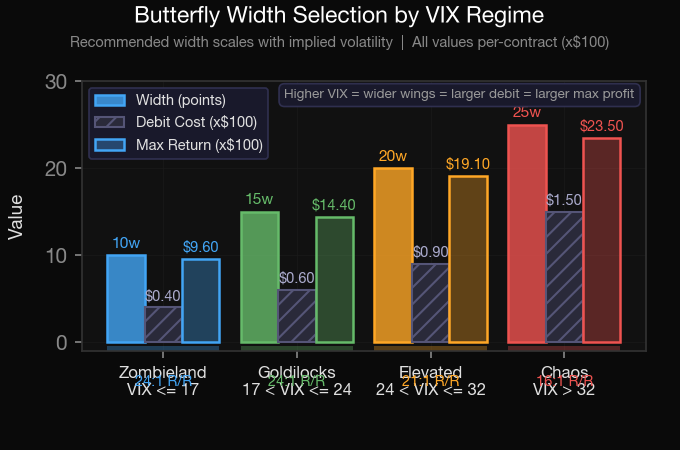
Then look at width and cost. Wider butterflies can offer a different balance between probability zone and payout shape. Narrower ones may be cheaper but more precise. There is no universally correct width. It depends on the market’s pace, your intended hold time, and how you define a valid attempt.
Entry timing matters too. A butterfly entered in a chaotic open is different from one entered after the day has shown acceptance around a price area. The same exact strikes can be sensible at one time and poor at another.
Most important, decide the loss before you enter. Not in theory. In practice. If the trade is wrong, where do you exit? If price leaves the area that justified the position, what are you waiting for? Hope is not management.
Risk is the point, not a footnote
The strongest argument for butterflies is not the payout graphic. It is defined risk.
Defined risk keeps a bad trade from becoming an account event. It gives you the ability to run repetitions. It creates room for review instead of regret. For self-directed traders, that is not a small feature. It is the foundation.
But defined risk only works if sizing is sane. Traders love limited-risk structures right up until they buy too many of them. Then a string of ordinary losses becomes a self-inflicted drawdown.
If your size is large enough to make you flinch, it is too large. If one loss changes your behavior on the next setup, it is too large. A professional framework is built around survival first. No survival, no edge.
Management is where discipline shows up
A butterfly can be held, trimmed, closed, or sometimes adjusted, but management should not be improvisation dressed up as skill.
Some trades deserve time. Others do not. If the auction shifts and your thesis no longer matches the tape, taking the planned loss is a good trade decision. Not a failure. A planned loss is one rep inside a larger process.
There is also a difference between active management and interference. Closing a position because your conditions were invalidated is disciplined. Constantly reshaping it because you cannot accept being wrong is expensive therapy.
This is why post-trade review matters. Did the structure fit the day? Was the location logical? Was the size appropriate? Did you exit according to plan or emotion? Those questions build skill. PnL alone does not.
SPX butterfly trading works best inside a framework
The traders who get the most from SPX butterflies are not the ones hunting the perfect setup on social media. They are the ones running a repeatable operating process.
That process usually includes a premarket map, clear structural criteria, a limited menu of trade types, defined sizing rules, and an end-of-day review. It may also include tools that help frame positioning and risk more objectively, such as convexity maps, exposure overlays, and visual risk graphs. The point is not to make trading complicated. The point is to make it less arbitrary.
That is the corrective most traders need. Not more signals. Not another guru. A framework that teaches them what they are looking at and why they are in the trade at all.
FatTail.ai is built around that idea: defined-risk structural trading, live review, and the kind of repetition that turns random behavior into a routine.
The real edge is psychological, but earned through structure
Many traders come to the butterfly looking for a safer way to trade SPX. That instinct is fine. But safety does not come from the shape alone. It comes from the behavior wrapped around it.
If you need the market to validate you quickly, the butterfly will frustrate you. If you chase the expiration peak, it will humble you. If you treat every loss as proof that something is broken, you will keep changing methods before expectancy has a chance to play out.
The better path is less exciting and more durable. Use the structure to define risk. Use context to guide placement. Use size to protect your staying power. Use review to improve. Over time, that is how you stop guessing.
A butterfly will never remove uncertainty from SPX. What it can do is give you a controlled way to participate without putting your account in front of a bus. For most traders, that is not a small improvement. It is the difference between gambling on outcomes and building a process you can trust tomorrow morning.
Frequently Asked Questions
What is SPX butterfly trading?
SPX butterfly trading uses a butterfly spread, one long option at a lower strike, two short at a middle strike, and one long at a higher strike, to take a defined-risk position on the S&P 500 index. It produces a tent-shaped payoff and is used to express a specific view on price, time, and volatility with capped loss.
Why trade butterflies on SPX specifically?
SPX is highly liquid, cash-settled, and offers same-day expirations, which suits the precision of a butterfly. Cash settlement also removes early-assignment risk on the short strikes. The same features that make it attractive, however, punish casual sizing and poor location.
How do you place the strikes in an SPX butterfly?
Placement should reflect where the market is actually trading relative to the expected move and developing range, not where you hope price will go. The body strike sets your peak payoff; the wings define risk and sensitivity. Width is a trade-off between a wider probability zone and a sharper payout.
Is SPX butterfly trading profitable?
It can be, but the edge comes from process, not the payoff diagram. Profitability depends on entering structures that fit current conditions, sizing so a loss is routine, and managing to a plan. Chasing the perfect expiration pin is the fastest way to lose with an otherwise sound structure.
When does an SPX butterfly work best?
It aligns best with balanced, range-bound sessions where price oscillates around a defined area and realized movement is compressing. On trending or rapidly expanding days, a narrow butterfly can become dead inventory, so the structure should match the session rather than be forced onto it.
FATTAIL BRIEFINGS
Get FatTail briefings in your inbox
Pick the lists you want. FOMC Alerts is selected by default.