


FOMC Alerts · FatTail Labs · Method v1.0 · October 27, 2026
FOMC Alerts Headline Pulse — our fed headline pulse — is how we measure the Fed conversation in public headlines. We collect the same Google Alerts feeds every weekday, tag what shows up, and publish the shape of that attention next to what the market already prices. This page is the public executive summary of that method — what it is, why it matters to traders, what we publish, and how the numbers are built. It is not a forecast of the next print.
What is Headline Pulse?
Headline Pulse is a short-window attention map of Fed-related coverage. We log every item our fixed keyword feeds return, classify them with a stable tag set, and report volume, rising topics, and fading topics over a rolling week. The point is descriptive: show what the conversation is emphasizing, not predict what the Committee will do.
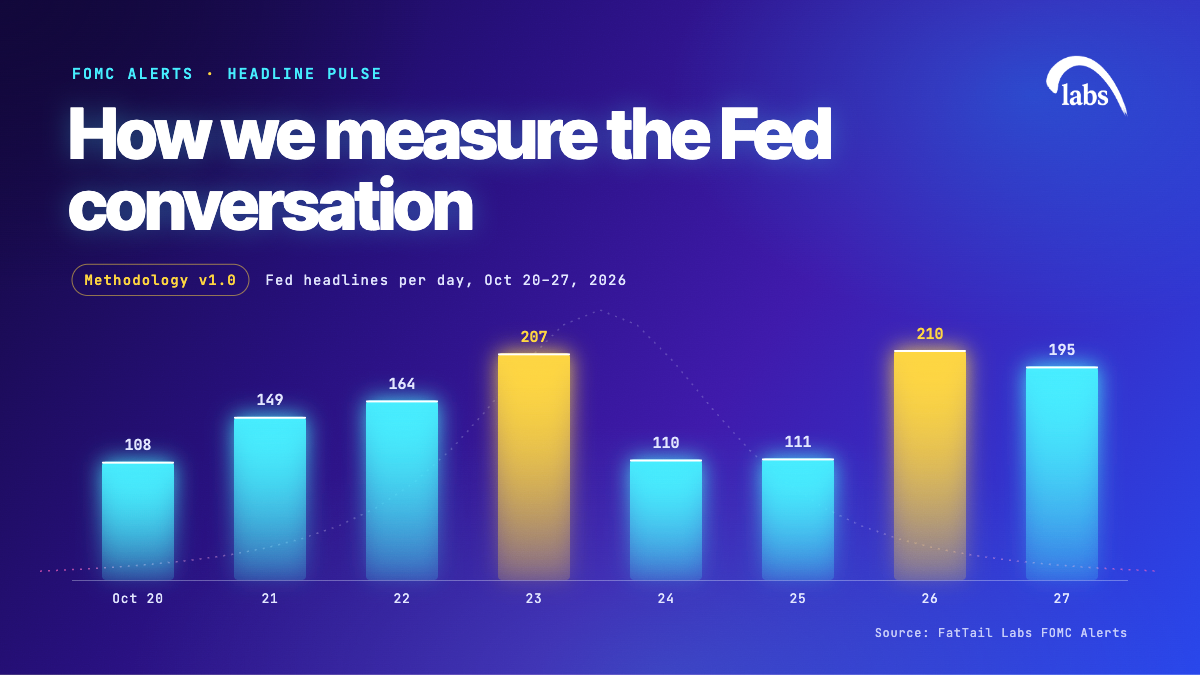
In the week of Oct 20–27, 2026, the tracker logged 1,254 items. Daily volume ran from 108 to a peak of 210 on Monday Oct 26, then 195 on Tuesday. The largest rising tag lifts — average mentions per day, last 2 days minus prior 5 days — were Fed +43.9 mentions/day, consumer +30.2, FOMC +24.8, PCE +17.4, and hold +14.5. Those are measured counts from our feeds — not invented round numbers.
Why does measuring headlines matter for traders?
Markets already price a path. Headlines often amplify a different story. Putting the two next to each other is useful: it shows where coverage is loud relative to what futures and options already imply, and where a narrative may be ahead of — or behind — the priced event.
That matters more on FOMC days because large moves cluster there. In our five-year SPX pack, close-to-close moves larger than one times the prior-day VIX expected move happened on 41.4% of FOMC decision days (n=29) versus 24.1% of non-FOMC days (n=899). Most days still finish inside the expected move; the right tail is fatter on decision days. Headline Pulse does not predict that fat tail. It frames the conversation traders are absorbing while they size defined risk around the clock.
Our working rule: illustrate and illuminate the facts. State the method. Stay consistent. Do not turn a rising tag into a trade call.
What we publish, and when
- Daily Headline Pulse (weekdays): short read of overnight / session coverage shape — volume, rising and fading tags, and one bridge to what is priced for the next event.
- Friday recap: the week’s attention map in one place, with the same method and the same caveats.
- Build-up and aftermath pieces: around FOMC meetings and major data, we publish the conversation next to the calendar (statement / presser times) and next to odds from fed funds futures when we show them.
Every public chart that uses this tracker should say Source: FatTail Labs FOMC Alerts and the method version. If the method changes, we bump the version on this page.
Methodology v1.0
As of Oct 27, 2026.
- Intake. Fixed Google Alerts keyword feeds for Fed / FOMC / related terms. We do not edit the live alert list for a publish cycle.
- Window. Default public window is the last seven calendar days of collected items (example above: Oct 20–27).
- Tags. Stable regex tag rules (examples: Fed, FOMC, PCE, CPI, hold, hike, consumer, named principals). An item can carry more than one tag.
- Rising / fading. Rising lift = average daily tag count over the last 2 days minus the average over the prior 5 days. A tag is “rising” when last-2 average is at least 3 and lift is positive under the published rule set. Fading is the reverse shape.
- Volume. Raw item counts by day from the same intake. Peak days are labeled with the real count (e.g., Mon Oct 26 = 210).
- Odds, when shown. Fed funds futures odds are calculated with CME’s method from delayed quotes and always carry a true as-of time. Odds are not Headline Pulse tags.
Limits (read these): keyword feeds miss stories that never match the query; syndication and wire repeats can inflate counts; the history is short; tag rules are incomplete for every named voter; a rising tag is not a probability of a policy surprise. Education only — not investment advice, not a forecast of the close.
How to cite this work
When you quote a Pulse chart or number, use:
Source: FatTail Labs FOMC Alerts · Method v1.0 · date of the snapshot.
We will keep this executive summary current. Method bumps get a new version label (v1.1, v1.2, …) and a short changelog on this page. Older Pulse posts keep the method version they were published under.
Sources
- FOMC Alerts Headline Pulse intake (Google Alerts feeds, tag rules, Oct 20–27 snapshot) (FatTail Labs FOMC Alerts (this method page; numbers from desk trends snapshot Oct 27, 2026), 2026-10-27)
- FOMC Calendars (Federal Reserve (meeting timing reference), checked 2026-10-27)
- Expected move options (FatTail) (FatTail (context for VIX expected-move framing; EM rates from internal 5yr SPX pack), evergreen; checked 2026-10-27)
- Observer (FatTail (six-week trial + training; live daily coaching), checked 2026-10-27)
Trade the clock with structure
Observer is a six-week trial and training program: train with Coach for $17/week. You get everything a full coaching member gets, every week, and the six weeks are designed to install pro trading habits: courses on strategy, process and risk management, live daily coaching, a Discord trade room with hundreds of experienced traders, and the platform (heatmap, GEX tools, risk graph, position analyzer and journal). Start Observer.