


A butterfly can look harmless because the risk graph is clean and the position has a defined worst-case outcome. But defined risk is not the same as understood risk. Knowing how to calculate butterfly max loss before you send an order is what separates a planned 0DTE position from a trade that is merely capped.
For a standard long butterfly, the math is simple. The discipline is harder. You must use the actual debit paid, include the contract multiplier, account for the number of flies, and size the trade against the loss your account can absorb without changing your behavior on the next setup.
That last part matters. A max loss is not a prediction. It is the cost of being wrong on that specific position. Treat it as a planned rep, not a personal failure.
How to Calculate Butterfly Max Loss
A standard long call butterfly uses three strike prices with equal spacing:
- Buy one lower-strike call
- Sell two calls at the middle strike
- Buy one higher-strike call
A long put butterfly is constructed the same way with puts. The payoff profile is different in direction only at entry. The max-loss calculation is the same.
If you enter the butterfly for a net debit, your maximum loss is the debit paid. That is the entire formula at expiration:
Maximum loss per butterfly = net debit paid × contract multiplier
For standard SPX options, the contract multiplier is 100. The Cboe SPX contract specifications confirm the multiplier. If you pay 2.40 points for one butterfly, the defined maximum loss is 240 in currency terms, before commissions and fees. If you trade five butterflies, multiply that loss by five.
The trade can expire anywhere outside the profitable region. It can also lose before expiration because the position value falls. Either way, the maximum loss is anchored to what you paid to enter, not to where you hoped SPX would settle.
Start With the Net Debit, Not the Individual Legs
The cleanest way to calculate risk is to look at the order ticket’s net debit. Do not calculate each leg separately after the fact unless you are auditing a fill.
Suppose you buy the lower wing for 8.10, sell two middle strikes for 5.00 each, and buy the upper wing for 2.30. The net debit is:
8.10 – 10.00 + 2.30 = 0.40 points
Your maximum loss is 0.40 points times the 100 multiplier, or 40 per butterfly before transaction costs.
The order ticket may show a debit in a different format depending on the platform. Your job is still the same: identify the total net amount paid for the entire structure, then multiply it by the contract multiplier and quantity.
This is basic arithmetic. Yet traders routinely get it wrong because they focus on the premium collected from the short middle strikes. That premium is not your risk. You also paid for the long wings. A butterfly is one position, not four independent opinions.
Why Strike Width Matters, Even When It Does Not Set Max Loss
For a debit butterfly, strike width does not determine your maximum loss. The debit does. But strike width determines the maximum possible value at expiration and therefore the structure’s potential reward relative to risk.
In a symmetric butterfly with 10-point wings, the maximum expiration value is 10 points. If you paid 2 points, the most the spread can be worth at expiration is 10 points. If you paid 7 points, you have much less room between entry cost and the spread’s maximum value.
The formula for maximum profit at expiration is:
Maximum profit = (wing width – net debit) × contract multiplier
That is not a reason to chase the cheapest butterfly. Cheap structures can be cheap because the market assigns low probability to the middle strike being relevant. A narrow fly can also be difficult to manage in fast 0DTE conditions. Price alone does not tell you whether the position fits the market structure. Compare structures in butterfly versus vertical spread.
The point is more practical: width helps you evaluate the full risk graph. Debit tells you what can be lost. Width minus debit tells you what is available if the structure performs as designed.
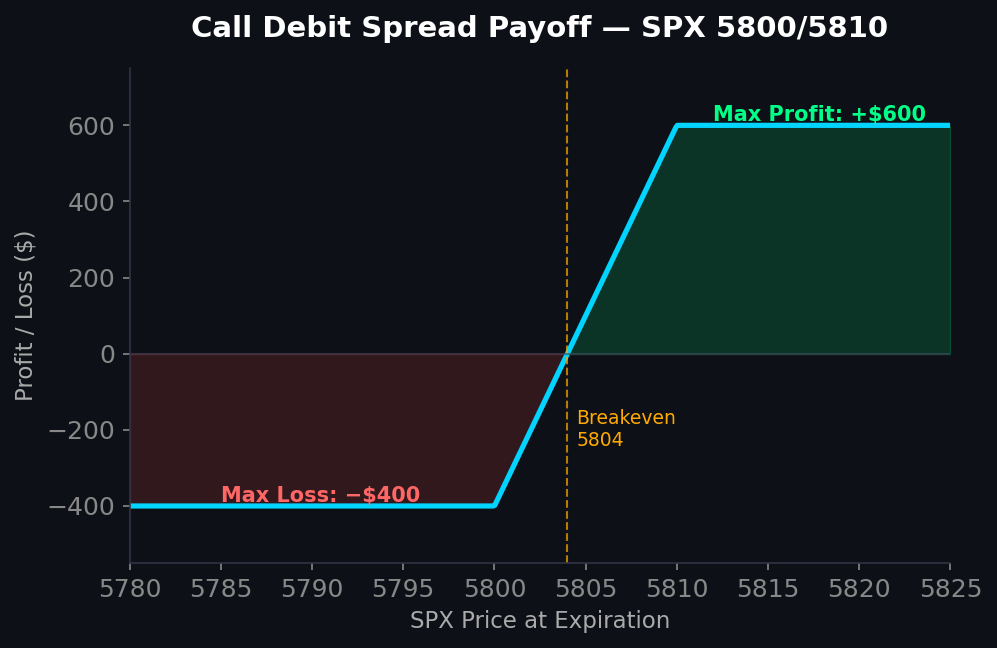
A 0DTE SPX Example
Assume SPX is trading near 5,200 and you construct a 5,190/5,200/5,210 call butterfly. You buy the 5,190 call, sell two 5,200 calls, and buy the 5,210 call. The wings are 10 points wide.
You pay a 1.65-point net debit. One contract has a maximum loss of 165, before costs. Three contracts have a maximum loss of 495, before costs.
At expiration, the position achieves its maximum value only if SPX settles exactly at 5,200. Its maximum potential profit is the 10-point width minus the 1.65-point debit, or 8.35 points per fly, multiplied by 100.
But do not confuse maximum potential profit with a target or an expectation. On expiration day, price can move quickly, implied volatility can change, and bid-ask spreads can widen precisely when you want to adjust or exit. A risk graph is a map. It is not a promise about fills. Plan the exit too, see structuring butterfly exits.
Maximum Loss at Expiration Versus Real-Time Loss
The debit is the maximum loss at expiration for a standard long butterfly held through settlement. Before expiration, your platform’s profit and loss can move in ways that surprise newer traders.
A butterfly can show a loss shortly after entry even if price has barely moved. That may come from the bid-ask spread, a change in implied volatility, or the fact that your closing value is marked near the bid while your entry filled closer to the ask. In 0DTE trading, these effects are not side details. They are part of execution risk.
Still, a standard long butterfly cannot lose more than the original debit at expiration. If the marked loss looks worse than expected during the day, confirm that you are reading the position correctly and that there are no extra contracts or unfilled legs. Then distinguish between a mark and an executable exit price.
Defined risk does not mean every intraday mark will be comfortable. It means the position has a known boundary if it is built and sized correctly.
Broken-Wing Butterflies Require a Different Calculation
Do not apply the simple debit formula blindly to every structure labeled a butterfly. A broken-wing butterfly uses uneven strike widths. It may be entered for a debit or a credit, and its risk is asymmetric.
For a broken-wing fly, calculate the expiration payoff on each side of the structure. Identify the worse side, then multiply that point value by the contract multiplier and contract count. If the trade is entered for a credit, that credit offsets the risk on the side where the wider wing creates exposure.
The practical question is not, “Is this called a butterfly?” The question is, “What is the worst possible expiration value of this exact position after the entry credit or debit?”
This is why traders should inspect the risk graph and verify the platform’s displayed max loss before entry. The graph should confirm your math, not replace it. The same approach covers spreads and iron condors. Platforms can display assumptions, marks, and labels clearly, but you remain responsible for understanding the structure.
Do Not Confuse a Butterfly With an Iron Butterfly
An iron butterfly is a different defined-risk structure. It combines a short call spread and a short put spread, usually entered for a net credit. Its maximum loss is generally the width of one wing minus the credit received, multiplied by the contract multiplier.
That is the opposite starting point from a long debit butterfly. With a long butterfly, the debit is your max loss. With an iron butterfly, the credit reduces your max loss.
Mixing up those formulas is not a minor bookkeeping error. It can lead to oversized positions. And oversizing is how a string of normal losses becomes account-level damage. The OCC’s options education covers each structure payoff math.

Size From the Loss You Can Repeat
Once you know max loss per butterfly, position sizing becomes a process instead of a feeling. Start with a predetermined amount of account risk you are willing to allocate to one trade. Then divide that amount by the maximum loss per butterfly and round down.
If your risk budget allows four flies but the market is moving fast, liquidity is thin, or you cannot describe the trade’s structural thesis in one sentence, trading fewer contracts is not timid. It is professional.
The right size is the size that lets you take the next valid setup after this one fails. Not the size that makes a single trade feel meaningful. A defined-risk system works because losses are contained and repeatable. It breaks when a trader treats a favorable-looking setup as permission to abandon limits.
Before every entry, write down the net debit, contract multiplier, number of butterflies, and total max loss. Then compare that number with your planned risk budget. At FatTail.ai, that kind of pre-trade clarity is the point: positioning over prediction, structure over impulse.
A butterfly does not need to be perfect to be useful. It needs to be understood, sized correctly, and placed inside a process you can execute again tomorrow.
Frequently Asked Questions
How do you calculate the max loss on a butterfly?
For a standard long butterfly entered for a debit, the maximum loss at expiration is simply the net debit paid times the contract multiplier (100 for SPX), times the number of flies. Pay 2.40 points for one SPX fly and the defined max loss is 240 before costs. It is anchored to what you paid, not where you hoped price would settle.
Is the premium from the short strikes your risk?
No. Traders routinely get this wrong by focusing on the credit from the two short middle strikes, but you also paid for the long wings. A butterfly is one position, not four independent opinions. Read the order ticket net debit for the whole structure rather than pricing each leg separately.
Does strike width set the butterfly max loss?
Not for a debit butterfly, the debit does. Width determines the maximum expiration value and therefore the reward relative to risk: maximum profit equals wing width minus net debit, times the multiplier. So width helps you read the full risk graph, but the debit is what can be lost.
Why can a butterfly show a loss right after entry?
Because of the bid-ask spread, a change in implied volatility, or your close being marked near the bid while entry filled near the ask. In 0DTE these execution effects are real, not side details. A standard long butterfly still cannot lose more than the debit at expiration if built and sized correctly.
How is an iron butterfly max loss different?
An iron butterfly combines a short call spread and short put spread for a net credit, and its max loss is generally one wing width minus the credit received, times the multiplier, the opposite starting point from a long debit butterfly. Mixing up the two formulas can lead to oversized positions.
FATTAIL BRIEFINGS
Get FatTail briefings in your inbox
Pick the lists you want. FOMC Alerts is selected by default.