


A position can look calm right up until it is not. That is the real issue in defined risk vs naked options. It is not a debate about who can collect more premium on an ordinary day. It is a question of whether one abnormal move can erase weeks or months of disciplined work.
For active SPX traders, that distinction is not academic. Zero-days-to-expiration options compress time, gamma, and decision-making into a few hours. A framework that survives requires you to know your worst-case exposure before you enter, size it intentionally, and treat every loss as a planned operating expense. Not signals. Not hope. Not an emergency adjustment made after the market has already moved. The OCC’s options education is a good grounding in the mechanics behind each structure.
What defined risk actually means
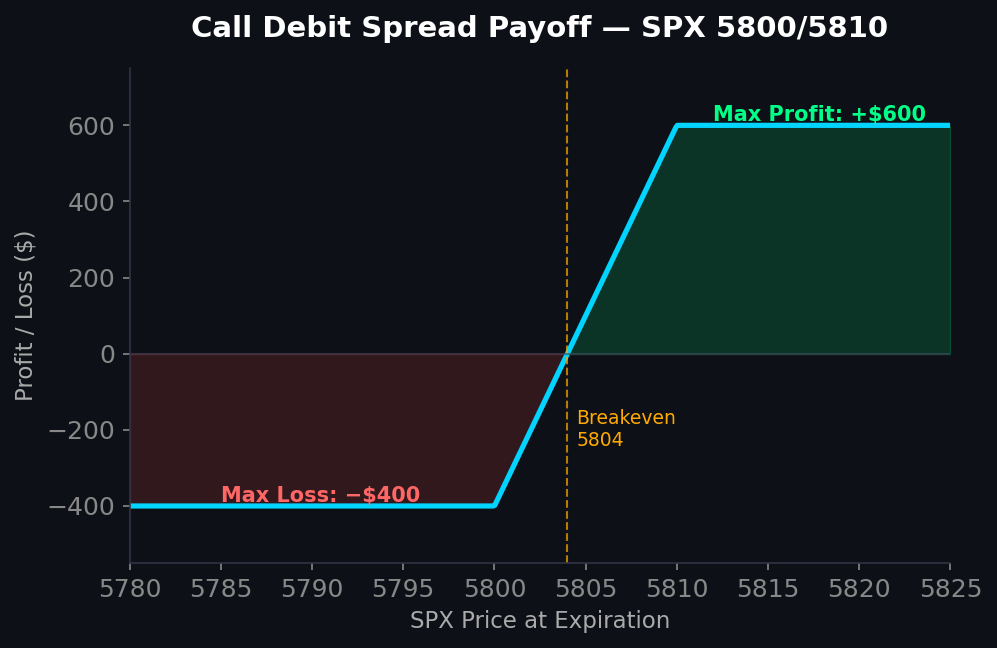
A defined-risk option structure has a known maximum loss at entry. A long option has defined risk because the premium paid is the most that can be lost. A vertical credit spread has defined risk because the purchased long option caps the exposure created by the short option. Iron condors and butterflies can also be constructed with known maximum losses.
The key word is known. Before placing the trade, you should be able to answer three questions without hesitation: What is the maximum loss? Where does that loss occur? What portion of the account does it represent?
That does not mean the position is safe, easy, or automatically well designed. A defined-risk trade can still be poorly located, too wide, too large, or entered with no structural reason behind it. Defined risk is the foundation. It is not the entire process. See our full SPX framework end to end.
For a credit spread, the risk is generally determined by the width between strikes less the credit collected, multiplied by the contract multiplier. That makes the risk visible and measurable. You can build position size around a fixed unit of risk rather than letting a position’s danger expand because the market did something you did not expect.
Naked options leave the loss boundary open
Naked options, also called uncovered options, involve selling an option without a position that fully caps the loss. A naked short call is the clearest example: if the underlying rises sharply, the short call’s losses can continue increasing. A naked short put has a different loss profile, but its downside can still be severe.
The attraction is understandable. An uncovered short option often collects more premium than a comparable defined-risk spread. Compare the income structures in our guide to selling options. It may also appear to have more room before it becomes challenged. But premium is not free. It is compensation for carrying exposure that may be much larger than the initial credit suggests.
This is where retail traders commonly get misled by a smooth stretch of results. Small gains arrive repeatedly. The position feels manageable. Then volatility expands, a major headline hits, or a directional move persists longer than expected. The trade that was supposed to be routine becomes an account-level event.
A trading method should not depend on the assumption that unusual days will never happen. Investor-protection resources from the SEC spell out the open-ended risk of uncovered options. Unusual days are part of markets. The question is whether your structure already accounts for them.
Defined risk vs naked options is really a sizing decision
Many traders frame this choice as a strategy preference. It is more fundamental than that. It determines whether position sizing is precise or approximate.
With a defined maximum loss, you can decide in advance what one trade is allowed to cost. You can then calculate how many contracts fit inside that limit. If the correct size is smaller than you hoped, that is useful information. The market does not owe your account a trade large enough to feel exciting.
With undefined risk, the sizing problem changes. You may estimate potential loss based on historical moves, a stop level, buying power, or a belief that you will adjust quickly. But estimates are not caps. Stops can fill worse than expected. Liquidity can change. Fast moves can occur between decisions. An adjustment made under pressure is not the same thing as risk that was engineered before entry.
This matters even more in 0DTE SPX trading. As expiration approaches, option sensitivity can change rapidly near key strikes. A small move in the index can materially alter the position. That is exactly when traders need a risk graph and a preplanned response, not an open-ended obligation to be correct. Here is how to read a risk graph.
The hidden cost of collecting more premium
Naked structures can make defined-risk structures look inefficient. The credit may be smaller after buying protection. The risk graph may look less attractive at first glance. That is the point of the hedge: it gives up some potential income to establish a boundary.
The wrong comparison is premium collected versus premium collected. The better comparison is premium collected relative to the loss you have deliberately accepted, the capital required, and the damage a bad sequence could do to your ability to keep trading.
A larger credit does not automatically create a better trade. It can simply mean you sold more exposure. If that exposure forces you to reduce size dramatically, monitor every tick, or make emotional decisions when volatility rises, it may be less efficient in the only way that matters: as a repeatable business process.
Professional risk management is often boring. It accepts that some upside is intentionally left on the table. It prioritizes staying solvent, consistent, and capable of executing the next qualified setup.

A stop loss does not make naked risk defined
This is one of the most persistent misconceptions in options trading. A trader sells an uncovered option, sets a mental or platform stop, and concludes the trade now has limited risk.
It does not.
A stop is an instruction to attempt an exit after a condition is reached. Defined risk is a structural property of the position itself. Those are different things. A stop may be part of a sound process, but it cannot guarantee the execution price in a fast market. It cannot eliminate slippage, a gap, widening spreads, or the time it takes to recognize and act on a changing position.
The distinction is especially relevant for short-dated options. When gamma is high, price changes can accelerate while the trader is still deciding whether the move is temporary. A long protective option does not require perfect timing to establish the maximum loss. That is why it changes the nature of the trade.
Where defined risk can still go wrong
Choosing capped-risk structures does not excuse lazy planning. Traders still need to understand the shape of the payoff, the location of their short strikes, and the market conditions that could pressure the position.
A defined-risk spread may be too close to a major structural level. An iron condor may be too wide for the credit received. A position may use too much account risk because the trader assumes several small losses cannot occur in a row. They can.
The remedy is not prediction. It is process. Establish a repeatable entry framework. Set the maximum loss per position before the session begins. Avoid stacking correlated exposure that turns multiple small positions into one large bet. Review whether actual exits match the planned risk assumptions.
At FatTail.ai, the goal is not to make every session a winner. The goal is to build a framework where losses are contained reps, position size is rational, and no single trade gets to decide the future of the account.
The better question before every trade
Do not ask only, “How much credit can this produce?” Ask, “If this is wrong in the fastest possible way, what happens to my account?”
If the answer is vague, dependent on a perfect stop, or dependent on your ability to react flawlessly, the trade is asking too much of you. A defined-risk structure gives you room to think clearly because the worst case was addressed before the order was sent.
That is not fear. It is independence. Build positions that let you survive being wrong, then use your review process to get better at the work that remains.
Frequently Asked Questions
What is the difference between defined risk and naked options?
A defined-risk structure has a known maximum loss at entry, because a long option caps the exposure, as in a long option, vertical credit spread, iron condor, or butterfly. A naked (uncovered) option is sold without a position that fully caps the loss, so an abnormal move can produce a loss far larger than the credit collected.
Why are naked options risky?
They leave the loss boundary open. A naked short call can lose more and more as the underlying rises, and a naked short put has severe downside. The extra premium is compensation for carrying exposure much larger than the initial credit, which turns a routine-feeling trade into an account-level event when volatility expands.
Does a stop loss make naked options defined risk?
No. A stop is an instruction to attempt an exit after a condition is reached; defined risk is a structural property of the position. A stop cannot guarantee the fill price in a fast market and cannot eliminate slippage, gaps, or widening spreads. A long protective option establishes the max loss without perfect timing.
Is a defined-risk trade always safe?
No. A defined-risk trade can still be poorly located, too wide, too large, or entered with no structural reason. Defined risk is the foundation, not the entire process. You still need to understand the payoff shape, short-strike location, and the conditions that could pressure the position.
Which is better, defined risk or naked options?
The choice is really a sizing decision. With a defined maximum loss you can size precisely and survive being wrong; with undefined risk, sizing relies on estimates and stops that can fail under pressure. Professional risk management often leaves some premium on the table to stay solvent and repeatable.
FATTAIL BRIEFINGS
Get FatTail briefings in your inbox
Pick the lists you want. FOMC Alerts is selected by default.