


The butterfly spread vs iron condor debate is the most important structural decision an options trader makes. Both are defined-risk. Both use four legs. Both profit when price stays within a range. But the similarity ends there — and the difference between them is the difference between positive and negative asymmetry. One risks small to win big. The other risks big to win small. Most traders never examine this comparison closely enough to understand what they are actually choosing.
The butterfly spread and the iron condor are not interchangeable strategies with different shapes. They represent fundamentally different philosophies about how to approach the market. This guide breaks down the butterfly spread vs iron condor comparison across every dimension that matters: structure, risk-reward, capital efficiency, win rate, and — most importantly — what each strategy requires you to know about the market before you place the trade.
How Each Structure Works
The iron condor sells a call spread above the market and a put spread below. You collect a net credit — typically $100-$200 on a $500-wide structure. In essence, you profit if price stays between your short strikes. Maximum profit is the credit collected. Maximum loss is the width of one spread minus the credit. The iron condor is a range-bound bet that pays you upfront and punishes you when the range breaks. The butterfly spread buys one option at a lower strike, sells two at a middle strike, and buys one at a higher strike. You pay a net debit — typically $30-$100. You profit if price lands near the middle strike at expiration. Maximum profit is the width of the spread minus the debit — often $500-$2,500. The butterfly is a convergence bet that costs you upfront and rewards you when price hits the target. Same market. Same number of legs. Completely opposite payoff structures.The Risk-Reward Comparison
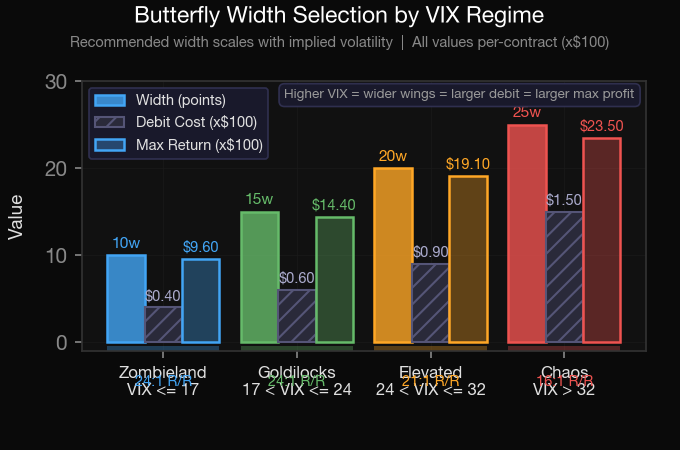
This is where the butterfly spread vs iron condor distinction becomes stark. The numbers tell the story. Iron condor: Risk $300-$400 to collect $100-$200. Risk-reward ratio of roughly 2:1 to 3:1 against you. You need to win three out of four trades just to break even. In practice, win rate is typically 65-75%, which sounds comfortable until you calculate the expectancy — the math is often flat or slightly negative after commissions and slippage. Butterfly spread: Risk $30-$100 to target $500-$2,500. Risk-reward ratio of 5:1 to 25:1 in your favor. Consequently, you can lose five to ten trades in a row and one winner erases them all. Win rate is typically 20-30%, which sounds uncomfortable until you calculate the expectancy — the math favors the structure because the winners dwarf the losers. The iron condor feels better. It wins more often. The account grows slowly and steadily — until the one loss that erases weeks of gains. The butterfly feels worse. It loses more often. However, when it wins, the payoff changes the month. This is the core asymmetry difference, and it is why the butterfly spread vs iron condor choice matters more than most traders realize.
Capital Efficiency: Where the Gap Widens
The iron condor ties up significant capital in margin. A $500-wide iron condor on SPX requires $300-$400 in margin per contract. Run five contracts and you have $1,500-$2,000 locked up — to collect $500-$1,000 in premium. That capital is unavailable for anything else until the trade closes or expires. The butterfly costs $30-$100 per contract. Run five contracts and you have $150-$500 deployed. As a result, the rest of your capital remains available. If the trade loses, you lose the debit. If it wins, the return on capital is extraordinary — a $75 butterfly that returns $1,500 is a 2,000% return on risk. For traders with accounts under $50,000 — which is most retail traders — this capital efficiency difference is decisive. The iron condor consumes your account. The butterfly leaves room to trade. You can place multiple butterflies at different targets across the session while a single iron condor locks up a meaningful portion of your capital.What Each Strategy Requires You to Know
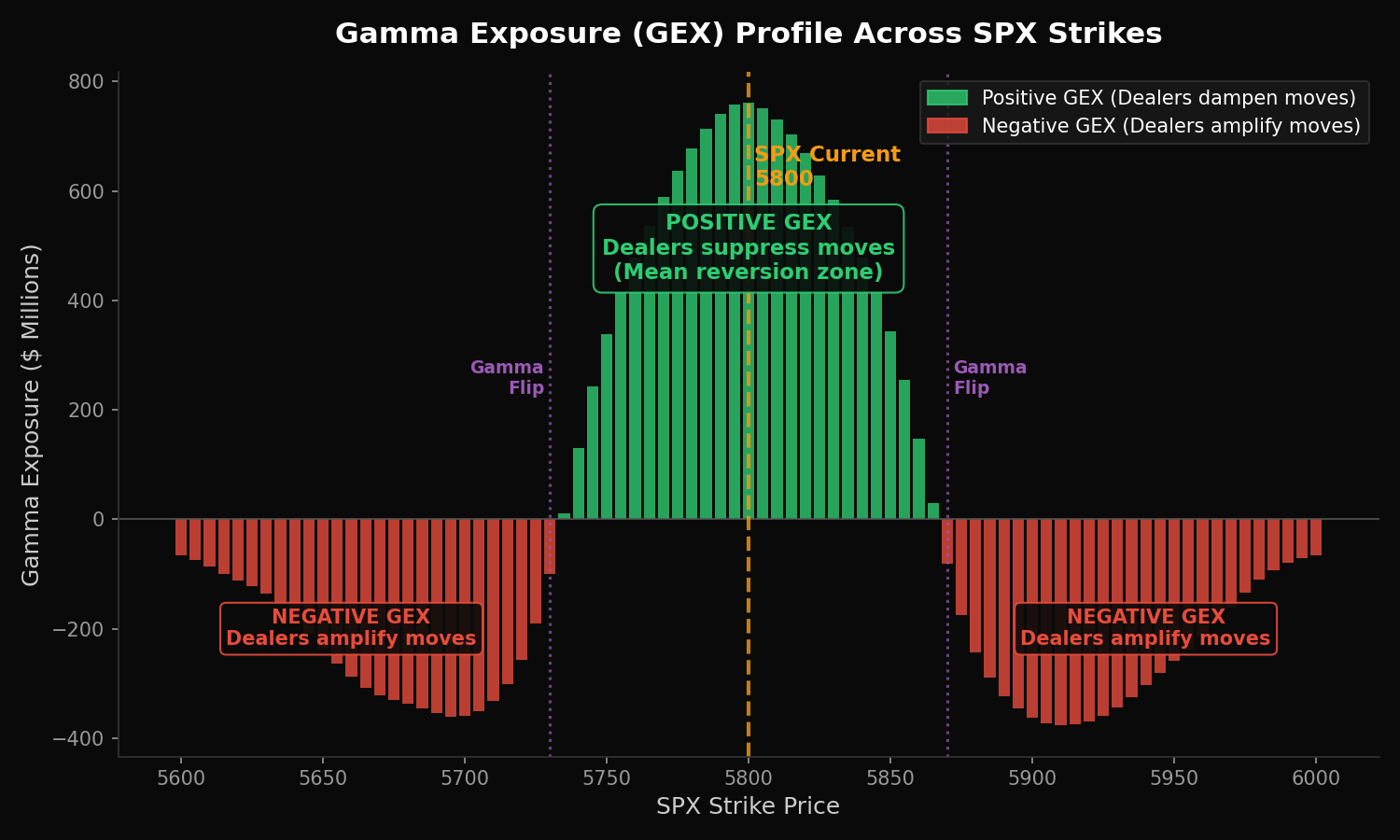
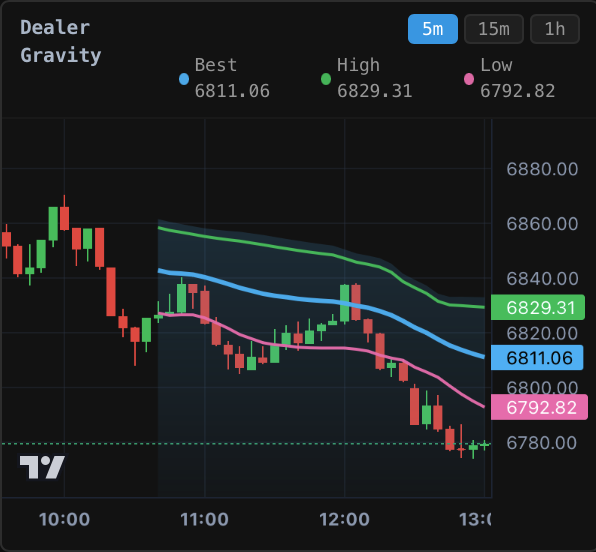
This is the section that changes the comparison entirely. The butterfly spread vs iron condor debate is not just about structure and math. It is about information — what each strategy requires you to understand about the market before you place the trade. The iron condor requires a range estimate. You need to believe that price will stay between two strikes. Where does that belief come from? For most traders, it comes from looking at a chart and guessing. They pick strikes that feel far enough away and hope the market cooperates. Some use the expected move to define the range, which is better — but the expected move tells you the market’s priced range, not whether price will actually stay inside it. The butterfly requires a target level. You need to identify where price is likely to converge. This is a fundamentally different type of information. It comes from reading the GEX landscape — where dealer hedging creates gravity that pulls price toward specific levels. It comes from order flow analysis that shows where positioning is concentrated. It comes from the market structure framework that identifies convergence targets before the session begins. In other words, the iron condor asks you to guess a range. The butterfly asks you to read a structure. One is a bet on the absence of movement. The other is a bet on a specific outcome informed by data. The daily pre-market analysis in Observer ($17/week) delivers exactly this data — GEX profile, dealer gravity levels, expected move, and VIX regime context — before every session. Activator ($97/month) adds real-time tools and weekly coaching to apply the framework live. Navigator ($267/month) provides daily direct coaching with Ernie. Compare all plans here.Adjustment Complexity
When an iron condor goes wrong, you enter the world of adjustments — rolling the untested side, closing the tested spread early, converting to a different structure, or closing entirely. Each adjustment has tradeoffs. Each adds slippage. Each requires a decision under pressure. As a result, managing a losing iron condor is often more work than the original trade was worth. When a butterfly goes wrong, you lose the debit. That is the adjustment. The entire risk was defined and paid for at entry. There is no rolling. There is no restructuring. There is no agonizing over whether to close at a partial loss or hold and hope. The butterfly either converges to the target or it does not. You move on and place the next one. Ultimately, this difference in management overhead is significant for traders who value their time and mental capital. The iron condor demands ongoing attention and creates decision fatigue. The butterfly demands good target selection and nothing else.When Each Strategy Actually Makes Sense
Of course, despite the structural advantages of the butterfly, the iron condor is not universally wrong. Each has a context where it fits. The iron condor works best when:- GEX is strongly positive — dealer hedging is dampening moves and mean reversion is favored
- The VIX is low (sub-15) — ranges are compressed and premium is thin but range breaks are rare
- You have 21-45 DTE — theta decay works in your favor without the gamma risk of short-dated options
- You place short strikes outside the expected move — the market’s own pricing confirms your range is reasonable
- Dealer gravity levels are clearly defined — GEX analysis shows specific price targets where positioning creates convergence
- The session favors mean reversion — positive GEX with identifiable structural levels
- You trade 0DTE or short-dated expirations — gamma works for you near the target, making the payoff explosive
- Capital efficiency matters — you want multiple shots at asymmetric payoffs instead of one large range bet
The Bottom Line
The butterfly spread vs iron condor comparison comes down to one question: do you want to be the insurance company or the asymmetric trader? The iron condor makes you the insurance company. You collect small premiums and hope the big claim never comes. When it does, it erases months of income. You spend your time managing positions, adjusting tested sides, and monitoring risk. The butterfly makes you the asymmetric trader. You pay small premiums for large potential payoffs. When the structure misses, you lose what you paid — pocket change. When it hits, one trade pays for ten losses. You spend your time reading the positioning landscape and selecting targets. Same market. Same options. Fundamentally different framework. The iron condor feels safe because it wins often. The butterfly feels risky because it loses often. In the end, the math — and the structural data behind it — favors the butterfly for traders who are willing to read the market instead of guessing the range. That structural read starts with Observer ($17/week): daily GEX profiles, gravity levels, expected move, and VIX context. Activator ($97/month) adds real-time tools and weekly coaching. Navigator ($267/month) provides daily direct coaching with Ernie. Compare all plans here.
Frequently Asked Questions
What is the difference between a butterfly spread and an iron condor?
A butterfly spread pays a debit to target a specific price level with asymmetric reward — risk $30-$100 to target $500-$2,500. An iron condor collects a credit by betting price stays within a range — collect $100-$200 while risking $300-$400. The butterfly has positive asymmetry with a lower win rate. The iron condor has negative asymmetry with a higher win rate. The payoff structures are fundamentally opposite.Which is more profitable, butterfly spreads or iron condors?
Neither is inherently more profitable — profitability depends on matching the strategy to the environment. Butterfly spreads have higher expected value when structural data identifies clear convergence targets. Iron condors perform better in extended low-volatility, range-bound environments. Over time, the butterfly’s positive asymmetry tends to outperform the iron condor’s negative asymmetry because one butterfly winner can erase five to ten losses, while one iron condor loss erases three to four wins.Is a butterfly spread riskier than an iron condor?
In terms of maximum dollar risk per trade, the butterfly is less risky — you risk $30-$100 versus $300-$400 on an iron condor. In terms of win rate, the butterfly loses more often (70-80% of trades) versus the iron condor (25-35% of trades). The butterfly has lower absolute risk but higher loss frequency. For most traders, losing $75 eight times and winning $1,500 twice is mathematically superior to winning $150 seven times and losing $350 three times.Can you trade both butterfly spreads and iron condors?
Yes, and structural traders sometimes do — using iron condors in strongly positive GEX environments with compressed expected moves, and butterflies when the GEX landscape identifies clear dealer gravity targets. The key is using structural data to choose the strategy rather than personal preference. Most traders who learn to read the positioning landscape gravitate toward butterflies because the data provides targets, not just ranges.Why do most traders choose iron condors over butterflies?
Iron condors feel safer because they win more often. The consistent small credits create a psychological comfort that butterflies — with their frequent small losses — do not provide. Additionally, most options education teaches iron condors as an income strategy without comparing the asymmetry profile to alternatives. Traders who evaluate both structures purely on math and structural edge typically prefer the butterfly’s positive asymmetry over the iron condor’s negative asymmetry.FATTAIL BRIEFINGS
Get FatTail briefings in your inbox
Pick the lists you want. FOMC Alerts is selected by default.