


FOMC Alerts · October 21, 2026
Same Fed, different numbers
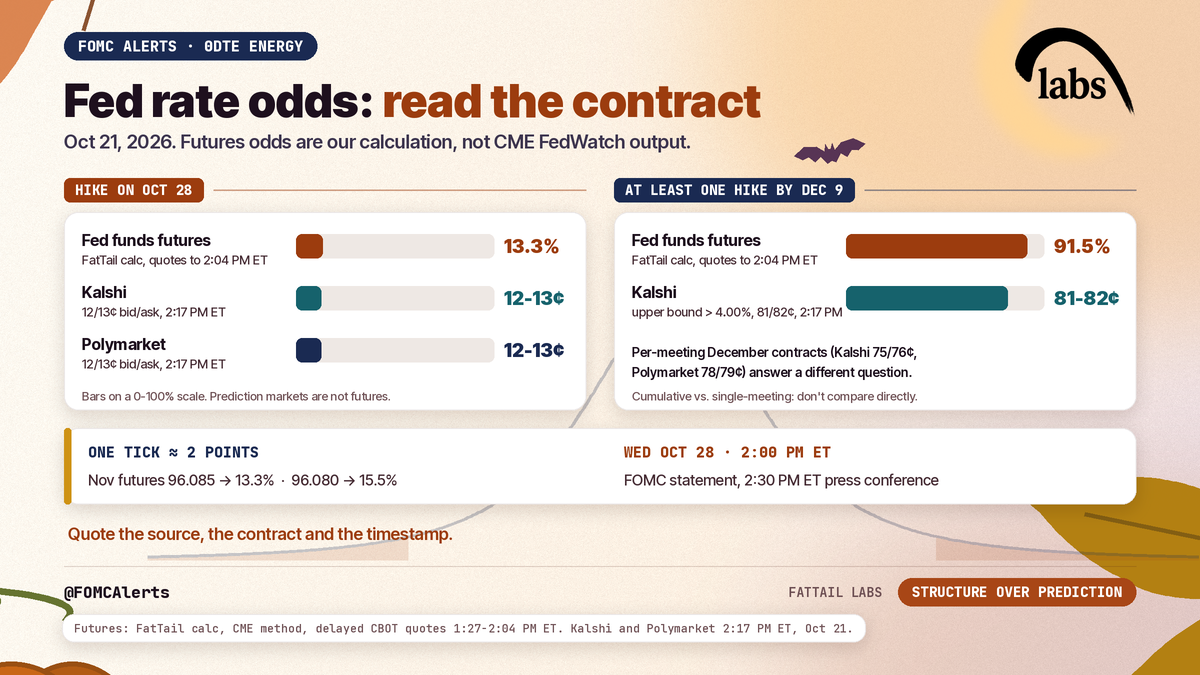
On Oct 21, fed funds futures, Kalshi and Polymarket all put a quarter-point Fed hike next week at roughly one in eight. Ask the same markets about December and they split by about 10 points. Same Fed, same data. The difference is what each one is actually pricing, and a fed funds futures probability doesn’t always answer the same question as a Kalshi or Polymarket price.
The number you see quoted most is from CME FedWatch: “a 13% chance of a hike,” or 16%, depending on who wrote the story and when. It isn’t a poll of economists or a forecast. It’s a translation of a futures price into a fed funds futures probability, using a few simple assumptions. Once you know the assumptions, you can read the number, check it yourself in two minutes, and tell when a move is news and when it’s noise.
One note on sourcing. CME’s FedWatch page didn’t load for us today, so every CME-style probability below is our own calculation from delayed futures prices, with a timestamp. We did not verify a live FedWatch reading. Where we quote FedWatch itself, we say who reported it.
What FedWatch shows
FedWatch shows one bar for each possible target range after each meeting. The first bar is “no change.” For the next meeting, Oct 28, the bars split between holding at 3.75-4.00% and a hike to 4.00-4.25% (Fed calendar). For later meetings the bars are cumulative: they show where the range ends up after that meeting, however it got there. Our 2026 FOMC meeting schedule lists the dates.
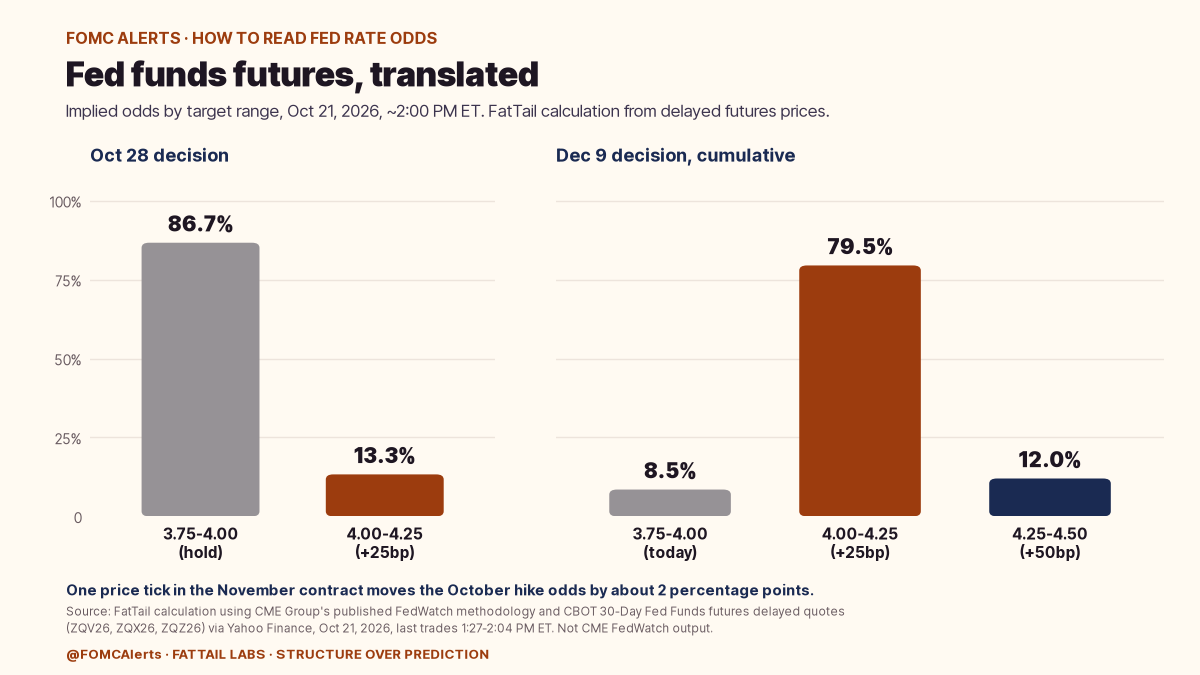
Here is what the futures said on Oct 21, by our calculation. For Oct 28: 86.7% hold, 13.3% hike. For Dec 9, cumulative: 8.5% that the range is still 3.75-4.00%, 79.5% that it is 4.00-4.25% and 12.0% that it is 4.25-4.50%. That 79.5% is not “79.5% odds of a December hike.” It’s the odds that the range ends the year exactly one step higher, whether that step comes in October or December. Add the two hike bars and you get 91.5% for at least one hike by Dec 9.
How CME turns a price into a fed funds futures probability
The method is public (CME Group). It assumes the Fed moves in 25bp steps and that the effective rate moves one-for-one with the target. It then reads each month’s contract as that month’s average rate. CME is clear about the limits: “Calculated probabilities are estimates based on these assumptions and may be subject to variation if any tenet is compromised.”
This October has one helpful quirk: there is no FOMC meeting in November. So the November contract prices the rate right after Oct 28, cleanly. December is harder. It needs the November rate as a starting point and splits December into the days before and after the Dec 9 decision. That’s why the December row moves more when a single contract wiggles.
Advertisement · From FatTail Labs

Observer: train with Coach for $17/week
A six-week trial and training program built to install pro trading habits: live daily coaching, courses, a Discord trade room and the full FatTail platform.
Prediction markets ask a narrower question
Kalshi and Polymarket sell a straight bet that pays $1 if something happens. Kalshi’s contract pays if “the upper bound of the target federal funds rate published on the Federal Reserve’s official website” clears a level after the meeting (Kalshi). Polymarket settles on the change in the upper bound, per the FOMC statement. At 2:17 PM ET on Oct 21, Kalshi priced an Oct 28 hike at 12 cents bid, 13 offered, and Polymarket at 12/13 (Kalshi, Polymarket). That’s very close to the futures.
December is where readers get tripped up. Kalshi’s and Polymarket’s December decision contracts (Kalshi 75/76 cents, Polymarket 78/79 cents for a 25bp hike at that meeting) price the move at the Dec 9 meeting only (Kalshi, Polymarket). FedWatch’s December table is the cumulative end-point. So 76 cents and 79.5% look alike but answer different questions, and they shouldn’t be compared directly. The like-for-like comparison is Kalshi’s “upper bound above 4.00% after Dec 9” contract at 81/82 cents (Kalshi) against the futures’ 91.5% for at least one hike by Dec 9.
The Atlanta Fed’s options view
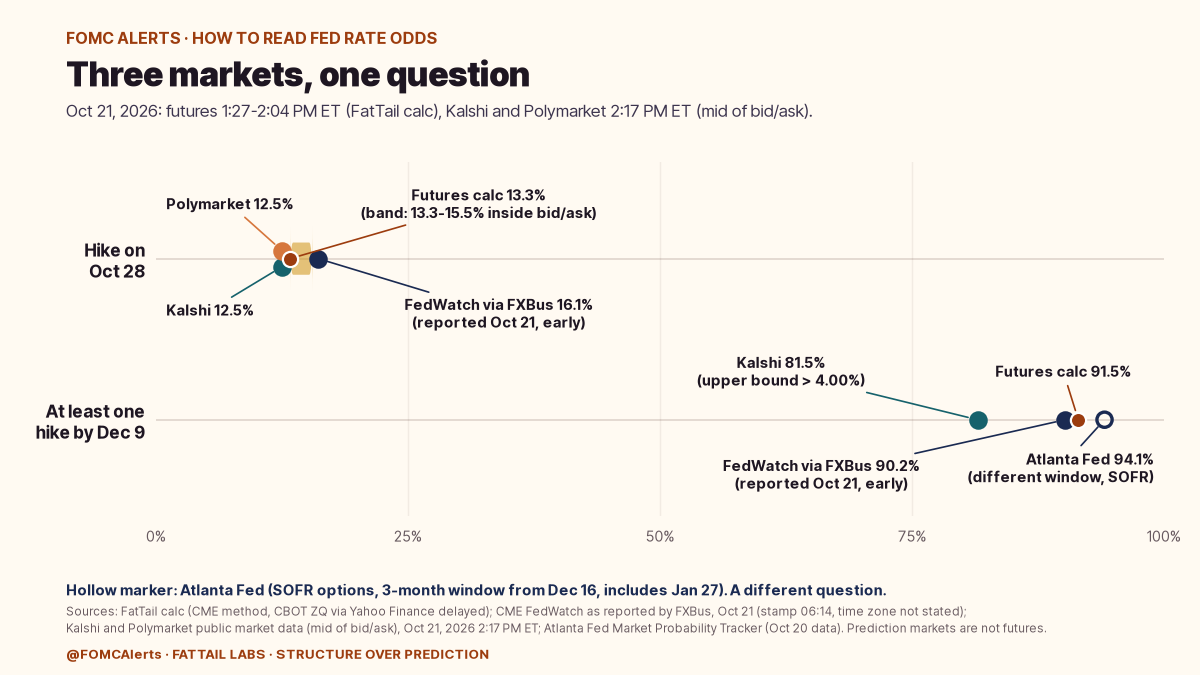
A third read comes from the Atlanta Fed’s Market Probability Tracker, which uses options on three-month SOFR futures (Atlanta Fed). For the three-month window starting Dec 16, it put 94.1% on average SOFR sitting above today’s range (Oct 20 data). That window runs past the Jan 27 meeting and measures SOFR, not the effective fed funds rate, so it’s a different question again.
Why the markets don’t match
For December, the futures say about 91% for at least one hike and Kalshi about 81%. Nothing in the data tells us which factor explains the gap, so treat the list below as possible reasons, not proven causes:
- Different questions. Per-meeting vs. cumulative, EFFR vs. upper bound vs. SOFR, and different windows.
- The 25bp assumption. FedWatch assumes 25bp steps. Kalshi’s strikes don’t need that assumption.
- The baseline. Measuring from the effective rate (3.88%) or the range midpoint (3.875%) changes the October reading by a couple of points.
- Timing and ticks. Our futures quotes are last trades from 1:27-2:04 PM ET; the prediction-market quotes are from 2:17 PM ET. One tick is about 2 points.
- Risk premium. One likely reason is that futures carry a premium for risk. Research by Monika Piazzesi and Eric Swanson finds “excess returns on federal funds futures have been positive on average and strongly countercyclical” (NBER). If so, futures prices aren’t pure forecasts.
- Fees, spreads and traders. Kalshi’s taker fee is 0.07 × price × (1 – price) per contract, about 0.8 cents on a 13-cent contract (Kalshi fee schedule), and spreads run about a cent. Different people trade each venue.
Why this matters for 0DTE
Short-dated SPX and SPY options price whatever surprise is left in an event. When rate odds reprice, the amount of surprise left changes. The swings have been real: FedWatch’s October hike odds were 22.1% on Oct 13 and 15.5% on Oct 20, as reported by Seoul Economic Daily (Seoul Economic Daily). On the ForecastEx prediction markets that Interactive Brokers runs, October hike odds fell from 47% to 14% in the week to Oct 16 (IBKR). We covered those moves in our Reuters poll piece and in the case for an October rate hike vs. what’s priced.
- Energy: The Fed’s blackout runs through Oct 29, so before the meeting the odds move on markets and data, not on Fed speeches. Oct 28 at 2:00 PM ET is the scheduled event. GDP and PCE land the next morning and feed straight into the December odds.
- Premium: The VIX prices the event. A low hike probability means most of the surprise sits in the less likely branch.
- Structure: A 2-point move in the odds is one futures tick. Don’t resize a position on it.
- Plan, don’t predict: Quote the source, the instrument and the timestamp. Then plan for both branches.
Cheat sheet
- Quote it right: “CME FedWatch, as of [time]” for CME’s number, “futures-implied, our calculation” for your own, “Kalshi/Polymarket price” for prediction markets.
- Check it in two minutes: 100 minus the November futures price, minus today’s effective rate, divided by 25bp.
- Read December carefully: cumulative end-point (FedWatch) vs. single-meeting bet (Kalshi/Polymarket decision contracts).
- Ignore the noise: a move of 2 points or so is one tick.
Related reading
- FOMC Alerts hub: the Oct 28 calendar, upcoming data and all our Fed coverage.
- Expected move in options: how short-dated options price the surprise that’s left.
- How to Plan Market Scenarios for 0DTE SPX: building the plan for both branches.
Sources
- Understanding the CME Group FedWatch Tool Methodology (CME Group, accessed Oct 21, 2026)
- 30-Day Fed Funds futures delayed quotes ZQV26, ZQX26, ZQZ26 (Yahoo Finance (CBOT, delayed), Oct 21, 2026, pulled 2:17 PM ET (last trades 1:27-2:04 PM ET))
- Effective Federal Funds Rate (Federal Reserve Bank of New York, Oct 20, 2026)
- CME FedWatch probabilities (as reported) (FXBus, Oct 21, 2026, stamped 06:14 (time zone not stated))
- AI pullback, housing slump strengthen case for Fed pause (Seoul Economic Daily, Oct 21, 2026)
- Fed funds rate (KXFED) and Fed decision (KXFEDDECISION) market prices (Kalshi public API, Oct 21, 2026, 2:17 PM ET)
- Contract terms: FED and FEDDECISION (Kalshi)
- Kalshi fee schedule (Kalshi, effective Jul 7, 2026)
- Fed Decision in October? / Fed Decision in December? (Polymarket, Oct 21, 2026, 2:17 PM ET)
- Market Probability Tracker (Federal Reserve Bank of Atlanta, Oct 20, 2026 data)
- Futures Prices as Risk-adjusted Forecasts of Monetary Policy (NBER (Piazzesi & Swanson), 2004; J. Monetary Economics 2008)
- October Fed Hike Odds Fell From 47% To 14% This Week (Interactive Brokers (Jose Torres), Oct 16, 2026)
- Meeting calendars and information (Federal Reserve, 2026)
Trade it with structure
Observer is a six-week trial and training program: train with Coach for $17/week. You get everything a full coaching member gets, every week, and the six weeks are designed to install pro trading habits: courses on strategy, process and risk management, live daily coaching, a Discord trade room with hundreds of experienced traders, and the platform (heatmap, GEX tools, risk graph, position analyzer and journal). Start Observer.
Educational content, not investment advice. Options involve risk and are not suitable for all investors.
FATTAIL BRIEFINGS
Get FatTail briefings in your inbox
Pick the lists you want. FOMC Alerts is selected by default.