


Expiration day exposes every weakness in a trading process. A position that looked calm at 10:30 can require a completely different decision at 2:45. That is why learning how to manage expiration day is not about finding a better alert or predicting the closing print. It is about operating a defined-risk position with rules that still make sense when time disappears, starting with SPX expiration timing.
For 0DTE SPX traders, the expiration date is not a footnote. It is the entire environment. Gamma changes quickly. Premium compresses quickly. A small move can alter the risk graph faster than your intuition can catch up. The trader who treats this as a normal day of trading often improvises. The trader who plans for expiration day works from position, risk, and structure. The OCC’s options education covers the exercise mechanics behind that structure.
Expiration Day Is a Risk-Management Problem
The common retail mistake is to judge a 0DTE trade by whether it is currently profitable. That invites emotional management. If the trade is green, the trader becomes passive. If it is red, the trader becomes reactive. Neither response tells you what the position actually requires.
Expiration-day management starts with a different question: what does this structure look like now, and what can it reasonably become before the session ends?
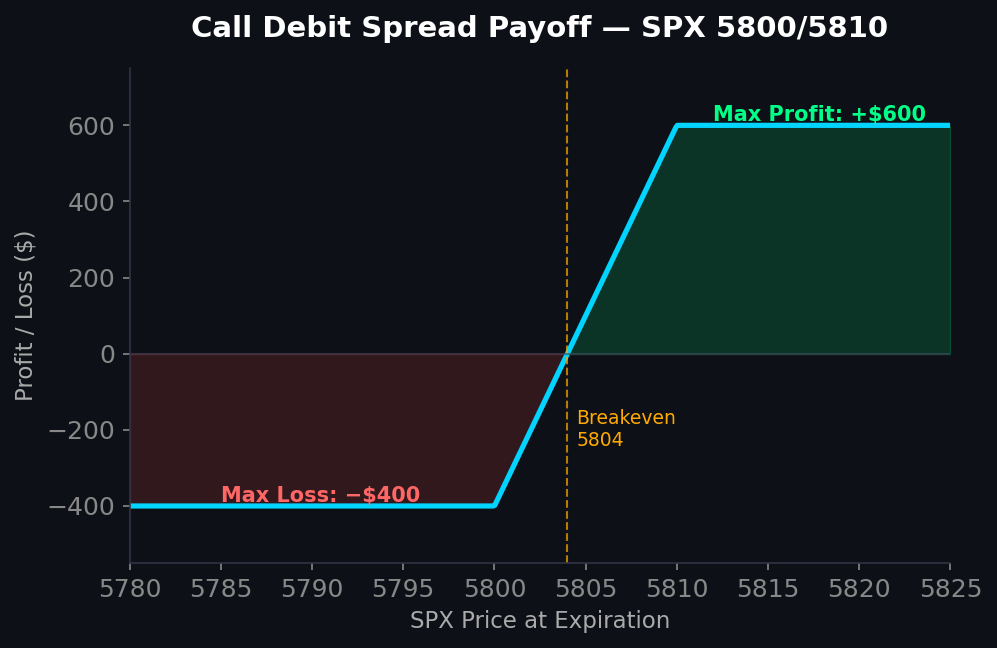
A defined-risk spread has a maximum loss. That matters. But defined risk is not the same as ignored risk. If a short strike is under pressure, the position may still be within its maximum loss while carrying a much larger probability of realizing that loss than it did at entry. You need to see that change clearly, without pretending a threatened position is fine simply because the risk was capped at the outset.
The goal is not to avoid every loss. It is to avoid turning planned losses into oversized decisions, revenge trades, or a pattern of size that can damage the account. A loss that fits the plan is a trading rep. A loss enlarged by poor management is a process failure.
Build the Plan Before You Enter
The best expiration-day decision is usually made before the order goes out. Entry is where you establish the conditions under which you will hold, reduce, exit, or do nothing.
Start with position size. Your size must allow you to think. If a normal fluctuation makes you stare at every tick or abandon your rules, the position is too large. Smaller size is not an admission of weakness. It is what makes repeatable execution possible while you gather evidence about your own process.
Then define the structure. Know the width, maximum risk, short strikes, long strikes, credit received, and the areas of the market that matter most to the trade. Do not reduce the position to a vague statement such as, “SPX should stay above this level.” Your risk graph and strike placement tell a more useful story than a directional opinion.
You also need an invalidation framework. This does not require a mechanical rule that treats every market day as identical. It does require clarity. What market behavior would tell you that the original thesis or positioning context has changed? Is it a sustained move through a key area? A change in dealer positioning? A failure to reclaim a level after a meaningful test? The answer depends on the structure and the day, but it cannot be invented after the trade is in trouble.
How to Manage Expiration Day by Time of Day
Time remaining changes the job. A practical framework separates the session into phases rather than treating every minute the same.
Early session: Avoid solving problems that do not exist
The open can be noisy. SPX may gap, reverse, test overnight levels, and establish an initial range before the market reveals any durable behavior. If you entered early, distinguish between a genuine structural change and routine opening volatility.
That does not mean blindly holding. It means using your planned references. Check where price is relative to your strikes, how quickly it moved there, whether positioning supports or resists the move, and whether the trade’s risk has materially changed. A fast test and rejection can mean something very different from price accepting above or below a key area.
Avoid adding risk because the first few minutes feel decisive. Expiration day punishes urgency. You do not need to prove that you can predict the open.
Midday: Reassess the structure, not the P&L
By midday, the opening impulse has often either developed into a trend or settled into a range. This is where traders can become careless. A position that collected premium easily in the morning may be carrying a new risk profile as the market drifts toward a short strike.
Review the trade in plain language. Where is SPX? How close is price to the area that threatens the position? Is the market moving with momentum, rotating, or pinning near a level? What has changed in the risk graph since entry? (Here is how to read a risk graph.)
If the trade is comfortably positioned, the correct action may be no action. That can be difficult for traders trained by alerts to constantly do something. But management is not activity. Management is making the decision that best matches the current structure.
If the position is challenged, choose from decisions you can explain before and after the fact: reduce exposure, close the defined-risk position, or hold according to a pre-established framework. What you should not do is turn the trade into a negotiation with the market. Hoping is not a management plan.
Late session: Respect accelerating gamma
The final stretch changes the math and the psychology. As expiration approaches, a position near its short strike can become highly sensitive to relatively small SPX moves. The Cboe SPX product page lists the exact closing times that decide settlement. The premium remaining may look attractive, but the risk you are accepting to capture it may no longer fit your plan.
This is where “just let it expire” becomes dangerous language. Sometimes letting a well-positioned defined-risk structure expire is entirely reasonable. Sometimes it means accepting a concentrated risk near the close because closing feels like admitting defeat. Those are not the same decision.
Use a simple test: if you did not already own this exact position at this exact time, would you initiate it for the remaining premium and risk? If the answer is no, examine why you are still holding it. The answer does not automatically mean exit. It forces an honest assessment.
Be particularly disciplined when price is near a short strike late in the day. A small apparent edge can disappear quickly. Defined risk protects the account from unlimited exposure, but correct sizing and timely decisions protect the process from repeated avoidable stress. Know exactly how the contract finishes with our settlement mechanics guide.

Use Positioning as Context, Not a Crystal Ball
Gamma exposure, key strikes, and convexity data can help explain why price may accelerate, stall, or rotate around certain areas. They are useful because they improve context. They are not a promise that SPX will pin to a strike or reverse on command.
This distinction matters. Prediction creates attachment. Positioning creates preparation.
When you see an area with meaningful structural relevance, ask what price behavior around that area would mean for your spread. If price holds below it, does your put-side risk improve? If price accepts through it, does the call-side risk need attention? You are not trying to guess the next candle. You are mapping decisions before pressure arrives.
At FatTail.ai, this is the discipline behind using tools such as risk graphs, GEX overlays, and convexity heatmaps. The tool does not manage the trade. The trader does. The tool gives the trader a clearer view of the environment in which the decision is being made.
Keep Adjustments From Becoming New Bets
An adjustment can reduce risk. It can also disguise a new trade. Know the difference.
Closing a challenged defined-risk spread may be the cleanest decision because it removes uncertainty and preserves capital for the next qualified setup. Reducing contracts can lower exposure if you are oversized relative to the current risk. But adding contracts, moving strikes impulsively, or layering on new structures simply to recover a loss often creates complexity without solving the original problem.
Every adjustment should answer one question: what specific risk am I reducing? If you cannot answer it in one sentence, you may be adding a fresh opinion rather than managing an existing position.
This is also why one trade should not determine your day. A trader who needs one position to finish green becomes vulnerable to bad decisions near the close. Your job is to execute a series of properly sized, defined-risk trades with positive expectancy over time. One expiration day is data, not a verdict on your ability.
End the Day With a Review You Can Use
The closing bell is not the end of the process. It is where improvement begins.
Record the entry context, structure, size, relevant positioning, management decisions, and exit. Then separate process from outcome. A profitable trade can be poorly managed if it broke your rules and happened to work. A losing trade can be well managed if size, risk, and decisions matched the plan.
Review screenshots of the risk graph and price action at the moments you felt pressure. Those moments reveal the gap between your written framework and your actual behavior. Over enough trades, patterns become visible: entering too large, holding too long near short strikes, taking profits without a reason, or reacting to noise at the open.
That record is how you stop depending on memory, signals, and post-trade stories. Expiration day will always move fast. Your response does not have to. Build the plan before the pressure arrives, size so you can follow it, and let each completed trade make the next decision more disciplined.
Frequently Asked Questions
How do you manage 0DTE options on expiration day?
Manage from position, risk, and structure, not from current profit or loss. Define size, invalidation, and exit rules before entry, then work the session in phases: avoid overreacting at the open, reassess structure at midday, and respect accelerating gamma near the close. Every adjustment should answer one question: what specific risk am I reducing?
Why is expiration day so risky for 0DTE SPX?
Time compression. Gamma changes quickly, premium compresses quickly, and a small SPX move can alter the risk graph faster than intuition catches up. A position near a short strike late in the session can become highly sensitive to small moves, so the remaining credit may no longer justify the risk carried to capture it.
Should you let 0DTE options expire or close them?
It depends on the structure’s remaining risk, your size, and the rule you set before the trade. Letting a well-positioned defined-risk structure expire can be reasonable; holding purely because closing feels like defeat is not. Use the test: if you did not already own this position at this time, would you initiate it for the remaining premium and risk?
How does time of day change expiration management?
Early session, distinguish genuine structural change from routine opening volatility and avoid solving problems that do not exist. Midday, reassess the structure rather than the P&L. Late session, respect accelerating gamma near short strikes, where a small apparent edge can disappear quickly.
When is an adjustment actually a new trade?
When it adds a fresh opinion rather than reducing a defined risk. Closing or reducing a challenged spread lowers exposure; adding contracts, moving strikes impulsively, or layering new structures to recover a loss usually creates complexity without solving the original problem. If you cannot name the risk you are reducing in one sentence, it is a new bet.
FATTAIL BRIEFINGS
Get FatTail briefings in your inbox
Pick the lists you want. FOMC Alerts is selected by default.