


A trader without a process is not really trading a system. They are reacting to price, headlines, a chart pattern, or somebody else’s conviction. That can feel productive on a green day. It becomes expensive when the market moves fast, a position goes against you, and every decision suddenly feels personal. Learning how to build a trading process changes the question from “What will SPX do next?” to “What is my planned action in this condition?”
That distinction matters most in 0DTE. Time is short. Gamma is high. A small mistake in size, structure, or exit discipline can overwhelm a dozen otherwise sensible decisions. The answer is not better prediction. It is an operating system built to keep any single trade, session, or losing streak from becoming an account-level event.
Start With the Job of Your Process
A trading process has one primary job: protect decision quality when uncertainty is highest. The OCC’s options education is a good grounding in the defined-risk structures a process relies on. It should tell you what markets you trade, what structures you use, when you participate, how much you risk, and what you do when the trade does not work.
Most retail traders start at the wrong end. They begin with entries. They search for a signal, an indicator, or a setup that looks precise enough to remove uncertainty. But entries are only one part of the machine. A good entry paired with poor sizing can still create a bad trade. A sound thesis paired with undefined risk can still create a blowup.
For an SPX 0DTE trader, the process should be designed around defined-risk structures and known exposure. You are not trying to be heroic. You are trying to run a repeatable business of decisions where the downside is understood before the order is sent.
Your process must also fit your actual life. If you cannot watch the market all day, do not build a plan that requires constant intraday adjustment. If a full-size loss makes you hesitate, your size is too large for your current psychological and financial tolerance. A process you cannot execute calmly is not a process yet. It is an aspiration.
Define the Market Conditions You Will Trade
Not every day offers the same opportunity. Some sessions open with clear positioning and orderly price behavior. Others are driven by major economic releases, abrupt repricing, or two-sided volatility that makes short-term structure hard to read. Treating every day as identical is how traders force trades.
Create a short market-context routine before looking for an entry. For 0DTE index options, that may include the overnight range, the opening location relative to key levels, expected event risk, volatility conditions, and options positioning. The goal is not to forecast the closing print. It is to identify where the market may be stable, where it may accelerate, and where your chosen structure is likely to be poorly matched to the environment.
A positioning-first approach is more useful than a prediction-first approach. You do not need to declare that SPX must rise or fall. You need to recognize whether the market is pinned, trending, expanding, or unstable – then decide whether your playbook has a trade for that condition.
Write down your no-trade conditions. This is not a minor detail. A process becomes real when it gives you permission to stand aside. For example, you may choose not to initiate new risk around a scheduled event, after a defined daily loss limit, or when price behavior does not match any setup you have tested. No trade is a valid execution decision.
Build a Small, Defined-Risk Playbook
A playbook is not a library of every options strategy you have ever seen. It is a limited set of repeatable structures tied to recognizable market conditions. Fewer setups create cleaner data, clearer reviews, and less room for improvisation.
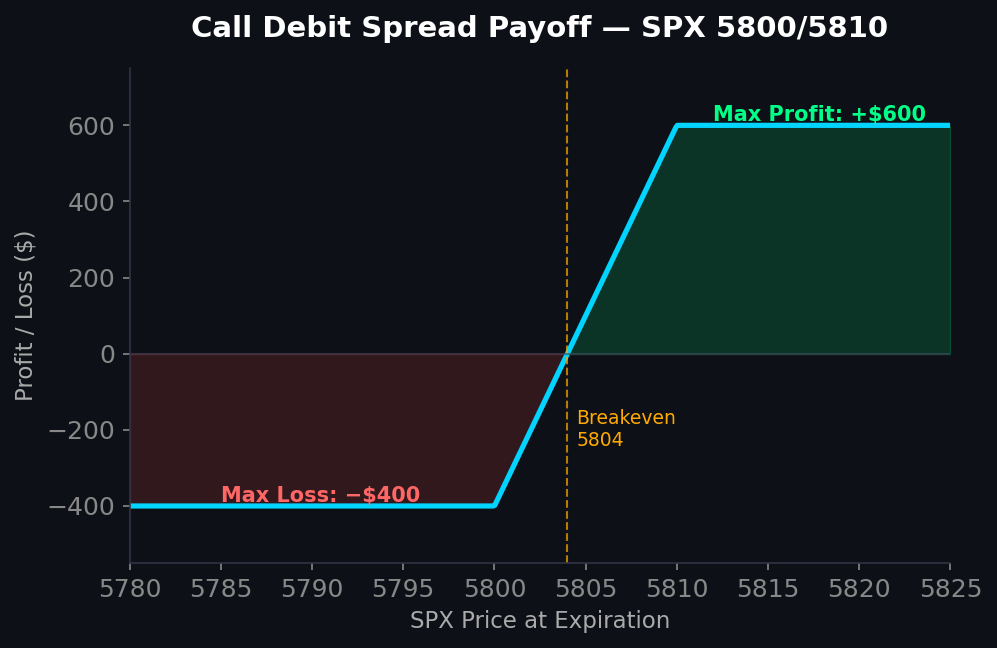
For each setup, document five things: the market condition, the structure, the entry criteria, the maximum planned risk, and the exit logic. If you cannot explain each of those in plain language before entering, you are still making the trade up in real time.
Your entry criteria should be observable. “I felt like the market was extended” is not observable enough. “Price rejected a defined level, positioning supported a contained range, and volatility conditions met my rules” is something you can review later. The point is not to make rules complicated. The point is to make them testable.
Exit logic deserves equal attention. A trader who only plans for profit has not planned the trade. Define what invalidates the setup, when risk must be reduced, whether profits are taken at predefined levels, and whether a position can ever be held through a specific time or event. In 0DTE, waiting for clarity can be a decision to accept accelerating risk. Your plan should account for that before the market asks you to act.

Make Position Size the First Risk Decision
Position sizing is where process becomes account protection. This is the heart of options risk management. The contract count should not be based on conviction, frustration, or the size of the previous winner. It should flow from a fixed amount of account risk you are willing to allocate to one planned loss.
Start with the maximum loss of the defined-risk structure, including the practical effect of fills and transaction costs. Then determine how many contracts keep the trade within your per-trade risk limit. If one contract exceeds that limit, the answer is not to bend the rule. The answer may be to use a narrower-risk structure, wait for a different opportunity, or not trade that setup at the current account size.
You also need session-level limits. A sequence of ordinary losses can become destructive when traders respond by doubling size, taking marginal setups, or trying to recover before the close. Set a daily risk limit that ends new trading when reached. Investor-education bodies like the SEC stress predefined risk limits for exactly this reason. This is not punishment. It is a circuit breaker designed to prevent emotional state from taking control of capital.
Risk limits should include correlation. Several positions that appear separate can express the same directional assumption. If all of them lose when SPX breaks one key level, you do not have diversification. You have concentrated exposure wearing different labels.
Turn Execution Into a Routine
A trading process should reduce the number of decisions made under pressure. See how this becomes a daily 0DTE routine. That requires a fixed routine, not a vague promise to be disciplined.
Before the opening bell or before your trading window, prepare the same essentials:
- Identify scheduled events and time-based risk.
- Mark relevant price areas and positioning references.
- Determine which playbook conditions are present and which are absent.
- Calculate the maximum size for each eligible defined-risk structure.
- Set your daily stop condition before the first trade.
During the session, separate observation from action. Markets produce constant information, but not every piece of information requires a trade. Use alerts, charts, and analytics to observe conditions, then act only when a documented setup appears. Not signals. Not alerts. A setup that you understand well enough to manage without needing someone else to tell you what comes next.
Use order-entry rules, too. Decide whether you use limit orders, what constitutes an acceptable fill, and when you will cancel an order rather than chase price. Chasing is often disguised as decisiveness. Usually, it is simply the process breaking down before the position even exists.
Review the Process, Not Just the P&L
The most useful review question is not “Did I make money?” It is “Did I execute the plan, and what does the data say about the plan?” A profitable trade can be poor execution if it violated risk rules. A planned loss can be excellent execution if the trade matched the setup and the exit was followed.
Keep a trade log with the market condition, structure, planned risk, actual entry and exit, adjustment decisions, and a brief note on whether you followed the rules. Screenshots help because memory is unreliable after the result is known. You want to see what you saw at the time, not the story you tell yourself afterward.
Review trades in batches. One loss proves very little. Ten or twenty trades in the same setup can reveal whether your entries are early, your size is inconsistent, your exits are rushed, or the market condition is being classified poorly. Change one meaningful variable at a time. If you revise entries, targets, and size simultaneously, you will not know what caused the difference.
Losses are planned reps, not evidence that you are incapable of trading. But repeated rule-breaking is information. It may mean the structure is too large, the rules are too vague, or the routine does not fit the way you actually make decisions. Fix the operating problem instead of searching for a new signal.
Let the Process Earn Your Trust
Trust does not come from a perfect streak. It comes from seeing yourself follow a defined plan through ordinary uncertainty, planned losses, and changing market conditions. That is how you stop needing a guru, an alert room, or a confident voice on social media to make the next decision for you.
Build the process small enough to execute, clear enough to review, and conservative enough to survive being wrong. Then give it enough disciplined repetitions to teach you something real. The goal is not to feel certain before every trade. The goal is to need no certainty at all to act professionally.
Frequently Asked Questions
How do you build a trading process?
Define what markets you trade, what defined-risk structures you use, when you participate, how much you risk, and what you do when a trade fails, then turn it into a repeatable routine. Its primary job is to protect decision quality when uncertainty is highest, not to predict the next move.
Why do most traders start with entries, and why is that wrong?
They search for a signal precise enough to remove uncertainty, but entries are only one part of the machine. A good entry paired with poor sizing still creates a bad trade, and a sound thesis paired with undefined risk still creates a blowup. Structure and size matter more than the signal.
How do you size positions within a process?
Position size is the first risk decision. Start from the maximum loss of the defined-risk structure, including fills and costs, then take only as many contracts as keep the trade within your per-trade risk limit. Add a daily risk limit that ends new trading when reached, and account for correlation.
How do you review a trading process?
Ask “did I execute the plan, and what does the data say about the plan?”, not “did I make money?” Keep a log of condition, structure, planned risk, entries, exits, and rule adherence, and review in batches of ten to twenty, changing one variable at a time.
How do you learn to trust your process?
Trust comes from seeing yourself follow a defined plan through ordinary uncertainty, planned losses, and changing conditions, not from a perfect streak. Build it small enough to execute, clear enough to review, and conservative enough to survive being wrong, then give it enough disciplined reps.
FATTAIL BRIEFINGS
Get FatTail briefings in your inbox
Pick the lists you want. FOMC Alerts is selected by default.