


There are hundreds of options trading strategies. Every book, course, and YouTube channel has a favorite. Bull call spreads. Iron condors. Covered calls. Straddles. The wheel. Each one is presented as the answer — the strategy that will finally make your account grow. And most traders spend years cycling through them, looking for the one that works, never finding it.
The strategy is not the problem. The framework is the problem. Options trading strategies are tools. A hammer is not useful or useless — it depends on whether you are driving a nail or turning a screw. The same trade that loses money on a trending day prints on a range-bound day. The same structure that works in low volatility bleeds in high volatility. The strategy does not know what kind of day it is. You need to know — and most traders do not.
This guide categorizes the major options trading strategies by what they actually do, explains when each category works and when it fails, and shows why structural traders choose their strategy based on positioning data rather than personal preference.
Why Most Options Trading Strategies Fail
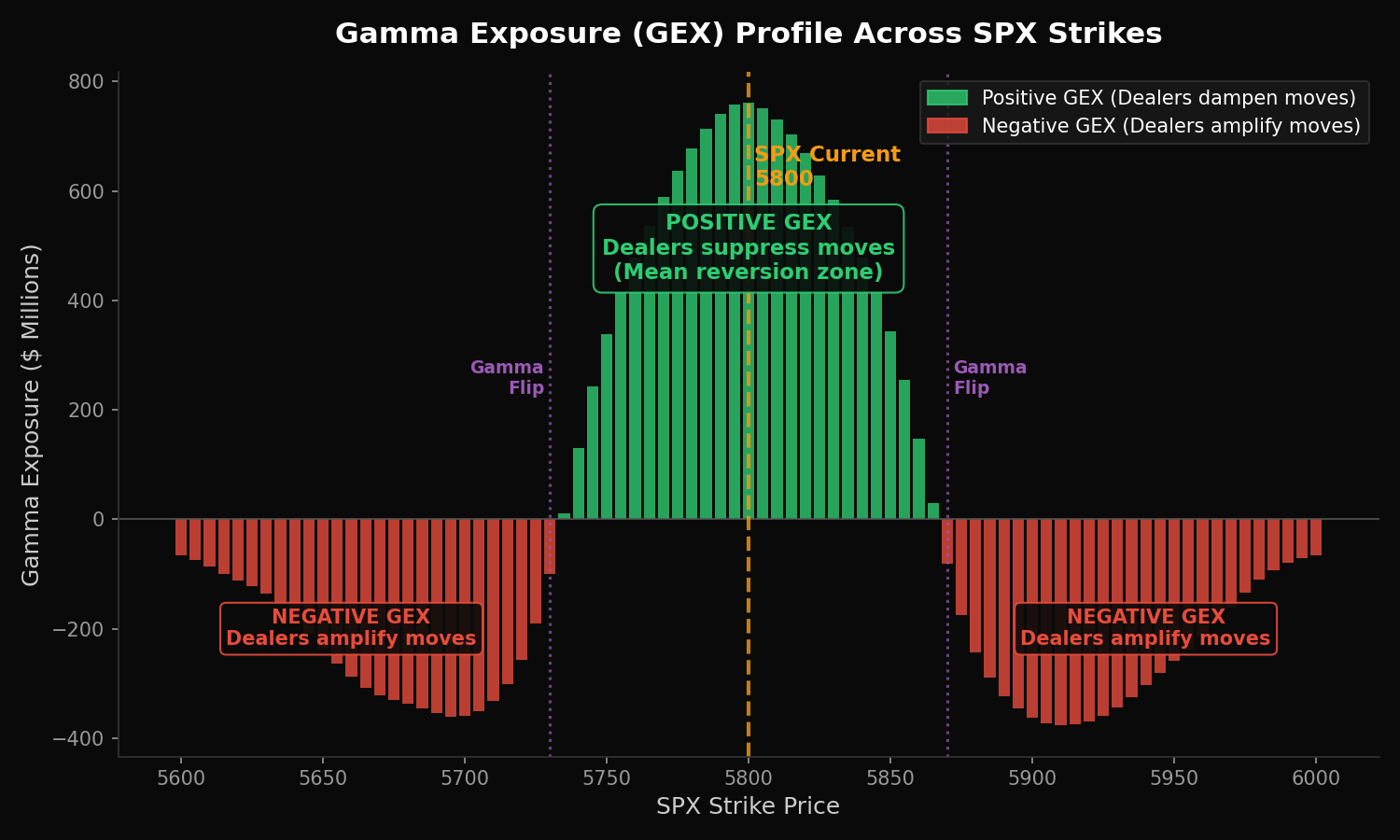
They do not fail because they are bad strategies. They fail because traders apply them without context. A credit spread is a legitimate structure. It collects premium, defines risk, and profits when the underlying stays within a range. But selling a credit spread on a day when GEX is deeply negative — meaning dealer hedging amplifies moves instead of dampening them — is walking into a buzzsaw. The strategy is fine. The application is wrong. An iron condor works beautifully in range-bound markets. Deploy one on a trending day and both wings get tested. The loss is defined, but the loss is still real. The trader blames the strategy. The strategy is not the issue. The trader did not read the environment. This is the pattern across all options trading strategies: the structure itself is neutral. The edge — or the loss — comes from matching the structure to the session. That matching requires data most traders do not have: where is dealer positioning creating support or resistance? Is the VIX regime favoring compression or expansion? What is the expected move for today? Without this context, strategy selection is a coin flip with better packaging.Directional Strategies: Betting on Where Price Goes
Directional strategies profit when you correctly predict the underlying’s direction. They are the simplest to understand and the hardest to execute consistently. Debit spreads — A bull call spread or bear put spread pays a debit for a capped directional bet. Maximum loss is the premium paid. Maximum profit is the width of the strikes minus the debit. You need the underlying to move in your direction by enough to overcome the cost. The problem is directional accuracy. Most retail traders hit 40-50% accuracy on direction — not enough to overcome the cost of the losing trades. Vertical spreads — The broader category that includes both debit and credit directionals. A vertical spread is structurally clean: two options, same expiration, different strikes. But clean structure does not mean edge. Without a structural read on where price is likely to go, you are guessing with guardrails. Long options — Buying calls or puts outright. Maximum leverage, maximum risk of total loss. Time decay works against you every day. IV crush can destroy your position even when direction is right. Long options are the highest-conviction, lowest-margin-of-error directional bet available. Most traders underestimate how often they need to be right to make this work. Ultimately, all directional options trading strategies share the same dependency: you must predict direction accurately enough to overcome the cost of being wrong. Some traders can do this. Most cannot — and the data is clear on that point.Income Strategies: Selling Premium for a Paycheck
Income strategies collect premium upfront and profit when the underlying does nothing dramatic. Of all options trading strategies, income plays are the most popular because they feel like getting paid. Covered calls — Own 100 shares, sell a call against them. Collect premium while capping your upside. The covered call is structurally identical to selling a naked put — same risk, different packaging. In a bull market, covered call sellers systematically surrender their best gains for small premiums. The wheel — Sell cash-secured puts, get assigned, sell covered calls, get called away, repeat. The wheel strategy ties up massive capital ($5,000-$56,000 per position) to generate small monthly credits. One 30% drawdown erases ten months of premium. The math is against you on any individual stock. Iron condors — Sell a call spread and a put spread simultaneously, collecting credit on both sides. Profit if the underlying stays between the short strikes. The iron condor wins 65-75% of the time. The losses are two to three times the size of the wins. As a result, net expectancy depends entirely on whether you deploy it in the right environment. Iron butterflies — A tighter version of the iron condor where both short strikes are at the same price. The iron butterfly collects more credit but has a narrower profit zone. Higher premium, less room for error. However, every options selling strategy shares the same flaw: negative skew. Small wins, large losses. The win rate is high enough to feel safe — until the one loss that matters arrives. The traders who survive this category long-term are the ones who deploy it only when the structural environment favors range-bound behavior. The rest learn the hard way.
Volatility Strategies: Trading Magnitude Instead of Direction
Volatility strategies profit from large moves in either direction — or from the absence of movement. They do not require a directional opinion. They require an opinion on how much the underlying will move. Straddles — Buy a call and a put at the same strike. Profit if the underlying moves far enough in either direction to overcome the combined cost. The straddle is a pure volatility bet. It loses when the underlying stays near the strike, which is most of the time. It wins big when the move exceeds what the market priced in. Strangles — Same concept, different strikes. Buy an out-of-the-money call and an out-of-the-money put. Cheaper than a straddle, but needs a larger move to profit. The straddle vs strangle decision comes down to how much you want to pay versus how much room you need. In practice, these options trading strategies live and die by implied volatility. Buy a straddle when IV is already elevated, and you need an even larger move to overcome the inflated premium. Buy when IV is low and a catalyst is approaching, and the structure works in your favor. Reading the options chain for IV levels before entry is not optional — it is the entire thesis. The structural framework that FatTail teaches addresses this directly. Before selecting any strategy, understand the session’s structural context. The daily pre-market analysis in Observer ($17/week) covers GEX positioning, expected move, and VIX regime — the exact inputs that determine whether a volatility play, an income play, or a directional play fits the environment. Activator ($97/month) adds real-time tools and weekly coaching. Navigator ($267/month) provides daily direct coaching with Ernie. Compare all plans here.Defined-Risk Asymmetric Structures: Where the Edge Lives
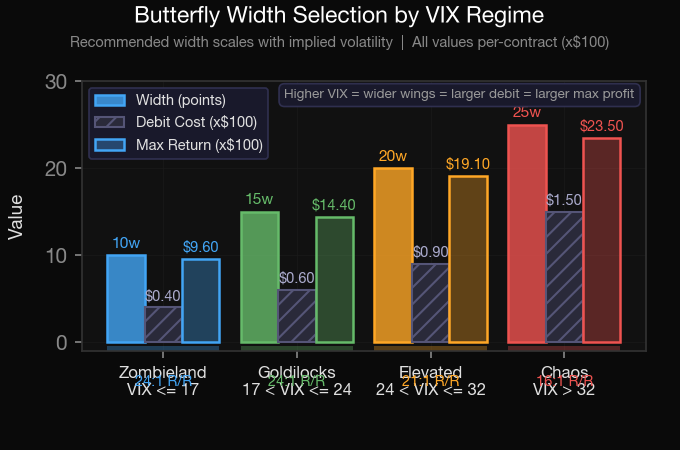
In contrast, this is the category most options education skips entirely — because it requires data and a framework that the traditional strategy-first approach does not provide. The butterfly spread is a defined-risk structure that targets a specific price level. Risk $30-$100. Target $500-$2,500. The payoff is asymmetric — you lose small and win big. The win rate is lower (20-30%), but one winner pays for five to ten losers. What makes the butterfly different from every other structure is how the target is selected. Directional traders guess. Income traders hope the range holds. Butterfly traders read the GEX landscape to identify where dealer positioning creates gravity — price levels where hedging flows pull price toward or repel it. The target is not a guess. It is a structural read. This is the market structure framework. The session has a character before it begins. The GEX profile tells you whether mean reversion or trending behavior is favored. The expected move defines the range. The VIX regime determines the appropriate structure width. The dealer gravity levels identify the target. You do not pick a strategy and hope it works. You read the structure and deploy the strategy it calls for.How the Numbers Compare
The comparison is stark: Directional strategies: risk $100-$500 per trade, require 55%+ accuracy on direction, no structural input. Income strategies: risk $5,000-$56,000 in capital, collect $150-$500 per cycle, one bad cycle erases months. Butterfly structures: risk $30-$100 per trade, target $500-$2,500, informed by positioning data that exists before the session opens. Same market. Same options trading strategies. Completely different framework. The first two categories require you to be right about direction or range. The third requires you to read the structure — and the structure is visible if you know where to look.
Choosing the Right Strategy for the Session
This is the section that matters. Every options trading strategies guide lists the strategies. This one tells you how to choose between them — not based on preference, but based on data. Step 1: Read the GEX profile. Positive GEX means dealers are hedging in a way that dampens moves — range-bound sessions are favored. Negative GEX means dealers amplify moves — trending sessions are likely. This single data point eliminates half of the strategy universe for any given day. Step 2: Check the expected move. The expected move defines the market’s priced range. If you are selling premium, your short strikes should be outside the expected move. If you are buying premium, you need the underlying to exceed it. The expected move is not a prediction — it is the boundary between likely and unlikely. Step 3: Assess the VIX regime. Low VIX (sub-15) compresses ranges and makes income strategies modestly attractive. High VIX (25+) expands ranges and makes directional and volatility strategies more viable. The VIX regime determines the width of every structure you deploy. Step 4: Identify dealer gravity levels. These are the price levels where concentrated open interest creates hedging flows that pull price. They are your targets for butterfly placement and your reference points for risk management on any other structure. Step 5: Deploy the structure the data calls for. Not the one you prefer. Not the one that worked last week. The one that fits today’s positioning landscape. That discipline — matching structure to environment — is the difference between cycling through strategies and having a framework. This is what Observer ($17/week) delivers before every session: the GEX profile, expected move, VIX context, and dealer gravity levels. Activator ($97/month) adds real-time tools and weekly coaching to apply the framework live. Navigator ($267/month) provides daily direct coaching with Ernie. Compare all plans here.
Frequently Asked Questions
What are the best options trading strategies for beginners?
Beginners should start with defined-risk structures where maximum loss is known before entry. Debit spreads and butterfly spreads cap your risk at the premium paid. Avoid selling naked options or running income strategies like the wheel until you understand how drawdowns compound. The best beginner strategy is less about which structure and more about understanding the environment — learn to read GEX, expected move, and VIX regime before selecting any trade.How many options trading strategies should I learn?
You do not need to learn every strategy. You need to understand three to four core structures and know when each one fits the market environment. A debit spread for directional conviction, a credit spread for range-bound conditions, a butterfly for structural convergence targets, and a straddle for volatility expansion events covers the vast majority of sessions. Mastering the framework for choosing between them matters more than memorizing twenty variations.What is the most profitable options trading strategy?
No single strategy is universally most profitable. Profitability depends on matching the strategy to the market environment. Butterfly spreads offer the best asymmetry — small risk for large potential reward — but require structural context to select targets. Credit strategies generate consistent income but suffer catastrophic drawdowns in trending markets. The most profitable approach is a framework that reads the market and deploys the appropriate structure, not a single strategy applied to every session.Do professional traders use the same options strategies as retail traders?
Professional traders use the same structures but with fundamentally different inputs. They read dealer positioning, gamma exposure profiles, and order flow data to time their entries. Retail traders typically select strategies based on opinion, chart patterns, or preference. The structures are identical — the information driving the decision is not. SPX options are the preferred instrument for structural trading because the positioning data is deepest at the index level.Is options trading just gambling?
Options trading without a structural framework is closer to gambling than most traders want to admit. Applying strategies randomly based on directional guesses produces random results. But options trading with positioning data — GEX analysis, dealer flow, expected move — is structured decision-making with defined risk. The difference is the information behind the trade, not the instrument itself.FATTAIL BRIEFINGS
Get FatTail briefings in your inbox
Pick the lists you want. FOMC Alerts is selected by default.