


The wheel strategy options approach is the most popular income strategy in retail trading. Sell a cash-secured put. If you get assigned, sell covered calls against the shares. Collect premium both ways. Rinse and repeat. Simple. Elegant. And for most traders, a slow bleed disguised as income.
That is the part nobody tells you. The wheel strategy looks good on a spreadsheet. It generates consistent small credits that feel like a paycheck. But the structure has a fundamental problem: it wins small and loses big. The same asymmetry that makes credit spreads dangerous applies here — except the wheel compounds the problem by tying up significantly more capital per trade. This guide breaks down how the wheel strategy options approach actually works, where it fails, who it works for, and why structural traders use a different method entirely.
How the Wheel Strategy Works
The wheel strategy options process is a two-phase approach built on stocks or ETFs you would not mind owning. Phase one: sell a cash-secured put below the current price. If the stock stays above your strike, the put expires worthless and you keep the premium. If it drops below, you get assigned — you buy 100 shares at the strike price.
Phase two: once you own the shares, sell covered calls above your cost basis. If the stock stays below the call strike, you keep the premium and the shares. If it rises above, your shares get called away at the strike — you sell them at a profit plus the premium collected.
Then the cycle repeats. Sell another put. Get assigned or collect premium. Sell calls. Get called away or collect premium. The wheel turns.
On paper, every outcome is acceptable. You either collect premium or acquire shares at a price you chose. You either collect more premium or sell shares at a profit. No scenario looks bad in isolation. The problem is what happens between the scenarios — when the stock drops 30% and you are sitting on shares with an unrealized loss that will take months of covered call premium to offset.
Why Traders Love It — And Why That Is the Problem
The wheel strategy options approach is popular for one reason: it feels like getting paid. Every week or month, premium hits your account. It looks like income. It feels like a business. You can calculate your “yield” and project your annual return. This psychological comfort is exactly what makes it dangerous.
The wins are small and frequent. A typical cash-secured put on a $50 stock might collect $1.50 in premium — a 3% return on the capital at risk. Do that twelve times a year and you are projecting 36% annual returns. Except you will not do it twelve times without interruption. The stock will drop. You will get assigned. And the covered calls you sell against those shares will be at strikes below your cost basis — which means you are either selling at a loss or waiting months for recovery while your capital is locked.
This is the negative skew problem that every options selling strategy faces. The wheel strategy options approach does not solve it. It just spreads it across two phases.
The real math: A $5,000 position collecting $150/month in premium loses $1,500 when the underlying drops 30%. That is ten months of premium wiped out in one move. And a 30% drawdown on an individual stock is not a black swan — it is a Tuesday. It happens multiple times per year across the market. The question is not whether it will happen to your wheel position. It is when.
The Capital Efficiency Problem
Here is what makes wheel strategy options particularly expensive: it requires enormous capital relative to the premium collected.
To sell one cash-secured put on a $50 stock, you need $5,000 in cash collateral. For a $200 stock, that is $20,000. For SPY at $560, that is $56,000 — for a single contract. The premium you collect on that put might be $200-$500 depending on the strike and expiration. That is a 0.4-0.9% return on capital deployed — per cycle.
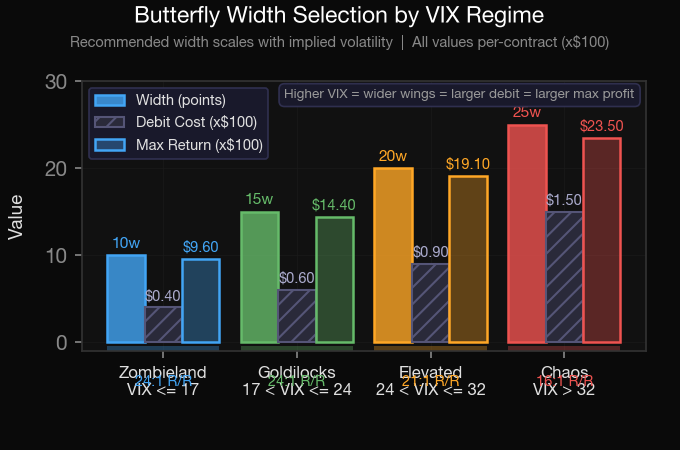
Compare this to a butterfly spread on SPX. A butterfly costs $30-$100 in defined risk. Maximum loss is what you paid. The potential return is $500-$2,500 — a 5:1 to 25:1 payoff. No $56,000 tied up in collateral. No shares to manage. No assignment risk. Just a defined-risk, defined-reward structure that either works or costs you the debit.
The wheel ties up your capital in collateral. The butterfly deploys a fraction of that capital with asymmetric upside. For traders with accounts under $100,000 — which is most retail traders — the capital efficiency difference is not a minor detail. It is the difference between running a strategy and being locked into a position.
The Wheel Does Not Work on SPX
This is the structural problem that most wheel strategy discussions ignore entirely. The wheel requires share assignment. SPX options are cash-settled — there are no shares. You cannot run a wheel on SPX because there is nothing to get assigned. No shares to own. No covered calls to sell against.
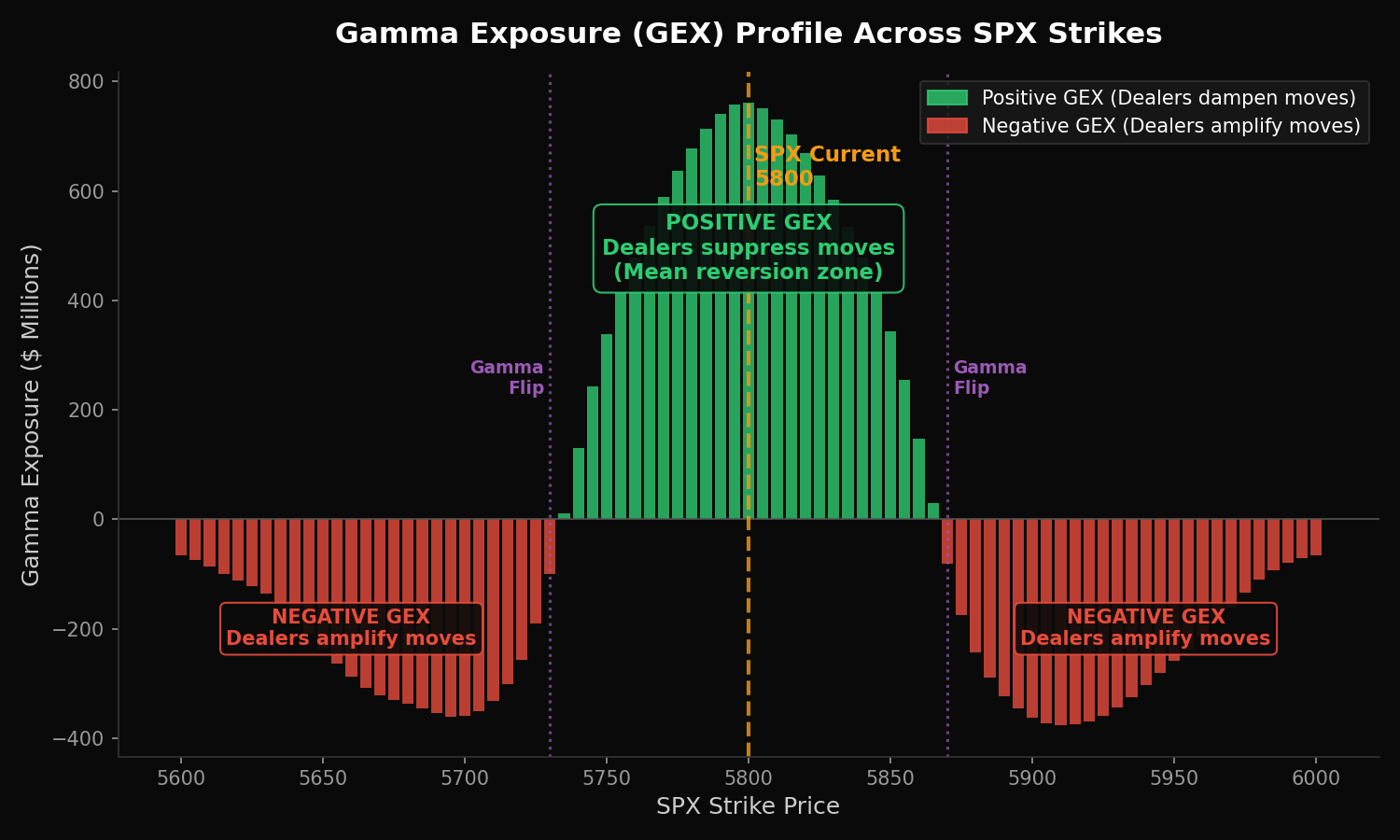
This matters because SPX is where the structural edge lives. The gamma exposure landscape, dealer positioning flows, expected move analytics — these tools exist for index options. They tell you where price is likely to go before the session starts. They give you an informational edge that stock-level wheel trading simply does not have.
When you run a wheel on AAPL or TSLA, you are making a directional bet on a single stock. You have no structural read on where dealer hedging creates pressure. You have no GEX profile telling you whether the session favors mean reversion or trending. You are selling premium into the void and hoping the stock cooperates. Sometimes it does. Sometimes it gaps down 15% on earnings and your year is ruined.
Structural traders do not hope. They read the positioning landscape and place defined-risk trades where the structure supports them. That requires instruments where the structural data exists — and that means index options, not single-stock wheels.
When the Wheel Actually Works
The wheel strategy options approach is not universally wrong. It works under specific conditions that most proponents fail to mention.
Large accounts with diversification. If you have $500,000+ and can run wheels on 15-20 uncorrelated positions simultaneously, the law of large numbers starts working for you. Individual stock drawdowns are absorbed by the portfolio. Premium collection across many positions creates genuine income. But this is a full-time portfolio management operation — not the simple side-income play it is marketed as.
Stocks you genuinely want to own long-term. If you would buy 100 shares of a company at $45 regardless of the wheel, selling a $45 put to potentially acquire them at a discount is rational. You are not running a premium-generation strategy — you are executing a buy-at-a-discount strategy with premium as a bonus. The difference is intent. Most wheel traders do not actually want to own the shares. They want the premium. The shares are an unwanted consequence.
Low-volatility, range-bound markets. The wheel performs best when the underlying trends slowly upward with small pullbacks — the exact environment where every premium-selling strategy thrives. The problem is identifying that environment in advance. The VIX regime helps for index-level assessment, but individual stocks have their own volatility dynamics that are harder to read structurally.
If you are exploring how structural analysis can replace directional guessing in your trading, the daily pre-market positioning analysis in Observer ($17/week) shows you exactly what the GEX landscape looks like before every session. Activator ($97/month) adds real-time tools and weekly coaching. Navigator ($267/month) adds daily direct coaching. Compare all plans here.
The Structural Alternative: Defined-Risk Asymmetry
The reason structural traders do not run the wheel strategy options cycle is not because it is complicated. It is because the risk-reward is backwards.
The wheel: risk $5,000-$56,000 in capital to collect $150-$500 in premium. Win 80% of the time. One bad cycle erases months of income. Negative asymmetry.
The butterfly: risk $30-$100 to target $500-$2,500. Win 20-30% of the time. One good trade pays for five to ten losses. Positive asymmetry.
Same market. Completely different structure. The wheel pays you to be right most of the time and punishes you severely when you are wrong. The butterfly costs you small amounts frequently and rewards you significantly when the structure delivers.
This is not a theoretical comparison. It is the daily practice of traders who read the options market structure and deploy butterfly spreads at dealer gravity levels. The process is: read the GEX profile, identify the gravity level, calculate the expected move, select the width for the current VIX regime, and place the trade. Risk management is built into the structure — maximum loss is defined before entry.
The wheel requires you to manage shares, monitor assignment, adjust covered calls, and tie up capital indefinitely during drawdowns. The butterfly is placed and managed within a single session. Capital is deployed and returned the same day. No overnight risk. No assignment. No shares to babysit.
Common Wheel Strategy Mistakes
If you are going to run the wheel despite the structural disadvantages, at least avoid the mistakes that turn a mediocre strategy into a catastrophic one.
Selling puts on stocks you do not actually want to own. This is the most common mistake. Traders sell puts on high-IV stocks — meme stocks, earnings plays, biotech — because the premium is fat. The premium is fat because the risk is real. When you get assigned on a stock you never wanted to hold, you are stuck selling covered calls on a declining asset while your capital bleeds. Only wheel stocks you would buy outright, with or without the premium.
Ignoring the total capital at risk. A $50 stock requires $5,000 in collateral per contract. Five contracts across three positions is $75,000 at risk. Most wheel traders track their premium income religiously but cannot tell you their total capital exposure. Position sizing applies to wheels exactly as it applies to every other strategy. Never deploy more than you can afford to see drop 30-50%.
Selling covered calls below cost basis after assignment. When the stock drops and you are assigned, the temptation is to sell covered calls at any strike that generates decent premium — even if that strike is below your cost basis. If the stock recovers and your shares get called away below cost, you lock in a loss. The correct approach is to sell calls above cost basis only, accept the smaller premium, and wait for recovery. This is painful and slow. That is the reality of the wheel after a drawdown.
No exit plan for extended drawdowns. The wheel has no built-in exit. If the stock drops 40%, you are holding shares and selling low-premium calls indefinitely. You need a predetermined exit point — a loss level where you close the position, accept the loss, and redeploy the capital elsewhere. Without this, the wheel becomes a capital trap.
Frequently Asked Questions
What is the wheel strategy in options?
The wheel strategy is a two-phase income approach. Phase one: sell cash-secured puts on a stock you are willing to own. If assigned, phase two: sell covered calls on those shares until they are called away. Then repeat. It generates premium income in both phases but requires significant capital and carries the full downside risk of stock ownership during drawdowns.
Is the wheel strategy profitable?
The wheel can be profitable in range-bound, slowly rising markets with large, diversified portfolios. For smaller accounts or concentrated positions, a single stock drawdown can erase months of collected premium. The strategy has positive expected value only when the underlying cooperates — and you have no structural tool to predict when it will stop cooperating. Profitability depends more on stock selection and market conditions than on the strategy itself.
What is the best stock for the wheel strategy?
The best wheel candidates are stocks you would own outright: strong fundamentals, moderate volatility, consistent uptrend, and high enough options liquidity to get reasonable fills. Blue-chip names with weekly options — not meme stocks with inflated IV. But even the best stock selection cannot eliminate the fundamental problem: you are making an undiversified directional bet with negative skew risk.
Can you run the wheel strategy on SPX or index options?
No. The wheel requires share assignment, and SPX options are cash-settled — no shares change hands. You cannot sell covered calls without owning shares. This is why structural traders who focus on SPX use defined-risk strategies like butterfly spreads instead. The structural data — GEX, dealer positioning, expected move — exists for index options, not for individual stock wheels.
What is a better alternative to the wheel strategy?
Defined-risk structures like butterfly spreads offer positive asymmetry — small risk for large potential reward — instead of the wheel’s negative asymmetry. A butterfly on SPX costs $30-$100 and can return $500-$2,500. No capital lockup. No assignment risk. No shares to manage. The tradeoff is a lower win rate (20-30% vs 70-80%), but the math favors the structure with larger wins relative to losses over time.
FATTAIL BRIEFINGS
Get FatTail briefings in your inbox
Pick the lists you want. FOMC Alerts is selected by default.