


FOMC Alerts · November 24, 2026
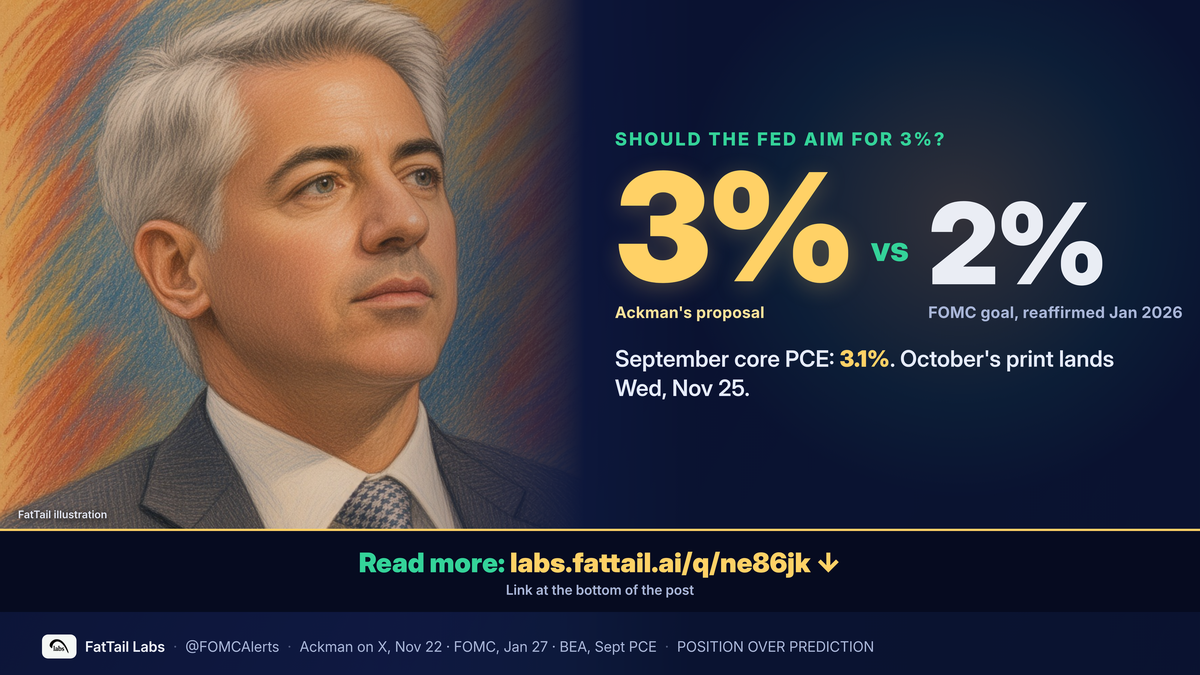
Bill Ackman, the CEO of Pershing Square Capital Management, used a Sunday evening post on X to argue that the Fed is aiming at the wrong number. The Ackman inflation target case is simple to state: he wants policymakers to treat 3% as the goal instead of 2%, and he thinks the Dec. 9 decision is shaping up as an error. Ackman is not an FOMC member and has no vote. What follows is his argument, set against the Fed’s own record and the latest data, not a forecast of what the Committee will do.
Ackman inflation target: what he posted Sunday
In the post, published Sunday, Nov. 22, at 5:21 p.m. ET, Ackman wrote that he believes the Fed is about to make “another mistake on December 9th.” His reasoning, in our paraphrase: higher military spending, deglobalization and tariffs, and the heavy investment in AI infrastructure and the energy behind it are features of a world that did not exist when the 2% figure was chosen. In that world, he argued, “3% inflation is a more realistic ambition in the new world.” He added that continuing to raise rates in pursuit of 2% risks recession in the U.S. and abroad. That is his forecast, not ours.
He also pointed to borrowing costs. He cited an 8.259% yield on recent secured financing tied to SpaceX versus sub-6% pricing on its unsecured bonds at the time of its IPO. The public deal terms support part of that comparison. The 8.259% matches the senior secured Class A-3 notes of Saturn Funding Trust, according to IFR deal reporting: a vehicle that buys GPUs and leases them to SpaceX, priced Nov. 20 as part of a roughly $44 billion package announced by Apollo and Goldman Sachs. It is not a conventional SpaceX corporate bond. SpaceX’s own June 23 release covered a $25 billion senior unsecured deal. On the pricing term sheet, the 2031, 2033 and 2036 notes yielded under 6%, while the 2046 and 2056 notes priced above it.
Advertisement · From FatTail Labs

Observer: train with Coach for $17/week
A six-week trial and training program built to install pro trading habits: live daily coaching, courses, a Discord trade room and the full FatTail platform.
What the Fed has actually committed to
The 2% goal is older and more settled than a single post. The FOMC first put a 2% longer-run goal for PCE inflation in writing in January 2012. The 2020 framework review added an averaging approach but kept the 2% anchor. In August 2025, the Committee unanimously reaffirmed 2% in a new consensus statement, and its press release said the 2% goal itself was not what that review set out to examine. On Jan. 27, 2026, the Committee reaffirmed the same statement word for word. A 3% goal is Ackman’s proposal. Nothing in the official record puts it on the table.
The data explain why the argument gets attention. Official BEA figures put September PCE inflation at 3.6% headline and 3.1% core (see our September PCE breakdown). The Cleveland Fed nowcast, updated Nov. 24, has October at 3.81% headline and 3.21% core year over year. That is a model estimate, not a print. The official October report lands Wednesday, Nov. 25, at 8:30 a.m. ET. Core inflation running near 3% is arithmetic. It does not mean the target should move, and the Committee’s reaffirmed statement still names 2%.
Where the Dec. 9 decision stands
The Fed raised rates by a quarter point on Sept. 16 and held on Oct. 28, with two dissents in favor of another hike, leaving the target range at 3.75% to 4.00%. The October minutes noted that a couple of participants saw a move larger than 25 basis points as worth considering at the next meeting if inflation data disappointed. Our rate-hike history has the longer arc.
On our RateWatch fed funds futures math, as of 1:36 p.m. ET on Tuesday, Nov. 24, the Dec. 9 distribution showed +25 bp at 98.71% and +50 bp at 1.29%, with no hold path. For Jan. 27, it showed +25 bp at 66.59% and a hold at 33.41%. These are market-implied odds, not a Fed signal, and they move with every print. Nothing here suggests the odds moved because of Ackman’s post. Check the FOMC schedule for the Dec. 8-9 meeting timing.
What it means for 0DTE
- Energy: This is commentary, not policy. A loud public argument about the target can color the conversation, but the scheduled event risk this week is Wednesday’s PCE report, and after that the Dec. 9 statement and press conference.
- Premium: Volatility has been swinging hard. The S&P 500 closed at 7,237.17 on Monday, Nov. 23, up 4.73% after Friday’s 3.70% drop. The VIX closed at 26.62 and the VIX1D at 26.69 (Massive, Nov. 23 closes). Let the VIX price the PCE morning rather than guessing the print.
- Structure: Our FOMC-day history (2015 through October 2026) shows a median S&P 500 move of 0.84% on hike days versus 0.47% on hold days, with wider intraday ranges. Those are base rates, not a forecast. Use defined-risk structures and know max loss before entry.
- Plan, don’t predict: Map two PCE mornings, one where core lands near the 3.21% nowcast and one that surprises, and size so either one is survivable. Whether Ackman is right about 3% is not a trade.
Related reading: FOMC Alerts · RateWatch: December Fed decision · September PCE inflation 2026 · Inflation drivers and Fed hikes
Sources
- Bill Ackman post on the Fed, the 2% target and Dec. 9 (X (@BillAckman), Nov 22, 2026)
- Federal Reserve issues FOMC statement of longer-run goals and policy strategy (Federal Reserve, Jan 25, 2012)
- FOMC announces revisions to its Statement on Longer-Run Goals and Monetary Policy Strategy (Federal Reserve, Aug 22, 2025)
- FOMC reaffirms its Statement on Longer-Run Goals and Monetary Policy Strategy (Federal Reserve, Jan 28, 2026)
- Minutes of the Federal Open Market Committee, October 27-28, 2026 (Federal Reserve, Nov 18, 2026)
- Personal Income and Outlays, September 2026 (BEA, 2026)
- Inflation Nowcasting (Federal Reserve Bank of Cleveland, Nov 24, 2026)
- SpaceX Announces Pricing of $25 Billion Inaugural Bond Issuance (SpaceX, Jun 23, 2026)
- Apollo and Goldman Sachs Announce Pricing of $44 Billion (Apollo, Nov 20, 2026)
- Yield trumps tech jitters as Apollo prices divisive SpaceX chip financing (IFR, Nov 20–21, 2026)
Trade it with structure
Observer is a six-week trial and training program: train with Coach for $17/week. You get everything a full coaching member gets, every week, and the six weeks are designed to install pro trading habits: courses on strategy, process and risk management, live daily coaching, a Discord trade room with hundreds of experienced traders, and the platform (heatmap, GEX tools, risk graph, position analyzer and journal). Start Observer.
Educational content, not investment advice. Options involve risk and are not suitable for all investors.
FATTAIL BRIEFINGS
Get FatTail briefings in your inbox
Pick the lists you want. FOMC Alerts is selected by default.