


FOMC Alerts · November 24, 2026
Section 301 tariffs are back on the calendar, and they are not alone. In a long post on X on Monday, Nov. 23, KPMG chief economist Diane Swonk argued that another tariff wave is building and that it could put upward pressure back on prices. We checked her dates against the official record. Three are real, but they are three different legal instruments, and none of them decides the Fed’s Dec. 9 call on its own.
Section 301 tariffs: three dates, three instruments
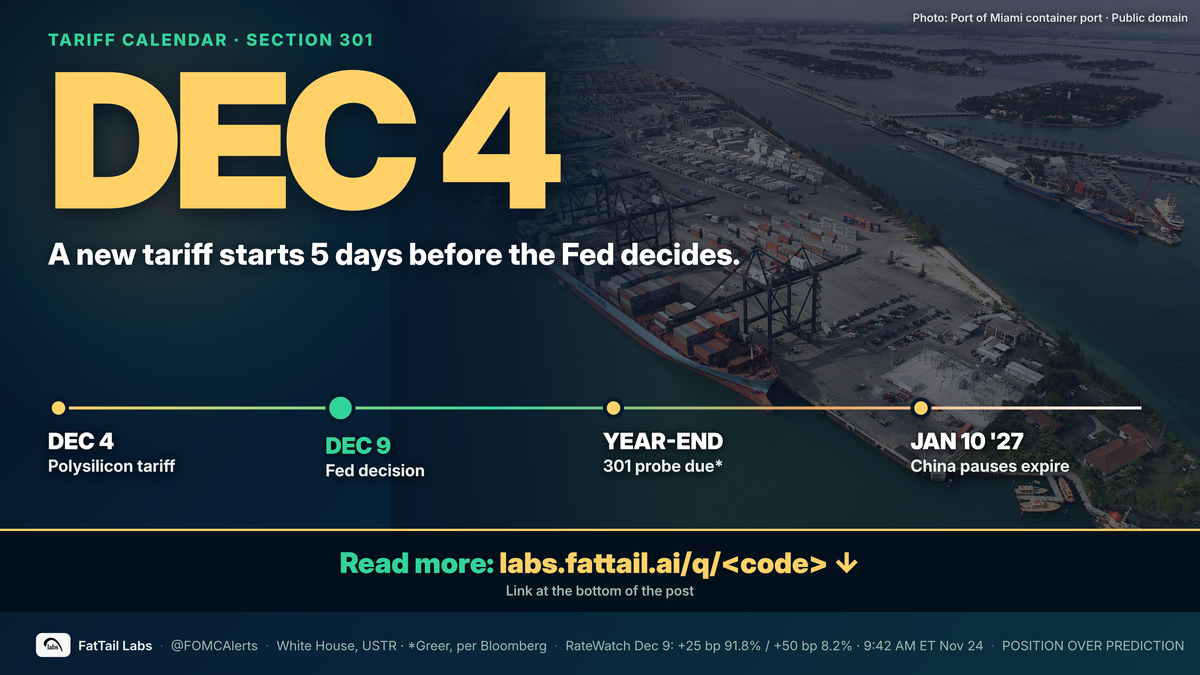
Dec. 4: polysilicon, under Section 232. A presidential proclamation signed Aug. 6 takes effect at 12:01 a.m. ET on Friday, Dec. 4, five days before the FOMC decision. It sets minimum import prices ($21/kg for polysilicon, $100/kg for ingots and wafers, $0.22/W for solar cells, $0.38/W for modules) and adds a separate 15% ad valorem duty on covered polysilicon ingots and derivatives, with country-specific caps. The proclamation mentions artificial intelligence as one use for the material, but its official subject is polysilicon. It is not titled an “AI-infrastructure tariff,” and we don’t call it one.
Year-end: the Section 301 excess-capacity probe. On March 11, USTR opened Section 301 investigations into structural excess capacity in manufacturing across 16 economies: China, the European Union, Singapore, Switzerland, Norway, Indonesia, Malaysia, Cambodia, Thailand, Korea, Vietnam, Taiwan, Bangladesh, Mexico, Japan and India. U.S. Trade Representative Jamieson Greer said in a Nov. 20 interview that the work would conclude by year-end, according to Bloomberg. That is interview reporting, not a legal deadline. USTR’s own enforcement report describes a 12-month clock for this type of investigation, which from March 11 runs to March 11, 2027.
Jan. 10, 2027: specific China pauses. November notices extended 178 Section 301 product exclusions and further suspended the maritime and shipbuilding Section 301 action, both until Jan. 10, 2027. China said on Nov. 9 that it would keep its 24% additional tariff on U.S. goods suspended for two more months, with a 10% additional tariff staying in place. These are narrow extensions. Jan. 10 is not the end of all China tariffs.
How the tariff lanes got here
On Feb. 20, the Supreme Court held in Learning Resources, Inc. v. Trump that the emergency-powers law (IEEPA) does not authorize the President to impose tariffs. The same day, a separate proclamation used Section 122 of the Trade Act of 1974 to impose a temporary 10% import surcharge from Feb. 24 to July 24, the 150-day limit, with exceptions that included certain electronics and USMCA-compliant goods from Canada and Mexico. Swonk’s summary of the shift is compact: “Tariffs didn’t disappear. They changed legal lanes.” Her argument is that Sections 232 and 301 are now where the rate increases come from.
Advertisement · From FatTail Labs

Observer: train with Coach for $17/week
A six-week trial and training program built to install pro trading habits: live daily coaching, courses, a Discord trade room and the full FatTail platform.
Import prices: what BLS actually called a record
Swonk also wrote that import prices rose at a record monthly pace in October. The official numbers are narrower. In the BLS October release (Nov. 17), all import prices rose 1.1%, the same as September and below April’s 2.3%. The record was in capital goods: up 1.5%, the largest monthly gain since that index began in December 1988, led by computers, peripherals and semiconductors. Prices of imports from China rose 1.4%, the largest monthly gain since that series began in 2004. She is right on one detail: the BLS index measures prices before tariffs are applied.
Where the Fed sits before Dec. 9
Fed officials have flagged this mix before. In a Sept. 3 speech, Governor Christopher Waller pointed to pressure on technology goods prices from the AI buildout alongside the possibility of more tariff increases. On Nov. 10, Philadelphia Fed President Anna Paulson said tariff effects looked to be fading, while energy supply and AI demand pressures were harder to call. Swonk’s view is that persistence is what matters: “Shocks are less look-through events the more they persist.” That is her read, not a Fed forecast.
The next official inflation print is October PCE, due Wednesday, Nov. 25, at 8:30 a.m. ET. The FOMC blackout runs from Saturday, Nov. 28, through Thursday, Dec. 10. The policy range is 3.75–4.00%. Our September PCE breakdown covers the last print. October CPI and October PPI are already on the tape. For what rate hikes can and cannot reach in a tariff-driven price rise, see Inflation Drivers 2026.
House RateWatch (our ZQ futures method), as of 9:42 AM ET on Tuesday, Nov. 24: Dec. 9 shows a +25 bp hike at 91.82% and +50 bp at 8.18%. For Jan. 27, the meeting-level split is +25 bp at 66.59% and hold at 33.41%; cumulative by Jan. 27, two hikes (+50 bp total) stand at 63.88% and one hike (+25 bp total) at 30.67%. For March 17, it is +25 bp at 52.10% and hold at 47.90%; cumulative by March 17: 1 hike (+25 bp total) at 14.69%, 2 hikes (+50 bp total) at 46.58%, 3 hikes (+75 bp total) at 35.89%. These are levels at one timestamp. They are not a reaction to Swonk’s post or to any tariff date. Live odds are on RateWatch.
What it means for 0DTE
- Energy: These are scheduled trade-policy dates, not data surprises. Dec. 4 is fixed. Year-end is an interview timeline. Jan. 10, 2027 is a renewal date. Treat each one as calendar risk to plan around, not a signal.
- Premium: The VIX was 26.62 and the VIX1D 26.69 at about 4:15 PM ET on Nov. 23, after a session in which the S&P 500 rebounded to 7,237.17 (4:05 PM ET tape) from Friday’s 6,910.39 close. That rebound came before this story, and we don’t tie the two together. The official 10-year Treasury yield was 4.92% on Nov. 23.
- Structure: Wednesday’s PCE and the Dec. 9 decision come first. Size for gaps around those events, and keep the maximum loss known before entry.
- Plan, don’t predict: Map the dates. A Section 301 recommendation before year-end and a Jan. 10 renewal are two different scenarios. Plan both rather than betting on one.
Related reading: FOMC Alerts · 2026 FOMC Meeting Schedule · Fed December Rate Hike Odds: Why RateWatch · PCE Inflation September 2026: Print, Gap and Dec Odds · Inflation Drivers 2026: What Fed Hikes Can Reach
Sources
- Long-form post on tariffs and the Fed (Diane Swonk (@DianeSwonk), X, Nov 23, 2026)
- Adjusting Imports of Polysilicon and its Derivatives into the United States (The White House, Aug 6, 2026)
- USTR Initiates Section 301 Investigations Relating to Structural Excess Capacity and Production (USTR, Mar 11, 2026)
- Initiation of Section 301 Investigations (91 FR 12886) (Federal Register, Mar 17, 2026)
- 2026 Trade Enforcement Priorities Report (USTR, 2026)
- Greer Sees US Trade Probe 'Certainly' Concluding by Year-End (Bloomberg Law, Nov 20, 2026)
- Notice of Product Exclusion Extensions (China Section 301) (Federal Register / USTR, Nov 10, 2026)
- Further Suspension of the Maritime, Logistics and Shipbuilding Section 301 Action (Federal Register / USTR, Nov 10, 2026)
- Customs Tariff Commission statement on additional tariffs on U.S. goods (State Council of the PRC (english.www.gov.cn), Nov 9, 2026)
- Learning Resources, Inc. v. Trump, No. 24-1287 (Supreme Court of the United States, Feb 20, 2026)
- Imposing a Temporary Import Surcharge to Address Fundamental International Payments Problems (The White House, Feb 20, 2026)
- U.S. Import and Export Price Indexes, October 2026 (Bureau of Labor Statistics, Nov 17, 2026)
- Speech by Governor Waller (Federal Reserve Board, Sep 3, 2026)
- 81st Annual Field Meeting capstone speech (Anna Paulson) (Federal Reserve Bank of Philadelphia, Nov 10, 2026)
- Daily Treasury Par Yield Curve Rates, 2026 (U.S. Department of the Treasury, Nov 23, 2026)
Trade it with structure
Observer is a six-week trial and training program: train with Coach for $17/week. You get everything a full coaching member gets, every week, and the six weeks are designed to install pro trading habits: courses on strategy, process and risk management, live daily coaching, a Discord trade room with hundreds of experienced traders, and the platform (heatmap, GEX tools, risk graph, position analyzer and journal). Start Observer.
Educational content, not investment advice. Options involve risk and are not suitable for all investors.
FATTAIL BRIEFINGS
Get FatTail briefings in your inbox
Pick the lists you want. FOMC Alerts is selected by default.