


Negative gamma exposure is the market condition that separates the session where everything works from the session where nothing does. When dealers are short gamma, their hedging amplifies every move. Price drops and dealers sell. Price rises and dealers buy — in the same direction, not against it. The feedback loop accelerates. Ranges break. Stops get run. Traders who do not understand this dynamic get caught on the wrong side of a move that should not have gone that far.
Most options education covers the Greeks as isolated variables — delta, gamma, theta, vega — without explaining how they aggregate into a market-wide force. Gamma exposure is that force. It is the sum of all dealer gamma across all strikes. When it is positive, dealers stabilize price. When it is negative, dealers destabilize it. This is the single most important variable for understanding why SPX behaves the way it does on any given session.
What Negative Gamma Exposure Actually Means
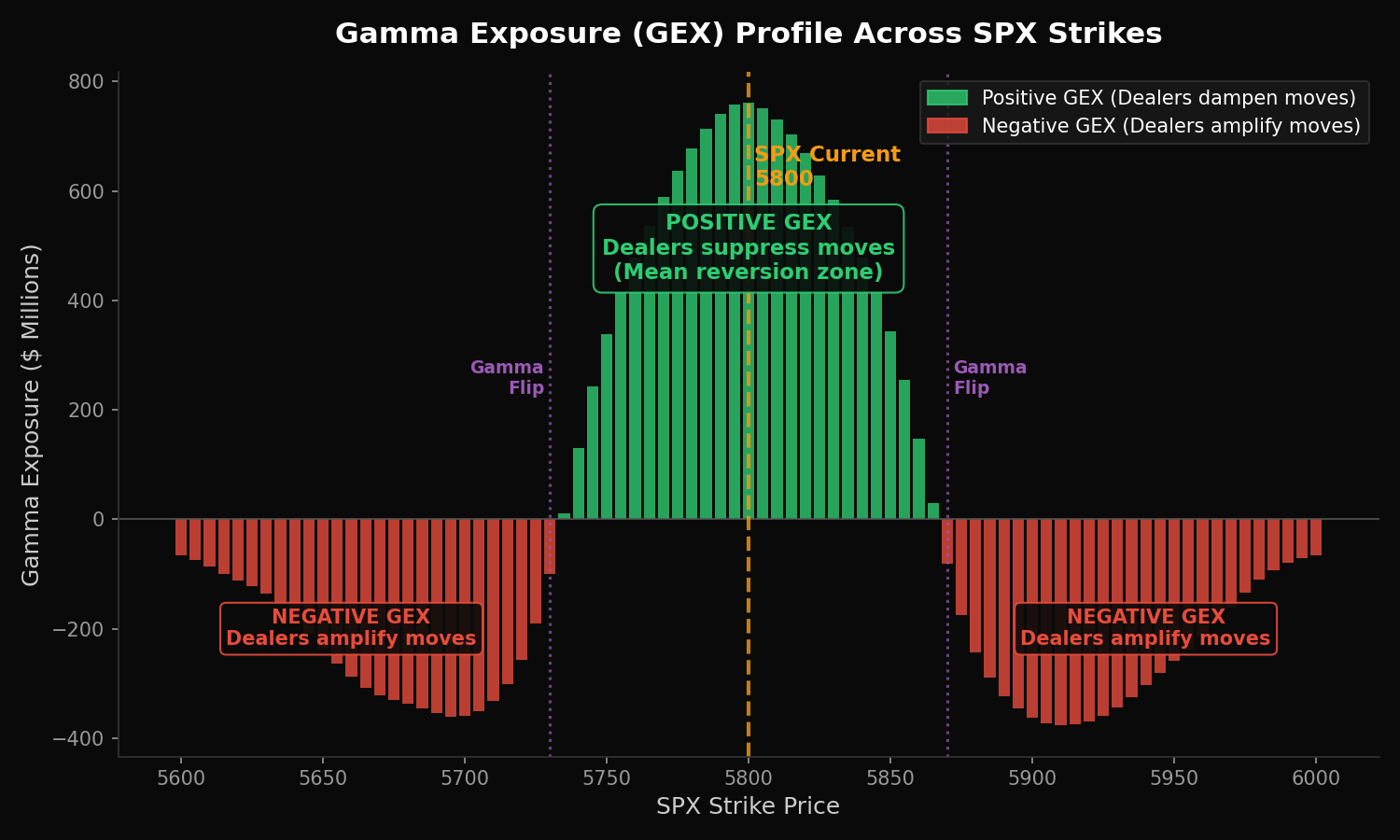
Negative gamma exposure means market makers are net short gamma. In practice, this happens when traders buy large quantities of puts — typically around market selloffs or before anticipated catalysts. Dealers who sold those puts are now short gamma. As a result, every move in the underlying forces them to hedge in the same direction as the move. Price drops. Dealers’ short put positions gain delta. To stay hedged, dealers must sell the underlying. Consequently, their selling pushes price lower — triggering more delta changes and more selling. The negative GEX regime creates a self-reinforcing cycle that amplifies volatility rather than dampening it. This is why some sessions see SPX drop 2% in an hour while other sessions with identical news barely move 0.3%. The news is not the variable. The gamma exposure landscape underneath the market is. Negative gamma exposure turns ordinary catalysts into outsized moves. The reverse also applies. In a short gamma environment, a rally forces dealers who sold calls to buy the underlying. Their buying pushes price higher. In other words, the feedback works in both directions — amplified moves, wider ranges, and violent reversals when positioning shifts.How Positive Gamma Exposure Differs
Positive gamma exposure is the opposite regime. Dealers are net long gamma — typically because traders have sold options that dealers now own. When price moves, dealers hedge against the move. Price rises and dealers sell. Price drops and dealers buy. In essence, their hedging creates a natural dampening effect that pulls price back toward equilibrium. In a positive GEX environment, ranges compress. Mean reversion dominates. Breakouts fail. The session feels orderly. This is where strategies like the butterfly spread and iron condor have their highest probability of success — because the structural landscape is actively suppressing directional moves. However, the difference between positive and negative gamma exposure is not subtle. It is the difference between a session that stays in a 20-point range and a session that moves 80 points in one direction. Same market. Same index. Completely different behavior driven by dealer positioning.
How to Identify the Current Regime
Reading the gamma exposure landscape requires data. You cannot guess it from a price chart. Three signals combine to reveal the regime. The GEX print. The aggregate gamma exposure across all strikes tells you whether dealers are net long or net short gamma. A positive print means dealers are hedging against moves — expect mean reversion. A negative print means dealers are hedging with moves — expect trend continuation and wider ranges. The VIX level. The VIX does not directly measure gamma exposure, but it correlates. A VIX above 20 often accompanies negative gamma environments because elevated fear drives put buying. A VIX below 15 typically reflects positive gamma with compressed ranges. In practice, the VIX confirms what the GEX data is telling you. The expected move. The options market prices an expected range for the session. In negative gamma environments, the actual move frequently exceeds the expected move because dealer hedging amplifies the initial impulse. In positive gamma environments, the actual move typically stays within the expected range. Comparing realized versus expected ranges over several sessions reveals the regime. These three inputs — GEX print, VIX level, expected move — form the structural read that determines how the session is likely to behave before it begins. The daily pre-market analysis in Observer ($17/week) delivers all three: GEX profile, VIX regime context, and expected move data before every session. Observer is a six-week trial and training program built to install pro trading habits: live daily coaching, courses, a Discord trade room and the full FatTail platform. Navigator ($267/month) provides daily direct coaching with Ernie. Compare all plans here.How to Trade Each Environment
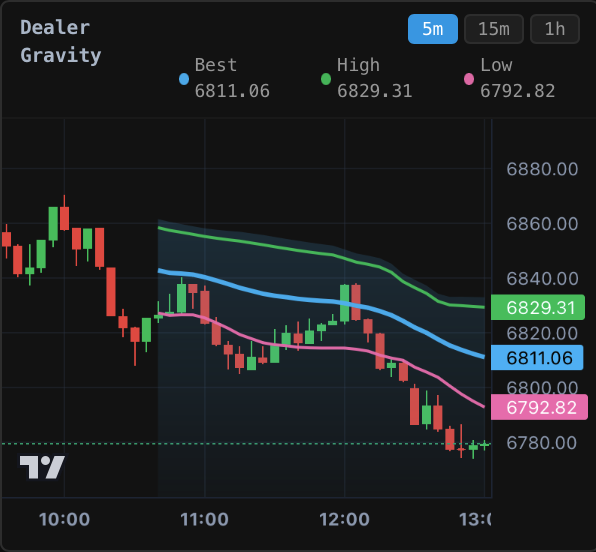
The strategy that works in positive gamma fails in negative gamma, and vice versa. This is why traders who use the same approach every session produce inconsistent results — they are ignoring the structural variable that determines which setups work. Trading in negative gamma: Respect the trend. Breakouts are real. Ranges expand. Selling premium is dangerous because the market structure supports sustained directional moves. Credit spreads and iron condors face their highest risk of maximum loss in this environment. The structural play is directional — order flow identifies the direction, and defined-risk directional spreads express the thesis. Trading in positive gamma: Fade the extremes. Breakouts fail. Ranges compress. Mean reversion dominates. This is where the butterfly spread thrives — dealer gravity levels create convergence targets that the GEX landscape reveals before the session. Place the butterfly at the structural target and let the dampening effect do the work. theta decay accelerates the position while gamma works in your favor near the target. For traders who use both approaches, the regime shift is the signal. When GEX flips from positive to negative — which often happens over a single session during a selloff — the entire playbook changes. The butterfly that worked yesterday becomes the wrong structure today. The directional spread that would have been stopped out in positive gamma becomes the correct play in negative gamma. Reading this shift in real time is what separates structural traders from everyone else. Ultimately, the strategy selection comes after the regime identification — not before. Most traders pick a strategy and hope the environment cooperates. Structural traders read the environment first and pick the strategy that fits.
Why Most Traders Ignore This
Most retail traders do not track gamma exposure. They cannot distinguish between a positive and negative gamma session. They sell premium on a negative gamma day and wonder why a 1% move turned into a 3% move. They buy breakouts on a positive gamma day and wonder why every breakout reverses. The information is not hidden. Dealer positioning data exists. The GEX framework translates that data into a readable landscape. But most options education focuses on strategy mechanics without addressing the market regime that determines whether those mechanics produce a profit or a loss. The structural gap extends beyond individual sessions. Traders who ignore gamma exposure often misattribute their results to skill or bad luck. A string of winning iron condors during positive gamma feels like mastery. Then a single negative gamma session erases weeks of gains — and the trader blames the market instead of recognizing the regime change they failed to see. After all, the gamma squeeze phenomenon that made headlines — where short squeezes and violent reversals caught billions off-guard — was negative gamma exposure at its extreme. The mechanics are identical. Only the scale differs. Every session where dealers are net short gamma carries a milder version of the same dynamic.The Bottom Line
Negative gamma exposure is not a rare event. It occurs regularly whenever put buying overwhelms call selling across the options chain. It happened dozens of times last year. It will happen dozens of times this year. The question is not whether you will encounter it — the question is whether you will recognize it before it costs you money. The difference between profitable and unprofitable options trading often comes down to this single variable. In positive gamma, target convergence. In negative gamma, respect the trend. Match the strategy to the regime. This is the structural approach — and it starts with reading the gamma exposure landscape before the session begins. That read starts with Observer ($17/week): daily GEX profiles, gravity levels, expected move, and VIX context. Observer is a six-week trial and training program built to install pro trading habits: live daily coaching, courses, a Discord trade room and the full FatTail platform. Navigator ($267/month) provides daily direct coaching with Ernie. Compare all plans here.
Frequently Asked Questions
What is negative gamma exposure?
Negative gamma exposure means market makers are net short gamma across the options chain. When price moves in any direction, dealers must hedge in the same direction — selling when price drops and buying when price rises. This creates a feedback loop that amplifies volatility and extends directional moves beyond what fundamentals alone would produce.How does positive gamma differ from negative gamma?
In positive gamma exposure, dealers hedge against price moves — dampening volatility and creating mean reversion. In negative gamma, dealers hedge with price moves — amplifying volatility and supporting trend continuation. Positive gamma produces tight ranges and orderly sessions. Negative gamma produces wide ranges and violent directional moves.How does negative GEX affect options prices?
A negative gamma environment typically coincides with rising implied volatility, which inflates option premiums across the chain. Put prices spike as the feedback loop drives the underlying lower. Theta decay still operates, but the volatility expansion overwhelms it — making premium selling strategies particularly risky.What strategies work in a negative gamma environment?
Respect the trend and avoid selling premium. Range-bound strategies like iron condors face their highest risk of maximum loss. Instead, use defined-risk directional spreads aligned with order flow. Keep position size small because amplified moves create rapid P&L swings.How often does the market enter negative gamma?
Negative gamma regimes occur regularly — especially around earnings season, FOMC announcements, and market selloffs when put buying surges. In a typical year, SPX spends roughly 20-30% of sessions in a negative gamma environment. The remaining sessions are positive or neutral, where dealer hedging dampens moves.FATTAIL BRIEFINGS
Get FatTail briefings in your inbox
Pick the lists you want. FOMC Alerts is selected by default.