


Gamma scalping is one of the most misrepresented concepts in options education. It gets taught as a strategy — buy options, hedge with the underlying, and profit from the difference between realized and implied volatility. The pitch makes it sound like a volatility arbitrage that anyone can run. In reality, gamma scalping is a market maker function that requires infrastructure, capital, and positioning data that retail traders do not have. Trying to replicate it from a retail account is like trying to run a bank from your kitchen table.
However, understanding how gamma scalping works is genuinely valuable — not because you should do it, but because it reveals how dealer positioning drives the market. Every time a market maker gamma scalps, they leave footprints in the price action. Reading those footprints is the structural edge that most traders miss entirely.
What Gamma Scalping Actually Is
Gamma scalping is the process of dynamically hedging a long gamma position by trading the underlying. A market maker who owns options — typically from buying what retail traders sold — is long gamma. As a result, when the underlying moves, the delta of their position changes. They sell the underlying when price rises and buy the underlying when price drops. Each round trip captures a small profit.
The math works like this. A dealer owns a straddle with a delta of zero. The stock rises $1. The straddle’s delta shifts to +0.05. The dealer sells 5 shares to flatten the delta. The stock drops $1. The delta shifts to -0.05. The dealer buys 5 shares. The round trip — sell high, buy low — captures a small gain. Over hundreds of these adjustments, the cumulative profit is the “gamma scalp.”
Of course, the catch is that the dealer paid for the options. The straddle cost money. The theta decay on that straddle erodes value every day. Consequently, the gamma scalping profits must exceed the theta decay cost for the strategy to be profitable. This only happens when realized volatility exceeds the implied volatility that was priced into the options at purchase.
This is the fundamental equation: gamma scalping is profitable when the market moves more than the options predicted it would. It loses money when the market moves less. In essence, it is a bet on realized volatility exceeding implied volatility — the opposite of selling premium.
How Market Makers Use Gamma Scalping
Market makers do not choose to gamma scalp. They are forced to. Their business is providing liquidity — buying options from sellers and selling options to buyers. As a result, they accumulate positions that carry gamma exposure. Hedging that exposure through gamma scalping is not a strategy. It is risk management.
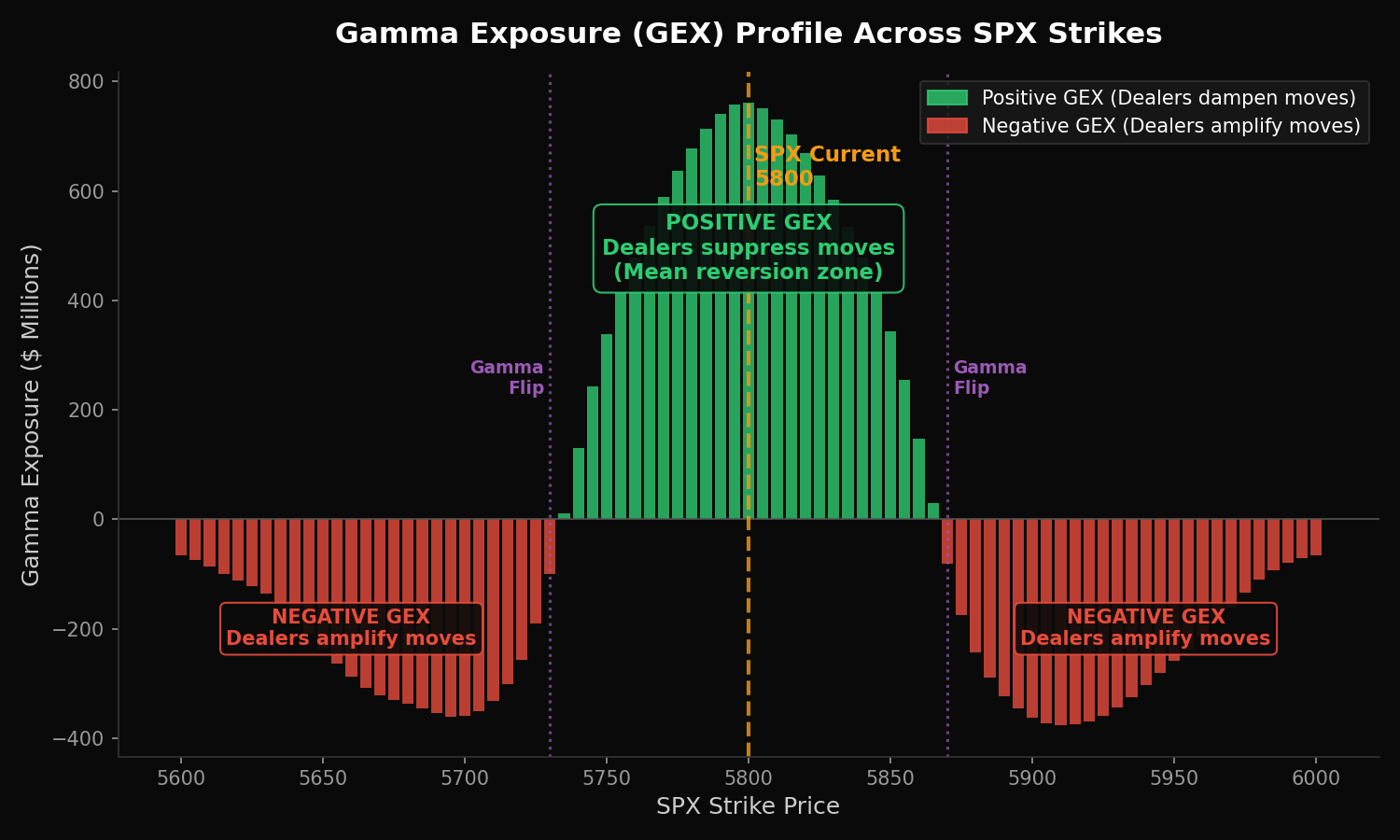
When dealers are net long gamma — meaning they own more options than they have sold — their hedging creates a dampening effect on price. They sell when price rises and buy when price drops. This is the positive GEX environment where ranges compress and mean reversion dominates. The gamma scalping activity itself is what creates the mean reversion.
When dealers are net short gamma — meaning they have sold more options than they own — the dynamic inverts. They must buy when price rises and sell when price drops, amplifying moves in both directions. This is the negative gamma environment where breakouts extend and ranges expand.
Importantly, the distinction matters because gamma scalping is not one behavior — it is two opposite behaviors depending on positioning. In positive gamma, dealer hedging stabilizes markets. In negative gamma, dealer hedging destabilizes them. Understanding which regime you are in tells you whether the market’s natural tendency is mean reversion or trend continuation.
Why Retail Gamma Scalping Fails
Despite this, the options education industry sells gamma scalping as a retail strategy. Buy a straddle. Hedge the delta. Collect the realized vol premium. It sounds systematic. It is also almost always unprofitable for retail traders.
Transaction costs destroy the edge. Gamma scalping requires frequent hedging — sometimes dozens of adjustments per day. Each adjustment incurs a commission, a spread cost, and slippage. Market makers pay fractions of a penny per share. Retail traders pay multiples of that. Moreover, the cumulative cost of hedging often exceeds the gamma profits, especially in moderate volatility environments.
Theta decay is relentless. The long gamma position bleeds theta every day. In a straddle that costs $10 per day in theta, you need $10 per day in gamma scalp profits just to break even. That requires the underlying to move significantly — more than the expected move implies. On most days, unfortunately, it does not.
Timing the hedges is subjective. When do you adjust? Every $0.50 move? Every $1 move? Every delta threshold? Market makers use sophisticated models and automated systems to optimize hedge timing. Retail traders guess — and the wrong timing either captures too little (hedging too infrequently) or costs too much (hedging too frequently).
You are competing against dealers. Market makers have superior execution, lower costs, better data, and automated hedging infrastructure. Attempting to gamma scalp as a retail trader is competing against professionals on their home field with inferior tools. Ultimately, the structural disadvantage is insurmountable.
What Gamma Scalping Reveals About the Market
In reality, the real value of understanding gamma scalping is not doing it — it is reading the market through the lens of dealer behavior. Every time dealers hedge their gamma exposure, they move the market. Naturally, tracking where they are positioned reveals where the market is likely to go.
GEX data quantifies this. The aggregate gamma exposure across all strikes tells you whether dealers are net long or net short gamma. Positive GEX means their gamma scalping dampens moves — expect tight ranges, failed breakouts, and mean reversion toward dealer gravity levels. Negative GEX means their hedging amplifies moves — expect wide ranges, real breakouts, and trend continuation.
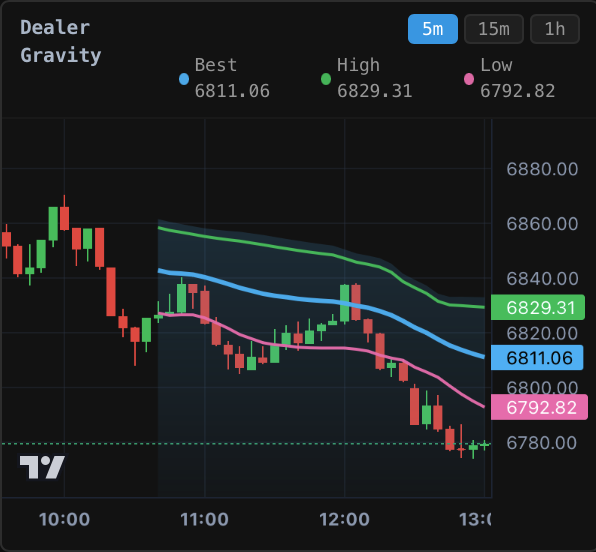
Dealer gravity levels become targets. In a positive gamma environment, the strikes where dealer gamma is concentrated act as magnets for price. Dealers who are gamma scalping at these levels create persistent buying on dips and selling on rallies. These levels — visible in the GEX profile — become convergence targets for structures like the butterfly spread.
The VIX confirms the regime. High VIX typically accompanies negative gamma environments where put buying has pushed dealers short gamma. Low VIX reflects positive gamma with compressed ranges. The combination of GEX data and VIX level gives you the full picture of whether dealer gamma scalping is stabilizing or destabilizing the session.
This is what structural traders actually use gamma scalping knowledge for — not to trade the strategy themselves, but to understand the market structure that drives every session.
The daily pre-market analysis in Observer ($17/week) delivers exactly this context — GEX profile, dealer gravity levels, VIX regime, and expected move — before every session. Activator ($97/month) adds real-time tools and weekly coaching. Navigator ($267/month) provides daily direct coaching with Ernie. Compare all plans here.
The Structural Alternative
Instead of gamma scalping, structural traders use the information that gamma scalping reveals. In fact, the approach is straightforward.
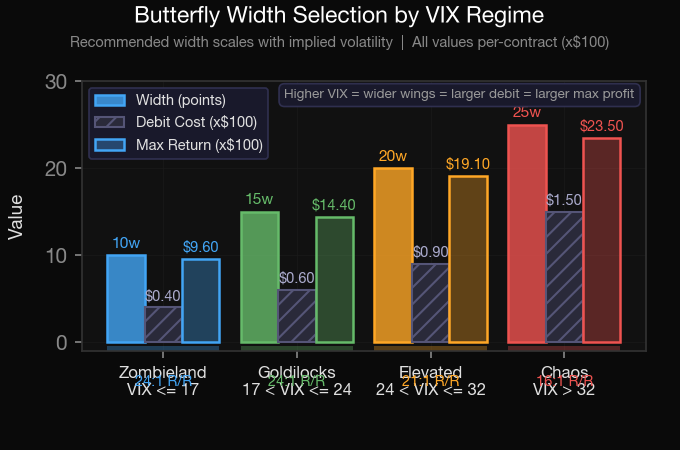
In positive GEX environments, dealer gamma scalping creates convergence. Place a butterfly at the dealer gravity level. Let the dampening effect — created by dealers hedging their long gamma — push price toward your target. Theta decay accelerates the position near expiration while the structural landscape supports convergence.
In negative GEX environments, dealer hedging amplifies moves. Credit spreads and iron condors face maximum risk. Instead, use directional structures aligned with order flow. Respect the trend that dealer hedging is reinforcing.
This is the structural approach — use the same gamma dynamics that market makers exploit, but express the view through defined-risk structures rather than trying to replicate the market maker hedging process itself.
The Bottom Line
Gamma scalping is a market maker function, not a retail strategy. Indeed, the infrastructure, capital, and execution advantages that make it viable for dealers are not available to individual traders. Attempting to replicate it produces losses from transaction costs, theta bleed, and suboptimal hedge timing.
The structural value of understanding gamma scalping is reading the market through dealer behavior. When you know that dealers are long gamma and actively scalping, you know the session favors mean reversion. When you know they are short gamma, you know the session favors trend continuation. This single variable — derived from GEX data — determines which strategies work and which fail on any given day.
That structural read starts with Observer ($17/week): daily GEX profiles, gravity levels, expected move, and VIX context. Activator ($97/month) adds real-time tools and weekly coaching. Navigator ($267/month) provides daily direct coaching with Ernie. Compare all plans here.
Frequently Asked Questions
What is gamma scalping?
Gamma scalping is the process of dynamically hedging a long gamma options position by trading the underlying. When price rises, the trader sells shares to flatten delta. When price drops, they buy shares. Each round trip captures a small profit. The strategy is profitable when realized volatility exceeds the implied volatility priced into the options.
Can retail traders gamma scalp profitably?
In practice, no. Gamma scalping requires frequent hedging that generates significant transaction costs. Retail traders pay higher commissions and wider spreads than market makers. Combined with relentless theta decay on the long gamma position, the cumulative costs typically exceed the scalping profits in all but the most volatile environments.
How does gamma scalping affect the market?
When dealers are long gamma and scalping, they sell when price rises and buy when price drops — dampening volatility and creating mean reversion. When dealers are short gamma, their hedging amplifies moves in both directions. The aggregate effect of gamma scalping across all market makers is the primary driver of whether a session trends or mean-reverts.
What is the difference between gamma scalping and selling premium?
They are opposite bets. Gamma scalping is long gamma — it profits when realized volatility exceeds implied volatility. Selling premium through credit spreads or iron condors is short gamma — it profits when realized volatility stays below implied volatility. Gamma scalping pays for theta and collects from movement. Premium selling collects theta and pays for movement.
How do you read gamma scalping activity in the market?
GEX data reveals the aggregate gamma exposure of dealers across all strikes. Positive GEX indicates dealers are long gamma and their scalping will dampen moves. Negative GEX indicates dealers are short gamma and their hedging will amplify moves. Combining GEX with VIX levels and the expected move gives the full structural picture.
FATTAIL BRIEFINGS
Get FatTail briefings in your inbox
Pick the lists you want. FOMC Alerts is selected by default.