


FOMC Alerts · November 25, 2026
October PCE 2026 is out. The Bureau of Economic Analysis says core PCE prices came in at +0.3% m/m and 3.3% y/y, at the top of the 3.2–3.3% range forecasters expected. Headline PCE was +0.3% m/m and 3.8% y/y. This was the last scheduled monthly PCE report before the Dec. 8–9 FOMC, and the bigger question it feeds is the one after December: the Jan. 27 meeting.
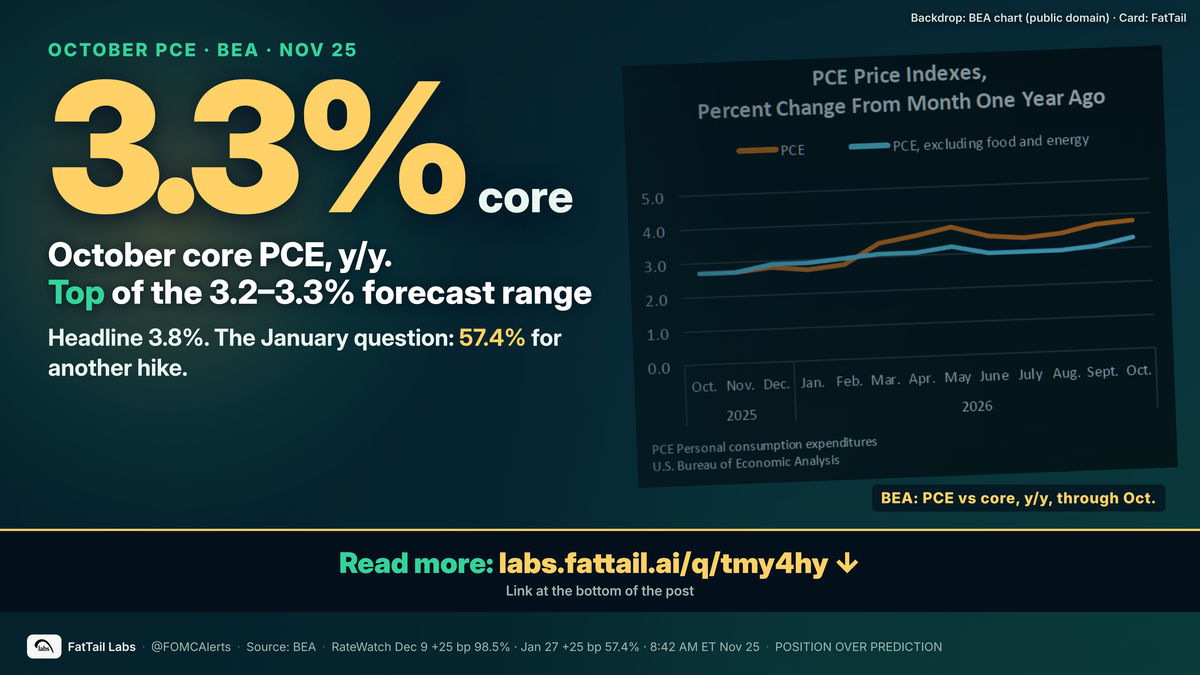
October PCE 2026: what BEA reported
From the BEA Personal Income and Outlays release for October 2026 (pulled 8:36 AM ET):
- PCE price index: +0.3% m/m, 3.8% y/y. September, as revised, was +0.5% and 3.7% (first reported at 3.6%).
- Core PCE, which leaves out food and energy: +0.3% m/m, 3.3% y/y. September was +0.3% and 3.1%.
- Personal income +0.7% m/m, consumer spending +0.3% m/m, saving rate 4.1%.
BEA’s historical comparison puts October core at its highest 12-month rate since November 2023, when it was 3.4%.
BEA put out the second estimate of third-quarter GDP in the same 8:30 a.m. slot. Real GDP grew at a 4.3% annual rate, compared with 3.4% in the advance estimate and a 3.6% median in the WSJ/Dow Jones survey (BEA). With two reports out in the same minute, this morning’s market reaction belongs to both of them, not to PCE alone. Our September PCE read has the prior month in detail.
One more input landed shortly before the release: the U.S. proposed new Section 301 tariffs on 14 trading partners, including China, the European Union, Japan and India, per CNBC. They are proposals for now, and nothing in October’s PCE data reflects them.
How the print compares with the forecasts
Going in, headline forecasts agreed on 3.8%. Core forecasts split. Every figure below is a forecast or a model estimate, not the official number:
- WSJ/Dow Jones survey (Nov. 20): 3.8% headline and 3.2% core y/y at the median, with +0.3% m/m for both.
- RBC Economics (Nov. 20): 3.8% headline and 3.3% core, each up 0.3% on the month.
- Cleveland Fed nowcast (page updated Nov. 20): 3.81% headline and 3.21% core y/y; 0.31% and 0.27% m/m.
- Governor Lisa Cook (Nov. 20 prepared remarks): cited estimates of 3.8% headline and 3.2% core for October, based on the previous week’s data.
October core at 3.3% landed at the high end of the 3.2–3.3% range, and headline at 3.8% matched the 3.8% consensus. Why the Fed targets PCE rather than CPI, and how the two differ, is covered in our October CPI 2026 breakdown and in BEA’s own FAQ.
Advertisement · From FatTail Labs

Observer: train with Coach for $17/week
A six-week trial and training program built to install pro trading habits: live daily coaching, courses, a Discord trade room and the full FatTail platform.
Fuel inside the core number
A Nov. 19 Dallas Fed staff note by Alexander Chudik, Lutz Kilian and Xiaoqing Zhou estimates that this year’s fuel price surge added 20 to 60 basis points to 12-month core PCE inflation as of September. Their estimates cover gasoline, diesel, jet fuel and natural gas. The authors call this kind of pass-through usually small and hard to pin down, but not negligible after this year’s swings. If fuel prices held at mid-October levels, they see that contribution shrinking by about 30 basis points by the end of 2027. This is staff research, not a Board or FOMC view. For the wider link between oil and rates, see what is driving inflation and Fed hikes.
What it means for Dec. 9 and Jan. 27
RateWatch, our fed funds (ZQ) futures method, before the print (8:06 AM ET, Nov. 25): Dec. 9 at +25 bp 97.5% and a hold 2.5%. For Jan. 27, 59.7% for another +25 bp and 40.3% for a hold.
After the release (as of 8:42:11 AM ET, Nov. 25): Dec. 9 at +25 bp 98.5% and a hold 1.5%. For Jan. 27, 57.4% for another +25 bp and 42.6% for a hold. Treat these as two snapshots, not a cause-and-effect read: GDP came out at the same time, and odds keep moving through the session.
The setup dates back to the Oct. 28 meeting. The Committee held the target range at 3.75–4.00%, with Cook and Beth Hammack dissenting in favor of a quarter-point hike. The minutes said almost all participants saw further tightening as likely appropriate under their baseline outlooks. A couple of participants went further, noting that “an increase of more than 25 basis points could warrant consideration at the next meeting if incoming inflation data were unfavorable.” The pre-meeting blackout runs Nov. 28 to Dec. 10 (FOMC schedule).
An in-line read. Hitting the forecast is not the same as cooling: headline and core PCE are both still more than a full point above the Fed’s 2% goal, which is set in terms of headline PCE, and almost all participants had already judged further tightening likely before this print. An in-line October leaves the January question open, so the next inflation and jobs reports matter more for Jan. 27.
What it means for 0DTE
- Energy: Scheduled event risk, printed before the cash open, with GDP alongside it. What’s left for the session is how December and January odds settle, not the 8:30 number itself.
- Premium: VIX 31.20 at 8:42 AM ET, up 4.84 from Tuesday’s 26.36 close (Massive). Our own sample of 21 PCE release days since January 2025 had a median SPX intraday range of 1.09%, compared with 0.87% on other days. The VIX fell on 13 of those 21 days. On the 12 days that also had a GDP release, the median range was 1.08% and the VIX fell on 8. That’s a short sample of base rates, not a forecast.
- Structure: Defined risk, max loss known before entry. Markets are closed Thursday for Thanksgiving and close at 1:00 PM ET Friday, so size for the holiday gap.
- Plan, don’t predict: Script a January-hike path and a January-hold path from RateWatch and let the session show which one gets priced. No direction call.
Related reading: FOMC Alerts · FOMC meeting schedule 2026 · Economic reports tracker · PCE Inflation September 2026 · October PPI 2026 · RateWatch: the December Fed decision
Sources
- Personal Income and Outlays, October 2026 (U.S. Bureau of Economic Analysis, Nov 25, 2026)
- GDP (Second Estimate) and Corporate Profits, 3rd Quarter 2026 (U.S. Bureau of Economic Analysis, Nov 25, 2026)
- Personal Income and Outlays, September 2026 (U.S. Bureau of Economic Analysis, Oct 29, 2026)
- PCE to confirm the inflation problem, labor pulse still strong (RBC Economics, Nov 20, 2026)
- GDP Revision and PCE Prices on Tap — Data Week Ahead (Dow Jones via MarketScreener, Nov 20, 2026)
- Inflation Nowcasting (Federal Reserve Bank of Cleveland, Nov 20, 2026)
- Speech by Governor Cook (prepared remarks) (Federal Reserve Board, Nov 20, 2026)
- Higher fuel prices seep into core inflation (Federal Reserve Bank of Dallas, Nov 19, 2026)
- Minutes of the Federal Open Market Committee, October 27-28, 2026 (Federal Reserve Board, Nov 2026)
- U.S. unveils new Section 301 tariffs targeting China, EU and others (CNBC, Nov 25, 2026)
Trade it with structure
Observer is a six-week trial and training program: train with Coach for $17/week. You get everything a full coaching member gets, every week, and the six weeks are designed to install pro trading habits: courses on strategy, process and risk management, live daily coaching, a Discord trade room with hundreds of experienced traders, and the platform (heatmap, GEX tools, risk graph, position analyzer and journal). Start Observer.
Educational content, not investment advice. Options involve risk and are not suitable for all investors.
FATTAIL BRIEFINGS
Get FatTail briefings in your inbox
Pick the lists you want. FOMC Alerts is selected by default.