


A trade alert can feel useful right up until the market does something the alert did not explain. Then you are left with the real question: Why was this position on, what invalidates it, and how much can it cost? Trader coaching should answer those questions before the order is placed. If it does not, it is not building a trader. It is building dependence.
For active SPX options traders, the issue is rarely a lack of market opinions. There are too many opinions. The problem is a lack of operating structure when volatility expands, price reverses, or a planned loss arrives. A coach cannot remove uncertainty from 0DTE trading. No one can. Good coaching teaches you to work inside uncertainty without exposing your account to ruin.
That is a different promise from signals, trade rooms, and high-conviction predictions. It is also more useful.
What Trader Coaching Should Actually Change
The first job of coaching is not to improve your ability to call direction. It is to improve the quality and repeatability of your decisions. That is how you build a repeatable process.
A self-directed trader needs a framework for choosing defined-risk structures, sizing them relative to account risk, managing them according to pre-set rules, and reviewing the result honestly. The individual trade matters, but the process matters more. One profitable trade can be careless. One planned loss can be excellent execution. That is process versus outcome trading.
This is where many traders get stuck. They judge every decision by whether it made money, then change the process after a small sample. That creates a cycle of overreaction: increasing size after a run of winners, abandoning a sound setup after two losses, or chasing a new strategy because someone online posted a spectacular result.
Coaching should interrupt that cycle. It should give you a way to distinguish a normal losing rep from a process failure. Those are not the same thing.
A planned loss that stays within the defined maximum is part of the design. Oversizing, moving a rule because you are uncomfortable, or entering a structure you cannot explain are process failures. Treating both as simply “losing” prevents you from finding the real problem.

Coaching Is Not a Better Signal Service
Signals outsource the most valuable part of trading: judgment. They may provide an entry, but they do not necessarily teach the positioning behind it, the risk logic, the reason for the structure, or the conditions that would make the idea wrong.
That gap becomes obvious when the market moves fast. If your plan is to wait for another person to tell you what to do, you do not have a plan. You have a dependency.
Useful coaching is different. It shows the work. It explains how market structure, volatility, dealer positioning, and time remaining influence the trade. It lets you watch decisions made in real market conditions, including decisions to pass. That is the value of live market coaching. Most importantly, it requires you to develop your own reasoning.
Not signals. Not alerts. Not copy trading. This is the heart of trade alerts versus self-direction.
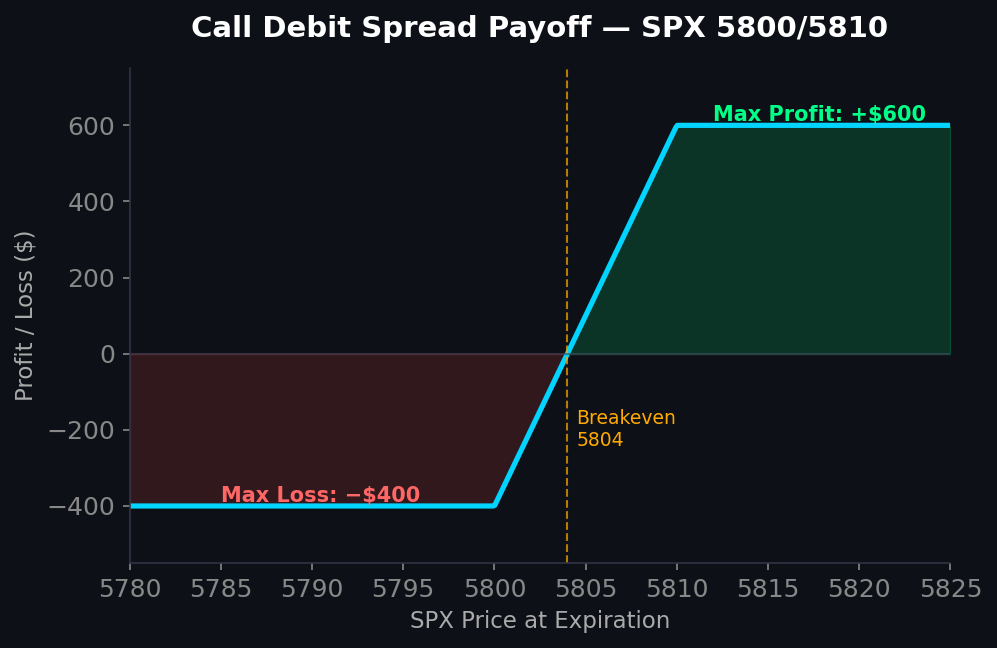
The goal is to become the person who can look at a risk graph and understand the trade you are considering. You should know where the defined loss is, what would need to happen for it to matter, and whether the size fits your rules. If you cannot articulate those points, the position is probably too complex or too large. The OCC’s options education is a solid independent foundation.
The Core Skills a 0DTE Trader Needs
0DTE SPX trading compresses time. The Cboe SPX specifications define those daily expirations. That does not mean it requires frantic decision-making. It means your preparation has to happen before the market becomes noisy.
Positioning Before Prediction
Markets do not owe you a clean directional move. A trader who needs to be right about up or down will often force trades when conditions are unclear. A structural approach begins elsewhere: Where is risk concentrated? What does the options positioning suggest about potential support, resistance, acceleration, or pinning behavior? What structure expresses the opportunity while keeping risk defined?
Positioning is not a crystal ball. It is context. It helps you form scenarios instead of predictions. The difference matters because scenarios include an exit plan.
A coach should help you build the habit of saying, “If this condition holds, this structure may make sense. If it fails, the risk remains limited and I reassess.” That is professional thinking. Certainty is not required.
Sizing That Lets You Stay in the Game
A well-constructed trade can still damage an account if it is oversized. This is one of the least glamorous parts of trading, and one of the most important.
Correct sizing starts with the maximum planned loss, not the potential payout. You decide what a normal loss means for your account and your ability to execute the next trade calmly. Then you choose contracts and structures that keep that loss within the boundary.
There is no universal position size. It depends on account size, trading frequency, your maximum daily loss rules, and the strategy’s expected loss profile. The correct size is often smaller than the size that feels exciting. That is not a flaw. Boredom is preferable to panic.
For smaller accounts and retirement accounts, access and trading permissions can vary. Verify the details with your broker and, where appropriate, your advisor. But the central principle does not change: a smaller account needs tighter risk discipline, not more aggressive risk-taking to compensate for its size.
Reviewing the Trade You Actually Took
Many traders review only their P&L. That is not enough information to improve.
A useful trade review records the setup, the market context, the structure chosen, planned risk, actual size, execution quality, adjustments if any, and whether the exit followed the rule. Over time, this gives you evidence. You can see whether losses cluster around a specific condition, whether you are entering too early, or whether your biggest problem is simply taking too much size.
The review must be specific enough to be uncomfortable. “Bad trade” teaches nothing. “Entered before confirmation, exceeded normal size, and exited outside the written rule” gives you something to fix.
At FatTail.ai, live trade review and purpose-built analytics are designed around that standard: turn activity into evidence, then turn evidence into better decisions. The point is not to make every day profitable. The point is to make your process visible.
What Productive Coaching Looks Like in Practice
The strongest coaching environments connect preparation, live observation, and review. Each part does a different job.
Before the session, you define the market conditions you are watching and the structures you are willing to consider. During the session, you observe how the framework holds up against live price action rather than a perfect chart drawn after the fact. Afterward, you review execution without rewriting history.
This rhythm matters because it replaces impulsive trading with a routine. You are not waking up and asking, “What is the trade today?” You are asking, “What does my framework allow today?”
Sometimes the answer is no trade. A coach who cannot teach restraint is teaching activity, not trading. Passing when the market does not offer your setup is a valid execution decision. It protects capital and protects your ability to recognize the next clear opportunity.
Questions to Ask Before Choosing a Trading Coach
Do not choose coaching based on a highlight reel. Ask what the program teaches when a trade loses, when volatility changes, or when the market does not fit the expected setup.
Look for clear answers about defined risk, position sizing, trade documentation, and decision-making under pressure. Ask whether the coach explains the reasoning behind structures or simply gives instructions. Ask whether you will be expected to build a repeatable process of your own.
Be cautious of anything built around certainty, urgency, or the idea that a high percentage of winners is the same as sound risk management. A strategy can show many small gains and still carry unacceptable tail risk. The question is not how often you win. The question is whether a normal losing sequence can permanently impair your account.
A coach should be willing to make that trade-off plain. Defined-risk trading may mean accepting losses that feel frustrating in the moment. In return, you know the boundary. You can plan for it, measure it, and survive it.
The Independence Test
The best test of trader coaching is simple: Are you more capable when the coach is not talking?
You should gradually need less reassurance, not more. You should be able to explain your setup, reject trades that do not meet the standard, size without emotion, and log what happened without excuses. You may still value a live room, experienced perspective, and accountability. Those are useful. But they should sharpen your judgment, not replace it.
The market will always produce days that challenge your assumptions. Meet them with a defined-risk framework, a small enough size to think clearly, and a review process that turns every result into useful data. That is how a trader stops chasing the next call and starts building something durable.
Frequently Asked Questions
What should trader coaching actually teach?
The quality and repeatability of your decisions, not better direction-calling. Good coaching gives you a framework for choosing defined-risk structures, sizing them to account risk, managing them by pre-set rules, and reviewing honestly, plus a way to tell a normal losing rep from a process failure.
How is coaching different from a signal service?
Signals outsource the most valuable part of trading: judgment. They may give an entry but not the positioning, risk logic, structure reasoning, or invalidation behind it. Coaching shows the work, explains how structure, volatility, positioning, and time affect a trade, and requires you to develop your own reasoning.
What skills does a 0DTE trader need from coaching?
Positioning before prediction (building scenarios with exits rather than forecasts), sizing from the maximum planned loss so you can stay in the game, and reviewing the trade you actually took, recording setup, context, structure, risk, size, execution, and whether the exit followed the rule.
How do you choose a trading coach?
Do not choose on a highlight reel. Ask what the program teaches when a trade loses, volatility changes, or the market does not fit the setup. Look for clear answers on defined risk, sizing, documentation, and decisions under pressure, and be cautious of anything built around certainty, urgency, or a high win rate.
How do you know if coaching is working?
The independence test: are you more capable when the coach is not talking? You should need less reassurance over time, be able to explain your setup, reject trades that miss the standard, size without emotion, and log results without excuses. Good coaching sharpens judgment rather than replacing it.
FATTAIL BRIEFINGS
Get FatTail briefings in your inbox
Pick the lists you want. FOMC Alerts is selected by default.