


FOMC Alerts · October 30, 2026
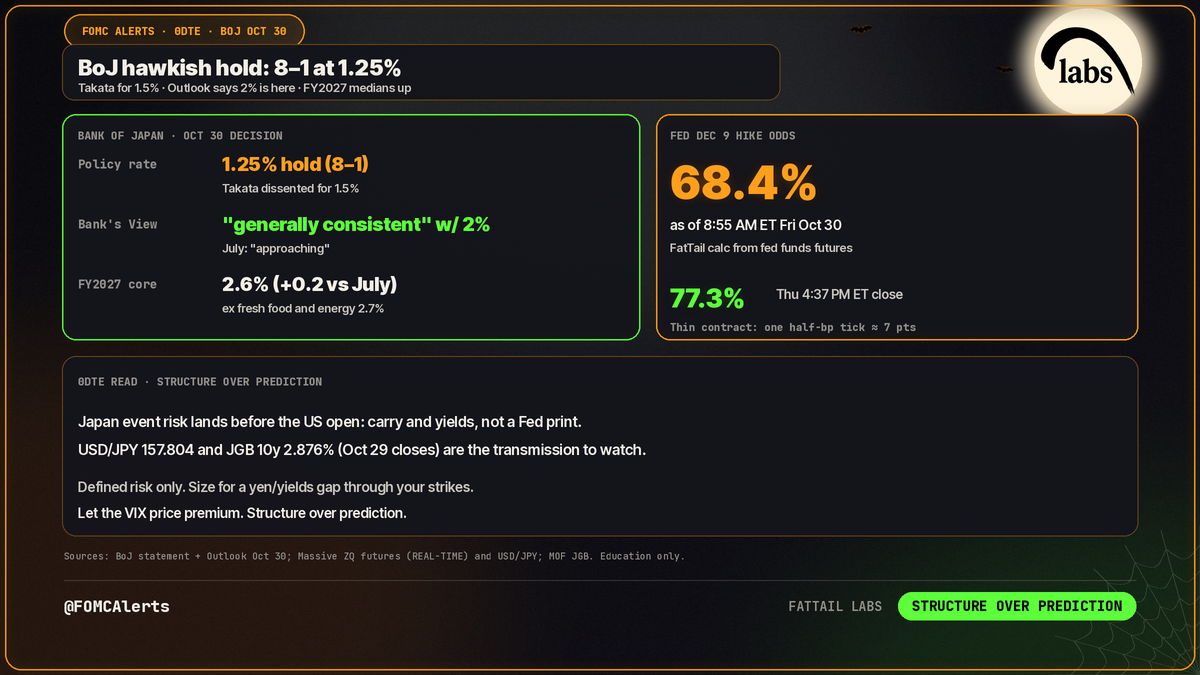
Bank of Japan rate decision October 2026: the Policy Board left the uncollateralized overnight call-rate guideline at around 1.25% by an 8–1 vote on Oct 30, with Takata Hajime dissenting for around 1.5% (Bank of Japan). The Outlook’s Bank’s View now says underlying CPI inflation is at a level that is generally consistent with the 2% target — July still said it had been approaching. That present-tense shift, raised FY2027 medians, and guidance that the Bank “will continue to raise” the policy rate are the hawkish hold into yen, JGBs and the Fed’s Dec 8–9 SEP meeting. Structure over prediction: classify the energy, let the VIX price premium, keep risk defined.
What did the Bank of Japan decide?
The Board set the overnight call-rate guideline at around 1.25%. Voting for the decision: Ueda, Himino, Uchida, Tamura, Koeda, Masu, Asada and Sato. Voting against: Takata, who proposed around 1.5% (BoJ statement).
The official Note on Takata’s dissent says that, with underlying CPI inflation having reached the price stability target, “the situation had shifted to a new phase in which the Bank needs to step up the pace of bringing the policy interest rate closer to the neutral interest rate so that it could make nimble responses.”
Separately and unanimously, the Board raised the pace of ETF sales to about 0.1% of market trading value, or about ¥860 billion per year in book value (from about ¥330 billion), effective January 2027 — secondary to the rate vote, but part of the same statement.
What changed from “approaching” to “generally consistent”?
The wording shift is the story. The October Bank’s View states: “Underlying CPI inflation is at a level that is generally consistent with the price stability target of 2 percent, and is expected to remain at around that level” (BoJ Outlook, Bank’s View).
July’s Outlook still used approaching language: “Given that underlying CPI inflation has been approaching 2 percent,” with guidance that the Bank would continue to raise the policy rate (BoJ Outlook, July 2026). October keeps the hiking guidance and hardens the inflation diagnosis into the present tense.
October guidance: given that underlying CPI inflation is at a level that is generally consistent with the 2% target and financial conditions have been accommodative, “the Bank will continue to raise the policy interest rate and adjust the degree of monetary accommodation.”
What did the Outlook do to FY2027 inflation forecasts?
Policy Board median forecasts (y/y %, changes vs July in parentheses), from the Outlook Report baseline:
| FY2026 | FY2027 | FY2028 | |
|---|---|---|---|
| CPI less fresh food | 2.5 (unch) | 2.6 (+0.2) | 2.0 (unch) |
| CPI less fresh food and energy | 2.4 (−0.1) | 2.7 (+0.1) | 2.3 (+0.1) |
Price risks are described as skewed to the upside — including the risk that underlying CPI will deviate upward above 2%. That is Board language, not a market forecast.
What is a BoJ policy decision and Outlook Report?
In plain terms: the Monetary Policy Meeting statement sets the uncollateralized overnight call-rate guideline by a majority vote of the nine-member Policy Board, and it can adjust balance-sheet operations (such as the ETF sales pace). The quarterly Outlook for Economic Activity and Prices publishes Board median forecasts and The Bank’s View on underlying inflation and policy guidance.
The Bank’s View releases with the statement. The full Outlook text follows at 2:00 p.m. Japan time the next business day on the BoJ’s schedule. “Underlying CPI inflation” is the Bank’s own concept (see the BoJ Review, March 2026) — related to, but not identical with, Tokyo or national CPI less fresh food, or less fresh food and energy.
For a broader map of how major central banks have moved this year, see our which central banks raised rates in 2026 scorecard.
Advertisement · From FatTail Labs

Observer: train with Coach for $17/week
A six-week trial and training program built to install pro trading habits: live daily coaching, courses, a Discord trade room and the full FatTail platform.
How can a hawkish BoJ hold inject energy into markets?
Hawkish BoJ guidance can tighten yen funding and pressure carry trades that borrow yen to buy higher-yielding assets. That channel shows up in USD/JPY, JGBs, global yields and — when the unwind is disorderly — US equity vol.
Our own calc on the Jul 31–Aug 5, 2024 window after a BoJ hike, using FRED daily closes: VIXCLS rose from 16.36 to 38.57 (+22.21 points); the S&P 500 fell from 5522.30 to 5186.33 (−6.08%); the 2-year Treasury yield fell 40 bp and the 10-year fell 31 bp. FRED DEXJPUS (yen per dollar) for that same window: 150.38 on Jul 31 to 143.95 on Aug 5 (yen stronger by roughly 4.3%). History is a map of channels, not a prediction that today repeats 2024.
As of Oct 29 (primary/our APIs): Massive daily USD/JPY close 157.804; MOF Japan 10-year JGB compound yield 2.876% (2y 1.901%, 5y 2.285%). US Treasuries (FRED, Oct 28): 2-year 4.67%, 10-year 5.05%. FRED VIXCLS 16.91 and SP500 7743.98 as of Oct 28.
What do Japan labor and Tokyo CPI show?
Same-day domestic backdrop, from primary sources: September seasonally adjusted unemployment was 2.4% (August 2.5%), employment 68.68 million (+340k), and participation 64.5% (+0.3 pp) per the Statistics Bureau Labour Force Survey. The jobs-to-applicants ratio was 1.19 (MHLW).
Tokyo mid-month October CPI (2025=100): headline 2.8% y/y; ex-fresh-food 2.6%; ex-fresh-food-and-energy 2.6% (Statistics Bureau kubu.pdf). Use these official prints; third-party wire summaries that put core-core at 2.4% are wrong against this PDF.
What does this mean for Fed December odds and SPX 0DTE?
The Fed held the funds target range at 3.75–4.00% on Oct 28 on a 10–2 vote (Cook and Hammack preferred +25 bp). Chair Warsh has led since May 22, 2026. Next FOMC is Dec 8–9 with a Summary of Economic Projections — see our December Fed meeting preview and the Oct 28 decision recap. Every date is on the next Fed meeting.
Fed December 9 hike odds — our calculation from fed funds futures using CME’s method — read 68.4% as of 8:55:19 AM ET Fri (hold 31.6%), down from 77.3% on Thursday’s 4:37 PM ET close (about 8.9 points; RateWatch log as_of 16:37:47 EDT, p_hike 0.7731). These reads can swing several points on a half-tick move in fed funds futures. Track the live path on RateWatch.
Japan tightening that lifts JGBs and global yields can firm the US rate backdrop into that SEP meeting. That is a channel, not a claim that the BoJ forces a Fed hike. For SPX 0DTE on a non-FOMC Friday, treat this as carry/global-vol energy into the Dec setup — not as an FOMC-day base rate. From our scheduled-FOMC history (2015–Oct 27, 2026): hold days median |SPX| move 0.47% / intraday range 1.09% (n=63); hike days 0.84% / 1.68% (n=21); SEP vs non-SEP range 1.20% vs 0.99%. Oct 28 hold: SPX +0.28% (FRED), VIXCLS 17.52→16.91.
- Energy: scheduled global-CB event risk into the US cash session (Asia already closed). Classify it as carry/yields transmission, not a domestic Fed print.
- Premium: let the VIX price the session; a Japan headline is not automatic license to pay up for premium.
- Structure: defined risk only; know max loss before entry; size for a yen/yields gap through your strikes.
- Plan, don’t predict: write two scenarios before the open — (1) wording fades and USD/JPY/JGBs mean-revert, (2) present-tense 2% + FY2027 lifts keep hike guidance live and firm global yields into Dec. Decide position rules in advance.
What comes after the Bank of Japan rate decision October 2026?
Ueda’s press conference transcript was not posted on boj.or.jp as of our overnight research window; we are not inventing presser quotes. The full Outlook text is due 2:00 p.m. Japan time the next business day. On the US side, watch Fed December odds on RateWatch, USD/JPY and JGB levels into the US session, and the path to Dec 8–9. Live desk updates sit on the FOMC Alerts hub.
Related reading: Which central banks raised rates in 2026 · December Fed meeting · Fed decision October 28, 2026 · Bank of Canada rate decision
Sources
- Statement on Monetary Policy (October 30, 2026) (Bank of Japan, 2026-10-30)
- Outlook Report baseline scenario / companion (October 2026) (Bank of Japan, 2026-10-30)
- Outlook for Economic Activity and Prices — The Bank's View (October 2026) (Bank of Japan, 2026-10-30)
- Outlook for Economic Activity and Prices — The Bank's View (July 2026) (Bank of Japan, 2026-07)
- Labour Force Survey (September 2026) (Statistics Bureau of Japan, 2026-09)
- Employment referrals / jobs-to-applicants (September 2026) (Ministry of Health, Labour and Welfare, 2026-09)
- Tokyo CPI mid-month (October 2026) kubu.pdf (Statistics Bureau of Japan, 2026-10)
- JGB compound yield CSV (Ministry of Finance Japan, 2026-10-29)
- USD/JPY daily aggregate C:USDJPY (Massive API) (Massive (derived), 2026-10-29)
- DGS2 / DGS10 / VIXCLS / SP500 (FRED, 2026-10-28)
- DEXJPUS — Japanese Yen to U.S. Dollar Spot Exchange Rate (FRED, 2024-07-31 / 2024-08-05)
- Federal Reserve press release — Oct 28, 2026 FOMC (Federal Reserve, 2026-10-28)
- Fed December 9 hike odds — FatTail RateWatch (our calculation from Massive real-time ZQ futures, CME method) (FatTail, 2026-10-30 8:55 AM ET)
- Which central banks raised rates in 2026 (FatTail, 2026-10-22)
Trade it with structure
Observer is a six-week trial and training program: train with Coach for $17/week. You get everything a full coaching member gets, every week, and the six weeks are designed to install pro trading habits: courses on strategy, process and risk management, live daily coaching, a Discord trade room with hundreds of experienced traders, and the platform (heatmap, GEX tools, risk graph, position analyzer and journal). Start Observer.
Educational content, not investment advice. Options involve risk and are not suitable for all investors.
FATTAIL BRIEFINGS
Get FatTail briefings in your inbox
Pick the lists you want. FOMC Alerts is selected by default.