


FOMC Alerts · November 25, 2026
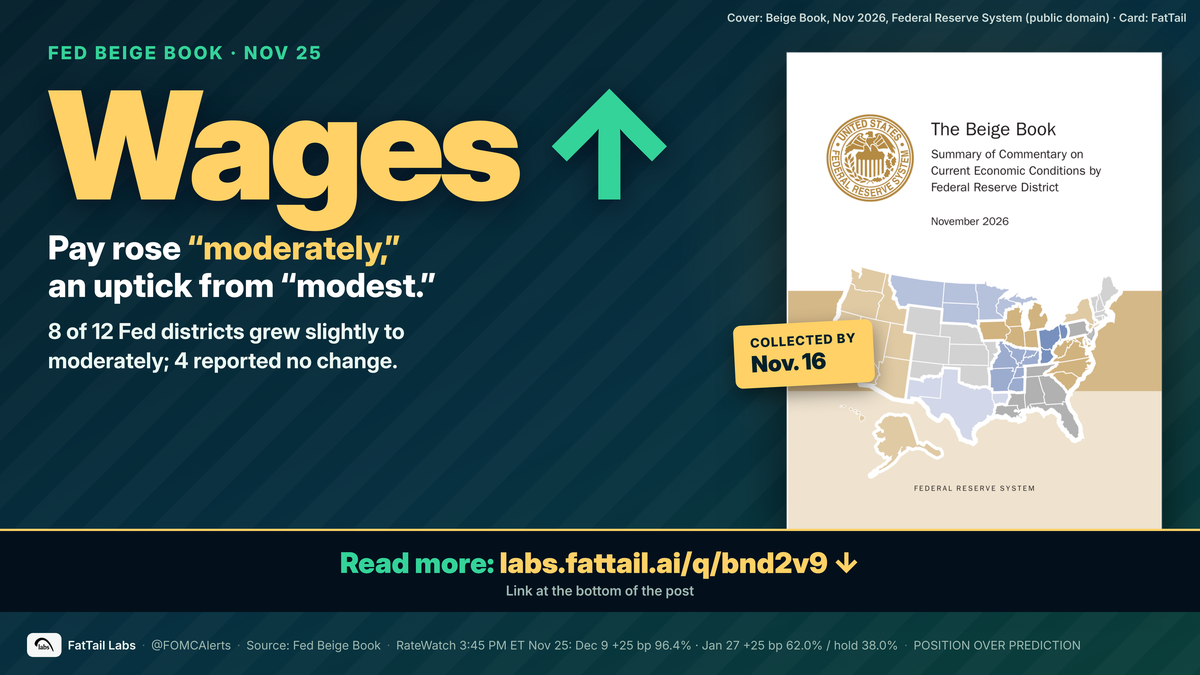
The Beige Book November 2026 edition, released by the Federal Reserve today, found growth in 8 of 12 districts, in the slight-to-moderate range, with four reporting no change. The line that stands out is on pay: wages and benefits rose moderately, which the report calls an uptick from modest gains last time. It’s the last Beige Book before the Dec. 8–9 FOMC meeting.
Timing caveat: the anecdotes were collected on or before Nov. 16, nine days before this morning’s PCE and GDP releases. The Beige Book doesn’t include today’s data and isn’t a reaction to it. It’s also, in the Fed’s words, not a commentary on Fed officials’ views.
Beige Book November 2026: the national picture
From the national summary, prepared at the Atlanta Fed:
- Activity: “Eight of the twelve Federal Reserve Districts reported growth in the slight to moderate range, while four Districts reported no change.” Boston, Chicago, Kansas City and San Francisco were the four with no change. Most districts expect slight to moderate growth ahead.
- Consumers: Spending was little changed. Households were described as price sensitive and more selective about discretionary purchases. Auto sales softened, with contacts pointing to high fuel prices and interest rates.
- Housing, building, factories, banks: Residential real estate weakened and construction declined. Manufacturing grew modestly overall. Loan demand was subdued.
- Jobs: Employment rose slightly on balance. Most firms held head counts steady and hired mainly to replace departures; skilled and technical roles stayed hard to fill.
- Wages: “Wages and benefits rose moderately, an uptick from modest increases in the previous report, driven by upward pressure concentrated in hard-to-fill positions and influenced by cost-of-living adjustments and increases in benefit costs.”
- Prices: Prices rose moderately overall, the same as last report. Energy, transportation, health care, insurance and tariff-related costs kept pressure on, though input costs generally outran selling prices because customers pushed back. Contacts expect both costs and prices to keep rising.
What changed since October
The October Beige Book (information through Oct. 5) had nine districts with some growth and three unchanged, so the count of growing districts slipped by one. That isn’t a simple slowdown story: Cleveland improved from modest to moderate, while Dallas slowed from moderate to modest and Boston went from slight growth to roughly flat.
On wages, October’s districts were mixed: five moderate, four modest and two slight. In November, Philadelphia, Minneapolis and Dallas all described faster wage growth. Prices were moderate nationally in both reports, but Cleveland and St. Louis still called price growth robust, and Dallas said it remained elevated.
A separate same-day survey: The Philadelphia Fed’s Price and Inflation Expectations Survey of Third District firms (fielded Nov 9–19, released today, not part of the Beige Book) showed expected compensation growth per employee at a trimmed-mean 4.3%, up from 3.4%, which the Bank called its highest level in three years. That sits beside the Beige Book’s Philadelphia line that wage inflation accelerated to a moderate pace. Philadelphia Fed PIES Q4 2026.
Advertisement · From FatTail Labs

Observer: train with Coach for $17/week
A six-week trial and training program built to install pro trading habits: live daily coaching, courses, a Discord trade room and the full FatTail platform.
District by district
| District | Activity | Employment and wages | Prices |
|---|---|---|---|
| Boston | Roughly unchanged | Employment ticked up; wages rose modestly | Rose modestly |
| New York | Increased slightly | Employment and wages grew modestly | Selling-price gains eased slightly but stayed moderate; input prices rose strongly |
| Philadelphia | Grew at a slight pace | Employment up modestly; wage inflation accelerated to moderate | Moderate |
| Cleveland | Increased moderately | Employment up modestly; wage pressures moderate | Selling prices grew robustly; nonlabor cost pressures robust for a 12th straight period |
| Richmond | Expanded moderately | Employment unchanged; wage growth moderate | Moderate |
| Atlanta | Grew modestly | Employment stable; wages rose moderately | Costs and prices rose moderately |
| Chicago | Unchanged | Employment up slightly; wages rose modestly | Rose moderately |
| St. Louis | Increased modestly | Employment unchanged; wage growth moderate | Rose at a robust pace; increases widespread |
| Minneapolis | Grew slightly | Employment up slightly; wage pressures moderate | Grew moderately |
| Kansas City | Little changed | Employment unchanged; wages rose moderately | Moderate increases strained affordability |
| Dallas | Slowed to a modest pace | Employment up modestly; wage growth accelerated | Price growth remained elevated |
| San Francisco | Changed little | Employment stable; wages rose slightly | Rose moderately |
Wording condensed from each district’s highlight in the November 2026 Beige Book.
Does it support a December hike?
We’re not making that call. Here’s how the pieces sit side by side:
- The anecdotes (through Nov. 16): slight-to-moderate growth in 8 of 12 districts, employment up slightly, a national wage uptick, and moderate prices with robust or elevated reads in three districts.
- The official data (after the cutoff): covered in October PCE 2026.
- The last decision: the FOMC held at 3.75–4.00% on Oct. 28, with Lisa D. Cook and Beth M. Hammack dissenting for a hike.
- The market’s path: RateWatch, our fed funds futures (ZQ) method, as of 3:45 p.m. ET, Nov. 25:
- Dec. 9: +25 bp 96.4%.
- Jan. 27: +25 bp 62.0% / hold 38.0%.
- By Jan. 27 (cumulative): +50 bp total 59.8% (4.25–4.50%) / +25 bp total 38.9% (4.00–4.25%).
- Mar. 17: +25 bp 55.8% / hold 44.2%.
- By Mar. 17 (cumulative): +50 bp total 48.1% (4.25–4.50%) / +75 bp total 33.3% (4.50–4.75%) / +25 bp total 17.9% (4.00–4.25%).
- Two-meeting sequences: Dec 9 +25 bp then Jan 27 +25 bp 59.8%; Dec 9 +25 bp then Jan 27 hold 36.6%.
These are market-implied probabilities, not forecasts, and we don’t read them as a response to the Beige Book. For the January setup, see January 2027 Fed hike odds; for the meeting calendar, December Fed meeting 2026.
What it means for 0DTE
- Energy: The Beige Book is qualitative and its anecdotes predate today’s data. It’s context for Dec. 9, not a scheduled number to trade.
- Premium: VIX 28.22 at 3:47 PM ET, versus Tuesday’s 26.36 close; SPX 7,175.74 (-0.35% vs. 7,201.09) at the same time (Massive). Timestamps only; we’re not assigning a cause.
- Structure: Defined risk, max loss known before entry. Markets are closed Thursday for Thanksgiving and close at 1:00 p.m. ET Friday.
- Plan, don’t predict: Keep a December-hike and a December-hold plan, and size for either. No direction call.
Related reading: October PCE 2026 · January 2027 Fed hike odds · December Fed meeting 2026
Sources
- Beige Book, November 2026: National Summary (Federal Reserve Board, Nov 25, 2026)
- Beige Book, November 2026 (PDF) (Federal Reserve System, Nov 25, 2026)
- Beige Book, October 2026: National Summary (Federal Reserve Board, Oct 14, 2026)
- Federal Reserve issues FOMC statement (Oct. 28, 2026) (Federal Reserve Board, Oct 28, 2026)
Trade it with structure
Observer is a six-week trial and training program: train with Coach for $17/week. You get everything a full coaching member gets, every week, and the six weeks are designed to install pro trading habits: courses on strategy, process and risk management, live daily coaching, a Discord trade room with hundreds of experienced traders, and the platform (heatmap, GEX tools, risk graph, position analyzer and journal). Start Observer.
Educational content, not investment advice. Options involve risk and are not suitable for all investors.
FATTAIL BRIEFINGS
Get FatTail briefings in your inbox
Pick the lists you want. FOMC Alerts is selected by default.