


FOMC Alerts · November 25, 2026
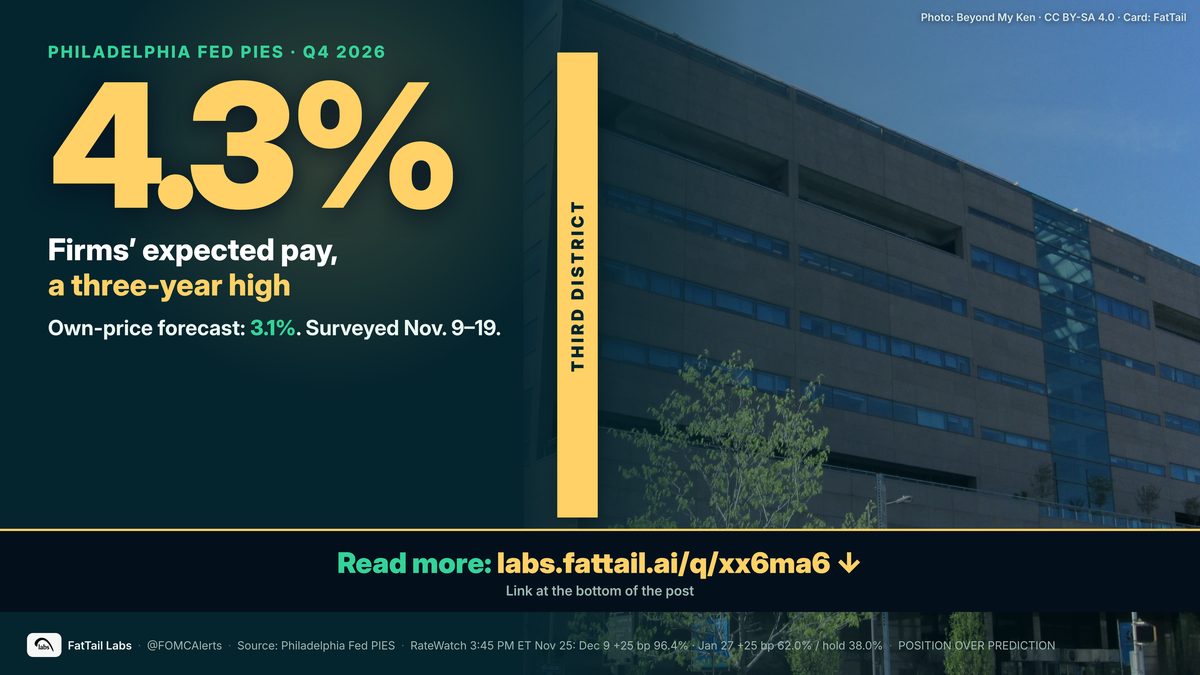
The Federal Reserve Bank of Philadelphia today published its Philadelphia Fed PIES report for 2026 Q4 — the Price and Inflation Expectations Survey of Third District firms, collected November 9–19. Firms now expect compensation costs per employee to rise 4.3% over the next four quarters, up from 3.4% in the third quarter. The Bank called that “its highest level in three years.” The official series ties the 4.3% reading in 2023 Q3 and is the highest since then; it is not the cycle peak of 5.8% in 2021 Q4 and 2022 Q3. The median is 4.0%, up from 3.5%.
Philadelphia Fed PIES: the Q4 2026 results
All-firms figures in the official table are 10 percent trimmed means unless they are labeled as a median. After values larger than 1,000 or smaller than −1,000 are dropped, the top 5 percent and bottom 5 percent of the combined manufacturing and nonmanufacturing sample are removed, then the mean and median of what remains are reported. Manufacturing and nonmanufacturing means are simple averages from that all-firms sample. The data are not seasonally adjusted. Sample size for this quarter is not published.
On their own selling prices over the next four quarters (Q4 2026 through Q4 2027), the trimmed-mean forecast is 3.1%, up from 2.4%. The median is 3.2%, up from 3.0%. Manufacturing firms came in at 3.6% (from 3.2%) and nonmanufacturing at 2.7% (from 1.8%). Over the past four quarters, firms said their own prices rose 3.4% (from 2.4%), above the 3.1% they expect ahead. The median for those past-year own-price changes is 3.1%, up from 2.0%.
For U.S. inflation over the next four quarters, both the trimmed mean and the median are 3.5%. The median is up from 3.0%; the trimmed mean is up from 3.4%.
On the 10-year question — the expected average annual change in U.S. consumer prices over 2026–2035 — start with the median. It rose to 3.5% after holding at 3.0% for three consecutive quarters (2026 Q1 through Q3). The trimmed mean is 8.9%, up from 7.3% (manufacturing 7.9% from 7.0%; nonmanufacturing 9.9% from 7.6%). That gap is wide even after trimming, so 8.9% should not be read as a typical firm’s long-run view.
| Measure | Q4 2026 trimmed mean | Q3 2026 trimmed mean | Q4 2026 median | Q3 2026 median |
|---|---|---|---|---|
| Own prices, next four quarters | 3.1% | 2.4% | 3.2% | 3.0% |
| Compensation per employee, next four quarters | 4.3% | 3.4% | 4.0% | 3.5% |
| Own prices, past four quarters | 3.4% | 2.4% | 3.1% | 2.0% |
| U.S. inflation, next four quarters | 3.5% | 3.4% | 3.5% | 3.0% |
| U.S. inflation, next 10 years (annual average) | 8.9% | 7.3% | 3.5% | 3.0% |
Source: Philadelphia Fed, PIES 2026 Q4 Report and the official PIES workbook. Trimmed means unless labeled median.
The Bank wrote: “Firms’ expected growth in compensation costs per employee rose from 3.4 percent to 4.3 percent this quarter, its highest level in three years.” On own prices, it said the firms’ mean forecast for the next four quarters was an increase of 3.1 percent, up from 2.4 percent last quarter. That “mean forecast” is the official 10 percent trimmed mean.
What PIES is, and what it is not
PIES is a quarterly survey that began in 2015 Q4. Five special questions are appended to the Philadelphia Fed’s monthly Manufacturing Business Outlook Survey and Nonmanufacturing Business Outlook Surveys in February, May, August and November. Respondents are CEOs, presidents and senior executives at manufacturing and nonmanufacturing firms in the Third District — Delaware, southern New Jersey, and eastern and central Pennsylvania. The panel is largely consistent, but participation is voluntary, so the respondent group can shift slightly. This wave was collected November 9–19, 2026. The next release is February 24, 2027.
Firms give point estimates for the expected change in their own selling prices over the next four quarters; expected compensation costs per employee (wages and benefits) over the next four quarters; expected U.S. consumer-price inflation over the next four quarters; the change in their own prices over the past four quarters; and the expected average annual U.S. consumer-price increase over the next 10 years. PIES is not a commentary on the views of Federal Reserve officials, and it is not a national survey.
It is also not a read-through of this morning’s official inflation and growth prints. The survey window closed November 19, before the November 25 8:30 a.m. ET data. For those prints, see our October PCE article and the January 2027 hike-odds path piece; this article does not retell them.
Advertisement · From FatTail Labs

Observer: train with Coach for $17/week
A six-week trial and training program built to install pro trading habits: live daily coaching, courses, a Discord trade room and the full FatTail platform.
How this sits next to the Beige Book and Cleveland SoFIE
The same-day November Beige Book — a qualitative report from all 12 districts, with anecdotes collected on or before November 16 — said wages and benefits rose moderately, an uptick from modest increases in the previous report. The Philadelphia district highlight said wage inflation accelerated to a moderate pace. PIES is the Third District’s quantitative counterpart, fielded November 9–19. Compare the two; don’t treat them as one instrument. (A FatTail Beige Book article is in the queue and is not linked here until it is live.)
The other firm-expectations print this quarter is the Cleveland Fed’s Survey of Firms’ Inflation Expectations (SoFIE). In 2026 Q4, that national, payroll-weighted panel, fielded in October, put 12-month CPI expectations at 3.5%, up from 3.3%, with a 5-year average of 3.3%, unchanged. PIES also prints a 3.5% near-term U.S. inflation figure (trimmed mean and median). The questions, geography, field dates and weighting differ, so the two 3.5% readings should not be described as the same survey “matching.” SoFIE’s five-year average (3.3%) is a different horizon from PIES’s 10-year median (3.5%) and should not be stacked as a single long-run number. A FatTail SoFIE article is not live; that comparison is from the research brief only.
Dec. 9 and Jan. 27: where RateWatch stands
This print lands two weeks before the Dec. 8–9 FOMC. Firm wage and price expectations are one input policymakers watch when they assess whether inflation is becoming embedded. That is context, not a forecast, and not a yes-or-no on December. For the market’s path into the meeting, RateWatch, our fed funds futures (ZQ) method, as of 3:45 p.m. ET, Nov. 25:
- Dec. 9: +25 bp 96.4%.
- Jan. 27: +25 bp 62.0% / hold 38.0%.
- By Jan. 27 (cumulative): +50 bp total 59.8% (4.25–4.50%) / +25 bp total 38.9% (4.00–4.25%).
- Mar. 17: +25 bp 55.8% / hold 44.2%.
- By Mar. 17 (cumulative): +50 bp total 48.1% (4.25–4.50%) / +75 bp total 33.3% (4.50–4.75%) / +25 bp total 17.9% (4.00–4.25%).
- Two-meeting sequences: Dec 9 +25 bp then Jan 27 +25 bp 59.8%; Dec 9 +25 bp then Jan 27 hold 36.6%.
These are market-implied probabilities, not forecasts. The last official decision was the Oct. 28 hold at 3.75–4.00%, with Lisa D. Cook and Beth M. Hammack dissenting for a quarter-point hike, per the Oct. 28 statement. The Sept. 16 meeting had raised the target by 25 basis points, with no dissents, per the Sept. 16 statement. Descriptive only. For the calendar, see the FOMC meeting schedule 2026 and our December Fed meeting 2026 · November Beige Book preview.
What it means for 0DTE
- Energy: PIES is a regional quarterly firm survey. This brief has no measured same-day market effect for the release, and we are not inventing one. It is context for the Dec. 8–9 meeting, not a same-day catalyst.
- Premium: VIX 28.00 at 3:52 PM ET, versus Tuesday’s 26.36 close; SPX 7,185.59 (-0.22% vs. 7,201.09) at the same time (Massive). Timestamps only; we are not assigning a cause, and we are not attributing the afternoon tape to PIES.
- Structure: Defined risk, max loss known before entry. Markets are closed Thursday for Thanksgiving and close at 1:00 p.m. ET Friday.
- Plan, don’t predict: Keep a January-hike plan and a January-hold plan. No direction call, and no claim that this survey decides December.
Related reading: FOMC Alerts · FOMC meeting schedule 2026 · Economic reports tracker · October PCE 2026 · January 2027 Fed hike odds · December Fed meeting 2026
Sources
- Price and Inflation Expectations Survey (PIES), 2026 Q4 Report (Federal Reserve Bank of Philadelphia, Nov 25, 2026)
- PIES 2026 Q4 Report (PDF) (Federal Reserve Bank of Philadelphia, Nov 25, 2026)
- PIES historical data workbook (Federal Reserve Bank of Philadelphia, Nov 25, 2026)
- Federal Reserve issues FOMC statement (Oct. 28, 2026) (Federal Reserve Board, Oct 28, 2026)
- Federal Reserve issues FOMC statement (Sept. 16, 2026) (Federal Reserve Board, Sept 16, 2026)
Trade it with structure
Observer is a six-week trial and training program: train with Coach for $17/week. You get everything a full coaching member gets, every week, and the six weeks are designed to install pro trading habits: courses on strategy, process and risk management, live daily coaching, a Discord trade room with hundreds of experienced traders, and the platform (heatmap, GEX tools, risk graph, position analyzer and journal). Start Observer.
Educational content, not investment advice. Options involve risk and are not suitable for all investors.
FATTAIL BRIEFINGS
Get FatTail briefings in your inbox
Pick the lists you want. FOMC Alerts is selected by default.