


FOMC Alerts · November 3, 2026
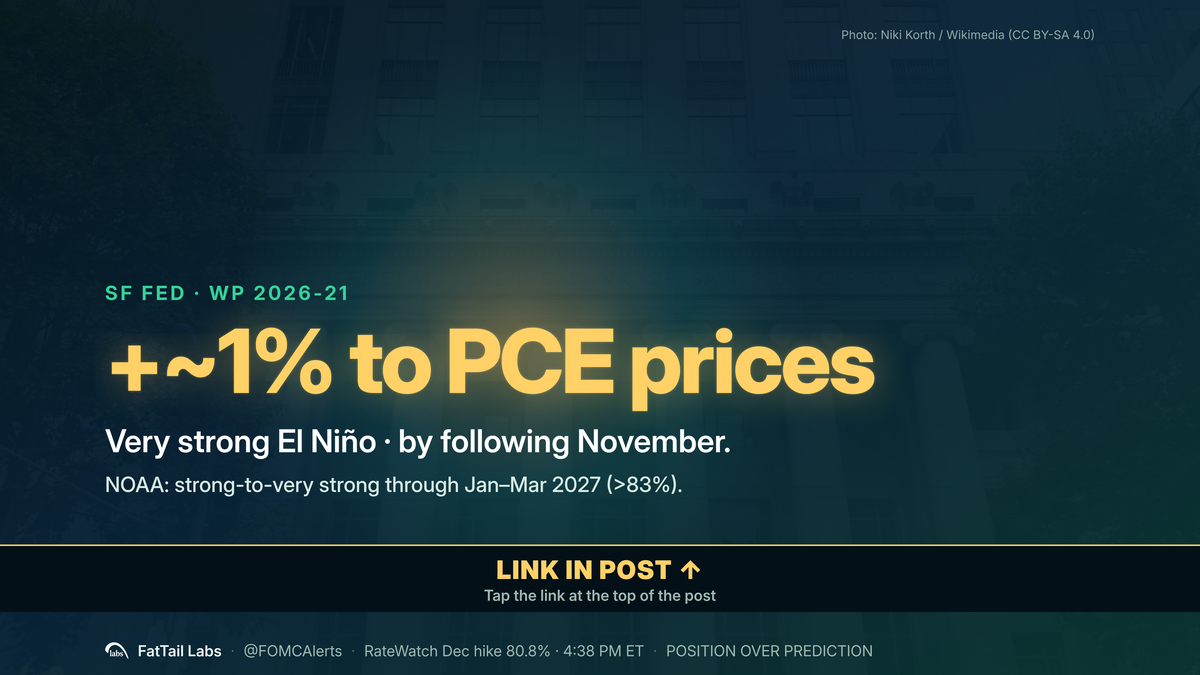
El Nino is a periodic warming of the eastern tropical Pacific that can shift global weather patterns and, through food and energy channels, US inflation. A San Francisco Fed working paper finds that El Niños pose material upside risk for US PCE prices and employment — with a typical very strong episode adding about 1% to the headline PCE price level by the end of the following November, driven by food and core services. The paper is FRBSF Working Paper 2026-21 by Brigitte Roth Tran (Oct 13, 2026). Our FatTail RateWatch Tool (CME fed funds futures) reads a 80.8% chance of a December 9 Fed hike as of 4:38 PM ET Tue Nov 3. NOAA CPC (El Niño Advisory, issued Oct 8, 2026): “a strong-to-very strong El Niño likely through January-March 2027 (remaining greater than an 83% chance).” Position over prediction: map that NOAA outlook against the paper’s historical very-strong path into Nov 10 CPI and Dec 8–9 — not a vote call. Desk coverage: FOMC Alerts hub.
El Nino inflation risk 2027: what the SF Fed found
Roth Tran’s In Hot Water? The Macroeconomic Impacts of El Niño (FRBSF WP 2026-21; DOI; PDF) estimates impulse responses for El Niño episodes. From the abstract: “I find that El Niños pose material upside risk for PCE prices and employment.”
Verified magnitudes from the PDF: a mean very strong El Niño lifts summer headline PCE by about 30 bp temporarily (May–July) via energy, food, and core services. By the end of the following November, the headline PCE price level is about 1% higher. Food contributes roughly 15–20 bp of that year-2 headline effect; core services are the primary driver. The food price series itself rises about +1% by June and about +2.5% net over 18 months from May of the ENSO year. Energy’s initial summer boost is mostly gasoline and accounts for nearly half of the initial summer headline bump; longer-run energy contribution to headline is small.
| Finding | Magnitude |
|---|---|
| Summer headline PCE (vs April) | ~30 bp temporary (May–July) |
| Headline PCE price level by following November (very strong) | +~1% |
| Food contribution to year-2 headline | ~15–20 bp (core services primary) |
| Food price series | ~+1% by June; ~+2.5% over 18 months |
| Energy (initial) | Mostly gasoline; ~half of summer headline boost |
| Year-2 price effect vs La Niña | Goes away when next-year ENSO controlled — highly uncertain |
| Employment | Widespread sector/state increases; not La Niña-conditional |
Food, energy, jobs — and the La Niña caveat
The longer-run price path is not a clean one-year story. Roth Tran finds the large year-2 price increase largely reflects the La Niñas that often follow El Niños. Controlling for the next year’s ENSO realization, those year-2 price increases disappear. In her words: “Thus, this second year inflationary effect is highly uncertain and actually owes to the La Niña that follows.” Employment gains, by contrast, are widespread across sectors and states from about the end of the El Niño year and are not La Niña-conditional in the paper’s results.
That split matters for desk structure: the paper’s price-level path is historical; the 2027 framing comes from NOAA CPC’s Oct 8, 2026 El Niño Advisory (strong-to-very strong likely through January–March 2027, remaining greater than an 83% chance). Price effects remain path-dependent (La Niña caveat); the jobs channel is a separate, more durable finding. Neither fact is a same-day print — the SF Fed piece is a research PDF, not an 8:30 AM data release.
Advertisement · From FatTail Labs

Observer: train with Coach for $17/week
A six-week trial and training program built to install pro trading habits: live daily coaching, courses, a Discord trade room and the full FatTail platform.
What the CPI is, and why it still moves the tape
The BLS Consumer Price Index for urban consumers is the headline inflation print most traders watch on release mornings. Headline CPI includes food and energy; core excludes them. Weather and commodity shocks often hit headline first through food and energy — the same channels Roth Tran maps into PCE. The Fed’s longer-run goal is on PCE, but CPI still reprices ZQ (and therefore RateWatch) and ES/SPX on print mornings. Next hard print on the path: October CPI, Tue Nov 10, 2026 at 8:30 AM ET (BLS November schedule). November CPI lands Dec 10 — the day after the Dec 8–9 FOMC.
How it can move markets. A CPI surprise versus consensus can reprice the front end (ZQ → RateWatch hike odds) and move ES/SPX. Same-day SPX options, including 0DTE, can amplify the first hour after 8:30. We do not invent typical point moves — no CPI→SPX event study is on the desk this turn. Qualitative only: scheduled event risk, not a research-PDF reaction.
How it maps into Dec 8–9. The Fed hiked +25 bp to 3.75–4.00% on Sep 16 (12–0), then held Oct 28 (10–2) with Cook and Hammack preferring another hike (Fed Oct 28 statement). Kevin Warsh has chaired the FOMC since May 22, 2026. December is an SEP meeting. Oct CPI (Nov 10) sits on the path; Nov CPI prints the day after. This El Niño paper is 2027 upside inflation-risk structure, not a same-day vote input. For the look-through framework — how the Fed has talked about looking through supply shocks — see Brainard (Nov 28, 2022) and Powell (Nov 9, 2023). Map the framework; do not call the vote. Sibling inflation context: Inflation drivers and Fed hikes and Inflation expectations 2026.
NY Fed President John Williams put the supply-shock / policy boundary this way in September 2026: “While monetary policy cannot move ships or reopen pipelines and refineries, it can diminish the risk that these supply shocks spill over into broader and more persistent inflation.” That is the look-through vs second-round-effects tension — structure, not a prediction.
Third-party PPI context (Continuum)
Separately, Continuum Economics’ public preview (due Nov 13) forecasts October PPI headline +0.4% m/m and 6.7% y/y (from 6.3%; Continuum: highest since Nov 2022), with ex food/energy +0.3% m/m / 5.0% y/y, and energy +3.0% after September’s +10.8%. Label: third-party forecast — not a BLS print. Source: Continuum October PPI preview. Useful calendar context next to Nov 10 CPI; do not blend Continuum into the SF Fed magnitudes.
RateWatch into Dec 8–9, and the tape
FatTail RateWatch Tool (CME fed funds futures): December 9 hike 80.8% / hold 19.2% as of 4:38 PM ET Tue Nov 3. Odds of at least one hike by the January 2027 meeting ≈ 86.1%. Live board: RateWatch. We cite the current stamped reading only — no intraday path, and no claim that odds moved as a reaction to this paper. Morning Dec-odds card: December Fed rate hike odds Nov 2.
Futures tape as of 9:15 AM ET Tue Nov 3 (Massive REAL-TIME; label third-party Massive): ESZ6 7581.75; VIX 20.94. Cite ES, not cash SPX, for the live proxy.
What it means for 0DTE
- Energy: Research PDF, not an 8:30 print — structural supply-shock risk into the inflation path, Nov 10 CPI, and Dec 8–9 SEP. Not same-day event risk from this paper alone.
- Premium: Let the VIX price residual event risk into Nov 10; VIX near 21 leaves room for a vol pop if the next hard print surprises. Do not invent a typical CPI-day range from this note.
- Structure: Defined risk only; know max loss before entry; size for a gap through your strikes if Nov 10 CPI or the next pipeline print reprices Dec odds.
- Plan, don’t predict: Write two scenarios before you size — (1) NOAA’s strong-to-very-strong path through early 2027 keeps food/energy upside risk live into Nov 10 CPI and Dec odds, (2) soft CPI and fading La Niña odds ease the hawkish inflation path. Decide position rules in advance. Track odds on RateWatch; calendar: Week Ahead Nov 2–6.
Related reading: December Fed rate hike odds Nov 2 · RateWatch December Fed decision · Inflation drivers and Fed hikes · Inflation expectations 2026
Sources
- In Hot Water? The Macroeconomic Impacts of El Niño (WP 2026-21) (Federal Reserve Bank of San Francisco, 2026-10-13)
- WP 2026-21 PDF (FRBSF, 2026-10-13)
- DOI 10.24148/wp2026-21 (FRBSF, 2026-10-13)
- ENSO Diagnostic Discussion (El Niño Advisory) (NOAA Climate Prediction Center / NCEP / NWS, 2026-10-08)
- Preview: Due November 13 — U.S. October PPI (Continuum Economics (third-party forecast), 2026-11-02)
- FOMC statement (September 16, 2026) (Federal Reserve, 2026-09-16)
- FOMC statement (October 28, 2026) (Federal Reserve, 2026-10-28)
- Speech (Brainard, Nov 28, 2022) (Federal Reserve, 2022-11-28)
- Speech (Powell, Nov 9, 2023) (Federal Reserve, 2023-11-09)
- Unwavering Dedication (Williams, Sep 29, 2026) (Federal Reserve Bank of New York, 2026-09-29)
- BLS CPI / November 2026 release schedule (U.S. Bureau of Labor Statistics, schedule)
- RateWatch — December FOMC hike odds (public odds_current.json) (FatTail RateWatch Tool (CME fed funds futures), 2026-11-03)
- Massive futures/indices snapshot (ESZ6, I:VIX) (Massive REAL-TIME (third-party feed; labeled in body), 2026-11-03)
Trade it with structure
Observer is a six-week trial and training program: train with Coach for $17/week. You get everything a full coaching member gets, every week, and the six weeks are designed to install pro trading habits: courses on strategy, process and risk management, live daily coaching, a Discord trade room with hundreds of experienced traders, and the platform (heatmap, GEX tools, risk graph, position analyzer and journal). Start Observer.
Educational content, not investment advice. Options involve risk and are not suitable for all investors.
FATTAIL BRIEFINGS
Get FatTail briefings in your inbox
Pick the lists you want. FOMC Alerts is selected by default.