


FOMC Alerts · October 30, 2026
Employment Cost Index Q3 2026: wages still trail prices
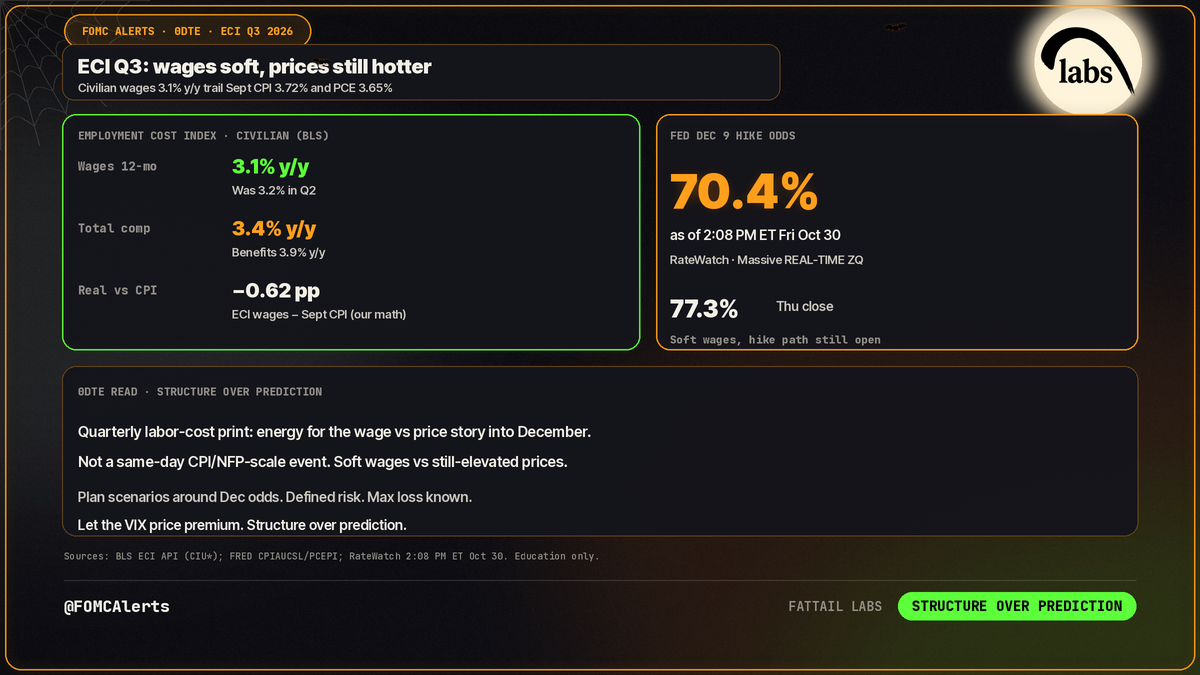
The Employment Cost Index Q3 2026 print is out, and for civilian wages the short answer is still no — they are not keeping up with prices this quarter. Wages & salaries rose 3.1% over the year ending Q3 2026, while September CPI-U ran 3.72% and PCE 3.65%. For the evergreen wages-vs-inflation question, see are wages keeping up with inflation (that page owns the broader intent). This note is the Q3 ECI release read. The gap frames the next FOMC on Dec. 8–9 — see the FOMC meeting schedule 2026 and our December Fed meeting preview — not a directional call. Live December hike odds sit on RateWatch. Full coverage lives on the FOMC Alerts hub.
What happened
From the BLS Public API (civilian workers), total compensation held at 3.4% y/y in Q3 (same as Q2). Wages & salaries eased to 3.1% from 3.2%. Benefits edged up to 3.9% from 3.8%. On a three-month seasonally adjusted basis, total compensation rose 0.8%, wages 0.9%, and benefits 0.8%.
Private industry matched the wage pace: wages & salaries 3.1% y/y (unchanged from Q2), total compensation 3.4% (up from 3.3%), benefits 3.9%. On our BLS pull, civilian wages’ 12-month pace of 3.1% is the lowest since Q1 2021; private wages at 3.1% match Q2 2026 as the lowest since that same quarter.
Our arithmetic — ECI 12-month % change minus inflation y/y at the quarter-end month — puts real civilian wages about −0.62 pp vs September CPI-U and −0.55 pp vs September PCE. Real total compensation is about −0.32 pp vs CPI and −0.25 pp vs PCE. Q2 gaps were thinner; Q3 widens them. That lines up with employment costs trailing headline inflation for a second straight quarter on our BLS + FRED math. For the longer real-wage story (evergreen owner of are wages keeping up with inflation), see Paychecks vs inflation. September’s price side is in our September PCE note.
What the Employment Cost Index is
The ECI is BLS’s quarterly measure of labor-cost change for civilian workers (private industry plus state and local government). It covers wages & salaries and benefit costs — health insurance, retirement, paid leave, legally required benefits — from an establishment survey. BLS uses fixed employment weights, so occupational mix shifts do not drive the index the way they can drive average hourly earnings. That is why the Fed prefers ECI as a cleaner wage-pressure read: soft wages with firm benefits can still keep total compensation elevated.
How it injects energy into markets. ECI is lower-frequency than CPI or payrolls, so it rarely sets same-day SPX ranges the way those prints do. Structurally, softer wages lean against a wage-price spiral narrative; firmer benefits keep labor-cost inflation in view. We do not invent an ECI-day SPX median here.
How it can affect upcoming rate decisions. For the December FOMC / Fed meeting, the print structures whether a hike case is about wage momentum or about still-elevated price inflation. Soft wages are a point against a wage-driven hike; benefits at 3.9% y/y and September PCE near 3.6% keep the price/labor-cost side open. Structure over prediction — map the print to odds and scenarios, not a side.
Advertisement · From FatTail Labs

Observer: train with Coach for $17/week
A six-week trial and training program built to install pro trading habits: live daily coaching, courses, a Discord trade room and the full FatTail platform.
December hike odds: soft wages, still ~70%
On Oct. 28 the Fed held 3.75%–4.00% on a 10–2 vote; Cook and Hammack preferred +25 bp (Federal Reserve). Our December Fed meeting preview covers the Dec. 8–9 SEP path.
RateWatch — CME FedWatch day-weighted / non-meeting-anchor on Massive REAL-TIME ZQ last_trade — shows December hike odds at 70.4% as of 2:08 PM ET Fri Oct. 30 (p_hike 0.7042), down from 77.3% on our 1:10 PM ET same-day read and from Thu close 77.3%. That window overlapped Logan headlines (~1:32–1:34 PM ET) and a tech selloff — coincidence of timing, not a claim that her speech moved the board. Soft ECI wages did not clear the hike path; prices that wages are not keeping up with remain the competing fire. Track the live board on RateWatch.
Soft wages vs Logan and Musalem
Soft Q3 ECI wages are one side of the December setup. Same afternoon, Dallas Fed President Lorie Logan — a 2026 FOMC voter who held with the majority on Oct. 28 — laid out a destination of more firming conditioned on the current outlook. St. Louis Fed President Alberto Musalem, a 2026 non-voter, made a related inflation-too-high case earlier the same day; keep him as counterpoint, not vote weight.
In remarks to Davidson College students (Dallas Fed primary, Oct. 30), Logan said “It remains clear to me, given the current outlook, that the FOMC needs to implement at least two more 25-basis-point rate increases.” After those two hikes, she said it would make sense in her view to pause and examine the data — paraphrase of the next sentence, not a separate quote. She also said “And skipping a meeting does not change the monetary policy destination.” She voted to maintain 3.75%–4.00% this week; the skip, in her framing, is about gradual timing, not a changed destination. Her destination case stays hawkish on the current outlook; gradual skip timing is not a changed end point.
In his keynote to the Shadow Open Market Committee in New York, Musalem said, “I judge that additional firming of monetary policy will be necessary, and soon.” He added: “Incremental adjustments made earlier are usually less disruptive than larger and abrupt actions taken later.” His more likely scenario is one where “persistent strong demand and ongoing supply pressures keep inflation elevated absent some additional firming of monetary policy.” His less likely scenario, in which no more hikes are needed, includes “an increase in potential output growth driven by higher productivity growth.” He described the risks to growth and the labor market as symmetric. Musalem is an alternate in 2027 and votes in 2028, so Logan’s case carries the vote weight in December.
Hold the data against both cases: our BLS pull has civilian wages at 3.1% y/y trailing September CPI and PCE, while Logan and Musalem still aim firming at elevated prices and easy financial conditions. Soft wages are a point against a wage-driven hike; they do not clear a price-driven path. Structure which fire a December move would fight. RateWatch Dec hike odds eased to 70.4% as of 2:08 PM ET Fri Oct. 30 in a window that also saw a global tech selloff — do not pin the odds move on Logan’s remarks alone.
What it means for 0DTE
- Energy: Scheduled quarterly labor-cost print — commentary on the wage vs price story into December, not a same-day CPI/NFP-scale event.
- Premium: Let the VIX price any residual vol; do not invent an ECI-day range from this print alone.
- Structure: Soft wages vs still-elevated PCE/CPI — plan scenarios around whether Dec odds firm or ease on the next hard inflation/labor prints, with defined risk and max loss known.
- Plan, don’t predict: The question for Dec. 8–9 is which fire a hike would fight. Size for gaps around the remaining data path; keep risk defined.
Related reading: Are wages keeping up with inflation · FOMC meeting schedule 2026 · September PCE inflation 2026 · December Fed meeting · Fed meeting this week
Sources
- Employment Cost Index — BLS Public API v2 (CIU* series) (BLS, 2026-10-30)
- CPIAUCSL — Consumer Price Index for All Urban Consumers (FRED (BLS CPI redistribution), 2026-09)
- PCEPI — Personal Consumption Expenditures Price Index (FRED (BEA PCE redistribution), 2026-09)
- PCEPILFE — Core PCE Price Index (FRED (BEA redistribution), 2026-09)
- Federal Reserve issues FOMC statement (Federal Reserve, 2026-10-28)
- RateWatch — December FOMC hike odds (FatTail RateWatch (Massive REAL-TIME ZQ), 2026-10-30)
- DeItaone — Musalem wire paraphrase (X) (DeItaone (X); third_party paraphrase only — not Musalem verbatim, 2026-10-30)
- Remarks to Davidson College students (Dallas Fed, 2026-10-30)
- St. Louis Fed — Musalem, Remarks on the U.S. Economy and Monetary Policy (SOMC) (stlouisfed.org (primary), 2026-10-30)
Trade it with structure
Observer is a six-week trial and training program: train with Coach for $17/week. You get everything a full coaching member gets, every week, and the six weeks are designed to install pro trading habits: courses on strategy, process and risk management, live daily coaching, a Discord trade room with hundreds of experienced traders, and the platform (heatmap, GEX tools, risk graph, position analyzer and journal). Start Observer.
Educational content, not investment advice. Options involve risk and are not suitable for all investors.
FATTAIL BRIEFINGS
Get FatTail briefings in your inbox
Pick the lists you want. FOMC Alerts is selected by default.