


A trade can be structurally sound and still become a bad decision when you improvise the entry, double the size, or move the exit because a candle looks uncomfortable. That is why a guide to execution decision rules matters for SPX 0DTE traders. Your market thesis is not your process. Your process is what tells you exactly what to do when the market does something you did not expect. Here is how to build that process.
Most retail traders have opinions. Fewer have rules that survive pressure. They know they want defined-risk structures. They may even understand dealer positioning, key strikes, and intraday context. But when price moves quickly, they revert to prediction: It has to turn here. That sentence has no place in an execution plan.
Execution rules replace hope with observable conditions. They do not make losses disappear. They make losses planned, sized, and survivable. The OCC’s options education is a good grounding in the defined-risk structures these rules govern.
What Execution Decision Rules Actually Do
A decision rule is a prewritten instruction that connects a market condition to an action. It answers a question before the trade asks it.
For example, “I will be careful near resistance” is not a rule. It leaves too much room for interpretation. “I will not open a short defined-risk structure directly into a scheduled event or while price is breaking and accepting above my invalidation area” is closer to a rule. You can observe it. You can follow it. You can review whether you followed it.
Good rules reduce the number of decisions you must make while capital is at risk. They also separate two issues traders often blend together: whether a setup was valid and whether the outcome was favorable. A valid trade can lose. An invalid trade can win. If you score every decision by its immediate P&L, you will train yourself to repeat luck and abandon discipline.
For 0DTE SPX trading, this distinction is especially important. Time is short. Convexity is real. A position that looked manageable at entry can change character quickly when price accelerates or implied volatility shifts. You need fewer vague guidelines and more hard boundaries.
Build Your Guide to Execution Decision Rules in Order
The cleanest framework starts with a hierarchy. Do not begin with entries. Begin with conditions that can disqualify the trade entirely. This hierarchy is the backbone of a written trading plan.
Start with no-trade rules
A no-trade rule is not missed opportunity. It is risk control doing its job.
Define the situations where you will stand aside: scheduled events you do not trade through, market conditions that do not fit your structure, periods when liquidity or pricing is unacceptable, and days when you have already reached your planned loss limit. Your specific filters will depend on your approach, but the principle is universal. If the environment violates the assumptions behind the trade, do not force a trade because it is a trading day.
This is where many traders fail. They treat daily activity as a requirement. It is not. A professional process includes the ability to do nothing without feeling behind.
No-trade rules should also address your own state. If you are trying to recover a loss, distracted, late to the session, or unable to monitor the position according to plan, that is information. The market is not obligated to provide a setup that fits your circumstances.
Define the market condition, not the prediction
A 0DTE trade should be based on what the market is doing relative to your framework, not what you need it to do next.
Your conditions might include the location of price relative to important positioning levels, the pace and quality of the move, whether price is rotating or trending, and where your proposed risk sits on the chart and risk graph. The point is not to create a long checklist that produces false certainty. The point is to identify the conditions required for your structure to make sense.
A useful test is this: Could another trained trader look at the same chart and tools and determine whether your condition was present? If not, the rule may still be an opinion disguised as a rule.
Avoid writing conditions that rely on emotional language. “The market feels extended” is difficult to audit. “Price has moved beyond the planned range and is accepting above the level that defines my short risk” gives you something concrete to act on.
Set the entry rule and the invalidation rule together
Entries get attention because they feel decisive. In reality, entry is only one part of a complete decision.
Before you enter, know what must be true to take the position, where the trade is wrong, and what action follows if that point is reached. The invalidation point is not a prediction that price will continue forever. It is the point where the original premise no longer justifies the risk.
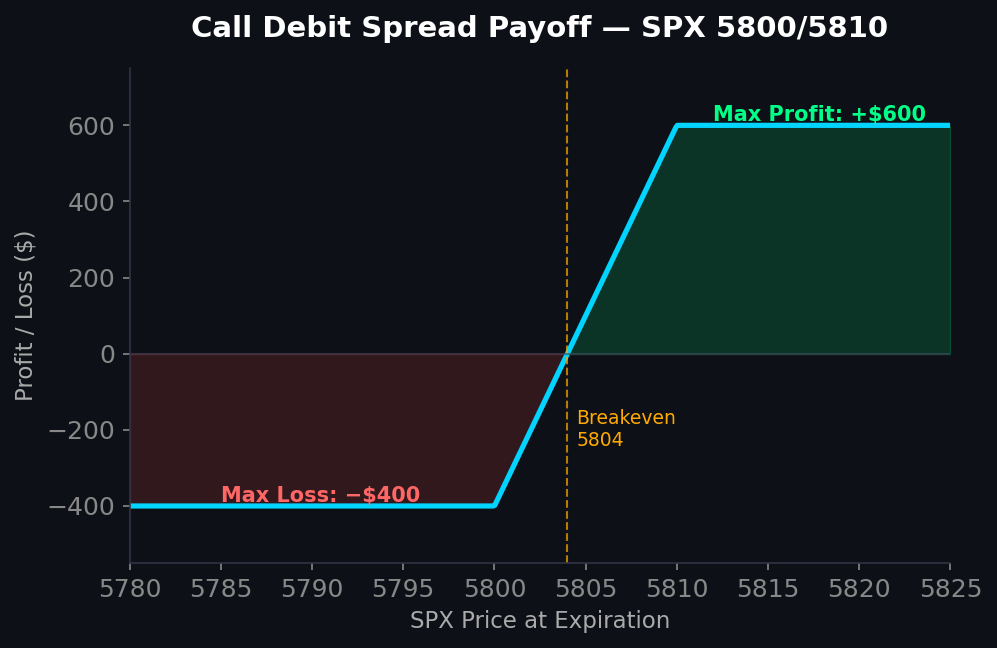
For a defined-risk SPX structure, that may mean exiting at a preset loss threshold, reducing exposure when price breaches a structural level, or closing based on a time condition when the trade has not developed as planned. This is core to trading defined-risk SPX. The correct choice depends on the setup. What matters is that the choice is made before the trade, when your judgment is not being distorted by open P&L.
Do not confuse a wide loss allowance with discipline. If your stop is so distant that it changes the intended risk of the trade, it is not a stop. It is permission to be wrong at a larger size.
Make sizing mechanical
Position size is where a reasonable idea turns into a dangerous trade.
Size should flow from a fixed risk budget and the actual risk of the defined-risk structure. Here is the position-sizing math. Not from conviction. Not from a recent winning streak. Not from the desire to make back a prior loss. If the appropriate size feels too small to matter, the answer is not to increase size. The answer is to accept that preserving the account matters more than satisfying the urge for action.
A practical sizing rule includes a maximum planned loss per trade, a maximum combined exposure if multiple positions are allowed, and a daily loss limit that ends new risk-taking. Those numbers are personal to the account and strategy, but the logic is not negotiable. A strategy cannot demonstrate expectancy if one oversized trade can erase a month of normal execution.
This is how you eliminate the risk of ruin as a decision-making habit. You do not wait for a crisis to become conservative. Investor-education bodies like the SEC stress predefined risk limits for exactly this reason. You build conservatism into the trade before entry.

Management Rules Must Prevent Mid-Trade Storytelling
Once a position is open, your brain will generate reasons to override the plan. A small loss becomes “noise.” A larger loss becomes “an opportunity to improve basis.” A profitable trade becomes “too good to close.” These stories usually appear after the rule should have already decided the action.
Management rules should cover three moments: when to take risk off, when to hold according to plan, and when not to add. For many developing traders, the last rule is the most valuable. Adding to a challenged 0DTE position may lower an apparent basis, but it can also increase complexity, directional exposure, and emotional attachment. If adjustments are part of your system, they need their own entry criteria, risk cap, and exit plan. They cannot be improvised rescue attempts.
Time belongs in your rules as well. In 0DTE, the same price can mean different things at different points in the session because the remaining time and gamma profile have changed. A position held late in the day should not be managed by the same assumptions used earlier. Define when you stop opening new positions, when you reduce risk, and when all positions must be closed. See how this fits a daily 0DTE routine.
The goal is not to automate every thought. The goal is to reserve judgment for the situations where judgment adds value, rather than using judgment as an excuse to avoid a difficult exit.
Review the Decision, Not Just the Result
A trade log should tell you more than entry price, exit price, and P&L. Record the setup condition, structure, planned risk, size, invalidation level, management action, and whether you followed each rule. A screenshot of the market context and risk graph can be more useful than a paragraph written from memory at the end of the day.
Then classify the trade honestly. Was it a planned loss, a rule-followed winner, a missed exit, an oversized position, or a trade that should never have been opened? These categories reveal the work. A losing trade that followed every rule may require no change at all. A profitable trade that violated size limits requires attention immediately.
Review patterns over a meaningful sample, not after two sessions. Here is how to review option trades. If a rule is repeatedly difficult to follow, ask whether it is too vague, too complex, or inconsistent with the actual market conditions you trade. Do not change rules simply because the last trade was painful. Change them when your data shows the rule is unclear or the underlying assumption is weak.
At FatTail.ai, this is the shift we want traders to make: away from needing a call and toward operating a process. Not signals. Not alerts. A framework you can execute, inspect, and improve.
The market will keep offering uncertainty. Your job is not to remove it or outguess it. Write rules that tell you when your risk is justified, when it is not, and when the best trade is to protect your ability to show up tomorrow.
Frequently Asked Questions
What are execution decision rules?
Prewritten instructions that connect a market condition to an action, answering a question before the trade asks it. “I will be careful near resistance” is not a rule; “I will not open a short defined-risk structure into a scheduled event or while price accepts above my invalidation area” is, because it is observable and auditable.
How do you build a trading rule hierarchy?
Start with no-trade rules (what disqualifies a trade), then define the market condition rather than a prediction, set the entry and invalidation together, and make sizing mechanical. Beginning with entries is backward; disqualifying conditions and risk come first.
What is a no-trade rule?
A predefined situation where you stand aside: scheduled events you avoid, conditions that do not fit your structure, unacceptable liquidity or pricing, reaching your daily loss limit, or being distracted or trying to recover a loss. No trade is risk control doing its job, not missed opportunity.
How do you stop overriding your plan mid-trade?
Management rules must cover when to take risk off, when to hold to plan, and when not to add, decided before the trade when open P&L is not distorting judgment. Adjustments, if allowed, need their own criteria, risk cap, and exit, not improvised rescue attempts. Time belongs in the rules too.
How do you review execution rules?
Log the setup condition, structure, planned risk, size, invalidation, management action, and whether you followed each rule, then classify the trade honestly. Review patterns over a meaningful sample, and change a rule only when the data shows it is unclear or its assumption is weak, not because the last trade hurt.
FATTAIL BRIEFINGS
Get FatTail briefings in your inbox
Pick the lists you want. FOMC Alerts is selected by default.