


A 0DTE position can go from calm to urgent in minutes. That is why traders ask, can 0DTE trades be planned? The answer is yes, but not in the way most people mean. You cannot plan the next SPX candle. You can plan the conditions under which you participate, the risk you accept, and the actions you take when the market does something unexpected.
That distinction separates structural trading from intraday guessing. A plan is not a prediction with better formatting. The OCC’s options education is a good grounding in the defined-risk structures a plan relies on. It is a decision framework that remains useful when your directional opinion is wrong.
What planning a 0DTE trade actually means
Many retail traders call a trade planned because they found a level, drew a trendline, or received an alert. Then price moves against them and the plan disappears. They add risk, move a stop, take off a hedge too early, or hold a defined-risk position as though the loss were optional.
That is not planning. That is reacting with a thesis attached.
A planned 0DTE trade defines the position before entry: the structure, maximum loss, intended size, timing window, market conditions that support the setup, adjustment rules if any, and exit conditions. It also defines the most overlooked item: when to do nothing.
The goal is not to produce a trade every day. The goal is to execute a process that can survive many days. Here is how to build that process. Some sessions will offer clean, usable conditions. Others will be too directional, too unstable, too late in the day, or simply outside your framework. Passing is part of the plan.
Start with the risk budget, not the market opinion
The market can open near a major positioning level, break it immediately, and reverse before lunch. If your entire trade depends on being right about that path, you have built fragility into the position.
Start from the amount you are willing to lose if the trade reaches its defined maximum loss. Then determine position size from that number. Not from how confident you feel. Not from the premium available. Not from the thought that this one looks obvious.
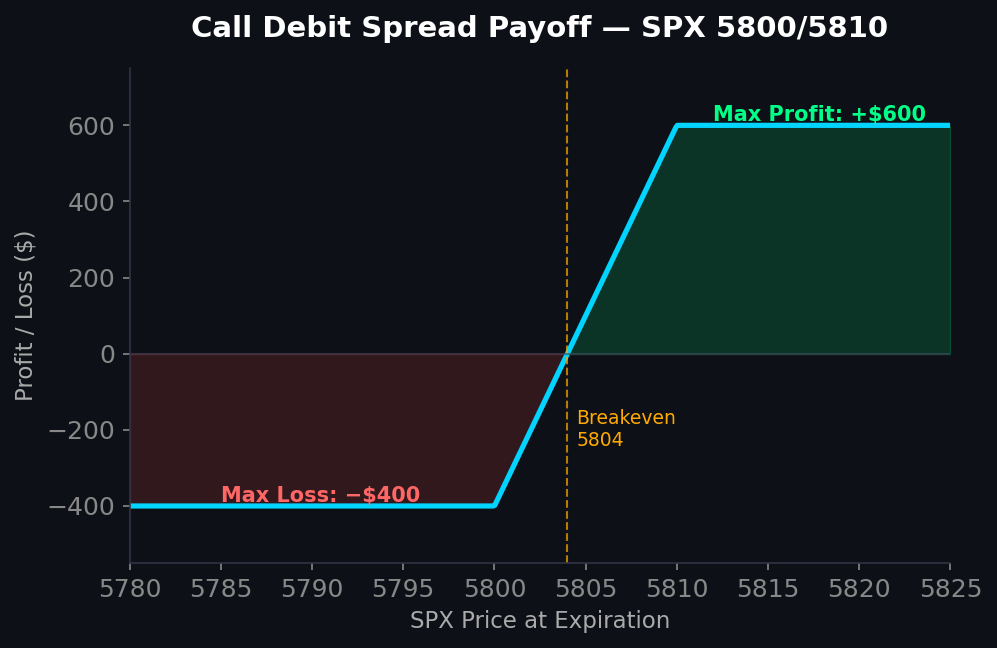
For defined-risk SPX structures, the width of the risk, the number of contracts, and the total planned loss must work together. A small position in a wider structure may fit your risk budget better than a larger position in a narrow one. There is no universally correct configuration. The correct one is the configuration whose worst-case outcome is routine rather than account-changing.
This is where many 0DTE traders fail. They optimize for credit, frequency, or a favorable-looking payoff graph while ignoring what happens when volatility expands and price travels. The result is a position that looks controlled at entry but becomes emotionally unmanageable under pressure.
If a full planned loss would cause you to abandon the system, your size is too large. See the position-sizing math. Reduce it before the market forces the lesson.
Defined risk is not the same as controlled risk
A structure with capped loss is a necessary starting point. It is not a complete risk process. You still need to understand where your risk sits, how quickly it can change, and how the position behaves as expiration approaches. The Cboe SPX contract specs detail the same-day settlement and expiration timing.
A short premium structure can appear harmless while price stays centered. But 0DTE gamma does not reward complacency. As SPX approaches your short strikes, the position can become more sensitive quickly. The plan needs to account for that sensitivity before you enter, not after the screen turns red.
Planning means reviewing the risk graph at entry and asking a plain question: what market move would make this trade difficult, and have I already decided what I will do? Sometimes the answer is to exit at a preselected loss. Sometimes it is to use an adjustment that preserves defined risk. Sometimes the right answer is no trade because the available structure does not provide enough room for the current environment.
Use market structure as context, not a crystal ball
Market structure matters. Dealer positioning, volatility conditions, expected move, overnight range, key intraday levels, and the distance from expiration all shape how a 0DTE position should be constructed. They help you identify where risk may concentrate and whether premium compensates you for accepting it.
They do not tell you what SPX must do next.
This is the corrective most traders need. Positioning data and technical levels are not signals that remove uncertainty. They are context for selecting strikes, defining risk, and recognizing when the market is likely to behave differently than a quiet, range-bound session.
For example, a compressed expected range and stable price behavior may support one type of defined-risk structure. A session with strong directional momentum, expanding volatility, or price accelerating away from major positioning areas may call for smaller size, more distance, a different structure, or no position at all. The framework adapts. The risk standard does not.
Planning is therefore conditional. Write the conditions in advance: if the market is within this environment, this structure is eligible. If volatility or price behavior changes beyond a threshold you have defined, the setup is not eligible or must be resized. You are not trying to forecast every branch. You are deciding how your process responds to each branch. These are your execution decision rules.

Build a daily operating routine
The best 0DTE plans are boring on purpose. They reduce decisions made under time pressure.
Before the session, review the market context and identify whether conditions are compatible with your framework. Mark the areas where price behavior could change. Establish your maximum loss for the day and the maximum allocation for any single idea. If you use multiple positions, decide in advance how their risks can overlap. Two defined-risk trades can still create one oversized directional bet.
At entry, confirm that the structure matches the environment you identified. Check the actual risk graph, not just the credit. Confirm contract count. Confirm the position has a reason to exist beyond wanting to be in a trade.
During the session, follow prewritten decision points. Do not turn every tick into a new thesis. Watch the factors that matter to the position: price location relative to risk, time remaining, volatility behavior, and whether the market regime has changed. A plan should tell you what deserves attention and what is merely noise.
After exit, record more than profit or loss. Capture the setup conditions, structure, size, entry timing, risk at entry, management decisions, and whether you followed the plan. A loss executed according to plan is useful data. A gain created by oversized luck is a process violation, even if it feels like a win.
Why planning does not eliminate losses
A repeatable 0DTE process will have losses. It must. The purpose of planning is not to avoid every losing trade. It is to make losses known, bounded, and small enough that they do not damage the account or distort your behavior.
That matters because the worst decisions usually happen after an unplanned loss. A trader who has no risk budget feels compelled to make it back. A trader who has no entry criteria chases the next move. A trader who has no review process learns nothing except that trading feels stressful.
Planned losses are reps. They show whether the framework, sizing, and execution held up under real market conditions. Over a meaningful sample, those records reveal far more than a collection of screenshots or someone else’s trade alerts.
Can 0DTE trades be planned without becoming rigid?
Yes. A plan should be disciplined, not mechanical in the wrong places. Markets change. Volatility regimes change. Liquidity and intraday behavior change. Your framework needs room for informed adaptation, but that adaptation should be tested and documented rather than invented mid-trade.
The line is simple. Change the framework between trades, after review. Follow the framework during the trade, unless the plan itself specifies a response to new conditions.
That is how traders become independent. Not signals. Not alerts. Not a guru telling you when to click. A defined-risk process, sized correctly, repeated honestly, and improved through evidence.
The next time you prepare for an SPX session, do not ask whether you can predict the close. Ask whether you can describe your maximum risk, your eligible conditions, and your response to being wrong before you enter. If you can, you are no longer hoping a 0DTE trade works. You are planning to trade like a professional.
Frequently Asked Questions
Can 0DTE trades actually be planned?
Yes, but not by predicting the next SPX candle. You can plan the conditions under which you participate, the risk you accept, and the actions you take when the market does something unexpected. A plan is a decision framework that stays useful when your directional opinion is wrong.
What does planning a 0DTE trade mean?
Defining the position before entry: the structure, maximum loss, intended size, timing window, supporting conditions, adjustment rules if any, exit conditions, and the most overlooked item, when to do nothing. Finding a level or getting an alert is not a plan; it is reacting with a thesis attached.
How do you plan 0DTE risk?
Start from the amount you are willing to lose if the trade hits its defined maximum loss, then size from that number, not from confidence or available premium. Width, contract count, and total planned loss must work together so the worst case is routine rather than account-changing.
Does planning eliminate losses?
No. A repeatable 0DTE process will have losses; it must. The purpose of planning is to make losses known, bounded, and small enough that they do not damage the account or distort behavior. Planned losses are reps that show whether the framework held up.
Can a 0DTE plan be flexible without becoming rigid?
Yes. Change the framework between trades, after review; follow the framework during the trade, unless the plan itself specifies a response to new conditions. Adaptation should be tested and documented, not invented mid-trade.
FATTAIL BRIEFINGS
Get FatTail briefings in your inbox
Pick the lists you want. FOMC Alerts is selected by default.