


A short strangle sells both a call and a put on the same underlying with the same expiration but at different strikes, both out of the money. You collect premium from two sides and profit when the underlying stays inside the range defined by your strikes. The structure looks simple. The risk profile is not. A short strangle has unlimited loss potential on the call side and substantial loss potential on the put side, and those risks arrive precisely when volatility spikes—the same environment that made the premium attractive in the first place.
The appeal of a short strangle is the double premium collection. Instead of selling just a put or just a call, you sell both. The combined credit widens your breakeven range and increases your probability of profit. But probability of profit and probability of a good outcome are not the same thing. A short strangle can win 80% of the time and still lose money over a full cycle because the 20% losses are multiples of the wins.
How a Short Strangle Works
The structure has two legs placed symmetrically (or asymmetrically) around the current price:
- Sell an out-of-the-money call above the current price. You collect premium and take on the obligation to sell shares at the call strike if assigned.
- Sell an out-of-the-money put below the current price. You collect premium and take on the obligation to buy shares at the put strike if assigned.
Both options share the same expiration date. The combined premium received is your maximum profit. You keep it all if the underlying closes between your two strikes at expiration.
Example: SPY is at $525. You sell the $540 call for $1.80 and the $510 put for $2.20. Total credit: $4.00 ($400). Your breakeven points are $544 on the upside ($540 + $4) and $506 on the downside ($510 − $4). SPY can move $19 up or $19 down before you start losing money. That is a $38 range, roughly 7% of the underlying’s price.
If SPY closes at $525 at expiration, both options expire worthless. You keep $400. If SPY closes at $550, the call is $10 in the money—your loss is $10 minus the $4 credit = $6.00 per share ($600 loss). If SPY crashes to $490, the put is $20 in the money—your loss is $20 minus $4 = $16.00 per share ($1,600 loss). There is no cap on how far the underlying can move against you.
Why Traders Sell Strangles
The short strangle attracts traders for three specific reasons, each with a corresponding trap:
Double Premium Collection
Selling both sides collects more premium than selling a single option. More premium means wider breakevens. The trap: more premium also means more obligation. You are exposed on both sides simultaneously. A straddle or strangle comparison shows the trade-off clearly—the strangle gives you a wider profitable range but with open-ended risk on both tails.
High Probability of Profit
A short strangle with 16-delta options on each side has roughly a 68% probability of both options expiring worthless (one standard deviation). With 20-delta options, the probability is even higher. These numbers attract traders who equate high win rates with profitability. But the economics of premium selling require that your average win exceeds your average loss adjusted for frequency. A 75% win rate with a 4:1 loss-to-win ratio is a losing strategy.
Volatility Mean Reversion
Short strangles are short vega. When you sell a strangle, you profit from implied volatility contracting. Since IV tends to mean-revert over time, selling strangles after volatility spikes captures the premium compression as IV falls back to normal levels. This is the most legitimate edge in the strategy—but it requires timing discipline that most traders lack.
Strike Selection for a Short Strangle

Strike placement determines everything about a short strangle’s risk profile. The two standard approaches:
Delta-Based Selection
The most common method uses delta as a proxy for probability:
- 16-delta on each side (1 standard deviation): The textbook setup. Roughly 68% probability of profit. Moderate premium, moderate range. This is where most educational content starts and where most traders begin.
- 10-delta on each side: Wider range, lower premium, higher probability (~80%). Less premium collected means smaller wins relative to potential losses. The risk/reward gets worse even as the probability improves.
- 25-30 delta on each side: Narrow range, more premium, lower probability (~50-60%). This starts behaving like a short straddle and requires more active management.
Using Market Structure
Better than mechanical delta selection is placing strikes at levels where market structure supports your position. Use GEX data to identify dealer hedging levels, max pain for open interest gravity, and expected move calculations to size your range against what the market is actually pricing. Selling a call at a GEX resistance level and a put at GEX support means dealer positioning works in your favour on both sides.
Timing Your Entry
Timing matters more than structure. The ideal entry combines three conditions:
- Elevated IV rank (above 50%). You want to sell expensive options. Check the VIX environment and the underlying’s IV rank relative to its own history. Selling strangles in low-IV environments means collecting thin premium for the same risk.
- No imminent binary events. Earnings, Fed meetings, CPI releases, and other catalysts can move the underlying far beyond your strikes in a single session. A short strangle before a binary event is a coin flip dressed as a high-probability trade. Check the calendar before entry.
- Range-bound expectation. The underlying should be consolidating or trading within a defined range. Trending markets punish strangles because one side absorbs increasingly larger losses while the other side contributes diminishing gains.
Position Management and Adjustments
Active management is not optional. A short strangle left unattended through a volatile market can produce catastrophic losses.
- Close at 50% of max profit. If you collected $4.00, buy the strangle back when it reaches $2.00. You capture half the premium in a fraction of the time and eliminate the risk of a late reversal. The last 50% of premium decays slowly and the expiration gamma risk is not worth the remaining reward.
- Roll the tested side. If the underlying moves toward one of your strikes, you can roll that option out in time (same strike, later expiration) to collect additional premium and give the position more time to recover. Only roll if the thesis (range-bound market) still holds. Rolling a tested strangle in a trending market compounds the loss.
- Close the entire position if one side goes in the money. Once either option is ITM, the position is no longer a probability trade—it is a directional bet you did not intend to make. Close the whole strangle and reassess. Do not let a small loss become a large one by hoping for a reversal.
- Set a maximum loss. Define your exit before entry. A common rule: close the strangle if the loss reaches 2x the premium collected. On a $400 credit, close at an $800 loss ($1,200 total cost to close). This ensures one losing trade does not erase five winners.
- Monitor implied volatility. A spike in IV increases the value of both options you sold, moving the position against you even if the underlying has not moved. Watch the VIX and your position’s vega exposure. If you sold a strangle collecting $4.00 and a volatility expansion pushes it to $6.00, you are underwater despite the underlying being in range.
Short Strangle vs Iron Condor
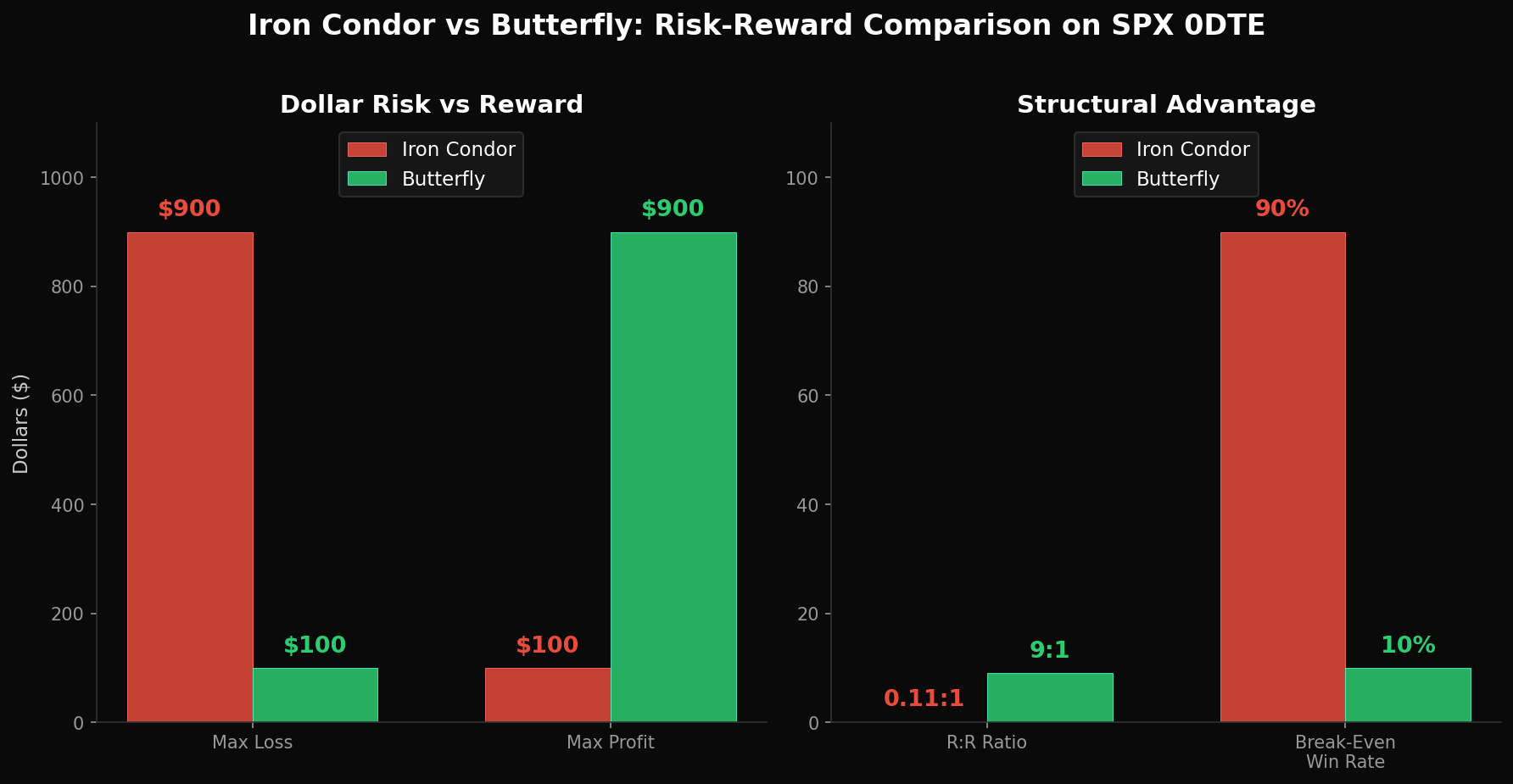
The iron condor is a short strangle with purchased wings—a long call above the short call and a long put below the short put. The wings cap your maximum loss but reduce your premium collected. Here is what actually matters:
- Risk: A short strangle has theoretically unlimited risk on the call side. An iron condor has defined risk. Winner: iron condor.
- Premium: A short strangle collects more premium because you are not paying for protection. The wider breakevens mean a higher probability of profit per trade.
- Margin: A short strangle requires significantly more margin because the risk is undefined. An iron condor’s margin requirement equals the wing width minus the credit received. For smaller accounts, the iron condor is often the only option.
- Tail risk: The short strangle can lose 5x, 10x, or more of the premium collected in a crash. The iron condor’s maximum loss is fixed at entry. If you cannot survive a 3-sigma move, do not sell naked strangles.
- Management: Both require active management, but the short strangle demands faster action because losses accelerate without a cap. The iron condor gives you more time to react because the wings slow the loss curve.
Most traders should use iron condors instead of short strangles. The defined risk means you can size the position properly, sleep through overnight moves, and survive the inevitable outlier event. Short strangles are for experienced traders with large accounts, strict risk management protocols, and the discipline to close losing positions immediately.
The Greeks That Drive the Position
Understanding how the Greeks interact in a short strangle is essential for managing the position:
- Theta (positive): Both short options decay daily. Time decay is your primary income source. Theta is highest when the underlying is between your strikes and accelerates as expiration approaches.
- Delta (near zero at entry): The short call has negative delta, the short put has positive delta. They offset, making the position roughly delta-neutral at entry. As the underlying moves, delta shifts and the position becomes directional—this is when management decisions become critical.
- Vega (negative): Both short options lose value when IV drops. This is your secondary edge. You want to enter when IV is high and exit as it contracts. A volatility crush after an event can deliver a quick profit even if the underlying moves modestly.
- Gamma (negative): This is the dangerous Greek. Negative gamma means the position gets worse as the underlying moves in either direction. Large moves accelerate your losses. Near expiration, gamma is highest, which is why holding strangles to expiration is risky. Negative gamma exposure is the primary reason short strangles blow up.
SPX vs Equity Strangles
The underlying you choose changes the strategy fundamentally:
- SPX: European-style (no early assignment risk), cash-settled, Section 1256 tax treatment (60/40 long-term/short-term). Higher notional value means more premium per contract but larger margin requirements. The diversified index reduces single-name gap risk.
- Individual stocks: American-style (early assignment possible), physical settlement. Earnings, FDA decisions, acquisitions, and other company-specific events can gap stocks 20-50% overnight. A short strangle on a single stock before earnings is not a volatility trade—it is a bet that the move will be smaller than the market expects.
- SPY/QQQ: A middle ground. American-style but diversified. Lower notional than SPX, more accessible for smaller accounts. No Section 1256 treatment.
For pure premium selling strategies, SPX is structurally superior due to European settlement, cash settlement, and tax treatment. The SEC’s investor guidance emphasises understanding settlement mechanics before trading index options—the differences from equity options are material.
Common Short Strangle Mistakes
- Selling strangles in low IV. The premium you collect in a low-IV environment is not worth the risk. If the VIX is at 12 and you sell a strangle collecting $2.00, a return to normal volatility (VIX 18-20) can double the cost to close your position before the underlying even moves. Sell strangles when IV rank is above 50%.
- Ignoring position sizing. A single short strangle on SPX can have $50,000+ in margin requirement and theoretically unlimited loss. If that represents more than 5-10% of your account, one bad trade ends your year. Size strangles so the maximum reasonable loss (3x premium collected) is no more than 2-3% of total capital.
- Holding through binary events. Selling a strangle on Tuesday and holding through a Wednesday Fed announcement or Friday NFP report is not a strategy—it is a gamble. Close or adjust before known catalysts.
- Not closing losers fast enough. The asymmetry of a short strangle means losses grow exponentially while wins are capped at the premium collected. A trader who lets a $400 credit turn into a $2,000 loss needs five winning trades to recover. Set your stop, honour it, move on.
- Confusing probability of profit with expected value. A 75% chance of making $400 and a 25% chance of losing $2,000 has a negative expected value (-$200). Many short strangle traders focus exclusively on win rate and ignore the math. Track your average win, average loss, and win rate together. If average loss exceeds 3x average win, the strategy is losing money regardless of win rate.
Frequently Asked Questions
What is a short strangle?
A short strangle is an options strategy where you simultaneously sell an out-of-the-money call and an out-of-the-money put on the same underlying with the same expiration date. You collect premium from both sides and profit when the underlying stays between the two strikes. Maximum profit is the total premium collected. Maximum loss is theoretically unlimited on the call side and substantial on the put side (down to zero).
How much margin do you need to sell a strangle?
Margin requirements vary by broker and underlying. For SPX, a short strangle typically requires $30,000-$60,000 in margin per contract depending on strike width and current volatility. For SPY, expect $8,000-$15,000. Individual stocks vary based on price and volatility. The margin requirement can increase if the underlying moves toward one of your strikes, potentially triggering a margin call. Always maintain excess margin beyond the minimum requirement.
Is a short strangle better than an iron condor?
Neither is universally better. A short strangle collects more premium and has higher probability of profit per trade, but has undefined risk. An iron condor has defined risk, lower margin requirements, and is easier to size properly. For most traders, especially those with accounts under $100,000, iron condors are the safer choice. Short strangles are appropriate for experienced traders who can manage undefined risk and have sufficient capital to absorb large losses.
What delta should I use for a short strangle?
The standard is 16-delta on each side, representing approximately one standard deviation of expected movement. This gives roughly a 68% probability of both options expiring worthless. More conservative traders use 10-delta (wider, less premium, ~80% probability). More aggressive traders use 25-30 delta (narrower, more premium, ~50-60% probability). The right delta depends on your risk tolerance, account size, and current implied volatility levels.
When should I close a short strangle?
Close at 50% of maximum profit as a standard target. This captures half the premium in a fraction of the time and eliminates the gamma risk of holding near expiration. Close immediately if the loss reaches 2x the premium collected. Close before any known binary event (earnings, Fed, economic data). Close if one side goes in the money and your directional thesis has not changed. Never hold a short strangle to expiration unless both options are far out of the money with minimal value remaining.
FATTAIL BRIEFINGS
Get FatTail briefings in your inbox
Pick the lists you want. FOMC Alerts is selected by default.