


SPX coaching should not make you more dependent on someone else’s market opinion. It should make you less dependent on opinions, period. If your current approach requires a chat-room alert, a social-media post, or a guru to tell you what to do next, you do not have a trading process. You have outsourced conviction. This is the crux of signals vs coaching.
For active options traders, the appeal of SPX is obvious: deep liquidity, daily expirations, and a market that forces clear decisions under real time pressure. The danger is just as obvious. A short-dated index option can turn a small sizing error, a vague exit plan, or a last-minute adjustment into a loss that overwhelms weeks of disciplined work.
Good coaching addresses that problem at the root. Not signals. Not prediction contests. A repeatable defined-risk framework that helps you decide when conditions fit, how much risk belongs in a position, and when doing nothing is the professional decision. The OCC’s options education is a good grounding in the mechanics coaching builds on.
What SPX Coaching Should Actually Teach
Many traders arrive at coaching after trying a high-win-rate strategy, a group that posts entries, or a discretionary method that worked until it did not. The pattern is familiar. A few wins create confidence. One oversized loss erases the progress. Then the trader changes systems, increases size to recover, or searches for a more accurate signal.
That is not primarily an entry problem. It is a risk and process problem.
SPX coaching worth your time teaches the operating system behind the trade. It starts with the mechanics of defined-risk structures and the behavior of 0DTE options, but it cannot stop there. You also need a method for reading positioning, identifying relevant price areas, framing a trade thesis, defining invalidation, and allocating risk before the opening order is sent.
The goal is not to be right about every move in the S&P 500. The goal is to make decisions whose downside is known, contained, and survivable. Losses are planned reps. They are not evidence that you are incapable of trading.
Positioning matters more than a market call
A trader can correctly predict that SPX will rise and still lose money with poor structure selection, bad timing, or an oversized position. The opposite can also happen: a trader may not know the next directional move, yet build a position that reflects where risk is acceptable and where the market’s structure has changed.
This is why a serious coaching process emphasizes positioning over prediction. Options markets contain information about expected movement, hedging pressure, and risk concentration. Tools such as gamma exposure overlays, convexity views, and risk graphs can help organize that information. They are not crystal balls. They are decision aids.
The distinction matters. A tool should make your reasoning more explicit, not replace it.

The Core of a Defined-Risk 0DTE Process
0DTE trading compresses time. That compression makes discipline more valuable, not less. You do not have the luxury of ignoring a position for several days while hoping the market comes back. You need rules that are clear enough to execute when the tape speeds up.
A useful process generally has four connected parts: market context, structure selection, position sizing, and review. If one is missing, the rest become fragile.
Market context means knowing what conditions you are trading. Is SPX opening near a meaningful positioning level? Has implied volatility changed? Is the market moving in a contained range or expanding away from the open? Are you trading before a scheduled event or after a sharp repricing? Context does not tell you the future. It helps you avoid treating every session as if it were the same session.
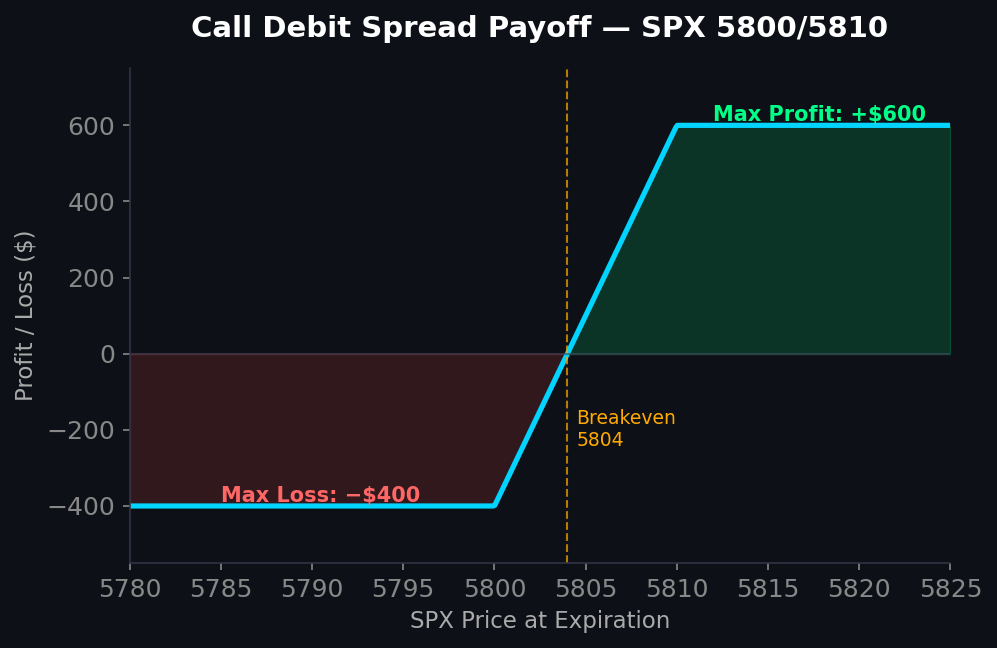
Structure selection follows from that context. The question is not, “What trade will make the most today?” The question is, “What defined-risk expression matches this environment, and what would prove it wrong?” A position must have a maximum planned loss that fits the account and the day’s risk budget.
Position sizing is where many otherwise capable traders fail. They understand a setup, then trade it at a size that makes normal variance emotionally unbearable. Once that happens, process disappears. Every tick becomes personal. The trader cuts winners too early, holds losers too long, or adds risk simply to avoid taking a planned loss.
Correct sizing makes it possible to think. That is its real value.
Finally, review turns experience into improvement. Without a trade log and a consistent review routine, traders remember the dramatic days and forget the ordinary decisions that drive results. They blame the market when the actual mistake was entering outside their plan, using too much risk, or failing to act at a predefined decision point.
Why Live SPX Coaching Has Value
Recorded education can teach mechanics. It cannot fully reproduce the moment when a quiet open becomes a fast directional move, a planned range breaks, or an attractive premium creates the urge to force a trade.
Live coaching provides context for those moments. A skilled coach can show how a framework is applied in real time, including the days when the best decision is no trade. That last part is often missing from retail trading education because abstaining is difficult to market. It is also essential.
The value is not someone handing you an entry. A trade alert may feel useful, but it leaves the central question unanswered: could you make the same decision without the alert tomorrow? See what a live coach should teach. If the answer is no, the service has built dependence rather than capability.
A better live environment exposes the reasoning. Why was a level relevant? What changed in the risk graph? Why did size stay small despite a compelling thesis? Why was a loss accepted instead of adjusted into something larger and less defined? These are the decisions that build an independent trader.
At FatTail.ai, that means treating daily market exposure, trade review, and analytics as parts of one learning loop. Observe the market, plan the risk, execute the structure, then review the decision against the plan. The platform and the coaching should support your judgment, not ask you to surrender it.
What to Look for Before You Join
Not all SPX coaching is designed to produce self-reliance. Read our coaching membership review for what to check. Some programs are signal rooms wearing an educational label. Investor-protection resources from the SEC are worth reading before you pay for any trading education. Before committing, listen carefully to what is being emphasized.
Does the program explain losses as a normal part of expectancy, or does it constantly defend its latest call? Does it teach sizing before it teaches setups? Does it show complete trade reviews, including mistakes and losing sessions? Can you see how risk is defined before a trade is entered? These questions reveal more than a highlight reel of profitable examples ever will. Here is how to choose a coaching program.
You should also assess whether the coaching fits your current level. A newer 0DTE trader may need more time on structure mechanics, expiration-day behavior, and order execution. An experienced trader may need less theory and more accountability around sizing, trade selection, and post-trade data. The right framework is not one that overwhelms you with jargon. It is one you can execute repeatedly under pressure.
There is a trade-off here. More discretion can create flexibility, but it can also create more room for rationalization. Tighter rules can reduce impulsive decisions, but they must still leave room for genuine changes in market context. Coaching should help you find that balance rather than hand you a rigid script for every day.
Build Independence One Review at a Time
A durable SPX routine is not built by finding a perfect setup. There is no perfect setup. It is built by making the same professional decisions often enough that they become normal: define risk, keep size appropriate, respect invalidation, and document what happened.
Start with a simple standard after every session. Did you follow the plan you had before the trade? If not, identify the exact decision where you departed from it. Do not hide behind a profitable outcome. A bad process can make money once. It cannot be trusted repeatedly.
Over time, your trade log should tell a clearer story than your emotions do. You will see which environments fit your approach, which mistakes recur, and whether your position size lets you operate without panic. That is real progress.
The market does not owe you certainty. Your process can still give you structure. Build that structure until you no longer need someone else to tell you what to think.
Frequently Asked Questions
What should SPX coaching actually teach?
The operating system behind the trade, not just entries: the mechanics of defined-risk structures, how to read positioning, frame a thesis, define invalidation, and allocate risk before the order is sent. The goal is decisions whose downside is known, contained, and survivable, not being right about every move.
Is SPX coaching just a signal service?
It should not be. A trade alert leaves the central question unanswered: could you make the same decision without it tomorrow? If not, the service built dependence rather than capability. Good coaching exposes the reasoning, why a level mattered, why size stayed small, why a loss was accepted.
What are the parts of a defined-risk 0DTE process?
Four connected parts: market context (what conditions you are trading), structure selection (a defined-risk expression that fits), position sizing (small enough to think clearly), and review (turning experience into improvement). If one is missing, the rest become fragile.
Why does live coaching have value?
Recorded education teaches mechanics but cannot reproduce the moment a quiet open becomes a fast move or an attractive premium tempts a forced trade. Live coaching shows the framework applied in real time, including the days when the best decision is no trade.
What should you look for before joining SPX coaching?
Whether losses are explained as normal expectancy or the program constantly defends its latest call, whether sizing is taught before setups, whether complete trade reviews (including mistakes) are shown, and whether you can see how risk is defined before entry.
FATTAIL BRIEFINGS
Get FatTail briefings in your inbox
Pick the lists you want. FOMC Alerts is selected by default.