


FOMC Alerts · October 26, 2026
Here’s the Fed balance sheet explained for Fed week. The rate call on Wednesday looks close to settled: fed funds futures price about a 90% chance of a hold, our calculation from fed funds futures using CME’s method. For the rate call and the December odds, see our Fed meeting this week preview. The Fed’s other lever is less settled. That’s its $6.754 trillion balance sheet, which is under review and feeds into Treasury’s Nov. 4 refunding.
Below: what the Fed owns, where the money sits, how the holdings lean on the 10-year, and the dates that matter for bonds over the next 10 days. All balance-sheet figures are Wednesday levels for Oct. 21 from the Fed’s weekly H.4.1 release (Federal Reserve).
Fed balance sheet explained: what the Fed owns
| Holding (Oct. 21) | Level | Change over one year |
|---|---|---|
| Treasury bills | $567.9B | +$372.4B |
| Treasury notes and bonds (nominal) | $3,620.8B | +$40.0B |
| TIPS | $277.7B | −$30.5B |
| Mortgage-backed securities | $1,895.2B | −$187.4B |
| Total assets (includes other items) | $6,753.6B | +$164.1B |
Source: Federal Reserve H.4.1, released Oct. 22.
The story of the past year is bills. The Fed’s T-bill holdings nearly tripled, from about $195.5 billion to $567.9 billion (2.9 times, our calculation). Bills went from 4.7% of the Fed’s Treasuries to 12.4%, and they account for 99% of the $376.2 billion rise in its Treasury holdings. Mortgage bonds went the other way: down $187.4 billion, though they’re still 28% of total assets.
That mix is policy. Quantitative tightening ended Dec. 1, 2025, and on Dec. 10 the FOMC said reserves had fallen to ample levels and it would start buying shorter-term Treasuries as needed (Federal Reserve). The current directive, issued Sep. 16, tells the New York Fed to buy bills when appropriate to keep reserves ample, roll over all maturing Treasuries at auction and reinvest all agency-security principal (mostly mortgage bonds) into bills (FOMC implementation note). The September minutes say those reserve management purchases had been paused and aren’t on a preset course; the Committee decides month by month (FOMC minutes).
Where the money sits: reserves, the TGA and reverse repo
The Fed’s liabilities are where its assets show up in the banking system:
- Bank reserves: $2,969.5 billion, down $61.3 billion in one week.
- Treasury General Account (the government’s cash account at the Fed): $945.2 billion, up $59.3 billion.
- Overnight reverse repo: $334.1 billion.
Those first two moves mirror each other. When Treasury builds cash in its account, reserves drain out of banks. In August, Treasury estimated the account could peak at $1.05 trillion (plus or minus $50 billion) in late October (Treasury). On Oct. 21 it was about $105 billion short of that (our calculation), so more of that drain may still come.
One more line on the H.4.1: earnings remittances due to Treasury stood at −$232.7 billion. That negative figure is a deferred asset: per the H.4.1’s own definition, it’s the net earnings the Reserve Banks need to realize before remittances to Treasury resume.
How the balance sheet leans on the 10-year
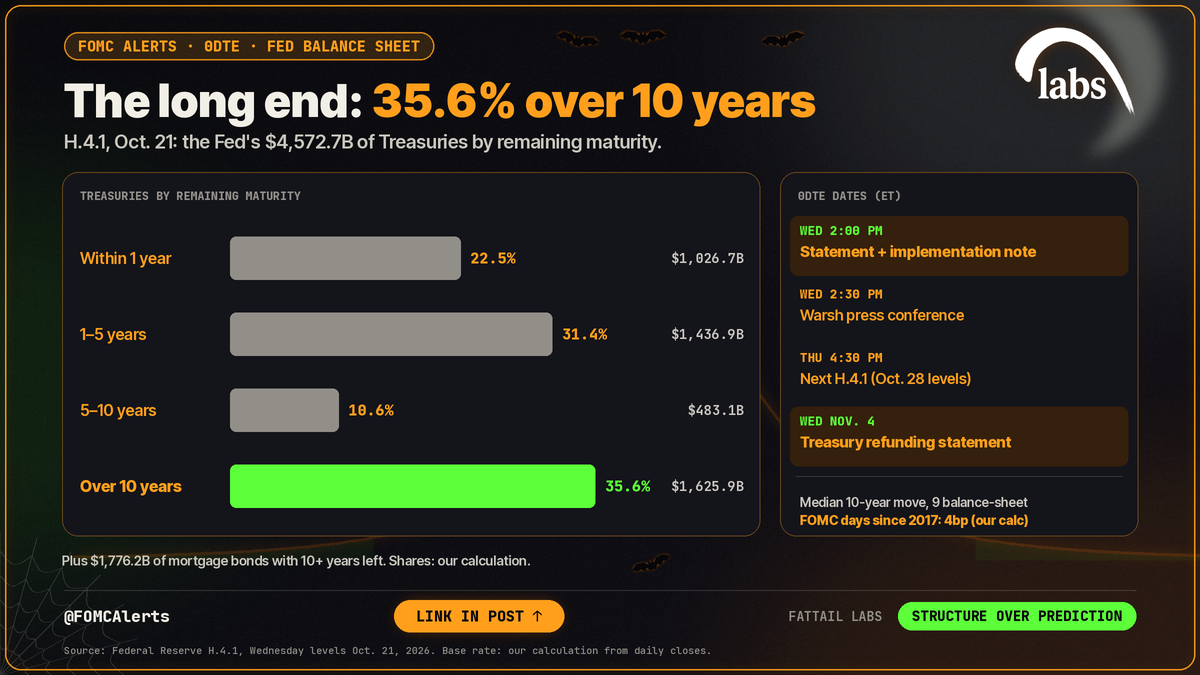
Maturity is what links the Fed’s holdings to long-term yields. On Oct. 21 the Fed’s $4,572.7 billion of Treasuries broke down like this (shares our calculation):
| Remaining maturity | Amount | Share |
|---|---|---|
| Within 1 year | $1,026.7B | 22.5% |
| 1–5 years | $1,436.9B | 31.4% |
| 5–10 years | $483.1B | 10.6% |
| Over 10 years | $1,625.9B | 35.6% |
Source: Federal Reserve H.4.1, table 2. Another $1,776.2 billion of the Fed’s mortgage bonds have more than 10 years to maturity.
Holding that much duration keeps it off private balance sheets. Board economists estimated that at the end of 2016 the Fed’s portfolio was holding the 10-year term premium about 100 basis points below where it otherwise would have been, as cited in a new Brookings paper (Brookings). The Bipartisan Policy Center puts the reverse case plainly: “Allowing long-term Treasurys to mature would put upward pressure on long-term rates and increase federal interest costs on the debt.” (BPC)
The 10-year Treasury closed at 5.00% on Monday, Oct. 26, unchanged from Friday, with the 3-month bill at 4.22% (Treasury). The Kim-Wright estimate of the 10-year term premium, a Fed Board staff model, is up 43bp since the bill purchases were announced on Dec. 10, 2025 (latest reading Oct. 16, Federal Reserve Board). For who else sets the 10-year, see why the 10-year Treasury yield is rising.
The effect is slow, not a decision-day jolt. On the nine FOMC days since 2017 when the statement changed balance-sheet policy, the 10-year’s median move was 4bp, the same as on all 93 scheduled FOMC days since 2015, and it fell on six of the nine. That’s our calculation from daily closes. The sample is small, and those days also carried rate decisions.
Advertisement · From FatTail Labs

Observer: train with Coach for $17/week
A six-week trial and training program built to install pro trading habits: live daily coaching, courses, a Discord trade room and the full FatTail platform.
The review: a task force and a smaller-balance-sheet proposal
The balance sheet itself is under review. On Jul. 9 the Fed named the leaders of Chair Warsh’s Balance Sheet Policy task force: Karen Dynan (Harvard), Raghuram Rajan (Chicago Booth) and Jeremy Stein (Harvard). Its job is to “examine the costs, benefits, and institutional implications” of the current regime (Federal Reserve). At the July meeting most participants commented on balance-sheet policy, including the appropriate maturity mix of the Fed’s Treasuries; many reaffirmed that the funds rate is the main tool (FOMC minutes). The Fed hasn’t published a date for the findings.
Outside the Fed, an Oct. 19 Brookings paper by Chris Hughes proposes an “Elastic Reserves” system: reserves plausibly on the order of $1 trillion, about a third of today’s, backed by lending facilities, with the balance sheet settling around $4.5 trillion (Brookings). It’s a proposal, not Fed policy.
What to watch, Wednesday through Nov. 4
- Wed Oct. 28, 2:00 PM ET: the statement and the implementation note. The note is where any change to the bill-buying orders would appear. Chair Warsh’s press conference follows at 2:30 PM (Federal Reserve; full calendar in our FOMC meeting schedule).
- Thu Oct. 29, 4:30 PM ET: the next H.4.1, with Oct. 28 levels for bills, reserves and the TGA.
- Mon Nov. 2 and Wed Nov. 4: Treasury’s financing estimates, then the refunding statement and auction sizes (Treasury). Release times aren’t posted yet; in August they were 3:00 PM and 8:30 AM ET.
Treasury and the Fed are watching each other. Treasury’s August statement: “Treasury is monitoring SOMA purchases of Treasury bills and growing demand for Treasury bills from the private sector.” (Treasury) Its November dealer survey, whose responses were due at noon Monday, asks for forecasts that include changes in SOMA holdings (Treasury).
Whether Wednesday’s statement or press conference says anything about the balance sheet is unknown. Listening for it is our framing, not a forecast. For how we turn futures into odds, see our guide to fed funds futures probabilities.
What it means for 0DTE
- Energy: the rate decision is mostly priced, so a surprise is more likely to come from the implementation note or a balance-sheet answer at 2:30 than from the rate itself.
- Premium: balance-sheet news hasn’t produced outsized same-day 10-year moves (median 4bp on nine days). Don’t pay up for a bond-driven move in SPX on that alone.
- Structure: if yields jump on balance-sheet wording, rate-sensitive pockets move first. Keep risk defined through 2:00–4:00 PM ET.
- Plan: mark Nov. 4 and the next H.4.1 on the calendar. Those are the dates where the bill-versus-coupon mix shows up.
Related reading: Why is the 10-year Treasury yield rising? · Mortgage rates vs. the 10-year Treasury · Why are Treasury yields falling? · More FOMC Alerts
Sources
- H.4.1 Factors Affecting Reserve Balances, Oct 22, 2026 (Oct 21 levels) (Federal Reserve, 2026-10-22)
- Implementation note, Sep 16, 2026 (Federal Reserve, 2026-09-16)
- FOMC statement, Sep 16, 2026 (Federal Reserve, 2026-09-16)
- FOMC statement, Dec 10, 2025 (Federal Reserve, 2025-12-10)
- Minutes of the FOMC, Jul 28-29, 2026 (Federal Reserve, 2026-07-29)
- Minutes of the FOMC, Sep 15-16, 2026 (Federal Reserve, 2026-09-16)
- Federal Reserve announces the leadership and objectives of its task forces (Federal Reserve, 2026-07-09)
- October 2026 calendar (Federal Reserve, 2026-10-24)
- Kim-Wright yield curve file (FEDS 2005-33) (Federal Reserve Board, 2026-10-16)
- Quarterly Refunding Statement of Deputy Assistant Secretary Brian Smith (U.S. Treasury, 2026-08-05)
- Most recent quarterly refunding documents (U.S. Treasury, 2026-10-24)
- Agenda: November 2026 Refunding (U.S. Treasury, 2026-10-16)
- Daily Treasury par yield curve rates (U.S. Treasury, 2026-10-23)
- What the Fed's Balance Sheet Could Mean for the Debt (Bipartisan Policy Center, 2026-10-23)
- The Case for an Elastic Reserves System (Hutchins WP #117) (Brookings, 2026-10-19)
- The case for an Elastic Reserves system (Brookings, 2026-10-19)
- 30 Day Fed Funds futures (ZQ), Oct 23 closes (CBOT via Yahoo Finance (delayed), 2026-10-23)
Trade it with structure
Observer is a six-week trial and training program: train with Coach for $17/week. You get everything a full coaching member gets, every week, and the six weeks are designed to install pro trading habits: courses on strategy, process and risk management, live daily coaching, a Discord trade room with hundreds of experienced traders, and the platform (heatmap, GEX tools, risk graph, position analyzer and journal). Start Observer.
Educational content, not investment advice. Options involve risk and are not suitable for all investors.