


FOMC Alerts · October 28, 2026
FOMC statement changes are now the main event on Fed day. Under Chair Kevin Warsh the statement has shrunk to roughly 130 words with no forward guidance, so when the Committee releases today’s text at 2:00 PM ET (a hold is about 91.1% priced, per our October hike odds), a single swapped sentence carries most of the signal. Here is what changed in June, the September redline, ten phrases to watch this afternoon, and what SPX did the last four times the words moved.
What are the FOMC statement changes under Warsh?
Warsh’s first statement, on June 17, rebuilt the format. Per the Federal Reserve, the vote tally moved to the opening line, and the paragraphs of forward guidance were dropped. That included April’s easing-bias sentence about weighing “the extent and timing of additional adjustments,” the line three regional presidents had objected to in their April dissents. In its place came a fixed closing line: the Committee will deliver price stability.
The text got much shorter. By our count, the policy text ran 244 words in April, then 131 in June, 132 in July and 131 in September. At the June press conference Warsh described the new version as shorter and simpler, and in July he called it a statement of facts only (Fed transcripts).
July barely touched the June text. Only two things changed: the vote went from 12 – 0 to 9 – 3, and the ample-reserves line switched from “reaffirmed” to “is continuing.” September, the hike, was the first real rewrite.
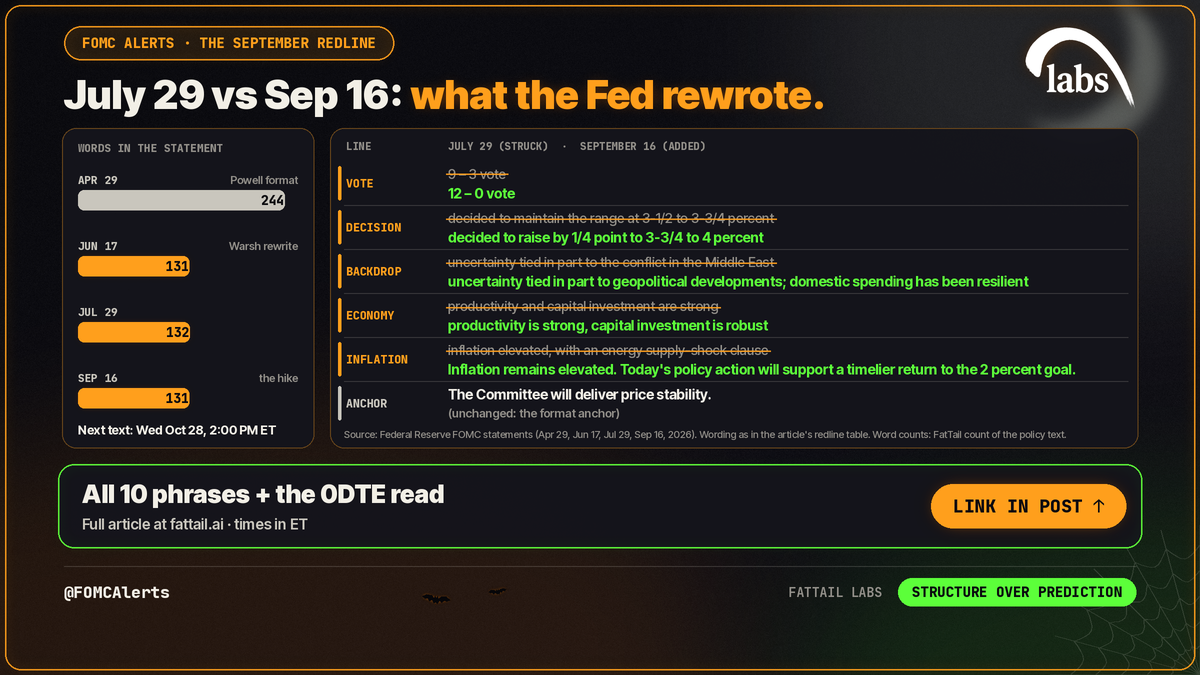
FOMC statement redline: what changed from July to September?
These are the edits that matter, set side by side from the July 29 and September 16 statements. The wording on the left and right is the Fed’s own; the summary column is ours.
| July 29 | September 16 | What changed |
|---|---|---|
| 9 – 3 vote | 12 – 0 vote | Three hawkish dissents went away once the hike they wanted arrived. |
| decided to maintain the range at 3-1/2 to 3-3/4 percent | decided to raise by 1/4 point to 3-3/4 to 4 percent | The decision verb. |
| uncertainty tied in part to the conflict in the Middle East | uncertainty tied in part to geopolitical developments; domestic spending has been resilient | The war reference was generalized, and a new demand line was added. |
| productivity and capital investment are strong | productivity is strong, capital investment is robust | Slightly firmer wording on investment. |
| inflation elevated, with an energy supply-shock clause | Inflation remains elevated. Today’s policy action will support a timelier return to the 2 percent goal. | The energy explanation was cut and the hike rationale added. |
| The Committee will deliver price stability. | (unchanged) | The format anchor. |
The cut in the inflation paragraph is the clearest example of how much one sentence can say. In July the Committee wrote: “Inflation remains elevated relative to the Committee’s 2 percent goal, in part reflecting supply shocks that have driven price increases in certain sectors, including energy.” By September the supply-shock explanation was gone and only the first three words were left. Dropping a reason for high inflation is a quiet way of saying the Committee no longer treats it as someone else’s problem.
10 FOMC statement phrases to watch today
This is our read of what a change could signal, not Fed guidance. Our calculation from fed funds futures using CME’s method, as of about 9:19 PM ET on Tue Oct 27, has a hold today at 91.1%, so the decision itself is mostly priced. The words are what’s left.
- The vote on line one. September was 12 – 0. Any other tally means dissents, and our FOMC Alerts coverage tracks who has dissented this year.
- Maintain or raise. A hold would read “maintain” at 3-3/4 to 4 percent.
- The “timelier return” sentence. It describes a hike, so it can’t stand unchanged on a hold. Whatever replaces it is the closest thing to guidance in the text.
- “Inflation remains elevated.” No qualifier since September. September CPI ran 3.7% over the year (BLS), so watch for any added clause.
- Resilient domestic spending. New in September. Kept or softened?
- Geopolitical developments. It replaced the Middle East reference. Does energy or war get named again?
- The jobs sentence. Unchanged since June. An edit would be the first labor change of the Warsh era.
- The price-stability line. Unchanged since June; its removal would break the format.
- Ample reserves. “Is continuing” since July. Any change is a balance-sheet signal.
- Any forward-looking sentence. There has been none since June. A tightening-bias line would be a format break, not a tweak.
Forecasts, not facts: KPMG expects the statement to be left largely unchanged. Pimco, as summarized by Newsquawk, sees a hold with a clear tightening bias. TheStreet Pro framed the range of outcomes as a yawner versus a shocker.
Advertisement · From FatTail Labs

Observer: train with Coach for $17/week
A six-week trial and training program built to install pro trading habits: live daily coaching, courses, a Discord trade room and the full FatTail platform.
How did markets react to past FOMC statement changes?
Our database (Cboe, FRED and Yahoo daily data) shows the last four meetings. These are close-to-close moves and daily ranges, so they can’t separate the 2:00 PM statement from the 2:30 PM press conference or from projections released the same day.
| Meeting | What changed | SPX | Range | VIX | 2-year |
|---|---|---|---|---|---|
| Apr 29 | Powell format, easing bias kept, 4 dissents | −0.04% | 0.53% | +0.98 | +8bp |
| Jun 17 | Format rewrite, guidance removed (projections same day) | −1.22% | 1.73% | +2.03 | +15bp |
| Jul 29 | Two edits: 9 – 3 tally, “is continuing” | −1.52% | 1.84% | +2.45 | −4bp |
| Sep 16 | Hike plus “timelier return” (projections same day) | −0.45% | 1.57% | +0.51 | +7bp |
The three Warsh-era FOMC days had a median SPX range of 1.73%, against 1.11% for all 93 scheduled FOMC days since 2015 and 0.87% on other days (our FOMC-day base rates). With only three cases, treat that as an anecdote, not a base rate. The bigger lesson is July. The text barely changed, yet CNBC, citing Bespoke, called it the worst second Fed day for a new chair in recent history, and DoubleLine’s Jeffrey Gundlach tied the long-bond move to the press conference. In September the 2-year ended 7bp higher after erasing an earlier decline, per CNBC. The 2:00 read can flip at 2:30.
Today has no projections, so the statement and Warsh’s press conference carry the day alone. Over the longer record, holds since 2015 have had a median SPX range of 1.09% (n=63), close to the 1.11% for all FOMC days, and VIX closed lower on 54.8% of FOMC days. Those are base rates, not a forecast for today.
What do FOMC statement changes mean for SPX 0DTE?
- Energy: Scheduled, and concentrated after 2:00 PM ET. A hold is about 91.1% priced (our calc, as of about 9:19 PM ET on Tue Oct 27), and at least one hike by Dec 9 is about 79.1% priced, so a reworded inflation or guidance line is the input that can reprice December. Morning trade before 2:00 is a different session from the afternoon.
- Premium: Let VIX set the price. VIX closed Tue Oct 27 at 17.52 (Cboe), still in FatTail’s Goldilocks 1 regime (17–24.5), near its lower edge. Know the SPX expected move going in; recent Fed days have stretched past it.
- Structure: In Goldilocks 1 the reference SPX/ES butterfly width is 30–40 points, with the debit at 5–10% of width (about 1.50 to 4.00 on those widths). If VIX moves into Goldilocks 2 (24.5–32) the reference widens to 40–50; under 17 (ZombieLand) it tightens to 20–30; above 32 (Chaos) it’s 50+. Keep it defined risk, like a fly or an 0DTE iron condor, with max loss known before entry and sized for a 2:30 reversal.
- Plan, don’t predict: Read the statement against the list above, then wait for the press conference before treating the 2:00 move as the day’s direction. July showed the presser can override a near-identical text. Our guide to planning market scenarios for 0DTE SPX covers the if-then setup.
Market context, closes Tue Oct 27: SPX 7722.60, VIX 17.52 (Cboe), 2-year 4.70%, 10-year 4.99% (U.S. Treasury). Prediction markets, separate from futures, as of 4:37 PM ET Tue: Kalshi’s October hike contract 0.05 bid / 0.06 ask, Polymarket October no change 0.948 / 0.951.
What comes after today’s FOMC statement?
Today’s statement is at 2:00 PM ET and Warsh’s press conference at 2:30 PM ET. The next FOMC meeting is Dec 8-9, with new projections, and it’s the meeting the December odds above are pricing. All remaining dates are in our FOMC meeting schedule 2026.
Related reading: How fed funds futures turn into rate odds · The case for an October rate hike · FOMC Alerts hub
Sources
- Federal Reserve issues FOMC statement (Sep 16, 2026) (Federal Reserve Board, 2026-09-16)
- Federal Reserve issues FOMC statement (Jul 29, 2026) (Federal Reserve Board, 2026-07-29)
- Federal Reserve issues FOMC statement (Jun 17, 2026) (Federal Reserve Board, 2026-06-17)
- Federal Reserve issues FOMC statement (Apr 29, 2026) (Federal Reserve Board, 2026-04-29)
- Transcript of Chairman Warsh's Press Conference, June 17, 2026 (Federal Reserve Board, 2026-06-17)
- Transcript of Chairman Warsh's Press Conference, July 29, 2026 (Federal Reserve Board, 2026-07-29)
- What a divided Fed means for investors (CNBC, 2026-07-29)
- 10-year Treasury yield climbs back to 5% after Fed hikes rates (CNBC, 2026-09-16)
- Fed paces itself (KPMG, 2026-10-22)
- Week in Focus 26-30th October 2026: FOMC, BoC, RBNZ, ECB, BoJ Policy Decisions, US PCE (Newsquawk, 2026-10-23)
- The Week Ahead: Can Big Tech Earnings Save the Day? (TheStreet Pro, 2026-10-25)
- Consumer Price Index – September 2026 (U.S. Bureau of Labor Statistics, 2026-10-14)
- 30-Day Fed Funds futures (ZQV26, ZQX26, ZQZ26), delayed quotes; odds are our calculation (CBOT via Yahoo Finance (delayed), 2026-10-26)
- Fed decision markets (KXFEDDECISION), public API; prediction market (Kalshi, 2026-10-27)
- Fed decision in October, public API; prediction market (Polymarket, 2026-10-27)
- Cboe VIX Index close (delayed quote; daily history CSV not yet updated for Oct 27) (Cboe, 2026-10-27)
- S&P 500 (SP500), FOMC-day base rates are our calculation (FRED, St. Louis Fed, 2026-10-16)
- S&P 500 Index (SPX) delayed quote, close (Cboe, 2026-10-27)
- Daily Treasury Par Yield Curve Rates, 2026 (U.S. Treasury, 2026-10-27)
Trade it with structure
Observer is a six-week trial and training program: train with Coach for $17/week. You get everything a full coaching member gets, every week, and the six weeks are designed to install pro trading habits: courses on strategy, process and risk management, live daily coaching, a Discord trade room with hundreds of experienced traders, and the platform (heatmap, GEX tools, risk graph, position analyzer and journal). Start Observer.
Educational content, not investment advice. Options involve risk and are not suitable for all investors.
FATTAIL BRIEFINGS
Get FatTail briefings in your inbox
Pick the lists you want. FOMC Alerts is selected by default.